A VoIP reseller programme is an arrangement where a wholesale telephony provider supplies the platform, numbering and call routing while the partner sells, brands and supports the service under its own name for recurring monthly revenue.
You may already have a customer asking whether their phone system needs replacing, while your account manager is negotiating another broadband renewal. The opportunity is straightforward: keep the communications relationship rather than handing it elsewhere. The harder questions concern what you'll earn after support costs, who takes responsibility when calls fail, and which additional services customers will value.
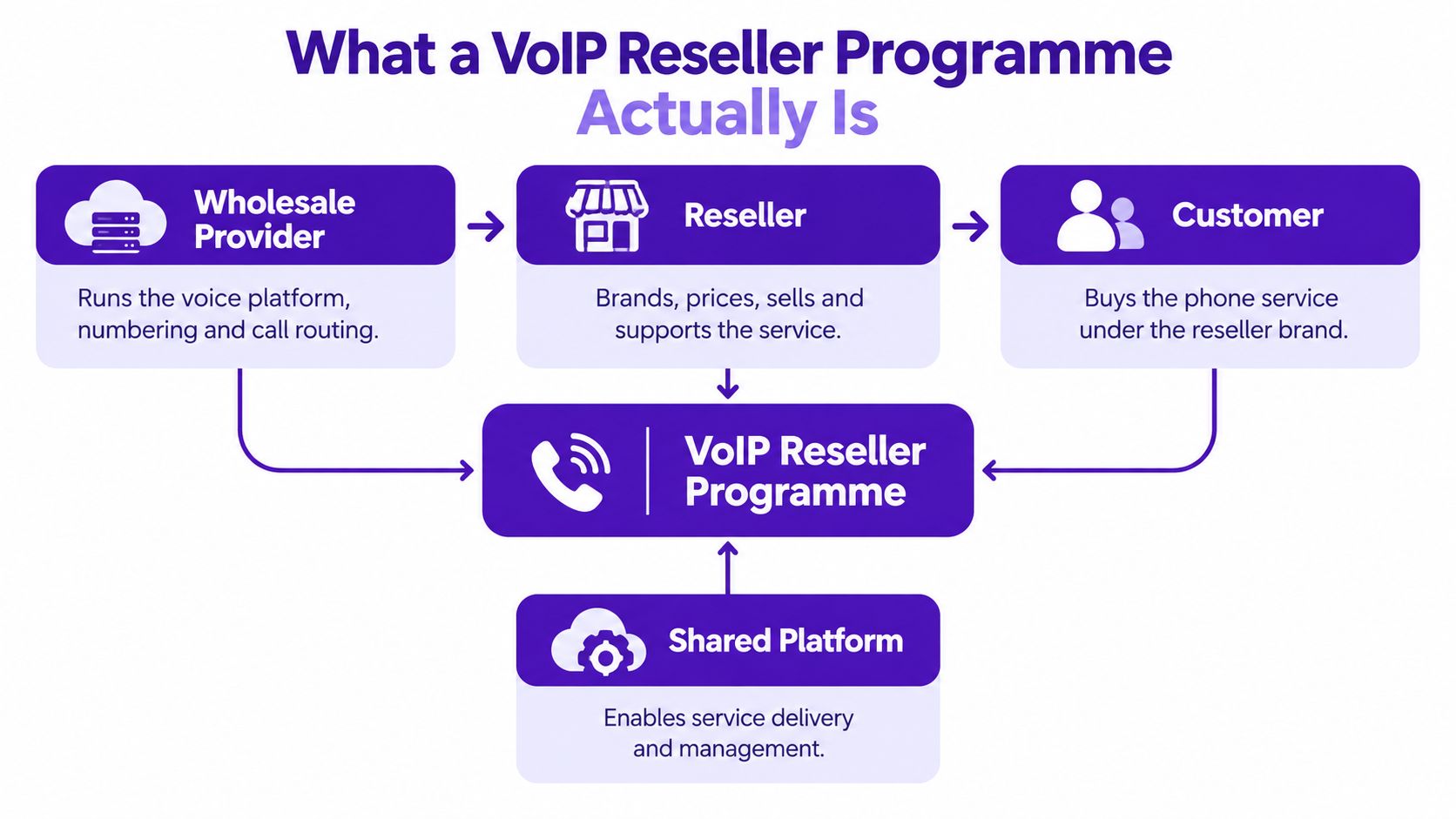
What a VoIP Reseller Programme Actually Is
The reseller model separates running telephony infrastructure from delivering the customer-facing service. You don't need to build a voice network, but you do need to understand what you're promising and what your supplier has agreed to deliver.
Who owns what
The relationship has distinct operational roles:
- Wholesale provider: Operates the underlying voice platform, numbering arrangements and call routing.
- Reseller: Packages the service, sets customer-facing prices where the agreement permits, manages sales and provides the agreed support.
- Customer: Buys business telephony from the reseller and supplies the information and local infrastructure needed for deployment.
The shared platform connects these roles through provisioning and administration. However, platform access isn't the same as operational control. Check which changes your staff can make directly and which require a supplier ticket.
Choose the relationship you can support
An agent or referral arrangement suits a business that wants to introduce opportunities without becoming the main service operator. The supplier generally manages more of the customer relationship, subject to the agreement.
Wholesale resale gives you greater responsibility for packaging, billing and support. Fully white-label resale extends that ownership into the customer experience, with your branding across agreed service touchpoints. These descriptions aren't interchangeable, so ask to see the contract and customer journey rather than relying on the programme label.
For an international comparison, BubblyPhone's resource on VoIP resale options for Pakistani businesses provides a separate market perspective. Use it to broaden your commercial questions, not as guidance on UK obligations.
Why the UK opportunity matters
Ofcom's Communications Market Report recorded UK fixed-voice connections falling by 3.1 million, or 11%, during 2024 to around 24 million, while connections classified as “other”, mainly managed VoIP, increased by 0.7 million, or 6%, to 11.5 million, partly through digital-voice and full-fibre migration.
That supports a practical sales proposition: help customers manage a communications change they already face. The model fits MSPs, telecoms providers and IT resellers prepared to own service delivery, rather than add another subscription to an invoice.
How VoIP Reseller Pricing and Commission Models Work
The headline discount is only the beginning of the calculation. A commercially sound offer must leave enough contribution to cover implementation, support, billing administration and the occasional difficult migration.
Ofcom's telecommunications market data recorded fixed-voice service revenue of £1.15 billion in the fourth quarter of 2024, down £43.4 million, or 3.6%, quarter on quarter and £157.4 million, or 12.0%, year on year, with BT accounting for 49.8% of revenue.
Those figures aren't a reseller margin benchmark. They are a reason to avoid building your business case around basic call minutes alone.
VoIP Reseller Commercial Models Compared
| Model | How You Earn | Typical Commitment | Best For |
|---|---|---|---|
| Wholesale discount | Difference between trade costs and your retail package | Customer billing, support and supplier obligations | Providers wanting pricing control |
| Per-user or per-seat margin | Mark-up on hosted licences and selected features | Licence administration and account management | MSPs packaging voice alongside managed users |
| Revenue share | Contractually agreed share of qualifying revenue | Sales activity and potentially ongoing account involvement | Partners sharing commercial responsibility |
| Agent or referral commission | Introduction or sale payment under the agreement | Lower delivery involvement, depending on terms | Businesses testing demand before operating a service |
These models can overlap. A wholesale agreement may combine per-seat licences with usage charges, while a referral agreement may include continuing commission rather than only an initial payment.
Calculate the contribution, not just the mark-up
Ask for a complete charging schedule and build an account-level cost model. Include items that are easy to miss during a sales demonstration:
- Call bundles: Check included destinations, exclusions, overage rates and how unusual usage is handled.
- Hardware: Separate handset purchase, delivery, configuration, replacement and financing.
- Service work: Price onboarding, user changes, training and out-of-hours support deliberately.
- Number movements: Establish porting charges, rejected-order handling and any associated administrative costs.
- Supplier commitments: Understand minimum spend, licence reductions and charges that continue after a customer leaves.
Practical rule: If your pricing only works when customers never contact support, the package is underpriced.
Bundling can support a stronger proposition, but don't use it to hide unprofitable voice delivery. Make the customer-facing offer simple while retaining separate internal cost lines for connectivity, telephony, support and optional services.
Customer ownership also has a cost. You control the renewal conversation, but you may carry collection risk and remain accountable for resolving problems. A modest commission arrangement can be more appropriate than wholesale resale if your team isn't ready for those responsibilities.
Onboarding Requirements and UK Regulatory Basics
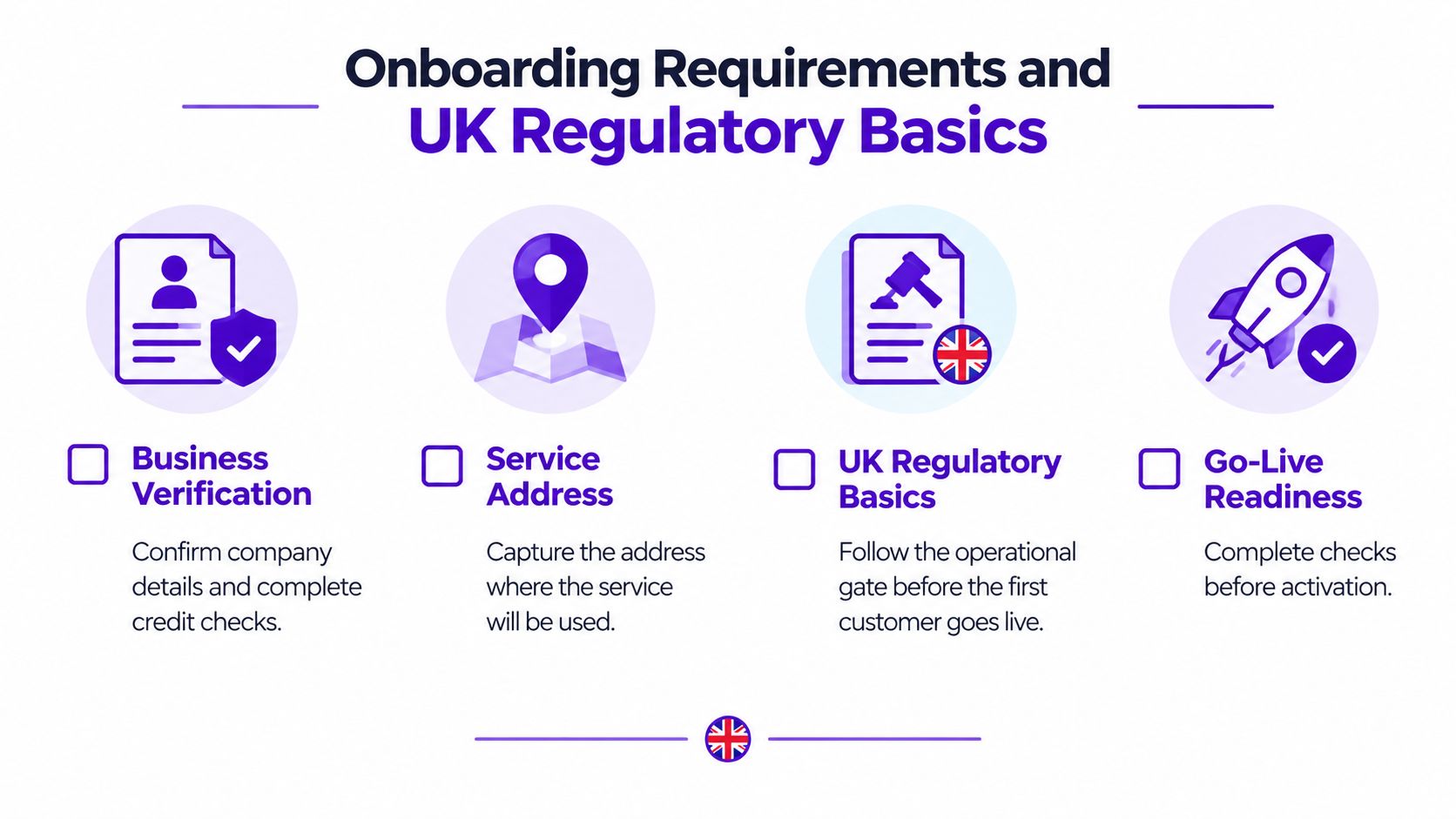
A signed order isn't permission to activate an incompletely documented service. Treat onboarding as a controlled handover from sales to operations, with named approval for anything that affects numbering, emergency access or migration.
Ofcom's VoIP guidance states that a public VoIP service enabling calls to and from ordinary national or international numbers with emergency access is likely to qualify as a Publicly Available Telephone Service. Its geographic-number policy also requires use consistent with the National Telephone Numbering Plan, retaining location significance even though IP routing doesn't technically require area codes.
Build the customer record before provisioning
Start with business verification and the credit checks required by your commercial policy or supplier agreement. Confirm the legal customer, authorised contact, billing details and who can request sensitive changes.
Then capture the information needed to deliver the service:
- Service location: Record the address where the service will be used and identify mobile or remote-working requirements.
- Emergency information: Validate location data and document who submits and maintains it upstream.
- Number inventory: Identify number types, existing provider details and the customer's authority to request porting.
- Routing ownership: Record the upstream carrier and escalation route for numbering or call-delivery faults.
Keep an unalterable audit history of changes, rather than making service information impossible to correct. Emergency-location records must remain maintainable when customers move or change their working arrangements.
Make migration and activation separate decisions
A porting request needs ownership from submission to completion. Confirm the requested numbers, dependencies, customer communications and contingency arrangements before committing to a cutover.
Don't advise customers to cancel the existing service without checking the consequences with the relevant providers. Record how rejected requests, changed dates and partial migrations will be handled.
Before activation, agree who manages 999/112 provisioning, outage notifications, misuse investigations and eventual termination. Explain emergency-access dependencies, including local power and connectivity, in language the customer can understand.
A technically available platform doesn't prove that the customer's complete service is ready. Use a documented acceptance checklist covering incoming calls, outgoing calls, routing and the supplier's approved emergency-access validation procedure.
Your supplier's assistance matters, but it doesn't remove the need to establish your own regulatory position. Obtain appropriate compliance advice where the service model or division of responsibility is unclear.
How to Evaluate a VoIP Partner Programme
A provider's demo environment always works. What separates a dependable wholesale partner from a resold liability is how the operation behaves when a deployment stalls, the platform goes down or a customer wants to leave. Ask each shortlisted provider to walk you through all three scenarios before you discuss commercials.
Test evidence, not the feature list
Every programme claims resilience. Far fewer can show it. Ask which service components the SLA covers, what it excludes, how incidents are communicated and what remedy applies when targets are missed. Then ask for the failover explanation in plain terms, including the parts that depend on carriers and networks outside the supplier's control.
Run the complete charging schedule against your own draft packages: setup fees, number rental, call bundles, minimum terms and early-termination charges. Margins that look healthy on a headline per-seat rate can shrink quickly once those items land on your invoice.
For white-label depth, inspect the customer portal, invoices, domains and support documentation yourself. Note every place the supplier's name still appears, then decide whether that undermines your proposition or sits comfortably within your price point.
A white-label logo doesn't make a service operationally yours. Access, authority and escalation rights do.
Ask providers to demonstrate a routine user change, a rejected porting request and a live support escalation while you watch. Their onboarding and training material should leave your team able to explain the service accurately, including its limits, rather than recite a feature list.
Agree a responsibility map
Use a map like this as a negotiation tool, not an assumption about legal liability.
| Area | Supplier role to agree | Reseller role to agree | Customer role to agree |
|---|---|---|---|
| Emergency access | Network provisioning and routing | Validate records and explain dependencies | Supply accurate location information |
| Outage communications | Technical updates and restoration work | Customer notices and coordination | Report local symptoms and follow continuity plans |
| Number porting | Carrier-facing processing | Order accuracy and migration management | Authorise requests and confirm requirements |
| Compromised accounts | Platform containment and investigation support | Coordinate response and customer contact | Report suspicious activity and approve remediation |
| Incident escalation | Named technical escalation route | Incident ownership and agreed notifications | Maintain reachable decision-makers |
Specify notification and escalation times contractually, along with the information each party must supply during an incident. Silence about responsibility becomes expensive during an incident.
Test the exit before signing
Check contract length, renewal mechanics and wholesale price-change rights. Then ask the harder question: what happens when your customer commitments outlast the supplier agreement? Numbers, configuration records and customer data all need a documented transfer path, and you want it in writing before you need it.
Integration options should reduce actual work. Test whether billing exports, APIs and service-desk connections support your workflow without requiring repeated manual entry.
Adjacent services deserve the same scrutiny as voice infrastructure. If you are weighing cyber risk monitoring reseller partnerships alongside a voice programme, assess them as separate obligations. Credential monitoring and communications resilience are different jobs, and neither supplier should imply its service replaces the other. Pairing fraud-risk education with dark-web monitoring is also one of the cleaner ways to differentiate your voice offer, since most competing resellers still sell minutes and seats alone.
Finish with a working demonstration and written answers to anything unresolved. "Our account manager will sort it out" is not an operating agreement.
Selling VoIP to Your Existing Customer Base
Start with an account conversation, not a broadcast announcing cheap calls. Existing customers already know your support team; your task is to connect a specific business requirement to a service you can deliver responsibly.
Use a real purchasing trigger
Consider a customer approaching a connectivity renewal or reviewing an ageing phone system. Ask which numbers matter, how calls reach staff and what happens when the office connection fails.
That conversation supports a combined proposal for voice, connectivity and support. It also exposes delivery work that a price-per-user quote can overlook, such as rebuilding call flows or briefing reception staff.
For hosting providers, web agencies and SaaS resellers, the useful trigger may be a customer reviewing its wider supplier arrangements. Don't force telephony into an unrelated website discussion. Establish the communications requirement first.
Handle the Teams objection properly
If a customer says they already use Microsoft Teams, don't immediately propose replacing it. Ask who currently manages external numbers, call routing and support.
Where your chosen programme supports the required integration, demonstrate that specific arrangement and confirm licensing and responsibility boundaries. If it doesn't, say so. Selling overlapping collaboration features without resolving the customer's telephony requirement creates confusion rather than value.
Make fraud education part of the discussion
Ofcom's scam-call presentation reports that telecoms services enabled 16% of authorised push payment fraud cases in 2024, total UK fraud losses reached £1.17 billion, and 42% of UK phone users received a suspicious call in the three months before February 2025.
Use that evidence carefully. It supports a customer education conversation, not a promise that hosted telephony will prevent fraud.
- Caller identity: Review who may change outbound caller ID and how requests are approved.
- Payment requests: Encourage staff to verify unexpected changes through an established contact route.
- Suspicious activity: Agree where users report questionable calls, messages or account behaviour.
- Credential exposure: Explain why a leaked password requires a different response from a suspicious inbound call.
Customers need a clear action to take, not a general warning to be more careful.
Use GoSafe Dark Web monitoring's telecom services guide when considering adjacent service packaging. Keep the proposal rooted in the customer's needs, with explicit boundaries between call-layer controls, staff education and identity-risk monitoring.
Adding Recurring Security Revenue With White-Label Monitoring
A hosted voice customer can pass every call-quality check and still sit one leaked password away from a compromised mailbox. Credential exposure is a different risk from platform availability, and it deserves a separately priced, separately explained service rather than a footnote in the telephony proposal.
The UK Government's Cyber Security Breaches Survey 2025 found that 43% of businesses, approximately 612,000 organisations, reported a breach or attack in the previous 12 months, rising to 67% of medium-sized businesses and 74% of large businesses. Those figures show how common reported incidents are. What they cannot tell you is how many of your own customers already have credentials circulating in breach dumps, which is precisely the question a monitoring service answers.

Package visibility and a defined response
White-label dark web monitoring works commercially as a monthly subscription attached to the voice contract. The offer stays simple to explain: monitor agreed business identifiers, alert the customer when their data surfaces and give them readable next steps. Sold at the point of migration or renewal, it adds recurring margin without adding a delivery project.
GoSafe focuses on one job. It runs continuous dark web scans for compromised email addresses, exposed passwords and breached domains, then issues early alerts written for business users rather than security analysts.
Its supporting capabilities include:
- AI-driven risk scoring: Helps prioritise detected exposure.
- Phishing simulations: Supports staff awareness alongside monitoring.
- Breach Breakdown reports: Explains the exposed information and recommended response.
- Domain and phone-number monitoring: Extends visibility across agreed business identifiers.
Keep delivery simple without overstating protection
GoSafe is fully white-label. Partners can brand the platform as their own service, sell it under their company name and retain the customer relationship without building security tooling internally. Setup is light, and no specialist security team is needed to run the tool day to day.
A monitoring alert still needs a human response. Before the first subscription goes live, agree in writing who contacts affected users, who resets passwords, who checks multi-factor authentication and who reviews a potentially compromised mailbox. Put that split in the service agreement. Otherwise the customer assumes the alert itself fixed something.
That boundary is what makes dark web monitoring for MSPs commercially credible. IT support companies, cyber consultants and telecom resellers can sell proactive visibility without claiming to deliver incident forensics, and the fraud-awareness conversation covered earlier gives you a natural entry point with existing accounts.
For more on packaging recurring revenue from telecom cybersecurity, keep the subscription scope explicit. Monitoring complements access controls and resilience measures. It replaces neither. Request a product demo before it reaches your rate card so you can see how the alerting reads under your own brand.
Your Next Steps as a VoIP Reseller
A reseller agreement that looked fine at signature can become a problem at month three, when a customer's emergency call routing needs verifying and nobody is sure whose job it is. Choose the programme your team can operate profitably and compliantly, not the one with the longest feature list.
Make the decision commercially defensible
Bring sales, finance and service delivery around a sample customer proposal before you commit. Each team should understand what has been sold, what it costs to deliver and what happens when the customer needs help at 7am on a Monday.
A compact decision checklist keeps that conversation honest:
- Commercial fit: Confirm that expected contribution covers implementation, support and supplier commitments.
- Operational readiness: Assign onboarding, numbering, emergency-access and incident responsibilities to named owners.
- Supplier comparison: Shortlist providers using the same demonstrations and written questions.
- Sales readiness: Select existing accounts with a genuine renewal, migration or service requirement.
- Service boundaries: Separate standard support from chargeable changes and optional monitoring.
Launch in controlled stages
Start with supplier selection and internal training. Complete the branded customer journey, billing workflow and escalation documentation before the PSTN retirement deadline starts pressuring customers into rushed migrations. Accounts moved under time pressure generate the support tickets that erode early margin.
Onboard suitable initial accounts next. Check that orders, provisioning and invoices match what customers accepted, and confirm in writing who owns emergency-service compliance, number porting issues and fraud response after go-live. Review support requests and delivery effort before expanding the offer.
Early sales prove demand, not pricing. Use actual delivery experience to refine onboarding charges, support scope and customer communications before scaling.
Adjacent white label security services deserve the same discipline. Credential monitoring needs a clear scope, an accountable contact and a repeatable response process to work as a subscription. Fraud-risk education is also a genuine differentiator when competing against providers who sell lines and leave the risk conversation to someone else.
GoSafe Dark Web monitoring offers fully white-label credential monitoring with understandable alerts that can sit alongside a VoIP subscription. Visit GoSafe Dark Web monitoring to explore the tool, and bring your proposed customer package to a demo to work through branding, monitoring scope and alert handling.