It's Friday afternoon. A customer calls because a member of staff thinks someone accessed their mailbox. Your engineer checks the account, but nobody can confirm which other services use that login, who owns the email domain, or whether the mailbox contains sensitive customer records.
That's where a useful security risk assessment starts. Not with a long questionnaire, but with the information and decisions your team would need if the same call came at 2 a.m.
Why Security Risk Assessment Matters Now for Customers
A customer can have antivirus, backups and a tidy support contract and still leave your engineer unable to contain an incident. The missing pieces are often ownership, access and evidence. Buying another control won't automatically resolve those gaps.
A security risk assessment should establish what could go wrong, what it would interrupt, and who can act. Treating it as a document produced at contract renewal misses the operational purpose.
Ordinary customers have material exposure
The UK Government's Cyber Security Breaches Survey 2025 found that 43% of businesses, approximately 612,000 organisations, reported a breach or attack during the previous 12 months; 16% experienced a negative outcome, compared with 13% in 2024.
Those findings make assessment relevant beyond large enterprises and regulated customers. Your local accountancy practice, wholesaler or web agency needs a defensible view of exposure too. The assessment should cover credentials, people, suppliers and critical systems, not just devices covered by your support agreement.
For a supplementary resource when preparing a customer discussion, IT Cloud Global, LLC's IT security risk review for SMBs is a useful starting point. Keep your own meeting focused on the customer's operations rather than asking them to interpret technical terminology.
Practical rule: If a finding doesn't help someone make a decision, assign work or respond to an incident, it needs rewriting.
Make the service continuous, not open-ended
A signed report describes the environment you assessed. It doesn't account for the contractor added afterwards, the newly registered domain or the administrator who leaves without a proper handover.
That makes ongoing assessment suitable for a recurring service, provided the commercial boundaries are explicit. Separate the initial discovery work, continuing monitoring, scheduled reviews and remediation labour. Otherwise, a modest subscription can become an unlimited incident-response commitment.
Customers should understand what they're buying: a maintained risk register, clear findings and an agreed route to action. They shouldn't assume every alert includes forensic investigation.
The recurring value is maintained readiness, not repeatedly selling the same audit. Your team earns that value by keeping ownership current, checking whether agreed actions happened and identifying changes that alter the customer's exposure.
Scoping and Inventorying Customer Assets First
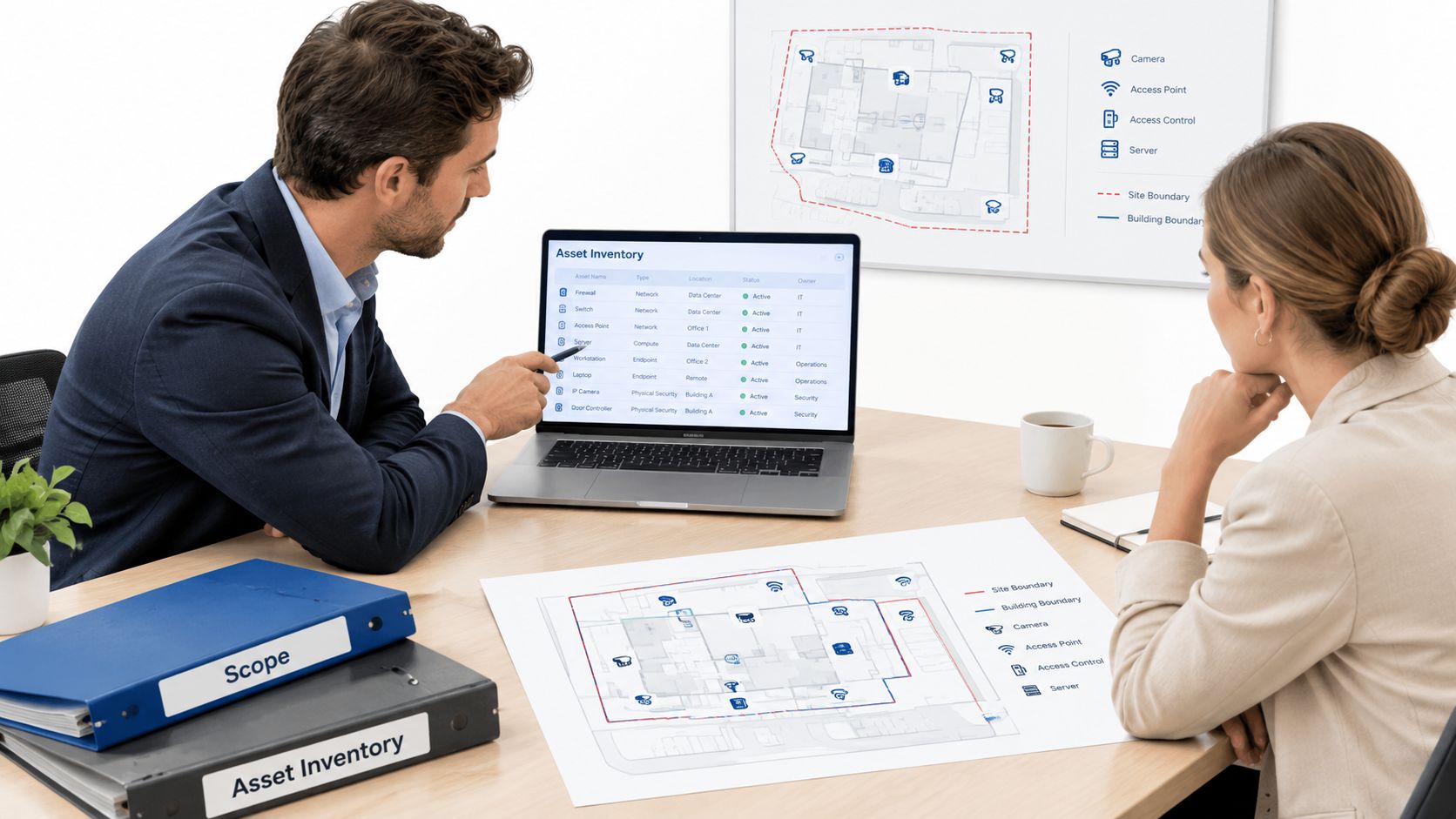
Start with a client meeting involving someone who understands daily operations and someone authorised to approve work. An engineer alone can identify systems, but may not know which application stops invoicing or which contractor still controls the website.
Write a scope statement before collecting evidence. Include sites, cloud tenants, email domains, business applications, contractors, hosting and telecoms services. Record exclusions with a reason and an accountable customer contact.
Build around business services
Don't scope by device count alone. A lightly used laptop and the administrator account controlling the customer's cloud environment aren't equivalent assessment units.
Begin with business activities: taking orders, paying suppliers, answering calls and accessing customer records. Map the supporting applications, identities, devices and suppliers beneath them. Include shared mailboxes, privileged accounts, SaaS subscriptions and data stores.
Use a spreadsheet if that's what your team will maintain. Give each asset a stable reference and record:
- Identity and location: Name the asset and where its authoritative record lives.
- Ownership: Identify the business owner and technical administrator.
- Criticality: Describe what stops if it becomes unavailable or untrusted.
- Access and data: Note privileged access, external users and sensitive information.
- Recovery dependencies: Record the supplier, account or backup needed to restore service.
Cross-check interviews against subscription invoices, management tools and existing documentation. A customer's application list is a starting point, not proof of completeness. Use attack surface management for MSPs to frame the separate task of checking externally visible exposure.
Use a baseline without confusing it with scope
Cyber Essentials provides a recognised starting point for UK customers. Its history includes launch in 2014, a framework built around five technical controls, and nearly 190,000 certificates issued by its 2024 tenth anniversary, as documented in the NCSC's history of Cyber Essentials.
Use the baseline to organise control evidence. Don't assume certification answers every operational question, particularly whether the customer can restore a critical service or authorise emergency access.
Keep uncertainties visible. If nobody can establish who owns a domain or whether an old account remains active, mark the record unverified and assign discovery work. Guessing makes later scoring look more reliable than it is.
Before moving on, ask the customer to approve the scope and nominate someone to maintain the inventory. A shorter, owned register is more useful than an exhaustive export nobody updates.
Threat Modelling Credentials, Domains and People
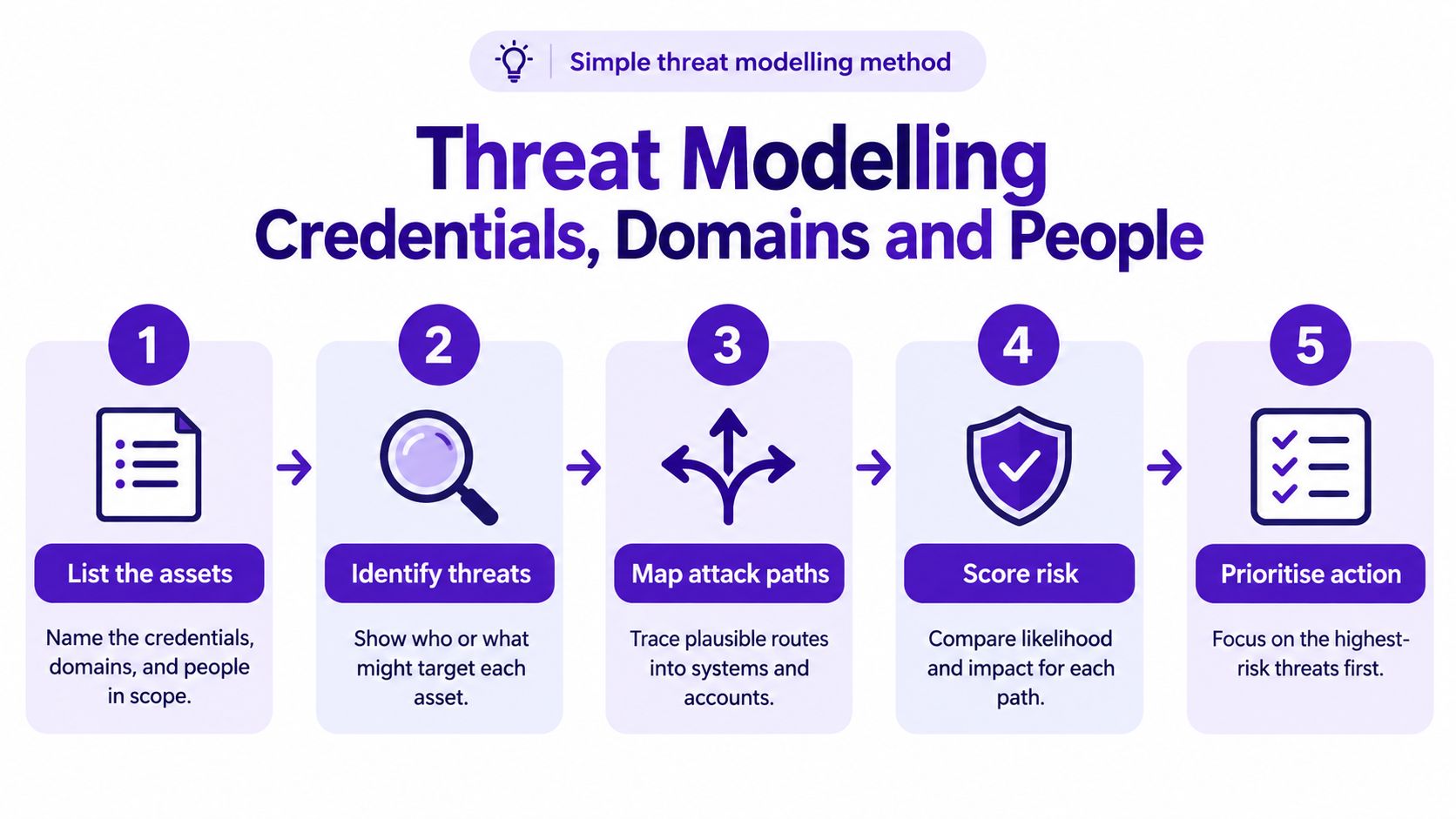
Consider an illustrative customer that uses cloud email, a hosted accounts package and an external web agency. An employee has reused a work password on another service. The customer's email domain also has weak email authentication.
These are assessment assumptions, not a reported incident. They give your engineer something concrete to test rather than writing “phishing” and “password risk” into separate spreadsheet rows.
Follow the attacker's possible route
The exposed password creates a possible route into an account if it remains valid and other controls don't block access. Weak domain authentication creates a separate impersonation concern. Don't claim that domain impersonation itself grants mailbox access.
Connect the findings where there's a credible business consequence. An attacker might attempt account access using the exposed credential, then use a convincing payment message to influence the finance team. The assessment should distinguish attempted access, successful authentication and fraudulent instructions.
For each route, ask what interrupts it. Check whether multifactor authentication is enforced, whether the account has unnecessary permissions, and whether staff verify payment changes through an independent channel. Record evidence rather than accepting a policy statement as proof.
Separate warning signals from confirmed incidents
Dark web monitoring belongs in the evidence-gathering process. GoSafe is a Dark Web Monitoring tool that continuously scans for compromised email addresses, exposed passwords and breached domains, providing early alerts when credentials appear on the dark web.
Its alerts are clear, simple and understandable for business users. That makes them useful for starting an investigation without requiring the customer to interpret a complex security dashboard. An alert still isn't proof that somebody accessed the customer's current systems.
The tool is fully white-label. Partners can brand it as their own service, sell it under their company name and include it in their product portfolio while retaining the customer relationship. It's one monitoring input alongside identity logs, access reviews and customer interviews, not a replacement for those checks.
Businesses can have compromised credentials online without knowing it. Monitoring supplies visibility and early warning, but the assessment must establish whether the affected identity is current, privileged or connected to other services.
An exposed credential is a finding to investigate. Successful containment is an outcome you must verify.
Finish the threat model with a testable statement: an attacker could attempt to access the finance mailbox using an exposed password, subject to the authentication controls identified. Name the account owner, evidence source and control checks. That gives the next engineer a useful starting point.
Scoring Risks So Priorities Are Clear
A score should explain a decision, not disguise uncertainty. If your engineer rates a finding High and the customer calls it Low, the useful work is resolving their different assumptions.
Use a simple three-level scale for likelihood and impact. Treat it as your assessment method, not a statistical prediction. Agree the definitions before rating individual findings.
Define the business meaning first
For likelihood, use Unlikely, Possible and Likely. Tie each label to evidence such as access requirements, observed exposure, tested controls and unresolved weaknesses. Don't attach probability percentages you can't substantiate.
For impact, use Limited, Material and Severe. Limited means the customer can manage the disruption through routine operations. Material requires significant management attention or interrupts an important service. Severe threatens essential operations or creates substantial consequences for affected people.
Agree what those descriptions mean for this customer. Losing access to a sales mailbox may be inconvenient in one business and stop order processing in another.
Simple likelihood and impact priority matrix
| Likelihood | Impact | Priority rating |
|---|---|---|
| Unlikely | Limited | Low |
| Unlikely | Material | Medium |
| Unlikely | Severe | High |
| Possible | Limited | Medium |
| Possible | Material | High |
| Possible | Severe | Critical |
| Likely | Limited | Medium |
| Likely | Material | High |
| Likely | Severe | Critical |
This is a proposed working matrix, not a universal standard. Review its outputs with the customer before using them to approve expenditure.
Record why the rating changes
Inherent risk describes exposure before considering relevant controls. Residual risk describes what remains after controls have been considered and, where practical, tested.
For example, verified access restrictions may lower likelihood without changing the impact of losing a critical service. Don't reduce both dimensions automatically because a control exists. Document what the control changes.
Your register should include the risk statement, supporting evidence, rating rationale, existing controls and treatment decision. Add the owner, review trigger and evidence confidence. A neat colour scheme won't compensate for missing reasoning.
Override the normal priority where a regulatory obligation, contractual commitment or credible ongoing incident requires faster action. Record the justification rather than changing the score without documentation.
For decisions requiring financial analysis, cyber risk quantification for MSPs offers a related way to frame the discussion. Don't invent loss estimates to make a qualitative assessment look scientific.
Close the scoring meeting by recording whether the customer will treat, monitor or accept each residual risk. Acceptance needs an authorised person and a review trigger. It isn't the same as leaving a ticket untouched.
Remediation Planning That Customers Can Follow
Patching everything isn't a remediation strategy. Customers have maintenance windows, supplier dependencies and limited staff time. Your job is to identify which actions reduce exposure meaningfully and which response gaps could leave them stranded.
The Cyber Security Breaches Survey 2025/2026 found that only 25% of businesses had a formal cyber-incident response plan, while an estimated 19%, approximately 267,000 businesses, experienced at least one cybercrime during the previous 12 months.
That makes recovery readiness an assessment deliverable, not an optional appendix.
Write outcomes and assign authority
Replace “review account security” with an outcome such as “confirm the affected account is under authorised control and investigate associated access”. Give it a named owner, deadline, dependencies and closure evidence.
Sequence work by urgency, customer effort and cost. An access restriction may be practical immediately, while replacing a legacy application needs approval and planning. Document interim protection rather than pretending the larger project is complete.
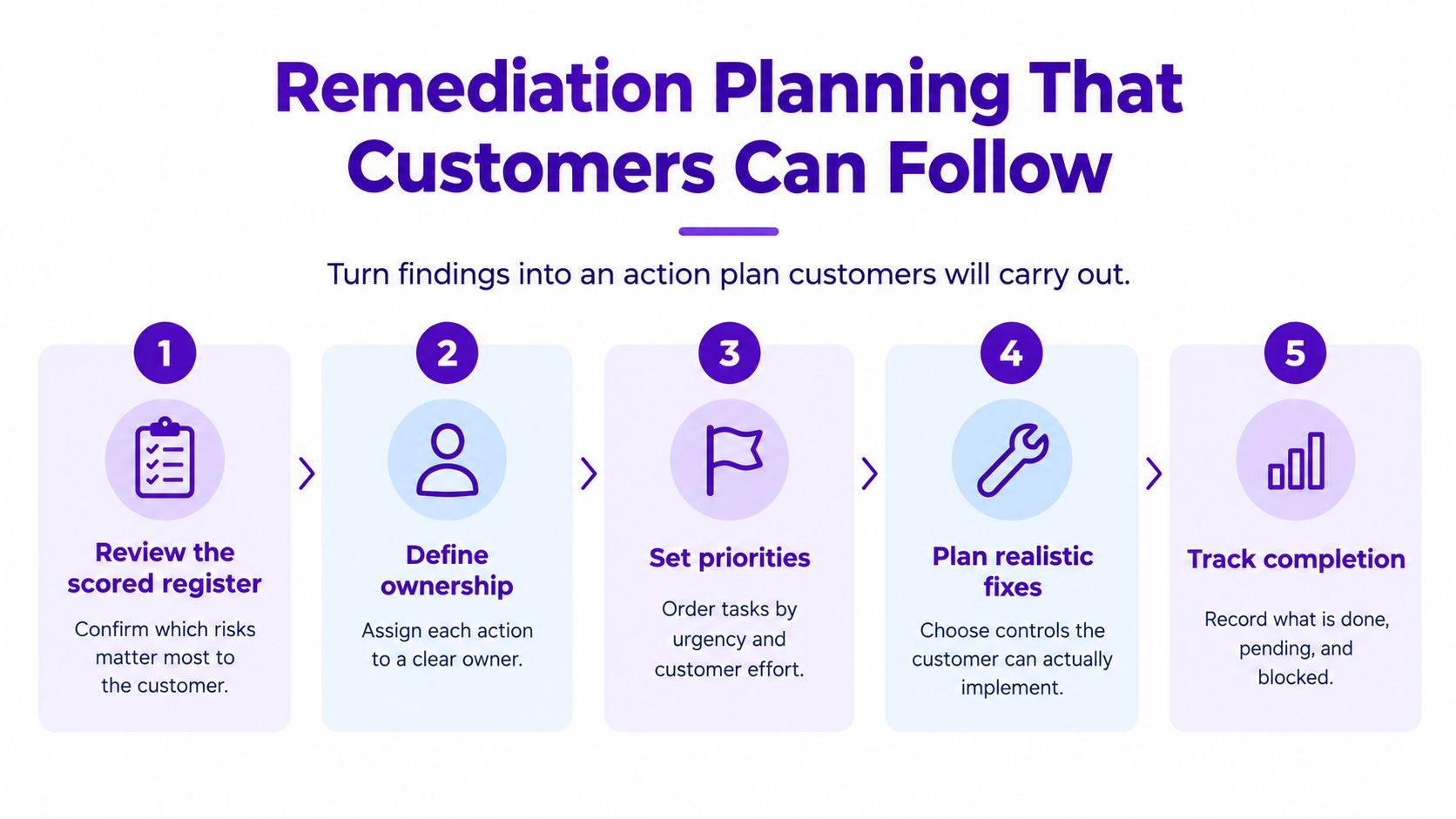
For service desks, Vight's PSA ticket assignment workflows provide a relevant reference when reviewing hand-offs. In your own PSA template, distinguish the person doing the work from the customer contact authorised to approve disruption.
Turn a credential alert into a timed playbook
Use milestones with agreed response targets rather than promising an arbitrary universal resolution time. Capture the alert timestamp, acknowledgement, containment actions, investigation decisions and closure. Test the workflow with a controlled exercise, not a real password.
- Verify the account: Confirm ownership, current use and privileges. Preserve the alert and relevant evidence.
- Contain access: Revoke sessions and restrict the account where appropriate. Confirm emergency authority before the incident occurs.
- Restore authentication: Reset credentials through an approved process and check MFA methods, recovery details and unexpected changes.
- Investigate wider exposure: Examine available access logs, related accounts, mailbox changes and possible reuse across services.
- Document closure: Record actions, unresolved questions, customer communications and the evidence supporting closure.
The order may need adapting during a live incident, particularly where evidence preservation and urgent containment compete. Record the reasoning and involve the appropriate response specialist when the investigation exceeds your contracted capability.
Recovery test: Can the nominated person follow the playbook at 2 a.m. without relying on an unavailable administrator?
Exercise backup restoration, escalation routes and customer communications too. Measure actual elapsed time and record where the team gets blocked. Use that evidence to verify and close security weaknesses, rather than closing tickets because somebody ticked a deployment box.
Reporting Templates and Keeping the Assessment Current
A customer report should make approval easier. The director needs to understand the business exposure and required decisions. Your service desk needs enough detail to execute work without reconstructing the assessment.
Keep the customer-facing summary separate from restricted technical evidence. Don't paste exposed passwords into a presentation, ticket description or broadly shared spreadsheet.
Build a reusable report pack
Use a consistent template, but write the executive summary for the actual customer. Explain what matters, what has changed and which decisions remain outstanding.
A practical report pack contains:
- Executive summary: Business impact, urgent decisions and significant limitations.
- Scope and asset summary: Included services, exclusions, ownership gaps and unverified records.
- Risk register: Ratings, rationale, controls, evidence confidence and accepted residual risks.
- Remediation plan: Named owners, deadlines, dependencies and completion criteria.
- Evidence appendix: Restricted references to test results, alerts, approvals and exercise records.
Record decisions as carefully as findings. If the customer postpones an application replacement, note who approved the delay, the reason, interim controls and the review trigger. Otherwise, the next account manager may mistake an accepted risk for forgotten work.
Make discovery and escalation auditable
Under ICO guidance on personal data breaches, organisations must notify the ICO of a notifiable breach without undue delay and, where feasible, within 72 hours of becoming aware of it; delays require an explanation, and affected people must be informed without undue delay where the breach is likely to create a high risk to their rights and freedoms.
The ICO's definition covers accidental or unlawful destruction, loss, alteration, unauthorised disclosure of, or access to personal data. Don't limit the assessment to stolen records.
A credential alert doesn't automatically establish a notifiable breach. Preserve discovery and escalation timings, investigation findings and the rationale for notification decisions. Monitoring exposed email addresses and domains can contribute to that audit trail, but it doesn't make the legal decision for the customer.
Package recurring work honestly
Agree scheduled reviews and additional triggers such as a new cloud tenant, supplier change, acquisition or incident. Revisit affected risks when those changes occur rather than rebuilding every document from scratch.
For MSPs, IT support companies, telecom and VoIP providers, hosting providers, web agencies, cyber consultants and SaaS or technology resellers, white label dark web monitoring can sit alongside existing support, cloud, connectivity and web services. A dark web monitoring service for businesses is straightforward to explain: identify exposure, send understandable alerts and follow an agreed response route.
Deployment requires no complex setup, specialist security knowledge or internally built tools. Routine monitoring needs minimal management rather than a dedicated security team. Investigation and recovery still need competent ownership, whether supplied by you, the customer or a response partner.
That distinction makes dark web monitoring for MSPs commercially workable. Sell the monitoring as a monthly subscription, define included handling and charge separately for additional response work. This gives white label security services and reseller dark web monitoring a clear place within recurring revenue security services, with proactive customer contact rather than an implied guarantee of safety.
To sell dark web monitoring under your own brand, use the GoSafe Reseller Programme to explore delivery options and book a demo. Bring your alert-handling template so you can assess how the service fits your existing customer relationship.
GoSafe Dark Web monitoring offers continuous scanning and clear credential-exposure alerts that can feed your assessment register and response playbooks. Review how those findings would reach your service desk, who would act on them and what evidence you'd require before telling the customer the issue is closed.