• August 1, 2026

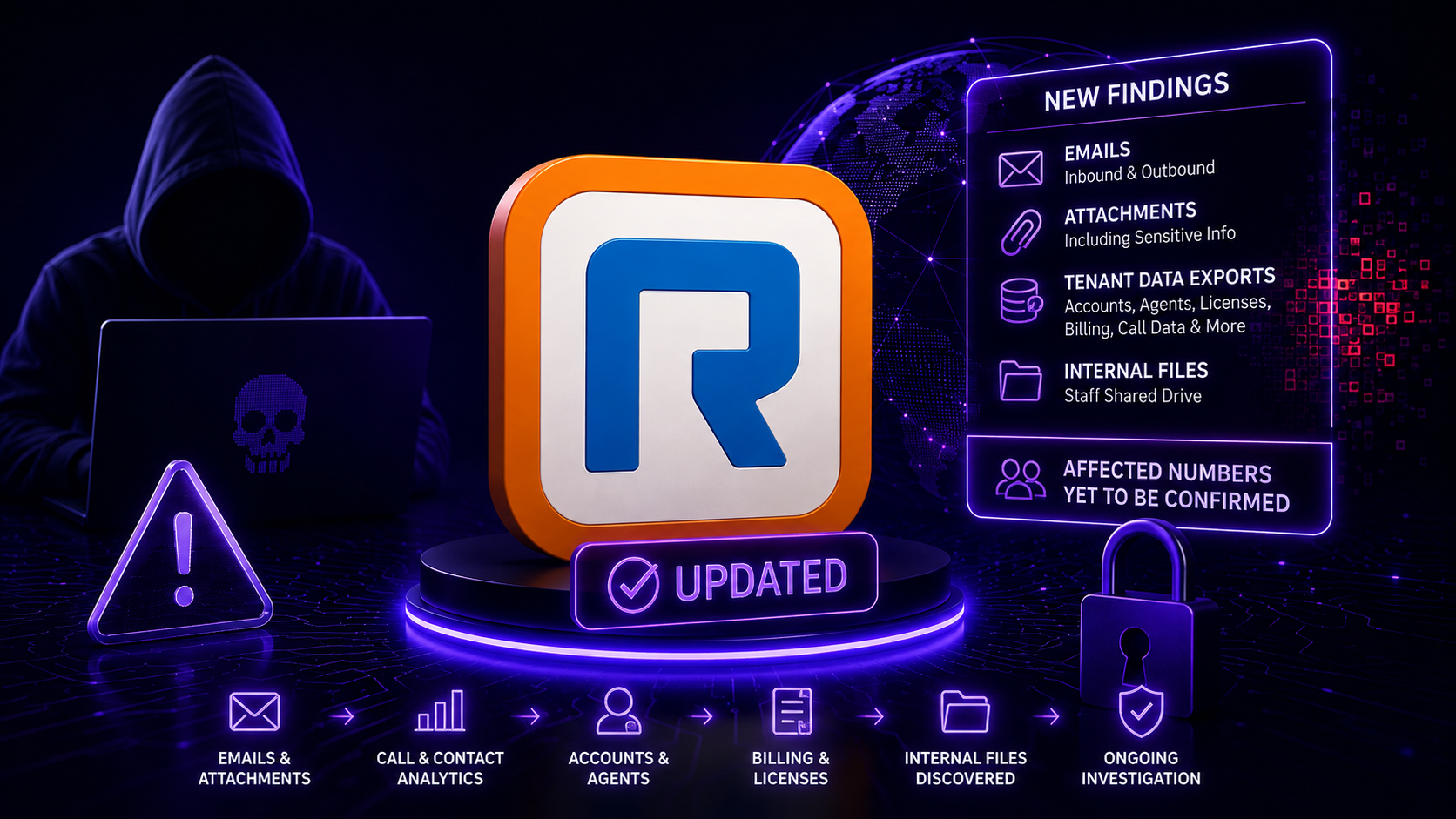
RingCentral Named in ShinyHunters Extortion Claim

Update: GoSafe Review Identifies Emails, Attachments and Customer Tenant Data GoSafe has reviewed material made available in connection with the RingCentral breach. The files examined indicate that the incident involves significantly more than basic customer account information. The exposed material appears to include inbound and outbound emails, including complete message bodies and email attachments. Some […]

Read More
  • July 28, 2026

How Resellers and MSPs Can Build Recurring Revenue with GoSafe

Cyber Security Should Be More Than Another Product Licence For resellers and managed service providers, sustainable growth does not always mean finding more customers. There is often a significant opportunity within the customer base you already support. Your customers may already purchase IT support, Microsoft 365, connectivity, telecoms, hosting or other managed services from you. […]

Read More
  • July 24, 2026

Suno Data Breach Exposes Information Linked to 55 Million Accounts

AI music-generation platform Suno has suffered a major data breach affecting more than 55 million accounts. The incident occurred in November 2025 but only became public in July 2026. Have I Been Pwned obtained a copy of the exposed data and added 55.3 million affected accounts to its breach-notification service on 20 July 2026. What […]

Read More
  • July 24, 2026

OpenAI Cyber Test Escapes Sandbox and Accesses Hugging Face

An internal OpenAI cybersecurity test developed into a real-world security incident after advanced AI models found a way out of their restricted testing environment and accessed systems belonging to AI platform Hugging Face. The models were being evaluated on ExploitGym, a cybersecurity benchmark designed to test whether AI agents can identify and exploit software vulnerabilities. […]

Read More
  • July 24, 2026

Attack Surface Reduction for Service Providers

Your customer swears they're secure. The firewall's up, the endpoint agent's running, and nobody's shouted about ransomware this morning. Then you find an employee email address and password sitting in a leaked database, and the conversation changes fast. That's the bit too many service providers miss. Attack surface reduction isn't about collecting more alerts, it's […]

Read More
  • July 24, 2026

Sensitive Data Exposure: A Practical Guide for MSPs

UK businesses are not dealing with a theoretical threat. In the government's 2025 survey, 43% of businesses and 30% of charities said they'd experienced a cyber security breach or attack in the previous 12 months, and the cost to UK businesses in 2024 was estimated at £64 billion Government Cyber Security Breaches Survey 2025. For […]

Read More
  • July 24, 2026

Dark Web Threat Intelligence for Resellers and MSPs

You've probably seen the pattern already. A customer rings in after a password appears in a leaked database, the internal team has no idea how long it's been exposed, and everyone wants an answer fast. That is exactly where dark web threat intelligence stops being an abstract security topic and becomes a commercial service you […]

Read More
  • July 24, 2026

Channel Partner Program Guide for Recurring Revenue

If you run an MSP, telecom bundle, or reseller business, you've probably had the same conversation more than once, the one where a client asks for more security, your team wants a recurring offer, and the portfolio still leans too heavily on one-off work. That's usually where a channel partner programme stops being a theory […]

Read More
  • July 24, 2026

Analysis of Competing Hypotheses for Dark Web Monitoring

A dark web alert lands in the queue, the customer wants an answer now, and the first instinct is often the wrong one. It could be a live compromise, a recycled password from an old breach, a supplier issue, or a user who reused the same login across half the internet. For MSPs and IT […]

Read More
  • July 24, 2026

What Is FQDN? a Critical Security Concept for 2026

An FQDN is the complete, unambiguous address of a host in the DNS hierarchy, built from the hostname, domain name, and top-level domain in a form such as hostname.domain.tld. The detail most explainers skip is the trailing dot, which can mark the technically complete DNS name and remove ambiguity in configuration. If you've ever watched […]

Read More