UK businesses are not dealing with a theoretical threat. In the government's 2025 survey, 43% of businesses and 30% of charities said they'd experienced a cyber security breach or attack in the previous 12 months, and the cost to UK businesses in 2024 was estimated at £64 billion Government Cyber Security Breaches Survey 2025. For MSPs, that changes the conversation fast. Sensitive data exposure is no longer a niche compliance issue, it's a recurring commercial problem, and it's one you can package, monitor, and sell.
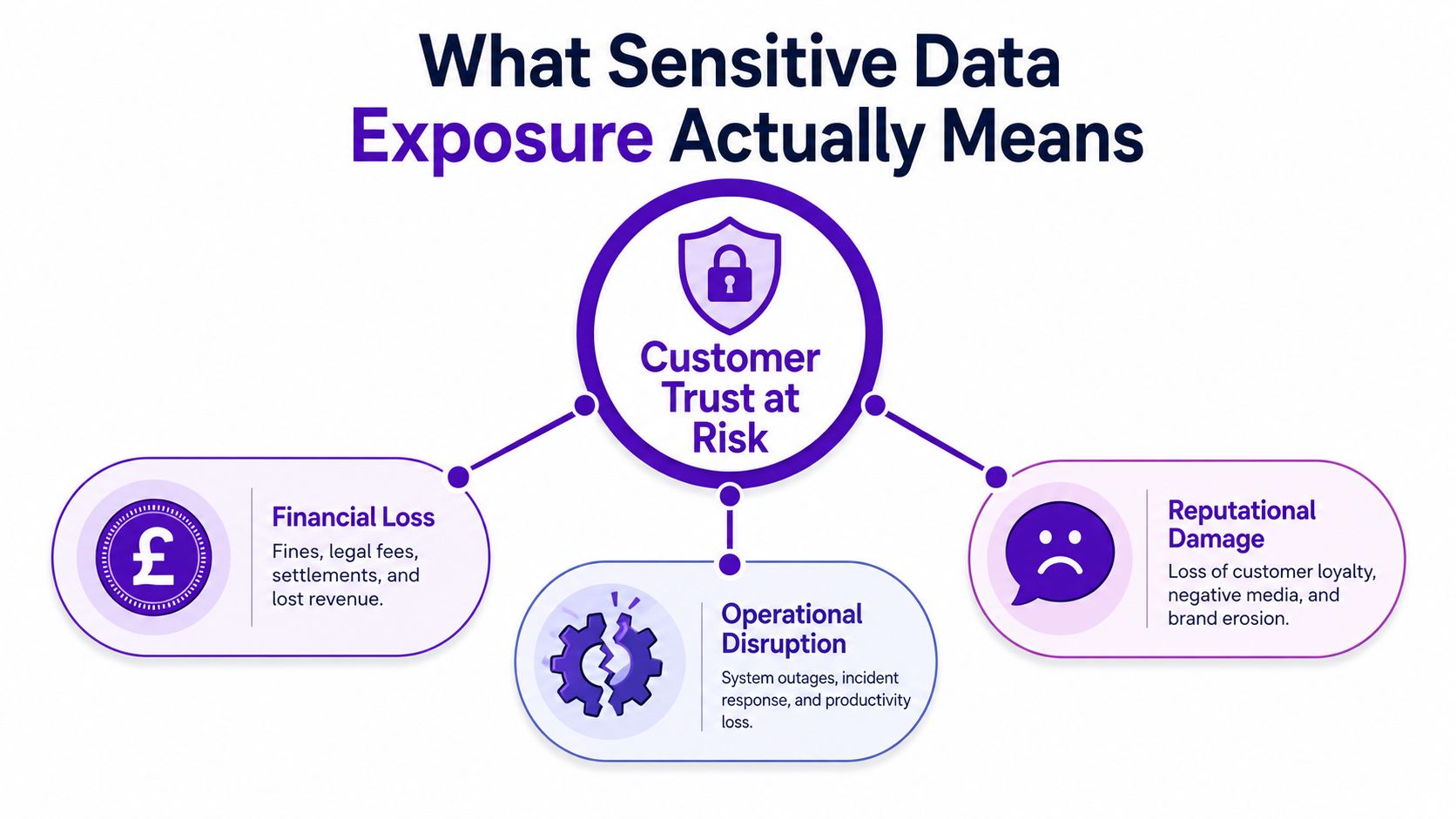
What Sensitive Data Exposure Means
Sensitive data exposure means information that should be restricted ends up reachable by someone who should not see it. The core issue is access to protected data, even before anyone confirms theft. OWASP's definition centres on unauthorised disclosure, which is the cleanest way to frame it in plain English CWE-200.
An open filing cabinet in a shared office is a fair analogy. Nobody has forced the door, yet the contents are still exposed. The same thing happens when a cloud bucket is public, an API returns too much data, or a password appears in a public repository. Exposure can come through misconfigured storage, unprotected API responses, secrets in code, or verbose error handling Sensitive data exposure basics.
What that means for an MSP client
For a business customer, exposure usually starts in ordinary ways. A staff member forwards the wrong file, a support tool shares too much detail, or a login gets reused somewhere it should not. The UK Information Commissioner's Office says most personal data breaches it receives are caused by human error, which is exactly why this keeps showing up in live service environments Zscaler summary of ICO reporting pattern.
That matters commercially because every exposure event creates work. Someone has to verify what was exposed, decide whether access was real, and tell the customer what to do next. For an MSP, that is a service line worth owning, because clients pay for clarity when they are under pressure.
Practical rule: if the data was reachable by the wrong person, treat it as exposure even before you know whether it was stolen.
Why Most Exposure Stories Miss the UK Pattern
A lot of generic security content still talks about sensitive data exposure as if it were mainly a coding defect or an encryption failure. That framing misses how UK exposure usually happens in practice. Cloud misconfiguration, over-permissive sharing, reused credentials, and identity data landing in the wrong hands before anyone notices are the patterns that matter.
Identity, not just data, is the core issue
The NCSC said it received 2,503 cyber incidents in the year to August 2024, including 89 nationally significant incidents, which is a blunt reminder that UK exposure risk is not abstract NCSC incident reporting context in verified data. In the same period, the ICO's breach reporting volume shows how often reportable personal data events crop up in practice ICO breach-reporting context in verified data. For an MSP, the useful task is to understand the shape of the problem, not to memorise incident counts.
The question that matters is simple. Which leaked identifiers can be tied to live accounts? If an exposed email address also maps to a working mailbox, or a reused password still opens a customer portal, you have a service problem that can turn into account takeover. Credential-focused monitoring is a better fit than broad, fuzzy data-leak talk for the UK SMB market.
What to challenge in sales conversations
When customers wave away exposure risk, push back on the assumptions:
- Cloud sharing is not harmless: public links, open folders, and loose permissions often expose data without any dramatic intrusion.
- Credentials age badly: a leaked email and password combination can stay useful long after the original mistake.
- Identity data travels: once an exposed domain or mailbox gets linked to a working account, downstream fraud becomes much easier.
- Human error is operational, not exceptional: staff mistakes are part of normal business flow, so controls need to assume they will happen.
The selling point is clarity. Narrow the gap between “we think we are fine” and “we know which accounts are exposed”.
That is why a modern dark web monitoring service for businesses sits so naturally in the MSP stack.
Core Controls That Actually Reduce Exposure
The controls that matter are not glamorous, and that's exactly why they work. Keep sensitive data out of clear text, encrypt it in transit and at rest, avoid storing data you don't need, lock down keys, and keep access tight. That's the foundation. Anything else is decoration if those basics are missing Detectify on OWASP-sensitive-data-exposure controls.
What an MSP can realistically deliver
Some controls are easy to wrap into a managed service. Others need engineering depth. You need to be honest about that if you're selling white label security services rather than pretending every customer needs a grand redesign.
| Control | Commercial reality | MSP fit |
|---|---|---|
| Encrypt data at rest and in transit | Essential, but often already partly in place | Good as a managed check and remediation project |
| Avoid unnecessary data storage | Strong reduction in blast radius | Good fit for advisory and policy work |
| Store keys in a vault, not source code | Easy to explain, often badly implemented | Best handled as part of deployment standards |
| Rotate keys and certificates regularly | Prevents stale trust from lingering | Good for recurring managed administration |
| Tighten access reviews | The most practical control for most clients | Strong fit for an ongoing service |
Where teams waste time
Too many providers sell “security” as a pile of tools. Customers don't buy that. They buy reduced exposure and less drama. If a client stores more personal data than it needs, no amount of dashboard theatre fixes the problem.
The controls that make a difference are the ones that reduce what can be seen, shared, or reused. Access review matters because it cuts off unnecessary visibility. Encryption matters because stolen data is less useful. Key management matters because hardcoded secrets and sloppy rotation turn one mistake into a permanent weakness.
Commercial takeaway: if a control doesn't change who can see the data, or how useful stolen data is, it's probably not moving the needle enough to sell as a standalone service.
Real UK Exposure Patterns You Can Talk to Customers About
The UK pattern is repetitive enough to use in a customer review. Businesses typically leak through everyday operational mistakes rather than a single dramatic exploit. The ICO says human error is the main cause of most personal data breaches it receives, and that gives MSPs a practical message to sell, because it points straight at process, access, and user behaviour.

How to turn the numbers into a customer conversation
The 2025 survey found 74% of medium businesses and 67% of large businesses reported incidents, compared with 42% of microbusinesses. Use that pattern properly. Bigger businesses have more moving parts, more access paths, and more chances for credentials or records to go walkabout. That is the core commercial point, not a generic warning about cyber risk. Government Cyber Security Breaches Survey 2025
For a customer review, turn that into plain questions that expose weak controls fast:
- Who can still access old shared folders? Over-permissioned storage is how exposure stays hidden.
- Which user accounts reuse passwords across services? Reuse turns one leak into several problems.
- Are staff sending files to the right recipients every time? Misdirected emails remain a common human-error route.
- Which domains are tied to external sign-ins? Exposed domains are a strong sign that credential monitoring matters.
That is the conversation an MSP should own. Lead with where the data travels inside the customer's business, then show where exposure is most likely to happen. If they want the operational detail, point them to the practical dark web monitoring guide and to monitor for stolen data, then tie both back to the same service motion.
Why this matters for recurring services
If exposure is common, monitoring is not a one-off project. It is a subscription problem. Customers need someone to spot exposed records, explain the impact, and keep watching for the same identifiers to resurface. That is a clean fit for dark web monitoring, because it turns a reactive scare into a managed relationship and gives partners a service they can package, renew, and expand.
Detecting Exposure Early With Continuous Dark Web Monitoring
Dark web monitoring is useful because it gives you early warning before a customer discovers the problem the hard way. The point is simple. Watch for compromised email addresses, exposed passwords, breached domains, and other leaked identifiers, then alert in language business users can understand. GoSafe does this as a white-label dark web monitoring tool, with continuous scanning, clear alerts, and a simple dashboard that partners can present under their own brand.
If you want a broader view of the category, the piece on monitor for stolen data is a decent external reference point. The important commercial point is that customers don't want a noisy threat feed. They want a plain answer to a simple question, is this worth acting on now?
What customers should actually see
A sensible alert flow is straightforward:
- Email address detected: tells you the account identifier is appearing in exposed data.
- Password or credential match found: gives you an immediate reason to force a reset.
- Breached domain linked: helps you understand whether the exposure maps to the business itself.
- Redacted preview available: lets you verify the nature of the leak without dumping full sensitive data into the inbox.
- Breach breakdown included: explains what was exposed, who might reach it, and what to fix first.
That's the level of clarity customers buy. They don't need a forensic lecture before breakfast. They need an alert, a short explanation, and a recommendation.
How GoSafe fits a reseller model
For MSPs and resellers, GoSafe is positioned as a dark web monitoring service for businesses that can sit beside support, connectivity, hosting, and cloud services. It scans continuously, highlights exposed passwords, email addresses, and domains, and gives partners a way to sell dark web monitoring under your own brand without building the stack yourself.
A practical internal guide on the channel opportunity is available in the practical dark web monitoring guide. That's the kind of resource that helps a sales team explain why exposure monitoring belongs in a monthly service bundle, not a one-off incident sale.
Practical rule: if the alert can't be explained to a non-technical director in one minute, it's too complicated for mainstream SMB resale.
A Step-by-Step Response Playbook After an Exposure Alert
An exposure alert should trigger a repeatable service desk workflow, not a scramble. Start with the facts, keep the evidence tight, and avoid over-collecting. The recommended standard is to prove access with minimal evidence, capture only a redacted sample, and record what was exposed, how it was reachable, who could access it, and what needs fixing first Vulnsy reporting standard.
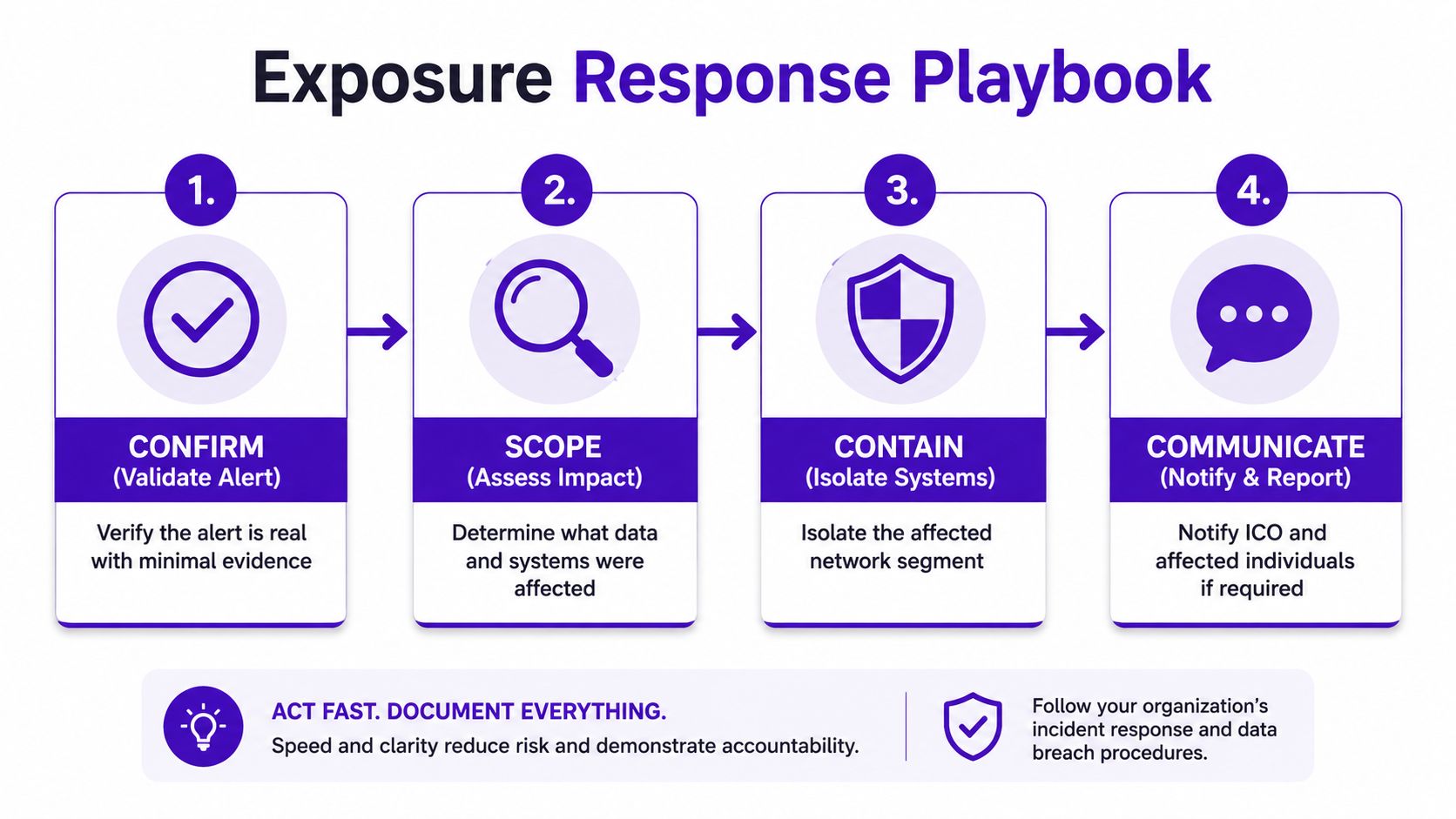
1. Confirm
Verify the alert is real. Check the exposed item against the customer's known domains, mailboxes, or user accounts. Don't ask for unnecessary screenshots or full dumps. If you need proof, use a redacted sample and keep the evidence handling disciplined.
2. Scope
Decide what was reachable and what was at risk. Was it a password, a mailbox, a domain, or a record tied to an employee or customer? That distinction matters because scope drives the response, and it changes what you tell the customer next.
3. Contain
Revoke tokens, force password resets, tighten sharing, and isolate the affected access path. If the issue sits in cloud storage or an external app, lock down the route first and fix the root cause immediately after. For a broader operational playbook, the GoSafe incident response playbook is a useful internal reference for service teams.
4. Communicate
Write the customer update in plain English. Say what was exposed, who might have seen it, and what action you've already taken. Don't hide behind jargon. If reporting obligations apply, the UK side of the process needs to be handled cleanly, and a separate reference on cloud security breach planning is worth keeping in your kit for structured response work.
When reporting becomes part of the job
The ICO breach-reporting framework is built around personal data being compromised, not merely sitting somewhere awkward. That means the practical question is escalation, not theory. If the alert points to exposed personal data, act as though you may need to report, document everything carefully, and make sure the service record is clean enough for audit and customer assurance.
Building a White-Label Exposure Service That Generates Recurring Revenue
The commercial logic is straightforward. Businesses need early warning, not a lecture. MSPs need recurring services, not one-off panic work. White label dark web monitoring fits both, because it can be sold as a monthly subscription, delivered with low overhead, and attached to services the customer already buys.
Why it sells
Most businesses already have compromised credentials on the dark web without knowing it. That makes the first conversation easy. You're not inventing risk, you're checking for it. Add the fact that customers want simple alerts instead of complicated dashboards, and you've got a service that's easy to explain to owners, finance leads, and operations managers.
The other advantage is operational. A reseller doesn't need a security team to stand this up. A platform like GoSafe gives partners a fully white-label way to sell dark web monitoring under your own brand, with branded alerts, breach breakdown reports, live phishing simulations, and staff training that keeps the conversation going after the first alert.
Where it fits in the stack
This service sits neatly alongside:
- IT support, where you already own the ticketing relationship.
- Cloud services, where identity and sharing risk already matter.
- Hosting, where domains and email exposure are natural concerns.
- Telecom and VoIP, where phone number monitoring adds obvious value.
- Web services, where customer accounts and login credentials keep resurfacing.
If you're building recurring revenue security services, this is one of the cleanest adds. It strengthens customer stickiness without demanding a major delivery model change.
A good way to frame the market to your sales team is to look at cybersecurity pitch deck examples). The useful lesson is the same in every channel pitch. Lead with the customer problem, show the service outcome, and keep the offer understandable.
What to sell, not what to overbuild
Sell clear alerts. Sell breach breakdowns. Sell peace of mind backed by ongoing monitoring. If the service becomes too complicated, the customer stops caring and your sales cycle gets slower. Keep it simple, brand it as your own, and make it part of the monthly relationship.
Use the GoSafe Dark Web monitoring reseller program if you want a white-label exposure service that's built for partner-led delivery and recurring revenue. It gives you a practical way to offer dark web monitoring under your own brand, without building the tooling or the operations from scratch.
GoSafe Dark Web monitoring gives MSPs and resellers a straightforward way to track compromised emails, exposed passwords, and breached domains, then present the findings under their own brand. If you're ready to turn sensitive data exposure into a recurring service rather than a one-off scare, visit GoSafe Dark Web monitoring and see how the reseller model works.