A client rings after a breach story hits the news and asks the same awkward question every MSP hears at some point, are we exposed too? That call usually comes after an email account has been reused, a password has leaked somewhere the business never watches, or a helpdesk ticket has hinted at strange login activity. Dark web credential monitoring gives service providers a practical way to answer that question with evidence, not guesswork.
For MSPs, resellers, telecom providers, hosting firms, and cyber consultants, the commercial logic is straightforward. Many customers want simple alerts, clear remediation, and someone to own the first response, not another complex security dashboard. The value sits in finding exposed credentials early enough to reset access, revoke sessions, and stop a leaked login from becoming an incident.
Why Your Clients Already Have Exposed Credentials
A small business owner doesn't usually call because they think they have a dark web problem. They call after a breach headline, then ask whether their own domain, inboxes, or staff logins might already be circulating somewhere unsafe. That's the right instinct, because exposed usernames and passwords are often already out there before the customer notices anything unusual.
The UK environment makes that risk feel less abstract. The National Cyber Security Centre, launched in October 2016, has repeatedly treated compromised credentials as a recurring route into organisations, and the UK Government Cyber Security Breaches Survey 2025 says 43% of businesses and 30% of charities reported a cyber breach or attack in the previous 12 months, with phishing still the most common attack type (BreachSense report on the UK context). When login details are exposed, credential misuse becomes a practical follow-on risk rather than a theoretical one.
Why service providers see it first
MSPs and resellers are often the first people asked to confirm whether exposure is real. That puts them in a useful position, because they already understand the customer's domains, mail systems, identity providers, and support history. They can connect an alert to a known user, a shared mailbox, or a legacy account faster than a customer can.
A mature monitoring service also changes the conversation. Instead of waiting for a breach to become visible through failed logins or mailbox abuse, the provider can tell the customer that a credential has appeared in an underground source and that action is needed now. For a useful reference point on the wider duty to protect client data in IT, this makes that conversation operational rather than theoretical.
Practical rule: if a customer already uses email, cloud services, remote access, and shared SaaS logins, they already have credentials worth monitoring.
The point isn't that every exposed record will lead to compromise. It's that the business can't manage what it can't see. Dark web credential monitoring gives service providers a way to surface that hidden exposure before attackers turn it into access.
How Dark Web Credential Monitoring Works
The workflow starts with collection. Monitoring platforms scan stealer logs, combo lists, underground marketplaces, ransomware leak sites, Telegram channels, and breach forums, then normalise the material into something a service provider can use. That raw feed is noisy by nature, so the platform has to separate useful exposure from recycled clutter.
A security guard checking a lost-and-found that never closes is a close fit. Your organisation's names, domains, and email patterns are compared against what turns up, then the system flags a match when it finds a likely connection. That matching stage is what turns underground data into a customer alert instead of just another pile of intelligence.
From raw data to a usable alert
Correlation does the heavy lifting. A platform does not just look for one exact email address, it checks domain patterns, user identities, related usernames, and exposed passwords so the alert can be tied back to a real account. That matters because a leaked mailbox address on its own is less useful than a known user plus a credential that can be reset immediately.
Freshness checks separate old noise from current risk. Recycled breach dumps can trigger endless false urgency, so the monitoring process needs enrichment that shows whether the record looks newly harvested or merely copied from an old dataset. In practice, that is what helps MSPs decide whether to treat an alert as a priority or as background intelligence.
Redacted previews matter for the same reason. They let an analyst confirm whether the exposure is an email/password pair, a session cookie, or a broader identity bundle without exposing the full sensitive record to everyone who sees the alert. That keeps the response team informed without turning the alert itself into another risk.
For a plain-language explanation of the data processing layer, the internal guide on what a parser does is a useful companion. If you want a broader primer on source coverage and monitoring logic, the CloudOrbis guide to dark web monitoring is also a practical read.
What good monitoring produces
The output should be simple. Business users do not need a forensic dump of underground infrastructure, they need a clear alert that says what was found, where it came from, and what to do next. That is the point where the service starts to earn its keep.
A monitoring tool only becomes valuable when the alert can be tied to a name, a domain, and a response step the helpdesk can carry out.
UK Breach Statistics and Reporting Deadlines
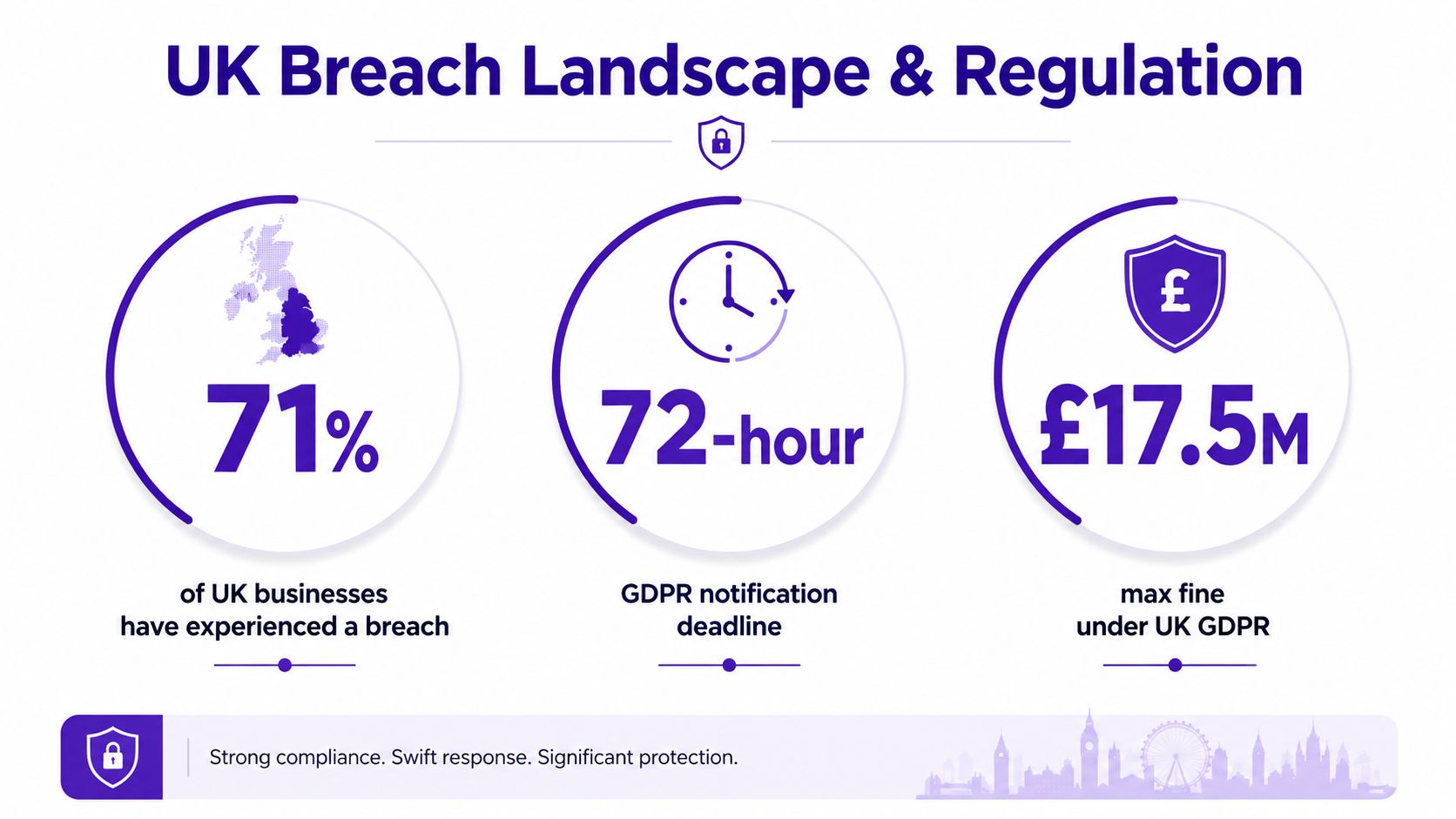
UK organisations face a specific mix of breach pressure and reporting urgency. The ICO received 3,195 personal data breach reports in its latest annual reporting period, and 79% of those incidents were caused by cyberattack rather than accidental loss (Bitsight overview of dark web monitoring and ICO telemetry). That makes compromised credentials an operational issue, not just a compliance box to tick.
The reporting clock matters because the ICO expects organisations to notify it of a personal data breach within 72 hours of becoming aware of it, where feasible, and to assess risk to individuals before deciding whether notification is required (CrowdStrike summary of ICO breach notification rules). If a business only discovers exposed credentials after misuse has started, the time left for triage, containment, and reporting shrinks fast.
Why speed changes the outcome
The NCSC has shaped UK guidance on credential exposure since 2016, and its advice has consistently treated stolen credentials as a major route into organisations. The practical problem is reuse. Once credentials appear in breach corpora or stealer logs, attackers can move quickly into credential stuffing, mailbox access, and lateral movement.
That is why dark web credential monitoring works best as part of a response workflow, not as a passive watchlist. The value comes from buying time before a stolen login gets used in an authenticated session. If the customer can reset a password, revoke tokens, and check for suspicious activity before that reuse happens, the alert has done real work.
The response window is the product
A lot of providers talk about exposure discovery. Fewer talk about what happens next. The difference shows up in how quickly an MSP can move from alert to validation to containment.
Operational rule: the first useful metric is not how many alerts arrive, it is how long it takes to turn one into a reset or revocation.
The UK breach picture makes that especially relevant for service providers. Businesses already dealing with phishing, mailbox compromise, and reportable incidents need a monitoring service that shortens the response window. If the alert cannot drive action, it is just another dashboard.
For providers building that workflow into a commercial offer, the GoSafe Dark Web monitoring reseller guide is a useful reference point. It helps frame the service around response timing, not just detection.
Building Recurring Revenue with White-Label Dark Web Monitoring
White-label is the commercial sweet spot for many service providers because it lets them sell a security service without building one themselves. They can brand the platform as their own, sell it under their company name, and keep the customer relationship in-house. That makes white label dark web monitoring much easier to fit into an existing portfolio than a bespoke security project.
The revenue model is also familiar. A monitoring service can be sold as a monthly subscription alongside IT support, cloud hosting, connectivity, VoIP, or web services, which gives partners a clean route into recurring revenue security services. Customers understand the logic quickly, because the offer is simple: early warning when their credentials appear where they shouldn't.
Why it sells cleanly
Most resellers don't need to explain stealer logs or underground marketplaces to a business owner. They need to explain risk in plain English. If a customer's email address or password appears on the dark web, the provider gets an early alert and the customer can act before misuse spreads.
That simplicity is why reseller dark web monitoring is often easier to position than broader security bundles. The conversation starts with a problem every business understands, exposed accounts, and ends with a straightforward action, review, reset, and protect. The provider doesn't need a specialist security team to make that offer credible.
For a practical commercial angle on packaging and messaging, the GoSafe Dark Web monitoring reseller guide is useful context for partners building the offer into a sales motion.
What the partner keeps
The best white-label model reduces friction rather than adding it. Partners want minimal management, no internal tool-building, and no need to create a separate operational team just to launch the service. They also want the service to strengthen their relationship with existing customers, because proactive security makes a provider harder to replace.
If the alert is easy to explain, the subscription is easier to renew.
That's the commercial case in a sentence. Sell dark web monitoring under your own brand, attach it to accounts you already support, and turn a hidden risk into a recurring line item that feels useful rather than forced. One option in that space is GoSafe Dark Web monitoring, which is positioned as a white-label service for partners rather than a general security suite.
Alerting Workflows and Remediation Best Practices
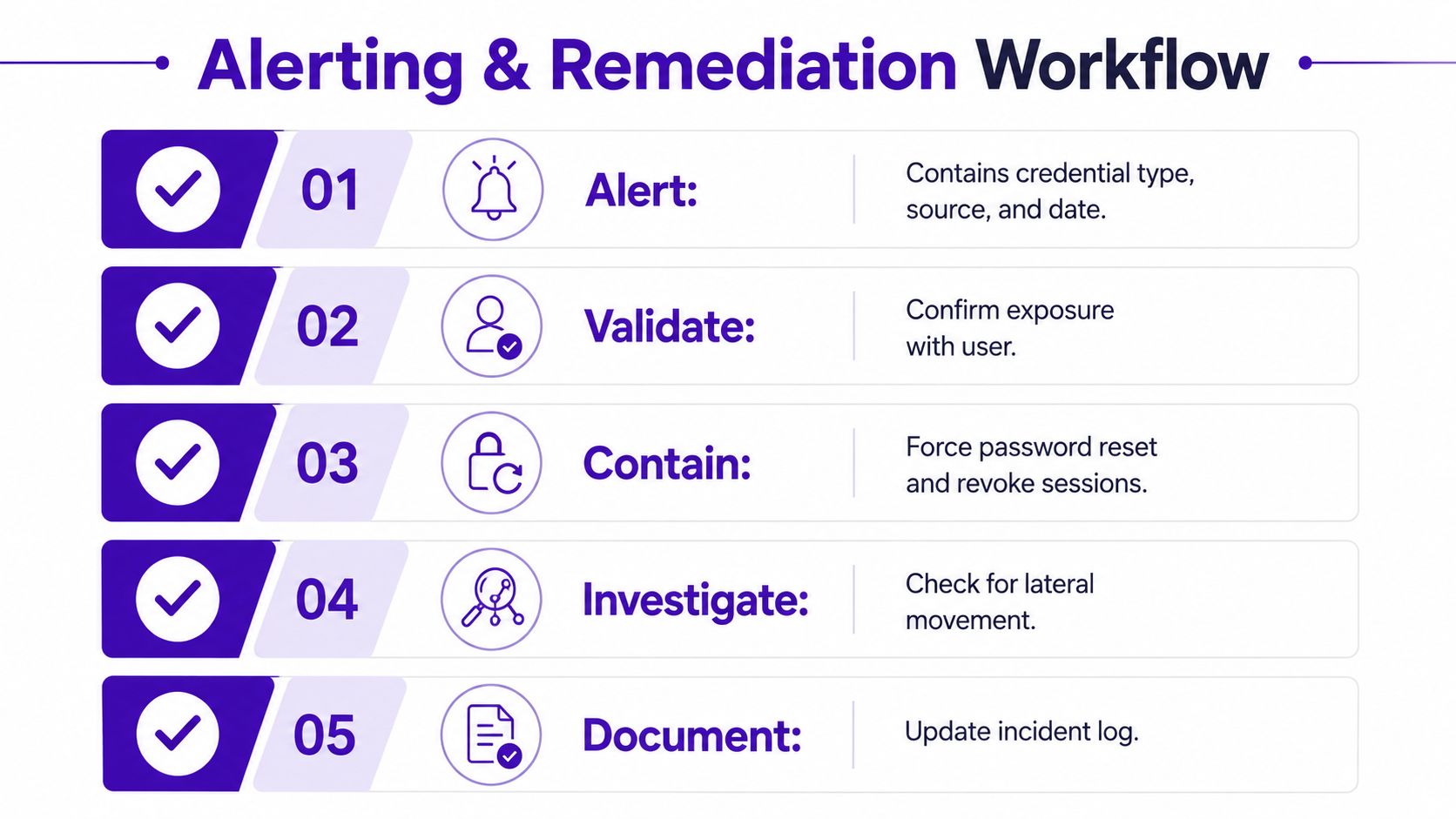
A useful alert tells the helpdesk what happened, who is affected, and what action to take next. A poor alert forces an analyst to guess. The difference shows up immediately in how much time gets lost between detection and containment.
The best operational model is closed loop. Detect, validate, reset, revoke, and hunt. That sequence keeps the provider focused on action rather than just evidence collection, which is where many monitoring programmes stall.
The response steps that actually matter
A leaked password should usually trigger a password rotation and a review of any sessions already in progress. If the credential is tied to an identity provider or remote access tool, token revocation matters just as much as the reset itself. Where MFA is in use, the provider should confirm that the second factor still protects the account and hasn't been weakened elsewhere.
Some exposures deserve user awareness training as part of the follow-up. If the same user keeps reusing passwords or falls for phishing, the monitoring alert should feed back into a wider behaviour conversation, not just another ticket. That is where the service becomes more than notification.
- Validate the exposure: confirm whether the alert matches a real employee, contractor, or shared account before you act.
- Contain access fast: reset the password and revoke active sessions where the platform or identity stack allows it.
- Check for follow-on activity: look for mailbox rules, suspicious login geography, or abnormal sign-in patterns.
- Document the outcome: keep a record of the event, the action taken, and the final status for audit and customer reporting.
Prioritisation keeps the queue usable
Risk scoring helps the team decide what needs action first. A simple severity label is often enough for a business user, as long as it reflects how exposed the account is and whether the data looks fresh. Redacted previews help here too, because they let the analyst see whether the alert is a password pair, a cookie, or broader identity data before choosing the response path.
The benchmark that matters is not just time-to-alert. It's time-to-reset. If the provider can move from detection to containment quickly, the alert becomes billable remediation work rather than noise.
Choosing the Right White-Label Monitoring Platform
Not every monitoring platform is worth putting under your brand. Some give you a dashboard and a lot of noise. Others give you a service your customers can understand, renew, and act on.
The first filter should be technical capability. You want continuous dark web scanning, detection of compromised email addresses, exposed passwords, and breached domains, plus practical extras like mobile phone number monitoring, instant breach search, and redacted breach previews. A central dashboard is useful only if it also shows breach history, risk scoring, and real-time activity in a way a service desk can work with.
What to ask before you sign
Commercial fit matters just as much as source coverage. If the platform is hard to brand, awkward to deploy, or dependent on specialist analysts, it will sit unused. Partners need something they can roll out cleanly, explain clearly, and manage without creating overhead that kills margin.
For UK-focused businesses, Cyber Essentials accreditation and a design sensibility that fits UK customer expectations can help when selling into cautious buyers. It's also worth checking whether the platform was built for service providers or retrofitted from an enterprise tool, because that usually shows up in how the customer experience is packaged.
- Branding and ownership: can you sell it under your own name without awkward workarounds?
- Deployment effort: does it require a long onboarding project, or can you move quickly?
- Operating model: can you run it without a dedicated security team?
- Alert quality: are the alerts clear enough for non-technical customers to understand?
- Response support: does the platform help you move from detection to remediation?
A service, not a suite
GoSafe fits that service-provider model because it is positioned as a dark web monitoring tool, not a broad, complex cybersecurity platform. That focus matters commercially, because simple products are easier to explain and easier to support. It aligns well with partners who want to add white-label security services without turning their business into a security consultancy.
The practical question is whether the platform helps you sell, deliver, and renew. If it does, it becomes part of your recurring revenue stack rather than a one-off add-on.
Start Offering Dark Web Monitoring Under Your Own Brand
Businesses don't need more vague security promises. They need early warning when credentials are exposed, a simple explanation of what that means, and a provider who can move quickly when the alert lands. That's why dark web monitoring service for businesses works so well as a white-label offer.
The opportunity for service providers is clear. White label security services are easier to attach to existing accounts when the value proposition is simple, and dark web monitoring for MSPs fits that requirement well. It helps differentiate your offer, starts better conversations with clients, and creates a recurring service that doesn't demand a large internal security function.
If you're weighing how to package the service, the easiest route is to offer dark web monitoring under your brand and keep the customer relationship in your own hands. For a practical look at how monitoring data can be surfaced and searched, the LLM Scrape API is a useful example of how structured access to data changes the pace of analysis.
GoSafe Dark Web monitoring gives service providers a white-label way to scan for compromised credentials, exposed passwords, and breached domains, then turn those findings into clear customer alerts. If you want to sell dark web monitoring under your own brand and add a recurring service your clients can understand, take a look at GoSafe Dark Web monitoring and see how the reseller programme works.