A dark web alert lands in the queue, the customer wants an answer now, and the first instinct is often the wrong one. It could be a live compromise, a recycled password from an old breach, a supplier issue, or a user who reused the same login across half the internet. For MSPs and IT providers, that's where analysis of competing hypotheses earns its keep, because it forces a disciplined look at alternatives before anyone tells a customer to panic, reset everything, or ignore the alert.
The method has intelligence-analysis roots, not cyber hype. It was formalised in the early 2000s, taught as a seven-step method, and built around a simple habit, try to disprove hypotheses rather than prove the one you like. That matters in security triage because the visible evidence is often thin, messy, and easy to overread. A useful adjacent discipline is anomaly detection in cyber security, but anomaly detection flags that something looks odd, while ACH helps decide what it most likely means.
For service providers, the commercial value is straightforward. Better triage means fewer false escalations, fewer messy customer conversations, and a more defensible security service that can be sold under a partner's own brand. The framework doesn't add drama. It adds discipline, which is what clients pay for when they want clear answers, not a noisy dashboard.
When a Dark Web Alert Demands More Than a Quick Glance
A dark web alert lands in the queue with one exposed email address and a customer who wants an answer now. The immediate questions are familiar, whether the credential is being used, whether it came from an old breach, or whether the alert is just background noise. If the analyst jumps to the loudest explanation, the customer gets unnecessary pressure and the MSP inherits avoidable work.
That is the point where analysis of competing hypotheses earns its place in incident triage. It was formalised in intelligence tradecraft in the early 2000s and taught as a structured way to keep the set of hypotheses manageable, with “7 is a good target” in the CIA-derived teaching materials. The better habit is to test whether evidence rules a hypothesis out, not to count how much support a preferred story seems to collect. For MSPs handling dark web credential monitoring, that discipline helps separate a live issue from stale data before the alert becomes an unnecessary escalation.
Why the first explanation is often the most dangerous
The first story that fits usually feels tidy. It also tends to hide weak assumptions. A leaked password can point to several different realities, and each one carries a different response for the customer.
Practical rule: if the alert makes you feel certain too quickly, slow down and ask what would make you wrong.
That habit fits other structured review processes in security work, including internal misconduct investigation, where the problem is rarely a single obvious fact and more often a set of competing explanations that need fair testing.
What service providers are really deciding
For an MSP, the immediate question is not just technical. It is whether to escalate, reassure, or keep watching. A weak alert handled as a breach creates panic and churn. A real breach handled as background noise damages trust more seriously.
This is why the value of ACH is practical, not academic. It gives the analyst a way to say, here are the explanations considered, here is the evidence that separates them, and here is what would change the view. That conversation is better than a flat yes-or-no answer based on one signal. It also supports an early warning system for stolen credentials by treating each alert as a triage problem first, not a headline breach.
Understanding the Core Mechanics of ACH
Analysis of competing hypotheses works because it changes the question. Instead of asking which story sounds best, the analyst asks which evidence separates one explanation from another. That sounds subtle, but it's the difference between a neat narrative and a defensible conclusion.

Disconfirmation beats accumulation
The method is built around disconfirmation. Analysts don't just pile up supportive facts for their preferred view. They actively look for evidence that is inconsistent with each hypothesis. In the verified data, this is the defining mechanic of ACH, and it's why the method is useful when several breach scenarios look similar at first glance.
A matrix makes that discipline visible. Hypotheses run across the top, evidence runs down the side, and each cell records whether the evidence is consistent, inconsistent, or not applicable. That structure stops the conversation becoming a loose list of impressions. It also makes assumptions explicit, which is essential when an alert is too thin to support confident conclusions.
Diagnosticity is the real filter
The key idea is diagnosticity. Evidence that fits every hypothesis isn't very useful, even if it feels reassuring. Evidence that separates one explanation from the others is what moves the decision forward. In a dark web investigation, that usually means treating indicators by how uniquely they support one account of events, not by how many of them there are.
A useful way to think about it is this.
| Evidence type | Value in ACH |
|---|---|
| Fits every hypothesis | Low diagnostic value |
| Contradicts one option | High diagnostic value |
| Depends on a shaky assumption | Needs sensitivity testing |
That's why ACH is more than a checklist. It is a structured way to avoid overvaluing volume and undervaluing discrimination. A customer does not need a larger pile of observations. They need the ones that narrow the field.
The Seven Steps of Structured Hypothesis Testing
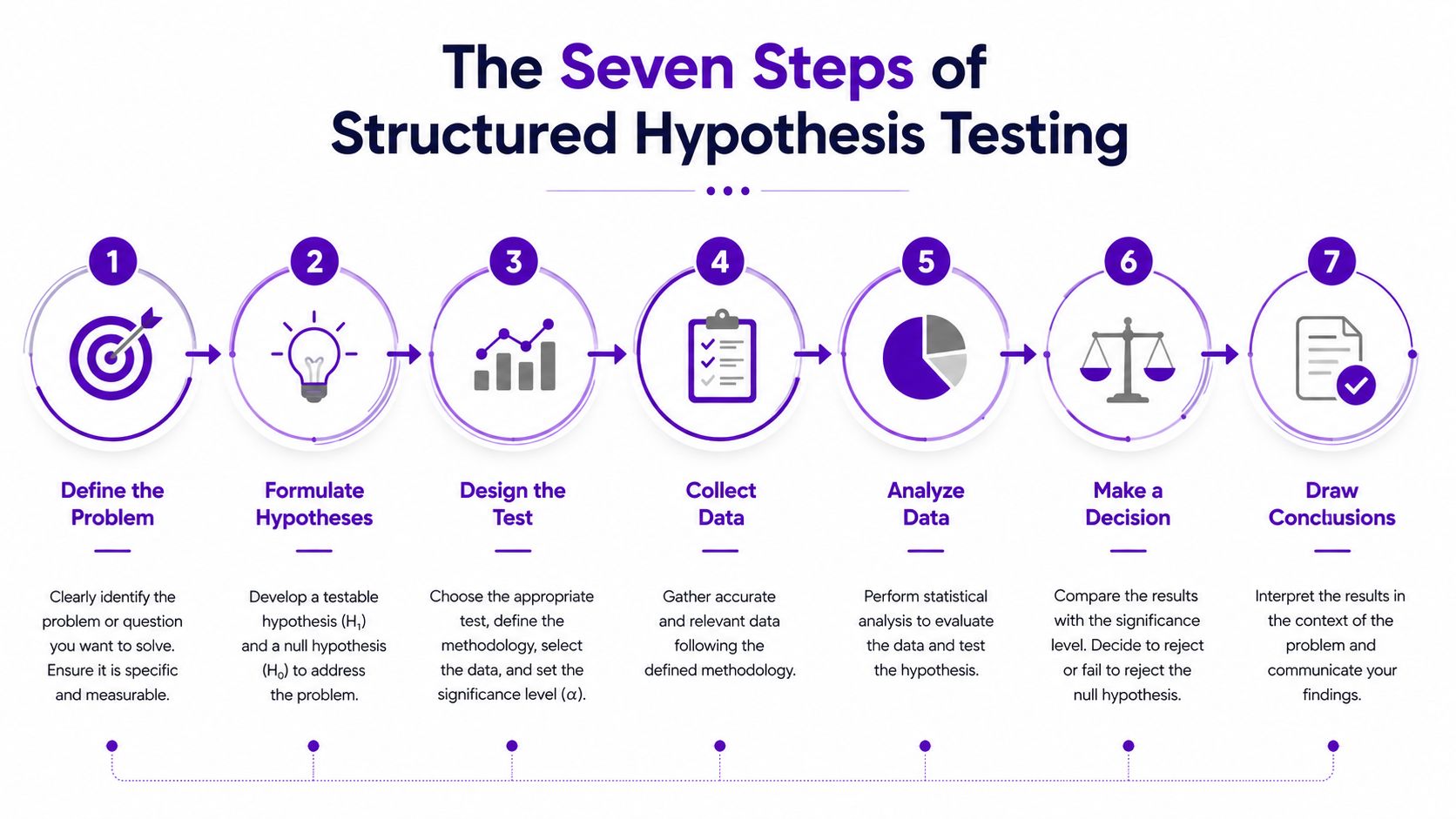
The seven-step version of ACH is widely taught because it gives analysts a repeatable sequence without turning the work into theatre. It begins with plausible hypotheses and ends with a report that keeps alternatives alive long enough to matter. The structure is especially useful in MSP work, where triage has to be fast, explainable, and good enough to withstand a customer challenge later.
The working sequence
- Identify hypotheses. Start with all plausible explanations, not just the obvious one. The discipline here is breadth before judgement.
- List the evidence. Pull in the indicators that matter, not every possible detail.
- Build the matrix. Compare each item of evidence against every hypothesis.
- Refine it. Remove items that do not discriminate and note where assumptions are doing the heavy lifting.
- Draw tentative conclusions. Tentative is the right word, because the evidence may still be incomplete.
- Test sensitivity. Ask which assumption, if wrong, would change the result.
- Report results. Give the relative likelihood of all hypotheses and state what future indicators would matter.
The teaching materials in the verified data also stress a manageable set of hypotheses, with about seven as the target. That's practical in incident triage because too many options make the matrix clumsy, while too few force premature closure.
A good ACH exercise should feel a bit uncomfortable. If it feels too tidy, the analyst probably simplified the problem too early.
What this looks like in an MSP workflow
In a dark web case, the analyst does not need to build a grand model. They need a disciplined path from alert to conclusion. That means including all plausible explanations first, then narrowing with evidence that rules options out. It also means reporting the result in plain language, because the customer usually wants an answer, a degree of confidence, and a sense of what to watch next.
The matrix is a thinking aid, not a substitute for judgement. That distinction matters more than people admit.
Applying ACH to a GoSafe Dark Web Alert
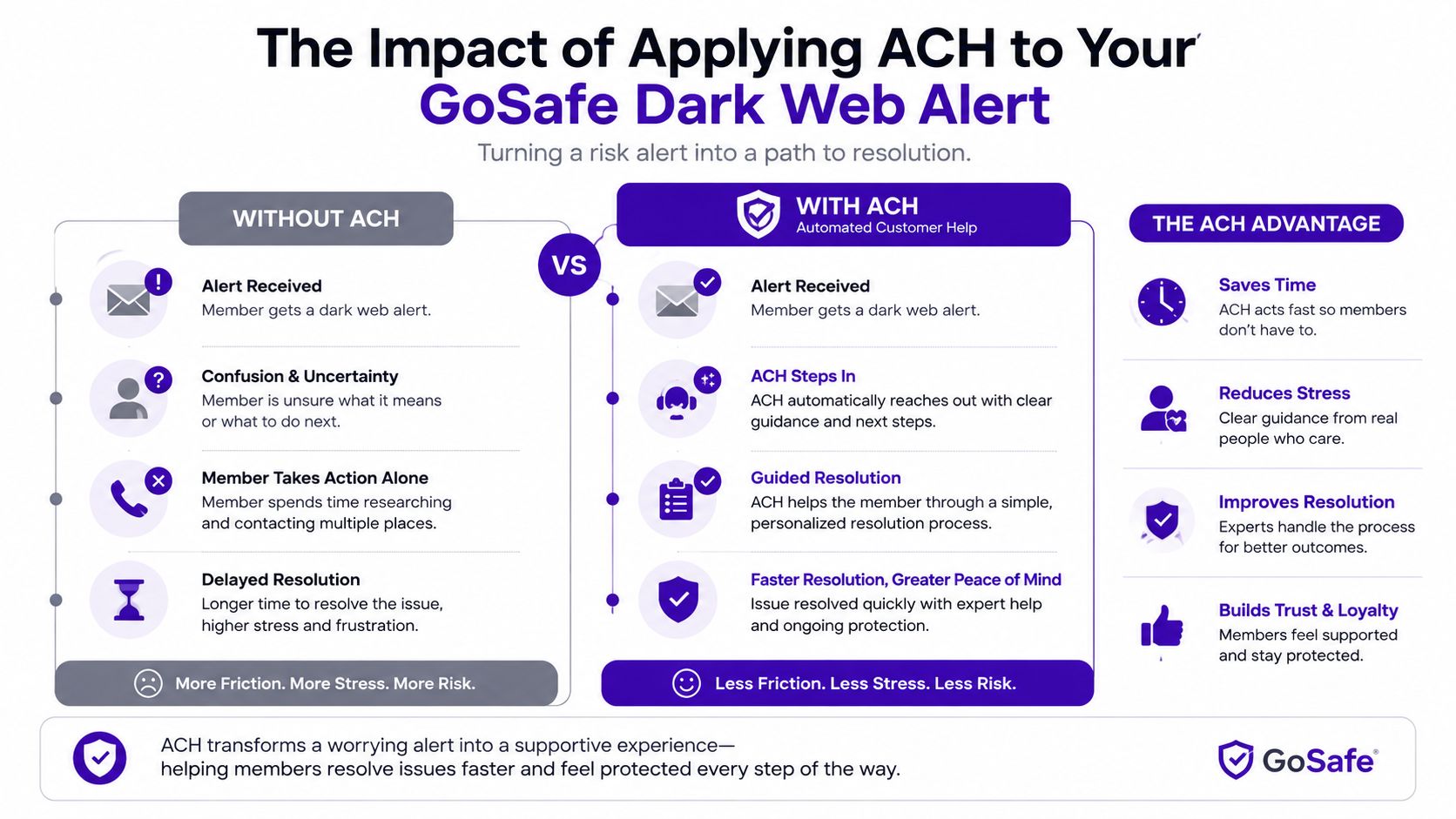
A partner receives an alert for a customer domain. The alert shows a breached email address, a password exposure, and a domain-level match. The instinctive reaction is to treat it as a probable breach, but that would be too blunt for a customer-facing service. The better move is to set out several competing explanations and test them against the evidence the alert provides.
The hypotheses worth testing
The analyst might start with four plausible explanations.
- Active account compromise. The account is currently being used or targeted.
- Credential stuffing from an older breach. The password is leaked, but not necessarily from a fresh incident.
- Third-party exposure. A supplier or connected service leaked the data.
- Internal misuse. A legitimate user account was exposed through poor practice or unauthorised behaviour.
Those are not the only possibilities, but they're the ones that usually matter most in triage. The point is not to guess early. The point is to compare each explanation against the evidence already in hand.
The evidence that actually discriminates
Some indicators matter more than others. If the exposed password matches the customer's current credential, that pushes the analysis in one direction. If the breach source is historical and the account has no other signs of misuse, another explanation becomes more plausible. If multiple accounts from the same domain appear together, that can point toward a broader exposure rather than an isolated mistake.
A sensible ACH pass also asks what the evidence does not do. If a finding is equally consistent with several hypotheses, it should not be overweighted just because it is visible in the dashboard. That is the quickest route to false confidence.
The practical output is a ranked view of the competing explanations, with notes on what would change the conclusion. For example, a new login anomaly, a second domain hit, or a confirmed supplier breach would all alter the picture. That keeps the customer advisory alive instead of freezing it into a single brittle verdict.
Common Pitfalls That Undermine Analytical Rigour
ACH can fail in practice when analysts treat the matrix as an answer machine. Recent scholarship is blunt about the method's limits, with a 2024 peer-reviewed review in Applied Cognitive Psychology concluding that ACH as a whole shows little to no overall benefit on judgment quality and may even harm it, although some components may still help analysts, as stated in the verified data linked to that review. That is not an argument against structure. It's an argument against sloppy use of structure.
Where teams go wrong
The first trap is selective weighting. Analysts start with the right matrix, then favour the hypothesis they already liked. The second trap is mechanical scoring, where every cell gets treated as if it were equally important. The third is premature closure, especially when the first plausible explanation feels good enough to brief.
What fixes those errors
- Score for diagnosticity. Give more weight to evidence that separates hypotheses, not evidence that merely repeats the same message.
- Run a sensitivity check. Identify the assumption that would break the conclusion if it turned out to be wrong.
- Use a second analyst. A fresh set of eyes often catches a hidden assumption or an overconfident jump.
- Accept thin evidence. Sometimes the right answer is that the evidence is not strong enough yet.
The main practical lesson from the 2024 review is not that ACH is useless. It's that ACH only helps when the analyst uses it as a discipline for thinking, not as a ritual. In a UK cyber context, where incident reporting shows the burden of breaches remains high and teams need defensible speed, that distinction matters.
If the evidence is noisy and the decision is time-sensitive, the right output may be a cautious holding view rather than a hard verdict.
For false-positive management, the GoSafe Dark Web monitoring guide is a useful reminder that alerts need interpretation, not blind acceptance. The best triage teams know when to escalate, when to watch, and when to keep the customer informed without overcalling the issue.
Packaging Structured Triage as a Recurring Security Service
Partners do not win customer trust by adding another dashboard. They win it by turning alerts into clear advice. White label dark web monitoring works best when the partner can sell dark web monitoring under their own brand and explain the result in language a business owner understands, without having to build the security workflow themselves.
That matters commercially because the service becomes easier to productise. It can sit alongside IT support, hosting, connectivity, telecoms, or web services as a practical monthly subscription. The customer gets visibility and early warning. The partner gets a cleaner recurring revenue motion and a stronger reason to stay embedded in the account.
Why ACH improves the offer
ACH gives the service a sharper edge. Instead of sending a raw alert and hoping the customer makes sense of it, the provider can deliver a structured view of the likely explanations, the evidence that mattered, and the indicators that should be watched next. That is especially helpful for dark web monitoring for MSPs, where buyers often want simple alerts, not a complex security posture review.
A structured triage approach also makes the service easier to explain in sales conversations. It says, in effect, that the partner is not just watching for exposed credentials, but handling them with a disciplined method that reduces false escalations and supports defensible advice. That is a better commercial story than a generic promise of visibility.
Commercial reality: customers keep paying for services that save time, reduce uncertainty, and help them make better decisions without building internal capability.
The strongest positioning is straightforward. Offer a dark web monitoring service for businesses as part of a broader stack of white label security services, keep the alerts plain, and use the structured assessment to create meaningful conversations with customers. That is where recurring revenue security services stop sounding like a slogan and start behaving like a product.
For providers looking at cybersecurity consulting reseller program, the appeal is simple. You can package a specialist service, keep the relationship, and avoid the cost of building your own security tooling from scratch.
Building Your ACH-Informed Monitoring Practice
The most useful starting point is not a perfect framework. It is a repeatable habit. Set the service up so that every meaningful alert is handled with a short hypothesis list, a matrix of evidence, and a written note on what would shift the conclusion. That alone lifts the quality of triage without slowing the team into bureaucracy.
A practical checklist looks like this.
- Keep the hypothesis set small. Aim for a manageable shortlist so the team can compare options.
- Separate support from discrimination. Not every piece of evidence deserves the same weight.
- Report all relevant hypotheses. Don't collapse too early onto a single explanation.
- Record future indicators. Note what would matter if the situation changes.
- Review the judgement. Revisit the conclusion if new evidence appears.
That last point matters because ACH is not just about the present alert. The method's reporting stage is designed to preserve alternatives and identify what future observations would tell you something new. In practice, that means the customer gets more than a verdict. They get a monitored view of risk.
Use the method where it helps, which is in messy, competing explanations rather than in cases that are already obvious. Used well, analysis of competing hypotheses gives MSPs a defensible way to handle dark web credentials, reduce false escalations, and present a cleaner service to business customers.
If you want to offer white label dark web monitoring under your own brand, see how the GoSafe Reseller Programme works and how it fits a recurring revenue model. Visit GoSafe Dark Web monitoring to book a demo, review the reseller option, and decide whether it's the right add-on for your services.