
A connectivity renewal lands in your inbox. The customer wants fibre, hosted voice and mobile services, but the conversation is almost entirely about price. You hold the account, yet each renewal feels less secure because the buyer can compare your core services with several near-identical alternatives.
That's the commercial problem facing UK telecom providers, MSPs, VoIP companies and technology resellers. Connectivity remains essential, but it's becoming harder to defend margin through access alone. Telecom value added services give you a practical way to attach recurring revenue to contracts you already manage, without building an entirely new sales operation.
The Flat Connectivity Market and the VAS Opportunity
Consider a Midlands communications reseller with a long-standing 200-seat customer. The reseller has supplied fibre and hosted voice for several years, handled service issues, supported changes and earned the customer's trust. At renewal, the buyer runs an RFX process and asks for a sharper price.
The reseller protects the account, but the outcome is underwhelming. Revenue stays broadly unchanged, margin is thinner and the account carries more commercial risk than before. The provider has retained the customer, but hasn't created much additional value for either side.
That situation is common because the core offer is easy to compare. Buyers can assess bandwidth, mobile allowances, voice features and service levels across competing proposals. A reseller that only sells access is forced into a price-led discussion, even when its service quality is better.
The UK telecoms sector generated £34bn in revenue in 2024, an increase of £0.5bn year on year, according to the UK Government's market scoping analysis. That's a mature market, not an environment where providers can assume broad sector expansion will solve account-level margin pressure.
Attach value to contracts you already renew
The defensible opportunity sits above connectivity. A customer may not pay more for another broadband line, but may pay for a service that helps protect accounts, support staff, improve communications or simplify compliance.
That's where VAS earns its place. It turns a basic connectivity contract into a wider commercial relationship, provided the extra service solves a recognisable problem and carries its own recurring fee.
This also makes integration important. Partners evaluating new services should look for practical billing, provisioning and customer-data connections. The Recepta.ai API integration insights provide useful context for thinking about how additional services can fit into existing operational workflows.
Commercial rule: Don't add a product because it looks impressive in a portfolio. Add it because your account team can explain the customer problem in one sentence and bill for the solution every month.
What Telecom Value Added Services Actually Are
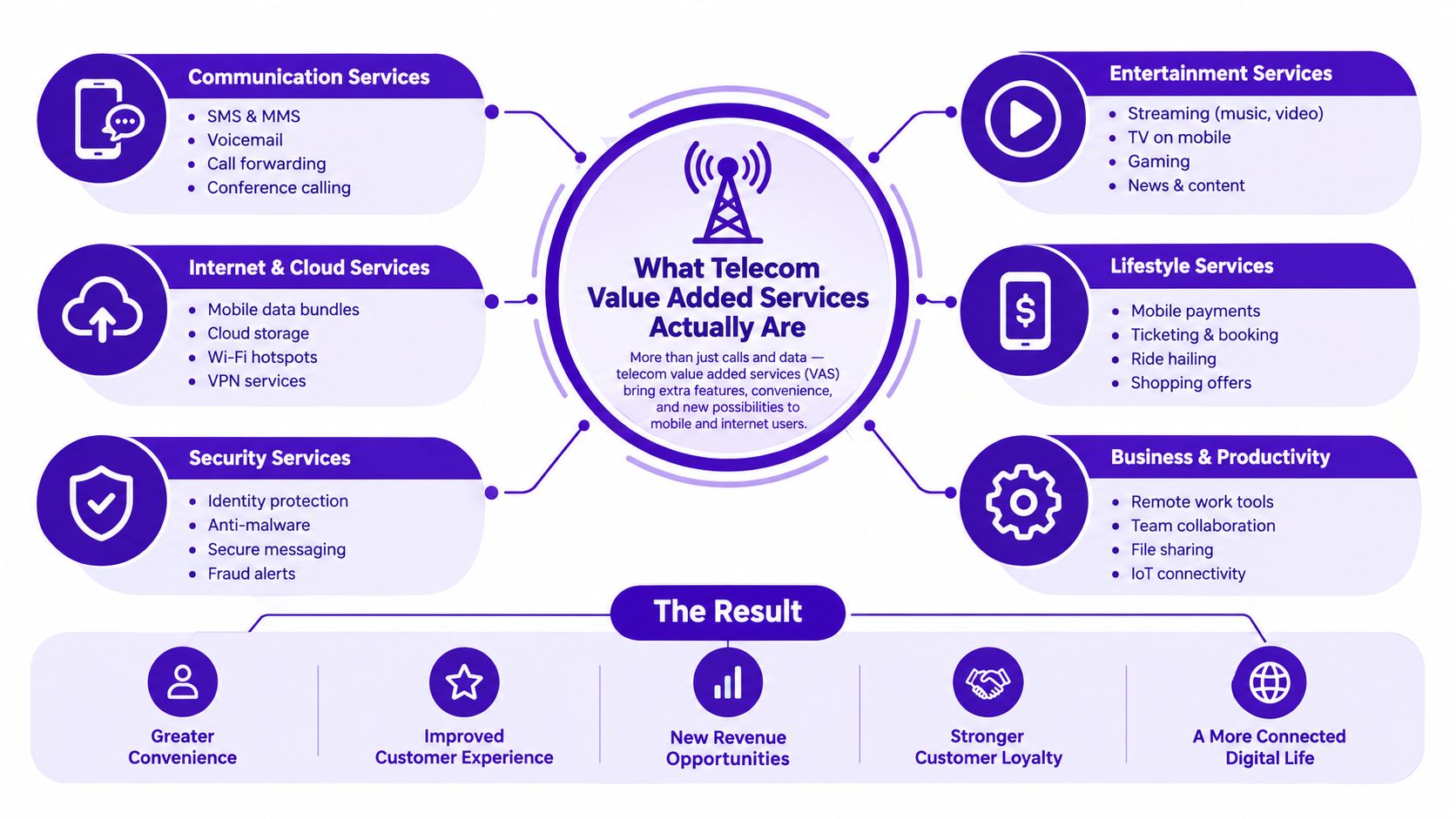
A useful definition for a UK reseller is simple: a telecom value added service is anything sold on top of voice minutes, broadband lines and mobile contracts that a customer is willing to pay for separately on a recurring basis.
That definition keeps the commercial test clear. A free feature may improve the customer experience, but it isn't automatically a VAS line. A paid service becomes commercially relevant when the customer understands its purpose, accepts a price and continues using it after the initial sale.
The terminology has defensible roots. Following liberalisation in the early 1980s, the UK's BT Act of 1981 allowed independent service providers to be licensed, with the first licences issued in 1982. Rapid growth followed in value-added network services, including voicemail, personal numbering, messaging, videoconferencing and information services, as documented in official UK trade evidence on telecom services.
Use five categories to organise the portfolio
A practical category map helps sales and product teams avoid presenting an unstructured catalogue.
- Communication services: Hosted voice features, call recording, analytics, voicemail and contact-centre functions.
- Messaging: SMS APIs, two-way business messaging and integrations with business messaging platforms.
- Security and identity: MFA, SIM swap protection, credential exposure alerts and dark web monitoring.
- Cloud and collaboration: Backup, Microsoft 365 services, Teams voice enablement and hosted SharePoint.
- Managed services: SD-WAN, failover connectivity, monitoring, support and compliance-related services.
The categories overlap technically, but they differ commercially. Communication and managed services often fit naturally into an existing account review. Security needs a clear explanation and credible customer outcome. Entertainment and lifestyle services can work in selected consumer segments, but they're often weaker propositions for an SMB buyer who wants operational value.
Your working test should be strict. Can the account manager show where the service fits in the customer's day-to-day operation? Can the provider provision it without creating manual work? Can billing, support and renewal be handled alongside the core telecom contract?
If the answer is yes, the service has a chance of becoming recurring revenue. If the answer is no, it may remain a slide in a product deck.
The Main Categories Resellers Can Sell Today
A reseller doesn't need a larger catalogue. It needs a better order of conversation. Start with services that attach naturally to an existing contract, then introduce more specialised options when the customer's needs justify them.
Communication services are usually the easiest entry point. Hunt groups, call recording, voicemail, call analytics and Teams voice enablement are tangible extensions of hosted voice. Buyers can connect them to missed calls, customer service, sales coaching and operational visibility.
Messaging has a clear use case where customers communicate with their own users. SMS APIs, two-way business messaging and WhatsApp Business Platform integrations can support appointment reminders, service updates and customer conversations. The sale stalls when the provider presents messaging as a channel without identifying the workflow it will improve.
Security and identity includes MFA, SIM swap protection, exposed credential alerts and white-label dark web monitoring. It converts best when positioned around a specific business risk, rather than a complicated security dashboard.
Cloud and collaboration covers Microsoft 365 backup, Teams voice and hosted SharePoint. These services can be valuable, but the proposal must explain ownership, recovery, support boundaries and licensing. Otherwise the customer sees another line item attached to software it already uses.
Managed services include managed SD-WAN, 4G failover and compliance monitoring. These are strong propositions for customers with distributed sites or limited internal IT capability, but they often need a more consultative sale.
A commercial comparison
| Category | Example services | Typical monthly margin | UK SMB attach rate |
|---|---|---|---|
| Communication | Hunt groups, call recording, voice analytics | Depends on supplier cost and packaging | Generally easier to attach where hosted voice is already installed |
| Messaging | SMS APIs, two-way messaging, WhatsApp Business integrations | Depends on usage and commercial model | Strong where a clear customer communication workflow exists |
| Security and identity | Dark web monitoring, MFA, SIM swap protection | Can support higher-margin packaging when operational overhead is low | Growing opportunity, but requires plain-language selling |
| Cloud and collaboration | Microsoft 365 backup, Teams voice, hosted SharePoint | Varies by licensing, support and storage requirements | Mixed, often dependent on incumbent relationships |
| Managed services | SD-WAN, 4G failover, compliance monitoring | Often stronger where support and management are bundled | Strong for operationally complex customers |
These attach-rate descriptions are qualitative because comparable verified UK SMB figures aren't available in the supplied evidence. That's also a useful warning: don't promise a universal conversion rate to partners or customers.
Use account data to decide where to lead. A voice-heavy customer may be ready for call analytics. A multi-site customer may need failover. A business with exposed staff credentials may respond to monitoring. Tools such as an AI agent for cross selling can help identify relevant account signals, but the recommendation still needs human judgement.
For security-focused partners, the next step is to become a dark web monitoring reseller. The offer should sit alongside existing IT support, cloud, hosting, connectivity, telecom systems and web services, not replace them.
Why VAS Matters More Than Ever for UK Providers
Connectivity providers need an account strategy that doesn't depend on raising the price of the access layer. The UK sector's £34bn revenue in 2024 shows the scale of the market, but it also reflects its maturity. The opportunity for a reseller is not to wait for the whole sector to expand. It is to improve the value of each relationship already on the customer base.
Age-sensitive adoption supports a segmented approach. Juniper Research found that 45% of UK respondents aged 16 to 29 were willing to adopt mobile operator value-added services, and that this group was almost twice as willing to buy additional services as respondents aged 46 to 59. The research covered 3,300 UK mobile subscribers and included 95% confidence intervals, as reported in the UK telecoms value services analysis.
That finding doesn't mean every young customer will buy an add-on. It means identical bundles shouldn't be offered to every segment. Consumer products may need simple digital features and monthly billing, while SMB buyers are more likely to assess an add-on through business risk, productivity and support.
Stop treating every bundle as growth
Bundling can defend an account, but it isn't automatically evidence of new demand. Ofcom reported that the sector generated £34bn in revenue in 2024, up 1.5% year on year, while fixed voice revenues fell 13.3% year on year in Q1 2025. The Communications Market Report 2025 shows why providers need to separate genuine service value from promotional packaging.
A VAS line should therefore pass three tests:
- The customer understands it: The benefit is clear without a technical briefing.
- The provider can deliver it efficiently: Provisioning, support and billing don't require a new specialist team.
- The account team can measure its role: Adoption, renewal behaviour, support demand or customer feedback can be reviewed.
The table below deliberately avoids unsupported percentages. The supplied evidence doesn't provide the requested daily smartphone use or payment rates for security, cloud and messaging services by age group.
| Age group | Daily smartphone use | Pay for security VAS | Pay for cloud VAS | Pay for messaging VAS |
|---|---|---|---|---|
| 16 to 29 | Not stated in the verified evidence | Not stated | Not stated | Not stated |
| 30 to 45 | Not stated in the verified evidence | Not stated | Not stated | Not stated |
| 46 to 59 | Not stated in the verified evidence | Not stated | Not stated | Not stated |
| 60 and over | Not stated in the verified evidence | Not stated | Not stated | Not stated |
The practical recommendation is to segment by customer problem, not just age or tariff. A reseller that matches the add-on to the account's operational context will usually have a better conversation than one presenting the same bundle to everyone.
Customer Use Cases That Convert to Monthly Revenue
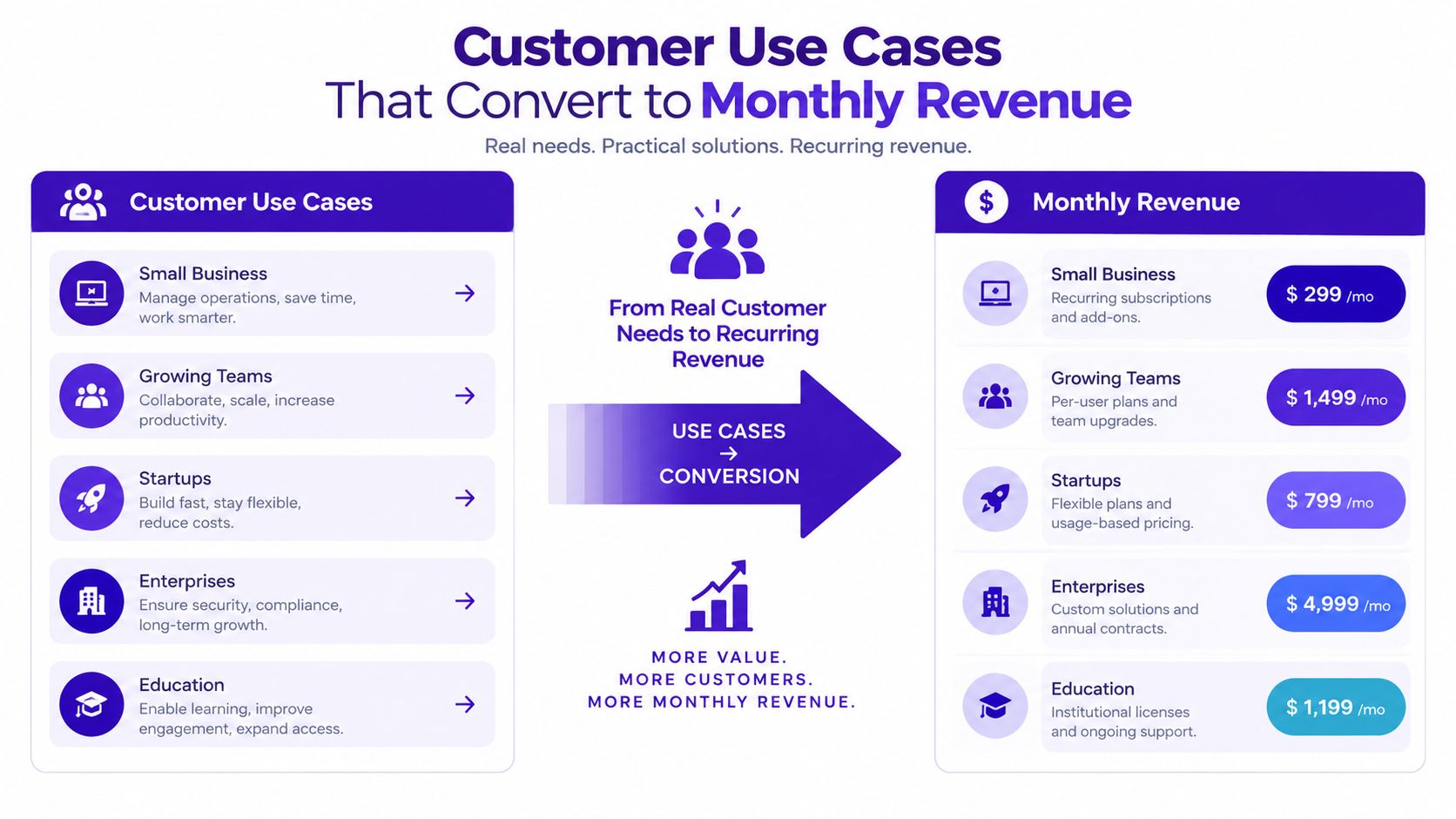
Different buyers pay for different outcomes. Consumers often accept convenience features inside a simple bundle. SMBs want services that reduce operational friction or help protect the business. Larger organisations expect clearer service levels, ownership and support arrangements.
For a consumer, the sale needs to be nearly effortless. Voicemail-to-email, caller display, safe browsing or messaging features can work when the value is immediately understandable and the billing is simple. The provider should avoid turning a small convenience service into a complex security consultation.
An SMB buyer is different. Hosted voicemail, call recording, call analytics, Microsoft 365 backup, credential exposure alerts and endpoint protection can all become credible recurring services when tied to a visible business process. The reseller already has the relationship, billing contact and service-review opportunity.
Enterprise customers typically ask for managed delivery. SD-WAN, UCaaS, compliance monitoring and credential scanning need defined responsibilities, escalation paths and reporting. A reseller should not sell an enterprise-style managed service with a consumer-style support model.
Build the account from the customer's use case
A ten-seat business may begin with connectivity and then add hosted voice, call recording, Microsoft 365 backup, endpoint protection or dark web monitoring. The correct bundle depends on its workflow, risk profile and appetite for managed support.
Don't start by forcing every available feature into the quote. Start with one problem that the customer already recognises, then add adjacent services only when they make the first purchase more useful.
| Buyer segment | Services to lead with | Services that may stall |
|---|---|---|
| Consumer | Simple communication, convenience and protection features | Complex dashboards and unclear premium content |
| SMB | Hosted voice, backup, monitoring and practical security | Broad bundles without a named business outcome |
| Enterprise | Managed networks, UCaaS, compliance and reporting | Unpriced support obligations or unclear service ownership |
The strongest VAS conversations use the existing contract as the route to a wider service relationship. For practical guidance on how partners can build recurring revenue with monitoring, focus the sales message on early warning and understandable action, not technical sophistication.
Security as the Smartest New Add-On for Connectivity
Security is a natural extension of connectivity because the same customer who relies on your network also relies on the accounts, domains and devices connected through it. A business may already have compromised credentials on the dark web without knowing it. Your role is to give the buyer an early warning that can be understood and acted upon.
The commercial case is supported by the cost of credential-related incidents. IBM's UK breach analysis identified third-party or vendor compromise as the most commonly reported cause at 18%, phishing at 16% and compromised credentials at 11%. The figures are reported in IBM's 2025 UK breach analysis.
A separate IBM UK report puts the average cost of a breach where stolen or compromised credentials were the initial attack vector at £4.27 million, compared with £3.59 million for phishing and £4.03 million for business email compromise. Those figures appear in IBM's UK breach cost reporting.
Sell visibility, not fear
A white-label dark web monitoring service is easier to explain when the customer hears a short, practical promise:
- Continuous scanning: Monitor for compromised email addresses, exposed passwords and breached domains.
- Early alerts: Notify the customer when credentials or related data appear in exposed sources.
- Clear reporting: Show what was found and what action the business should take.
- Simple delivery: Keep the customer experience understandable for a business user.
Partners don't need to build security tools internally or hire a security team to add this service. A fully white-label platform can carry the partner's brand, sit inside its own product portfolio and preserve ownership of the customer relationship. That makes it suitable for MSPs, IT support companies, telecom providers, VoIP providers, hosting companies and technology resellers.
GoSafe Dark Web monitoring is one example of this model. It continuously scans for exposed credentials and breached data, then provides clear alerts and a dashboard designed for practical customer response.
Sales advice: Lead with “we'll tell you when exposed credentials are found”. Don't lead with dark web terminology, threat feeds or a complicated security architecture.
The operational test remains important. Confirm how alerts are handled, what the partner supports, how billing works and where the customer receives help. If those answers are clear, security can become a useful monthly attachment to broadband, mobile, hosted voice or managed services.
Where UK Telecom VAS Is Heading Next
The next phase of telecom value added services won't be won by the provider with the longest list of consumer perks. It will be won by the reseller that packages practical services into existing contracts and manages them as a margin portfolio.
Three directions deserve attention.
White-label security is the clearest opportunity for partners that already sell connectivity, support or cloud services. Dark web monitoring, credential exposure alerts and device protection address risks that customers recognise, while the partner can keep the offer under its own brand.
AI-assisted contact and collaboration tools will sit above hosted voice. Call analysis, assisted workflows, intelligent routing and better reporting can give an existing voice customer a reason to expand its monthly service rather than renegotiate only on line price. The buyer still needs a clear operational benefit, not an AI label.
Compliance-ready managed services will matter to regulated and risk-sensitive SMBs. Monitoring, reporting, access controls and documented support can be packaged around the customer's industry requirements, provided the reseller is precise about what it does and doesn't cover.
The strategic shift is from product launches to recurring revenue bets. A VAS should earn a place in the portfolio because it improves account economics, creates a useful review conversation or makes the relationship harder to replace.
Low-margin vouchers and content perks may still work in selected consumer propositions. They shouldn't distract a B2B reseller from services that protect accounts, support operations and produce visible monthly value.
Portfolio test: If the service can't be attached, explained, supported and renewed, it's not yet a commercial VAS proposition.
Common Questions from Providers Adding VAS
What regulation should a reseller consider?
The regulatory position depends on the service, customer type and delivery model. Premium rate services have operated under UK regulation since 1986, and day-to-day regulatory responsibility transferred to Ofcom on 1 February 2025, as recorded in Parliament's written statement. Ofcom also requires regulated providers to register new services at least five working days before regulated activity begins.
That regime is separate from the basic commercial act of reselling a security monitoring service, but it demonstrates why partners should check the rules before launch. Review telecom, data protection, marketing, financial promotion and sector-specific obligations with qualified advice. The BT Act history provides useful context for the language of VAS, but it isn't a substitute for checking the rules that apply to the specific offer.
How should the service be priced?
Use the pricing model that matches the customer's value unit:
- Per seat: Suitable for user-based monitoring, voice features and collaboration services.
- Per site: Useful for connectivity resilience, SD-WAN and location-based managed services.
- Tiered bundle: Appropriate when customers need a simple good, better and best choice.
- Base fee plus usage: Relevant to messaging and services where consumption affects supplier cost.
Protect the connectivity margin by showing the VAS as a distinct service line. Don't hide a complex managed service inside a low-cost access tariff. The customer should understand what it receives, while your support team should know which supplier owns each component.
What should a 25-seat bundle look like?
A realistic bundle starts with the customer's existing connectivity and adds services that the reseller can explain and support. The table uses qualitative price bands because the verified evidence doesn't provide reliable market prices for these packages.
| Service line | Example product | Indicative monthly price |
|---|---|---|
| Connectivity | Business broadband, leased access or mobile connectivity | Supplier and site dependent |
| Hosted voice | Hosted seats, hunt groups and voicemail | Per user and feature dependent |
| White-label monitoring | Compromised email, password and domain monitoring | Per user, domain or package dependent |
| Endpoint protection | Managed endpoint security | Per device and support scope dependent |
| Managed support | Service desk, reporting and escalation | Based on SLA and coverage |
For a provider, the buying decision should centre on onboarding, provisioning, billing records, alert handling and customer support. Choose a programme that handles the technical plumbing so your team can focus on the account conversation, the quote and the renewal.
The UK Government's Cyber Security Breaches Survey 2025 found that the mean self-reported cost per business linked to cyber crime, excluding phishing, was £990 including zero responses and £1,970 excluding zero responses. The most disruptive incident averaged £1,600 including zero responses and £3,550 excluding zero responses, according to the Cyber Security Breaches Survey 2025. Those figures support a plain commercial conversation about visibility and response, without promising that monitoring prevents every incident.
Before adding the service to your standard quote, run a small partner pilot, define the alert workflow and give account managers a short explanation they can repeat without technical jargon. That's how telecom VAS becomes recurring revenue rather than another unused product tile.
GoSafe Dark Web monitoring offers continuous scanning for compromised email addresses, exposed passwords and breached domains, with clear alerts that business users can understand. Visit GoSafe Dark Web monitoring to see how a white-label monitoring service can sit alongside your connectivity portfolio and support a new recurring revenue conversation.