
A day zero vulnerability is a security flaw with no available fix, so attackers can exploit it before defenders can patch the affected system. In 2023, most of the UK's top routinely exploited vulnerabilities were first used as zero-days, showing that this is an active business risk rather than a purely theoretical one.
For a UK business, the danger rarely arrives as a dramatic warning on a security dashboard. It may begin with an employee's exposed password, a compromised administrator account, or a service that attackers have reached before the vendor has issued a fix. That's why understanding a day zero vulnerability requires more than learning a definition. Organisations also need to understand what attackers do during the gap, what defenders can and can't see, and how service providers can give customers practical early warning.
Understanding the Threat Landscape in 2026
A London-based company may have firewalls, endpoint protection and a regular patching process, yet still face a period when a critical supplier, appliance or business application has no available security update. During that period, the company can't remove the underlying flaw through ordinary patching. It must reduce exposure, watch for suspicious activity and prepare to respond.
The UK National Cyber Security Centre reported that the majority of the top 15 routinely exploited vulnerabilities in 2023 were first exploited as zero-days. The NCSC contrasted this with 2022, when fewer than half of the vulnerabilities on that top list had initially been exploited as zero-days. The same advisory identified 32 additional vulnerabilities that were routinely exploited in 2023, indicating a sustained pattern rather than an isolated technical curiosity. The NCSC's advisory on the shift towards zero-day exploitation gives UK security leaders useful context for risk planning.

The window before patching
The NCSC describes the operational risk as highest before a patch exists. Once a vendor releases a fix, the vulnerability becomes an n-day vulnerability, but that doesn't mean the danger disappears. The NCSC also warns that, once zero-days become public, reusable attack tooling can be rapidly commoditised, giving defenders less time to detect and contain attacks. Its assessment of commercial cyber proliferation explains why public disclosure can quickly change the risk calculation.
The scale of serious incidents reinforces the point. In its late-2024 annual review, the NCSC reported 430 incident-management cases in the previous 12 months, compared with 371 the year before. Of 89 nationally significant incidents, six were attributed to the exploitation of two zero-day vulnerabilities, linking zero-days to about 6.7% of the most serious incidents in that period. The Record's report on the NCSC warning provides the published figures and their wider context.
For a board, the implication is straightforward. Patching remains essential, but it can't be the only control that matters during the period when no patch exists. A risk matrix can help startup teams and smaller firms rank exposed services, sensitive accounts and customer impact, rather than treating every alert as equally urgent. These risk matrices for startup teams offer a useful way to structure that discussion. Service providers can also spot security demand with GoSafe when assessing which customers need a more proactive monitoring conversation.
What Is a Day Zero Vulnerability
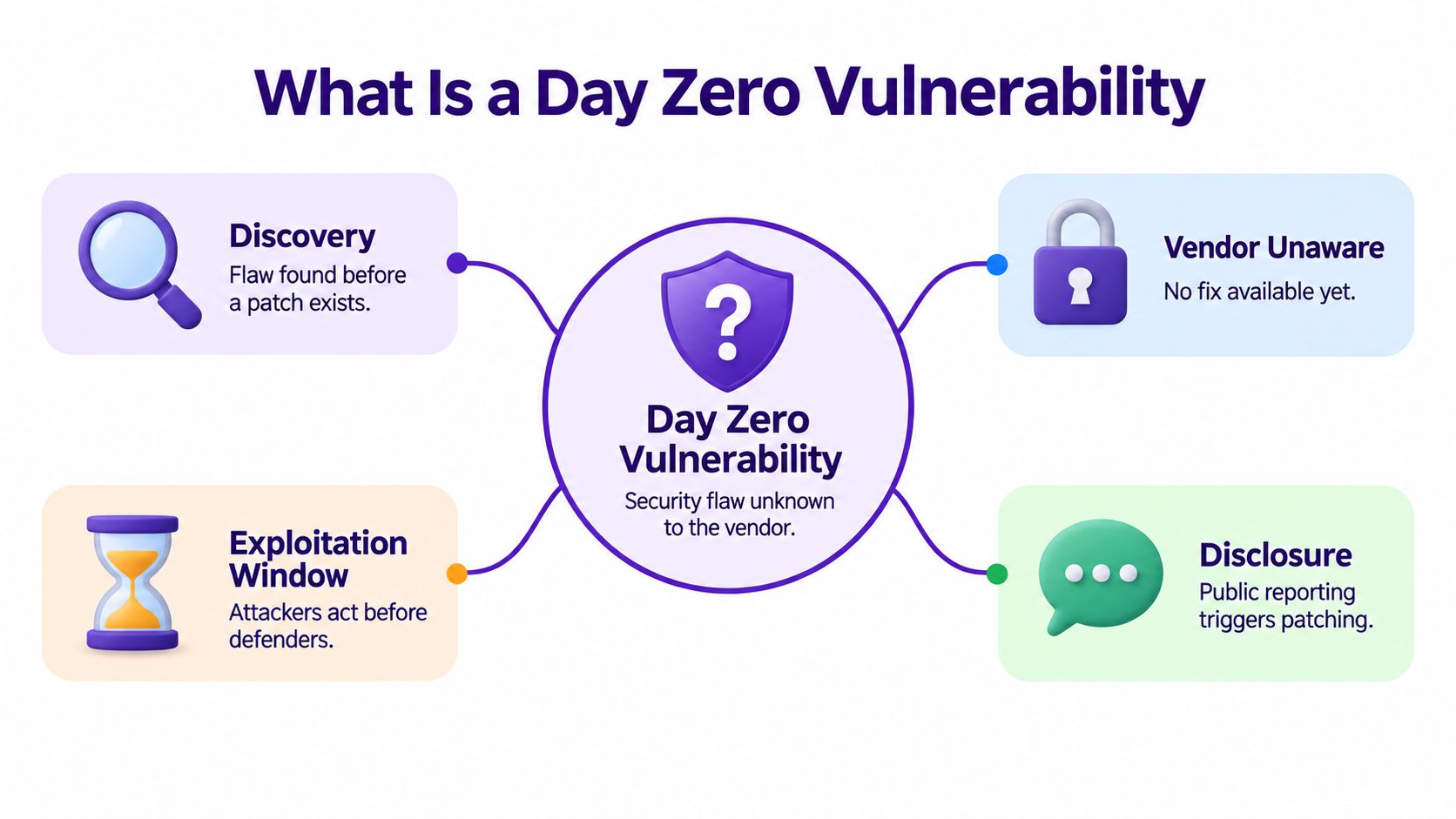
A day zero vulnerability is a security flaw that attackers can exploit before the vendor has made a security fix available. The name refers to the defender having had no practical time to respond. It doesn't necessarily mean that the flaw was discovered on the very first day, and it isn't a synonym for every new cyber attack.
Think of a commercial building with a concealed door in its foundations. The architects don't know the door exists, the security team has no lock specification for it, and an intruder finds it before anyone can secure it. Guards may still patrol the corridors, cameras may still operate and visitors may still show identification, but the hidden entrance creates a route around those controls.
The terms that cause confusion
The distinction between zero-day and n-day is important:
- Zero-day vulnerability: The flaw has no available security fix, and attackers may exploit it before the vendor and customers can apply a remedy.
- N-day vulnerability: The flaw is known and a fix is available, although an organisation may not have installed it yet.
- Zero-day exploit: The technique or code used to take advantage of the flaw. The vulnerability is the weakness, while the exploit is the method of using it.
A vendor may discover the issue internally, receive a responsible disclosure from a researcher or learn about active exploitation from incident reports. Until a usable fix exists, customers still face the central problem. They may know that a product is being targeted, but they can't just complete a normal update and close the weakness.
Security operations need to avoid false reassurance here. A fully patched organisation can still be exposed to a newly discovered issue in a product it relies on. Patch processes, asset inventories and vulnerability-management workflows remain necessary, but they operate alongside controls that look for unusual behaviour and signs of compromise.
Teams reviewing how assets, alerts and remediation work together may also find value in this practical overview of Freshservice and Automox integration. The toolset doesn't remove the zero-day window, but better coordination can reduce confusion when a vendor issues urgent guidance.
Practical rule: Treat “no patch available” as a reason to increase monitoring and prepare containment, not as a reason to wait.
How a Day Zero Attack Unfolds
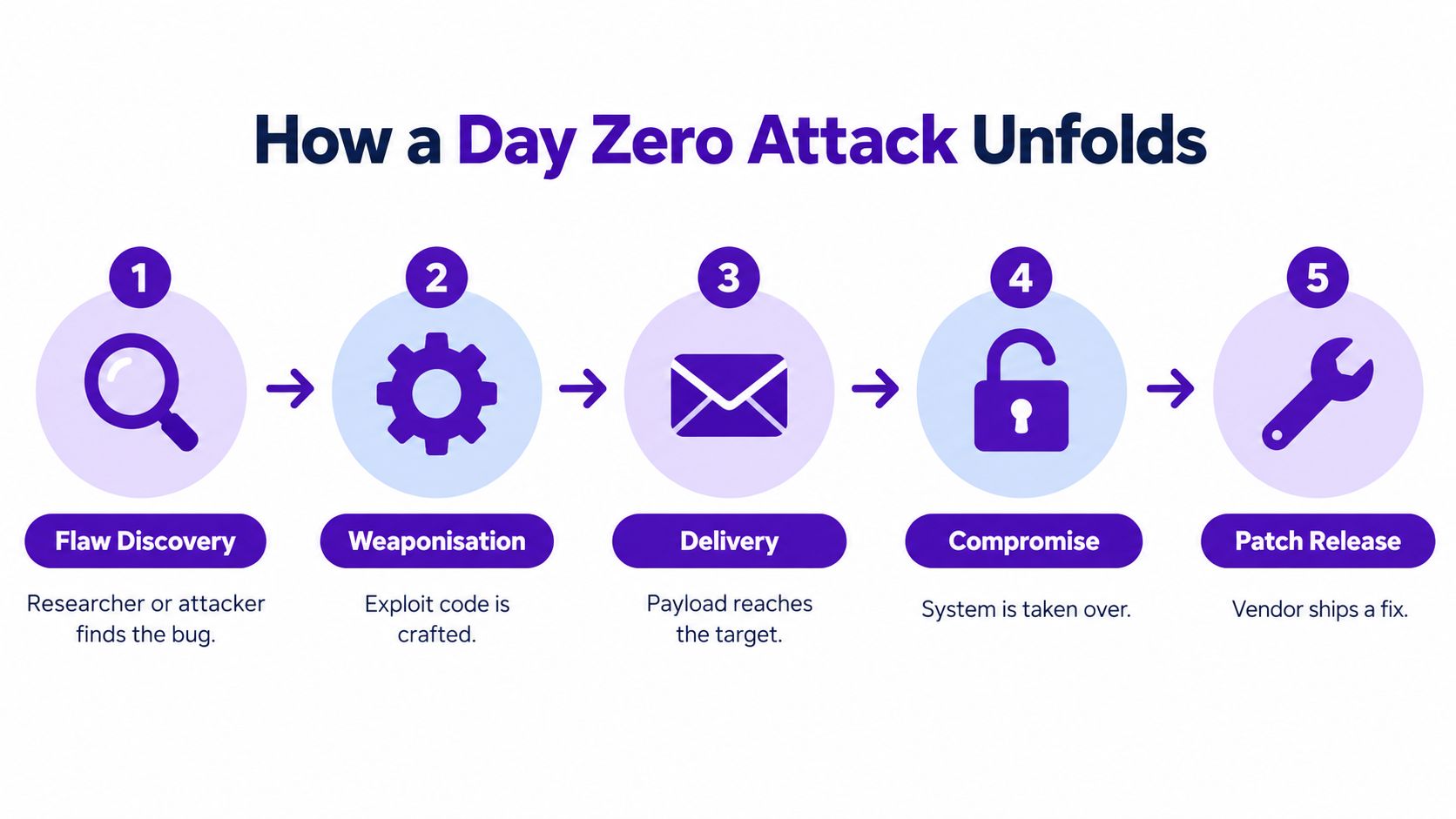
A day zero attack usually develops as a sequence of decisions rather than one mysterious technical event. The attacker identifies a weakness, works out how to use it, chooses a target and tries to gain something valuable before defenders understand the route.
From flaw to access
Discovery comes first. A criminal group, security researcher or vendor may find an unexpected way to make software behave outside its intended rules. The discovery can involve an internet-facing appliance, an enterprise application, a browser component or another widely deployed service.
Weaponisation follows when an attacker turns knowledge of the flaw into a repeatable method. The attacker may create code, modify an existing tool or combine the weakness with stolen credentials. The important point for a non-technical board is that the flaw becomes an operational route into a real organisation.
Delivery describes how the attacker reaches a target. They may send a crafted request to an exposed service, exploit a remote management interface or use a compromised account to reach an application from inside. The route varies, so a single defensive product can't be expected to identify every possible version of the attack.
Compromise occurs when the attacker achieves their objective, such as obtaining access, stealing data, creating persistence or moving towards a more valuable system. A zero-day doesn't automatically mean total takeover. Its impact depends on the affected asset, account privileges, network design and the organisation's ability to detect unusual activity.
Patch release is the point at which the vendor provides a fix or mitigation. Organisations then need to identify affected assets, test the change where necessary, deploy it and check whether attackers accessed the system before remediation. The exposure timeline doesn't end just because an advisory has been published.
Why the sequence matters
The UK NCSC says that once zero-days become public, reusable attack tooling can be rapidly commoditised. That matters because a technique first used by a capable specialist group may become accessible to a much wider group after disclosure. The defender's task therefore changes over time, from reducing exposure without a patch to applying the fix and investigating possible earlier access.
Attackers also don't need to exploit every customer. They can select organisations with valuable data, exposed services, weak identity controls or a high likelihood of paying for recovery. That makes asset criticality and customer context more useful than a simple list of software versions.
A zero-day creates a race between the attacker's ability to find a route in and the defender's ability to notice, contain and recover from unusual access.
Why Detection Is Difficult for Defenders
Many organisations assume that antivirus, firewalls and intrusion detection will automatically identify a day zero vulnerability. That assumption confuses blocking known techniques with recognising behaviour that has never been catalogued.
Signature-based security tools compare files, traffic or activity with patterns associated with known threats. A newly exploited flaw may not have a reliable signature. The payload may also be customised for one target, delivered through legitimate functionality or hidden inside normal-looking traffic.
A firewall can restrict connections and an endpoint tool can monitor a device, but neither control repairs an unknown defect in the application itself. Network segmentation can limit movement, while multifactor authentication can make stolen passwords less useful. These are valuable controls, but each addresses a different part of the problem.
The visibility problem
A day zero can produce weak or ambiguous signals:
- Normal-looking access: The attacker may use a valid account or an expected service rather than an obviously malicious executable.
- Limited evidence: A new exploit may not trigger a mature detection rule, especially if the affected product logs little detail.
- Distributed activity: Small actions across several systems can appear harmless when reviewed separately.
- Delayed confirmation: The vendor may need time to reproduce the issue and publish reliable indicators.
Behavioural monitoring can help by asking whether an account is accessing an unusual system, whether a service is making unexpected requests or whether an administrator is performing actions outside their normal pattern. It won't guarantee detection, but it gives defenders another way to identify consequences when they can't yet match the exploit itself.
A useful explanation of how IDS detects threats can help non-technical stakeholders understand the difference between monitoring traffic for suspicious signs and fixing the software weakness that created the risk.
External indicators matter too
Organisations should also watch for evidence that their information has already escaped. An employee may reuse a password that appears in a breach, an old credential may be sold to another criminal or a company email domain may appear in a leaked dataset. Those indicators don't prove that a specific zero-day caused the exposure, but they can reveal account risk that internal tools may not show.
The UK government's 2025/2026 Cyber Security Breaches Survey found that phishing affected 38% of businesses and 25% of charities, and that 69% of organisations experiencing a breach or attack judged phishing the most disruptive type. The survey results show why credential theft deserves attention alongside software flaws.
For UK service providers, the commercial lesson is practical. Customers don't need a complex explanation of exploit chains before they take action. They need to know which account or domain is exposed, what to change first and who will help them respond.
Bridging the Gap with Proactive Monitoring
Traditional patching and proactive monitoring solve different problems. Patching removes a known software weakness. Monitoring looks for signs that an account, domain or organisation may already be exposed, including during the period when a technical fix isn't available.
| Approach | Limitation | Proactive Solution |
|---|---|---|
| Reactive patching | It depends on a vendor releasing a fix and the customer deploying it. | Track exposure and suspicious indicators while mitigation is still developing. |
| Perimeter security | It may not recognise misuse of a valid account or a new exploit path. | Combine internal alerts with credential and breach visibility. |
| Periodic reviews | A review can miss information exposed between checks. | Use continuous dark web scanning for newly appearing data. |
| Complex security dashboards | Business users may struggle to understand which alert deserves attention. | Deliver clear alerts with an identifiable account, domain or exposed data type. |
A dark web monitoring tool can sit beside existing controls without pretending to replace them. It can scan for compromised email addresses, exposed passwords and breached domains, then alert the responsible team when relevant information appears. That gives a business an opportunity to reset credentials, review sign-in activity, contact an affected user and investigate related systems.
The approach is particularly relevant in the UK because credential-led attacks remain common. The 2025 Cyber Security Breaches Survey estimated approximately 7.87 million phishing cyber crimes and 595,000 hacking cyber crimes experienced by businesses during the previous 12 months. This published summary of the survey data puts the scale of credential theft into commercial terms.
A service opportunity for providers
An MSP, IT support company, telecom provider, VoIP provider, hosting company or web agency can package monitoring as a monthly subscription alongside services customers already understand. The offer is easier to explain when it focuses on a simple outcome: identify exposed business information and give the customer a clear next action.
The model also creates a useful customer conversation. A provider can review domains, discuss password hygiene and establish an escalation process without building its own security platform or hiring a specialist team. Guidance on identifying buying signals in prospects can help sales teams recognise when an existing customer is ready for a service that adds ongoing protection.
GoSafe Dark Web monitoring is one option for this layer. It continuously scans the dark web for leaked passwords, exposed email credentials and breached company data, then provides clear alerts and a simple dashboard. As a fully white-label dark web monitoring tool, it allows a partner to sell dark web monitoring under its own brand, keep ownership of the customer relationship and add a recurring revenue security service without developing the technology internally.
The commercial value isn't in adding another complicated dashboard. It's in giving customers a clear warning they can understand and act on.
Practical Steps to Reduce Exposure
A sensible response to a day zero vulnerability combines technical preparation with customer communication. Organisations can't guarantee that a vendor will identify every flaw before an attacker does, but they can make the exposure window easier to manage.
Maintain an accurate asset view. Record which cloud services, appliances, applications and remote-access tools are business-critical. Include systems managed by suppliers, because a provider's product can still create risk for your organisation.
Set an emergency response route. Decide who receives vendor advisories, who can approve temporary restrictions and who communicates with customers or staff. A response plan should cover isolation, credential resets, evidence preservation and recovery.
Prioritise identity exposure. Check whether business email addresses, passwords, phone numbers or domain-related data have appeared in breach records. A compromised credential can remain useful to an attacker even after the original software issue has been fixed.
Use layered detection. Keep endpoint protection, firewalls, secure configuration, access controls and intrusion monitoring in place. Add external breach visibility so the team can act on signs that information has entered criminal circulation.
Train people around the current risk. Phishing remains disruptive for UK organisations, so staff need practical guidance on suspicious messages, urgent payment requests, unexpected login prompts and password reuse. Training should explain what to report and how quickly to report it.
Keep remediation moving. Follow the patch management lifecycle explained when a fix becomes available, but don't treat patch deployment as the end of the investigation. Review logs, accounts and exposed data for evidence of earlier access.
For MSPs and resellers, fully white-label dark web monitoring can turn these steps into a straightforward customer service. The partner can brand the platform as its own, offer understandable monthly alerts and add monitoring beside IT support, hosting, connectivity, telecom systems or web services. That creates a practical dark web monitoring service for businesses, with low operational overhead and no requirement to build specialist security tools internally.
The right message to customers is calm and specific. A day zero vulnerability may affect the software they use, but their immediate priorities are knowing what is exposed, which accounts need attention and what evidence might indicate misuse.
GoSafe Dark Web monitoring continuously scans for compromised email addresses, exposed passwords and breached domains, then sends clear alerts that business users can understand. Visit GoSafe Dark Web monitoring to see how service providers can offer this protection under their own brand and build a recurring monitoring service.