A Monday morning password reset email lands in the inbox of an operations manager at a 35-person accountancy firm. She never asked for it, but someone else did, because her business email and password are already in circulation. That's the point most SME owners miss, the breach often starts without warning, long before malware, encryption, or visible disruption.
For service providers, that moment is the commercial opening. A client does not need a grand cyber strategy at that point, they need a fast check, a clear alert, and someone who knows what to do next. That is where cyber security for SMEs becomes a service line, not a scare story.
The Hidden Risk Sitting in Every SME Inbox
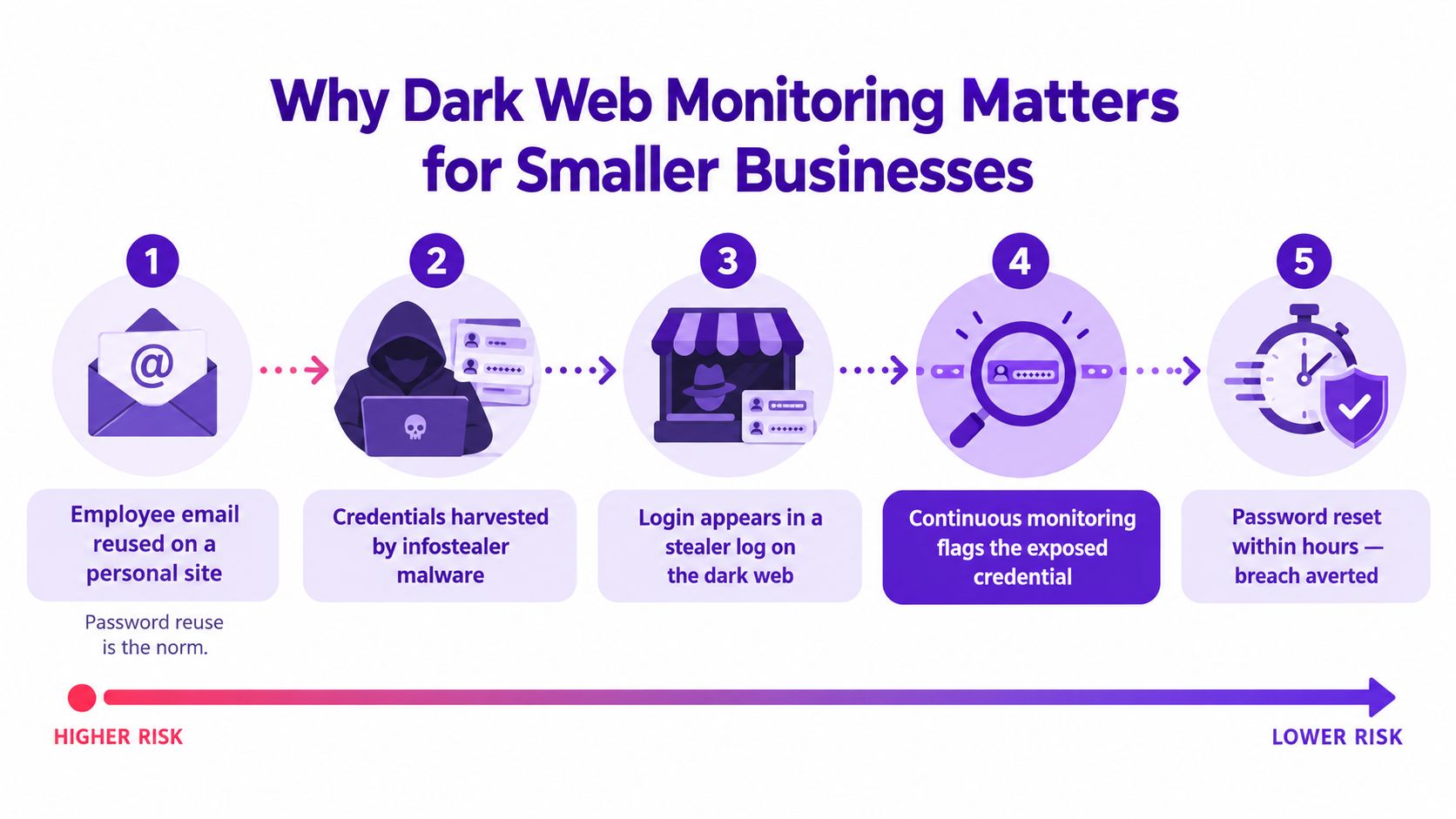
The core problem is not the dramatic breach headline, it's the ordinary inbox. An employee reuses a password on a personal site, a stealer log picks it up, and the same login later opens Microsoft 365, a finance app, or a CRM.
Practical rule: if an SME relies on one password across work and personal services, assume exposure already exists somewhere.
For a managed service provider, that's the exact moment to intervene with white label dark web monitoring and a simple response workflow. The client doesn't need a technical lecture, they need to know whether the credential is live, where it appeared, and whether the account must be reset now or can be watched.
The UK government's latest breach survey makes the threat hard to dismiss. 43% of businesses reported at least one breach or attack in the previous 12 months, which the survey estimates as about 612,000 UK businesses. The same survey found 3% suffered cyber-facilitated fraud, affecting around 40,000 businesses UK Government Cyber Security Breaches Survey 2025.
For a service provider, the lesson is blunt. Credential exposure is not a niche edge case, it's a persistent market need. A dark web monitoring service for businesses gives you a practical way to start the right conversation with clients who think they're too small to be noticed, but are already in the risk pool.
If you're helping clients spot suspicious login activity or credential reuse, GoSafe Dark Web monitoring phishing tips is a useful adjacent resource to keep in your toolkit.
The Current Threat Picture for UK SMEs
For UK SMEs, the immediate threat is ordinary and repeatable. Phishing, weak account practices, and rushed decisions at the inbox remain more relevant than a targeted attack against the network. The latest government analysis records phishing affecting 37% of businesses overall UK Government Cyber Security Sectoral Analysis 2026. Service providers should build their offer around that reality, not enterprise-grade theory that smaller clients cannot operate.
The earlier breach figure already shows that exposure is normal operating risk. The readiness gap is the commercial opportunity. Many SMEs still believe antivirus and a password policy provide enough protection, while attackers continue to target staff, email accounts, and cloud access.
The 2024 survey shows that this is a sustained operating problem rather than a temporary spike. It found 50% of businesses and 32% of charities had experienced a breach or attack. The rate rose to 70% for medium businesses and 74% for large businesses UK Government Cyber Security Breaches Survey 2024. Larger organisations are not immune. They are more likely to have accepted that exposure requires an ongoing process, budget, and response plan.
| Measure | Reported figure | Practical implication |
|---|---|---|
| Phishing exposure overall | 37% | Email remains a primary attack route |
| Phishing exposure for micro businesses | 35% | Small teams still receive targeted attacks |
| Phishing exposure for small businesses | 42% | Credential theft remains a live concern |
For a provider, the recommendation is straightforward: sell monitoring, training, and response together. Reseller dark web monitoring becomes more useful when an exposed credential triggers a defined action, such as a reset, access review, client notification, or incident escalation. Package those actions as a recurring, white-label service rather than a one-off warning. That gives SMEs practical coverage and gives the provider a service clients can understand, renew, and extend.
Essential Cyber Controls Every SME Needs
Cyber Essentials is the right backbone for SME security because it keeps the discussion anchored to controls that block real attacks, not boardroom abstractions. The UK Government's minimum recommended standard is built around firewalls, secure configuration, security update management, user access control, and malware protection Cyber Essentials overview. If a provider wants a clean, defensible baseline, that's the starting point.

What each control actually stops
Multi-factor authentication blocks a stolen password from becoming instant account access. It won't fix a compromised device, but it cuts off the easiest route into email and cloud apps.
Patching and updates close known holes before attackers find them. Delay here, and you're betting the business on luck.
Firewalls and secure network settings filter hostile traffic at the boundary. They're not a cure-all, but they do force attackers to work harder.
Secure backups give you a recovery route when ransomware or deletion hits. If the backups aren't isolated, they're just another target.
User access control limits the blast radius when one account goes bad. Least privilege is boring, which is exactly why it works.
Use expert cybersecurity tips from Cloudvara as a practical reference point when you're explaining basic defences to non-technical clients.
The commercial point is straightforward. SMEs don't need a hundred tools, they need the small set that removes the easiest attack paths first. That makes Cyber Essentials-grade delivery a sensible package for white label security services, especially when the offer is tied to monitoring and a response plan rather than sold as a pile of controls.
Why Dark Web Monitoring Matters for Smaller Businesses
Continuous monitoring matters because credential reuse is normal behaviour, not an exception. One reused business email can open an email account, a finance portal, or a CRM if the password has already been harvested and traded.
The signal needs context
A decent alert is not just “your email was found.” It tells you whether the credential came from a stealer log, a breached domain, or a broader data dump, and it gives a partner something concrete to do. Without that context, monitoring becomes noise.
The FSB's analysis shows why identity exposure should be taken seriously. Only 24% of smaller businesses have a strict password policy, 4% have a written incident-response plan, and just 2% have a recognised security standard such as Cyber Essentials or ISO 27001 Hiscox cyber readiness. That weak baseline means a leaked credential is rarely just one password, it's often a sign of wider reuse across systems.
For SMEs, the risk is immediate. A compromised inbox can be used for invoice fraud, mailbox rule abuse, and follow-on identity attacks. That's why white label dark web monitoring works best when the alert is tied to a clear action path, who resets the password, who checks for inbox rules, who confirms whether the domain is affected, and who closes the loop.
GoSafe fits this operational need as a Dark Web Monitoring tool. It continuously scans for compromised email addresses, exposed passwords, and breached domains, then sends clear alerts a partner can brand and sell under their own name. Used properly, that turns recurring revenue security services into something easy to explain and easy to deliver.
Staff Training and the Human Layer of Defence
Training only works when it's short, repeated, and linked to live incidents. Long annual awareness sessions don't change much on their own, because staff forget the detail and carry on clicking.
Build the habit, not the presentation
Monthly micro-learning keeps the message fresh. Quarterly phishing simulations test whether people spot the bait, and a simple reporting route makes sure suspicious emails reach the right person fast. Leadership needs short briefings too, because executives set the tone when incidents happen.
A report from a user should be treated like a sensor, not a nuisance.
That matters for service providers because the same pipeline should handle both human reports and dark web alerts. If a user flags a suspicious email in the morning and a credential exposure appears later that day, the client should not be juggling separate processes. The alert should feed the same response workflow.
| Component | Frequency | Measured Outcome |
|---|---|---|
| Micro-learning modules | Monthly | Better recall of common attack signs |
| Phishing simulations | Quarterly | Fewer risky clicks over time |
| Reporting route for staff | Always on | Faster triage of suspicious messages |
| Executive briefing | Quarterly | Clearer ownership when something goes wrong |
This is also where dark web monitoring for MSPs becomes commercially useful. Training teaches staff what to notice. Monitoring catches what they don't. Together, they create a behavioural layer that complements the technical controls already in place, without pretending employees will become perfect.
A Practical Incident Response Plan for SMEs
A compromised mailbox can disrupt an SME before anyone agrees who should take charge. The response plan must settle that question in advance, with clear actions, owners, and escalation points.
Keep the sequence tight
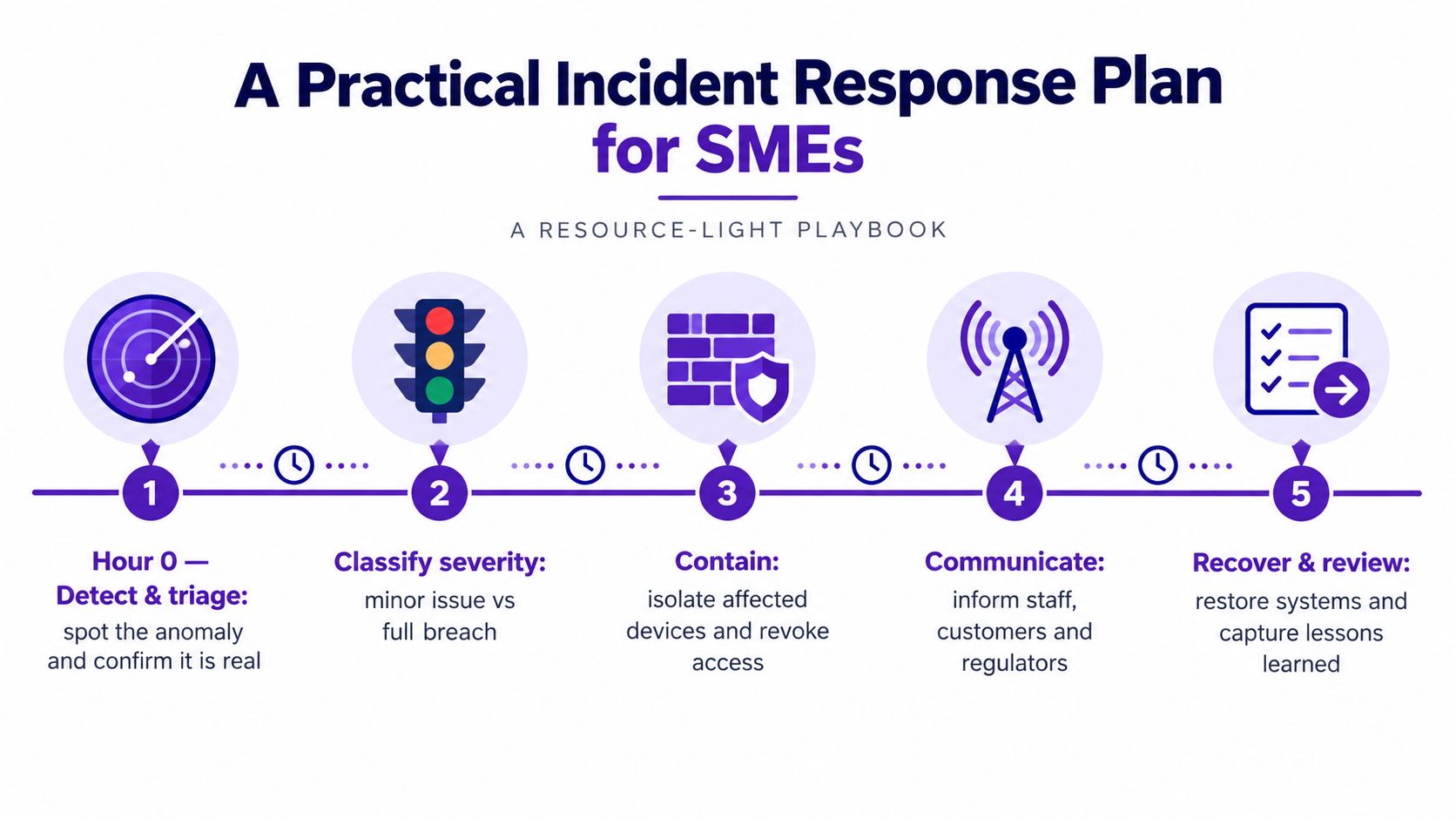
Start with detection and triage. Confirm that the alert is genuine, grade its severity, and establish whether it affects one account or indicates wider compromise.
Contain the incident next. Reset credentials, lock the mailbox where necessary, isolate affected devices, and revoke access tokens when appropriate. Then remove any attacker access that remains, confirm recovery, and check other accounts, devices, and systems for the same exposure.
The F1Group incident response guide reinforces a practical rule: a response plan only works when people can follow it under pressure. Keep the steps short enough for a busy SME and specific enough to prevent guesswork.
After-hours ownership is the pressure point for smaller teams. A service provider can supply a named escalation contact, an evidence-preservation routine, and a defined route to specialist help without building a full SOC. If you already deliver an incident response playbook for MSPs, a dark web alert becomes one input into that decision tree, rather than a separate service ticket.
Don't wait to “see what happens next”. If credentials are confirmed exposed, assume the account will be tested quickly.
The plan should also define who communicates with the client, who records actions, and who checks that access has been restored safely. Providers can standardise those steps across accounts and deliver them as part of a recurring, white-label security service.
Speed and consistency matter more than a lengthy manual. Reset access, preserve evidence, communicate clearly, and escalate before uncertainty gives an attacker more time.
Turning Cyber Security into a Recurring Revenue Service
The commercial case is straightforward. Monitoring is low-touch, training can run automatically, and response retainers carry clear value when an incident occurs. Together, they give service providers a practical route to recurring revenue security services without building a security product from scratch.
Package the outcome, not the tool list
Build the offer around three connected layers. Start with Cyber Essentials-grade baseline controls. Add continuous dark web monitoring for compromised email addresses, exposed passwords, and breached domains. Finish with staff awareness training and a documented response retainer.
The UK market supports this bundle. The government's 2025 survey illustrates the level of breach exposure businesses face UK Government Cyber Security Breaches Survey 2025. That makes active monitoring easier to justify than another passive control, particularly when insurers, customers, and supply-chain partners expect evidence that risks are being watched.
Sell the service through a 12-month agreement with quarterly business reviews. Each review gives you a reason to demonstrate actions taken, identify new exposures, and adjust the customer's priorities. It also protects margin by turning separate tasks into a repeatable delivery process.
For providers building white-label security solutions, the product is the managed outcome, not a list of tools. Put your brand around the onboarding, alerts, reporting, training, and escalation process. Clients should know who owns the result and what happens when an alert requires action.
The white-label security solutions partner model lets you sell under your own name without building the entire stack internally. GoSafe provides a Dark Web Monitoring tool with continuous scanning, clear alerts, and a white-label setup suited to partners that want to keep operational overhead under control.
Bringing It All Together
SME security should be built on five actions. Keep Cyber Essentials-grade controls in place, monitor for exposed credentials, train staff continuously, maintain a written response plan, and sell the whole package as one service rather than five disconnected tasks.
The market is already telling you what clients need. Compliance pressure, insurance expectations, and supplier scrutiny have made security table stakes, not a nice-to-have. SMEs don't need enterprise theatre, they need consistent execution delivered by a partner who owns the outcome.
For a service provider, the next move is practical. Review the reseller programme, map the bundle against your existing clients, and set the pricing, onboarding flow, and quarterly review rhythm now. That's where cyber security for SMEs stops being a cost line and starts becoming a service line you can run.
GoSafe Dark Web monitoring helps service providers detect exposed credentials, breached domains, and leaked passwords, then deliver clear alerts their customers can act on quickly. If you want to sell that capability under your own brand and turn it into a recurring service, visit GoSafe Dark Web monitoring and see how it fits your offer.