
A telecom provider can have reliable connectivity, well-managed hosted voice and responsive support, yet still overlook one of the easiest routes into a customer account: a compromised email address or password. The problem often sits outside the network perimeter, in leaked credentials linked to employees, contractors, suppliers or customer administrators.
That creates a practical opportunity for telecom security services. A white-label dark web monitoring offer can sit alongside VoIP, hosting, connectivity and IT support without requiring you to build a security operation from scratch. The service gives customers understandable alerts, while your business retains the relationship, the recurring revenue and the opportunity to help them act before exposed credentials are reused.
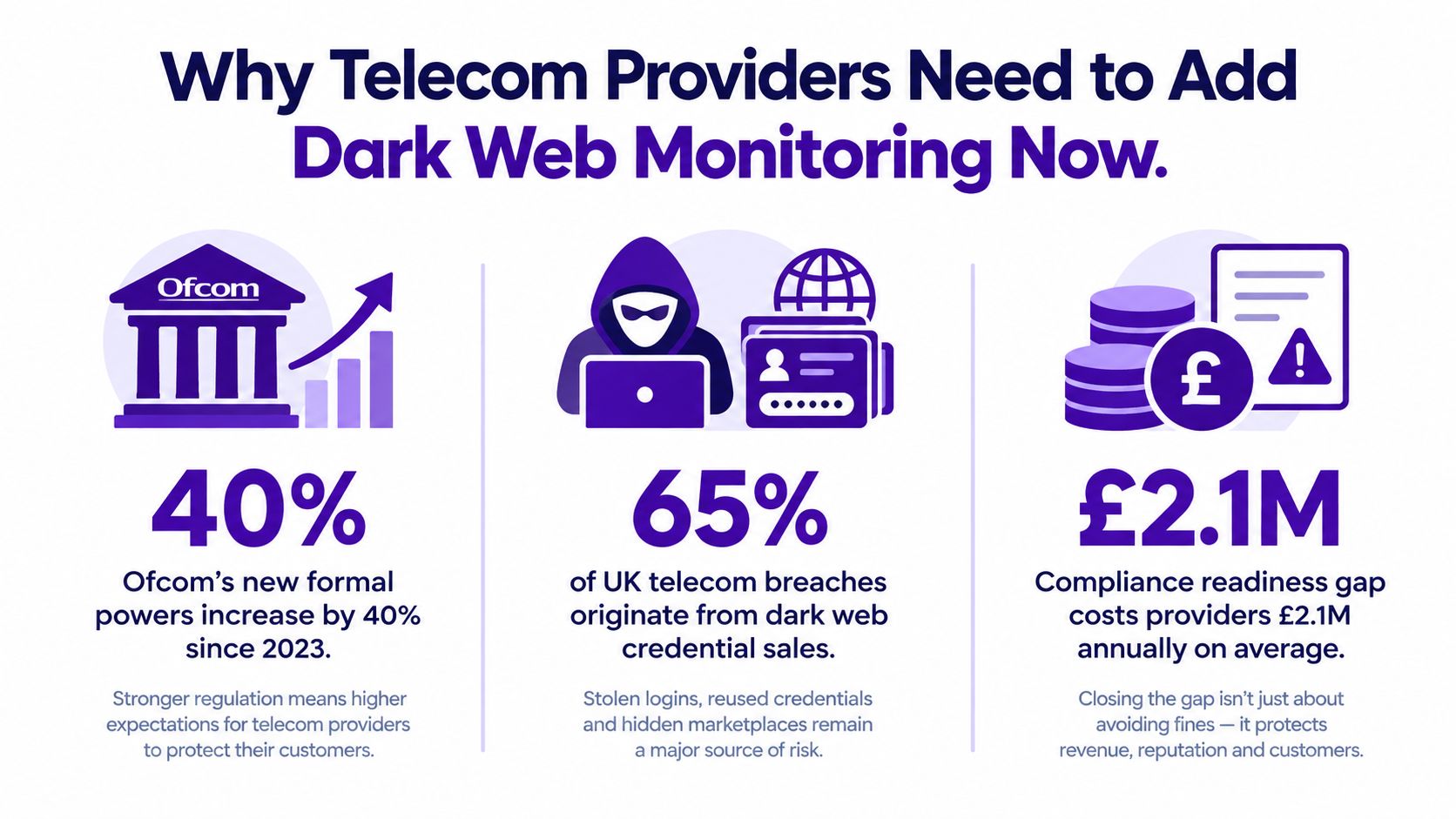
Why Telecom Providers Need to Add Dark Web Monitoring Now
UK telecom security has moved from a voluntary best practice to a formal regulatory responsibility. After the Telecommunications (Security) Act 2021 came into force, Ofcom gained powers to oversee network security, require compliance and fine providers up to 10% of relevant turnover or £100,000 per day for continuing failures. Ofcom's overview of its telecoms security powers explains how the regulator can also commission audits, technical tests and penetration testing.
That changes the buying conversation. Providers still need strong network controls, resilience planning, access management and incident response, but they also need evidence that those controls are being managed. Monitoring compromised credentials and exposed company data doesn't replace those safeguards. It adds visibility to an area that traditional network monitoring won't cover.
Ofcom's latest report, covering 1 October 2024 to 30 September 2025, recorded 625 incident reports, comprising 9 cyber security incidents and 616 resilience incidents, compared with 1,526 total incidents in the previous reporting period. The government's published Ofcom security report says the sharp fall was largely associated with the transition from copper PSTN to fibre-enabled VoIP.
Infrastructure change doesn't remove identity risk
The incident figures are useful, but they need careful interpretation. Ofcom cautioned that the low cyber incident count may not fully reflect the sector's exposure. A provider that sees fewer reported cyber events shouldn't assume that credential theft, supplier abuse or account compromise has disappeared.
For telecom and VoIP businesses, identity matters because compromised accounts can affect customer portals, hosted voice administration, routing changes, support systems and privileged supplier access. Dark web monitoring helps identify exposed email addresses, passwords and breached domains that may become useful to attackers. It gives the provider a reason to contact the customer before an incident becomes a service disruption or a wider investigation.
The broader UK business market reinforces the need for a straightforward offer. The UK Cyber Security Breaches Survey 2025/2026 recorded breaches or attacks affecting 43% of businesses and 28% of charities in the previous 12 months. The same survey found that the rate was 65% for medium-sized businesses, 46% for small and micro firms, and 69% for large businesses.
A service opportunity with a manageable operating model
Most telecom providers don't need another complex platform that creates a new queue for a security team. They need a service that can be explained in a few sentences, activated through an existing customer process and supported with clear notifications.
That makes white label dark web monitoring commercially attractive. You can sell it under your own brand, attach it to an existing contract and present the benefit in business terms: find exposed credentials, notify the customer and guide the next action. For providers building recurring revenue security services, this is a more approachable starting point than attempting to deliver a full managed detection and response operation.
A useful general resource for organisations reviewing their wider protection model is Networking2000's guidance on how to protect your business from cyber threats. For a telecom reseller, the commercial question is simpler: which security layer can you deliver consistently, with limited operational friction, while making your existing services more valuable?
How to Select and Integrate a White-Label Platform
The right platform should pass a simple test. A member of your sales team should be able to explain it, a customer should understand an alert, and your support team should know what to do next without becoming a specialist security function.
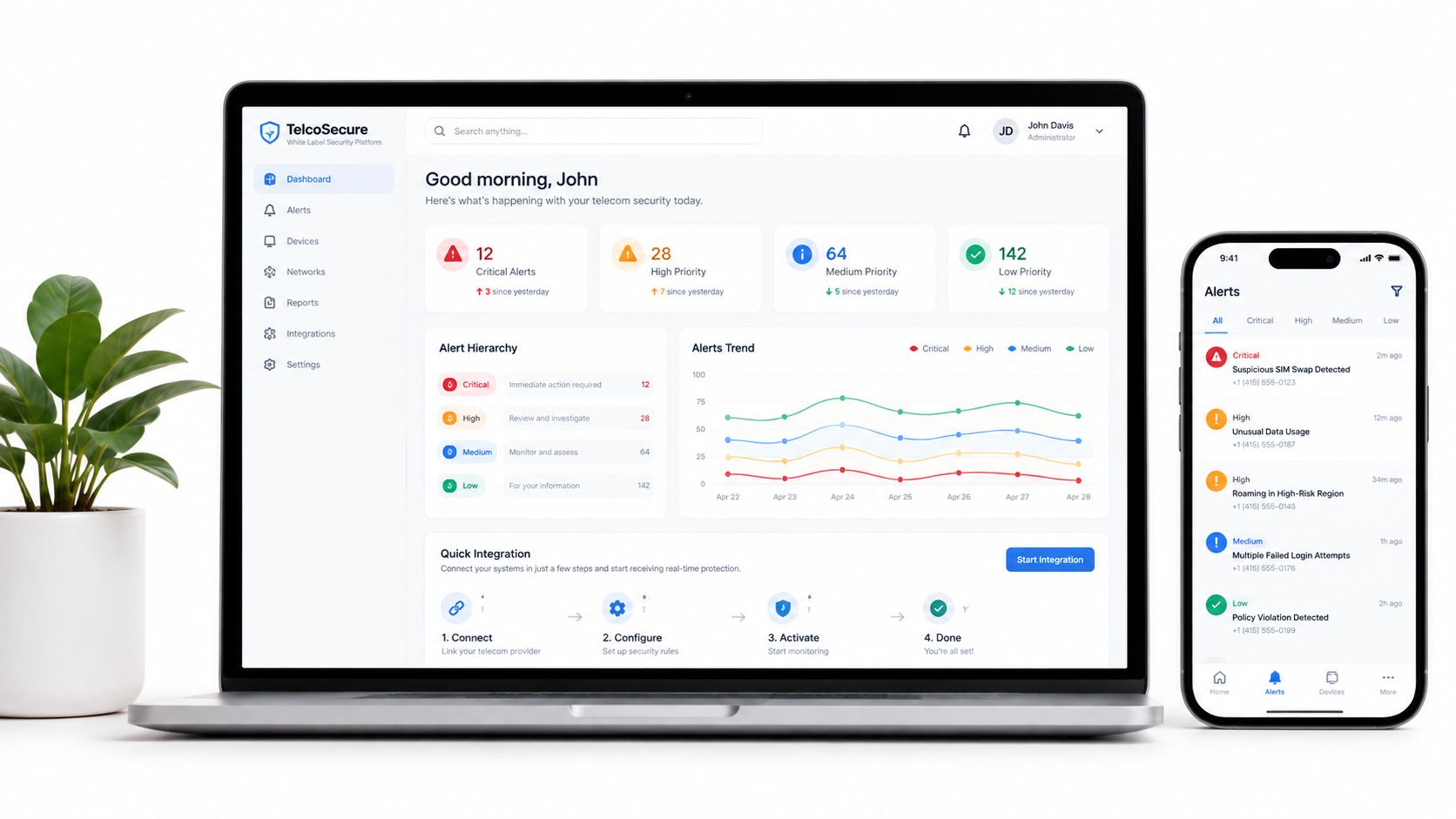
Start by assessing the customer experience rather than the vendor's feature list. A dark web monitoring service for businesses should show the monitored email addresses, domains and relevant breach information in a way that supports action. If the dashboard presents a mass of technical indicators without a clear priority, customers will either ignore the alerts or send every notification to your helpdesk as an emergency.
Evaluate the service against daily reseller work
Use a short assessment process before signing up:
- White-label control: Confirm that the platform can carry your company name, colours and customer-facing language. Your customer should experience it as part of your portfolio, not as an unrelated third-party product.
- Monitoring scope: Check that it supports continuous scanning for compromised email addresses, exposed passwords and breached domains. Domain monitoring is particularly useful when you manage a customer's email, hosting or connectivity relationship.
- Alert clarity: Ask to see a real alert and its recommended response. Business users need to know what was exposed, which account or domain is involved and what action should follow.
- Account administration: Review how you create customers, assign monitored assets, handle permissions and remove access when a contract ends.
- Reporting: Look for breach history and plain-language reports that your account managers can use during service reviews.
- Support model: Establish who answers product questions, who handles technical issues and what information you can pass to a customer without exposing sensitive breach data.
A platform that meets those requirements is more valuable than one that merely has a longer feature list. Your team isn't selling threat research. You're selling visibility and a practical response path.
Set up the workflow before adding customers
Decide who owns each stage. Sales should capture the correct customer domain and authorised contacts. Your onboarding team should confirm the scope of monitoring and explain how alerts will be delivered. Support should have a short response script covering password resets, MFA checks, account review and escalation.
Don't promise that monitoring prevents every attack. It identifies evidence that credentials or data have appeared in exposed sources. The customer still needs to reset passwords, review access, check forwarding rules, verify supplier accounts and investigate suspicious activity.
GoSafe Dark Web monitoring is one example of a tool that continuously scans for compromised email addresses, exposed passwords and breached company domains, then presents alerts, risk scores and breach history through a user-facing dashboard. Its fully white-label model allows a partner to brand the platform as its own service and deliver it without building security tools internally or hiring a dedicated security team.
Practical rule: If your support desk can't explain the first customer action in plain English, the service isn't ready for launch.
Integration doesn't need to mean a large technical project. Add the monitoring step to your existing CRM or provisioning checklist, create a standard customer welcome message and record the authorised contact for security alerts. If your business already delivers hosted voice, connectivity or IT support, the offer should fit into the same account review and renewal rhythm.
Partners also need to understand the wider commercial category. The recurring revenue with threat intelligence opportunity is strongest when the service is connected to a customer problem your team already discusses, rather than presented as an isolated security product.
Pricing and Packaging Strategies for Recurring Revenue
A reseller can sell dark web monitoring in several ways, but the choice should reflect how customers already buy from you. A standalone subscription gives the offer a clear price and makes it easy to add to an existing contract. A bundle creates a stronger value story and can make the service feel like a natural part of keeping the customer's communications environment dependable.
Compare the main commercial models
| Package Type | Ideal For | Revenue Potential |
|---|---|---|
| Standalone monitoring subscription | Customers that want a clearly separated security service | Creates a distinct monthly recurring line and a simple entry point |
| Per-user or per-account package | Organisations with a defined group of staff, administrators or users to monitor | Expands as the customer adds monitored people or accounts |
| Domain-based package | Businesses that want coverage linked to one or more company domains | Works well with hosting, email and managed IT relationships |
| Telecom bundle | Hosted voice, VoIP or connectivity customers | Increases the value of the core service and creates a stronger renewal conversation |
| Managed service package | Customers that want your team to interpret alerts and coordinate the response | Supports a higher-touch recurring offer, provided the scope is clearly controlled |
The table shows the trade-off. A standalone plan is easy to understand and quote, but the customer may remove it when budgets tighten. A bundle can improve perceived value, although your sales team must explain exactly what is included so the security element doesn't become invisible.
Sell the outcome, not the mechanics
Customers rarely need a lesson in how dark web scanning works. They need to know what happens if an employee's email address or password appears in a breach.
A good sales explanation is direct: “We'll monitor your approved company details for exposed credentials and breached data. If we find a match, you'll receive a clear alert showing what needs attention.” That gives the buyer a visible benefit without implying that the service is a complete security programme.
Use the customer's existing service relationship to make the offer relevant:
- Hosted voice: Position monitoring as an additional check for administrator and user identities connected to the voice environment.
- Connectivity: Present it as a security add-on that complements network resilience and service management.
- IT support: Use alerts to start a conversation about password resets, MFA and access reviews.
- Hosting and web services: Link domain monitoring to the customer's online identity and business email.
- Cyber consultancy: Include it as an ongoing visibility layer between formal assessments.
Phishing gives sales teams an accessible entry point. The ICO says 79% of UK businesses identified a phishing attack in the last 12 months, up from 72% in 2017, and reports that 56% of businesses and 62% of charities that experienced breaches or attacks considered phishing the most disruptive type. The ICO's review of phishing incidents provides a credible basis for connecting awareness training, credential exposure and monitoring.
Build a price that your team can support
Avoid a complicated matrix at launch. Choose a small number of packages that sales staff can quote without seeking approval. Define the number of monitored assets, alert handling, reporting and any account review included in each tier.
If you bundle the service, show its value without hiding its scope. The customer should understand whether you monitor company domains, selected email addresses, phone numbers or other approved identifiers. They should also know whether your team provides guidance only or carries out remediation such as password resets and MFA re-enrolment.
A useful partnership model should give you room to protect margin, support customers properly and adjust the service as the account grows. Review the GoSafe Dark Web monitoring partnership for a model built around resellers adding monitoring to an existing portfolio.
Defining SLAs and Delivery Models for Clients
Dark web monitoring usually runs in the background. That doesn't mean the service can operate without a delivery plan. Your SLA should tell the customer what you monitor, how alerts are sent, what your team will do and what remains the customer's responsibility.
Start with scope. List the domains, email addresses, phone numbers or other identifiers that the customer has authorised you to monitor. State how additions and removals are requested, who can approve them and how quickly your team expects to process a change. This prevents disputes when a customer assumes every employee, supplier or subsidiary is covered automatically.
Set realistic commitments
Your SLA should cover four practical areas:
- Alert delivery: Explain whether alerts arrive by email, dashboard notification or both. State what happens if the named contact is unavailable.
- Initial acknowledgement: Define when your team confirms receipt of a customer query. Don't promise immediate incident investigation unless you genuinely provide that service.
- Reporting: Set a regular review rhythm, such as a service report or account review, without claiming that a clean report means the customer has no security risk.
- Escalation: Identify the conditions that require a support ticket, account manager involvement or referral to an incident response specialist.
The service should distinguish between detection and remediation. Monitoring can identify exposed information and provide useful context. The customer still needs to validate the account, reset credentials, review access and investigate suspicious activity.
Customer promise: “We'll tell you when monitored information appears in a breach source and explain the next sensible action. We won't describe an alert as proof that your network has been compromised.”
Choose the delivery model that fits your team
A self-service model keeps operational overhead low. You provide access, onboarding instructions and automated alerts, while the customer manages the response. This suits technically capable customers and providers that want a simple recurring subscription.
A guided model adds value through regular reviews. Your account manager or service desk explains alerts, checks whether remediation has happened and records outstanding actions. It works well for MSPs and IT support companies that already run scheduled service reviews.
A managed response model has the greatest commercial potential, but also the greatest responsibility. If you promise to coordinate password changes, MFA re-enrolment, access reviews or incident escalation, define the boundaries carefully. You may need additional processes, trained staff and an arrangement with a specialist incident response provider.
Protect trust during onboarding
Collect only the information needed for the agreed monitoring scope. Explain who can see alerts, how customer contacts are verified and how sensitive breach details are handled. Don't include full exposed passwords in customer communications. A clear summary and a safe route to the dashboard are more appropriate.
Your first customer message should answer three questions: what is being monitored, what an alert means and what the customer should do when one arrives. Follow that with a short support guide for common actions, including password changes, MFA checks and account access reviews.
The reporting style matters as much as the detection. Business users want a short explanation, a priority and a next step. A complex dashboard can remain available for administrators, but your regular service report should focus on decisions rather than technical volume.
Going to Market and Launching Your New Security Offer
Launch the offer through customers who already trust your team. Prioritise businesses with several users, visible phishing concerns, multiple domains, outsourced IT administration or a strong dependence on hosted voice and customer portals. You don't need to frighten buyers. Explain that the service adds an early warning layer to the systems you already support.
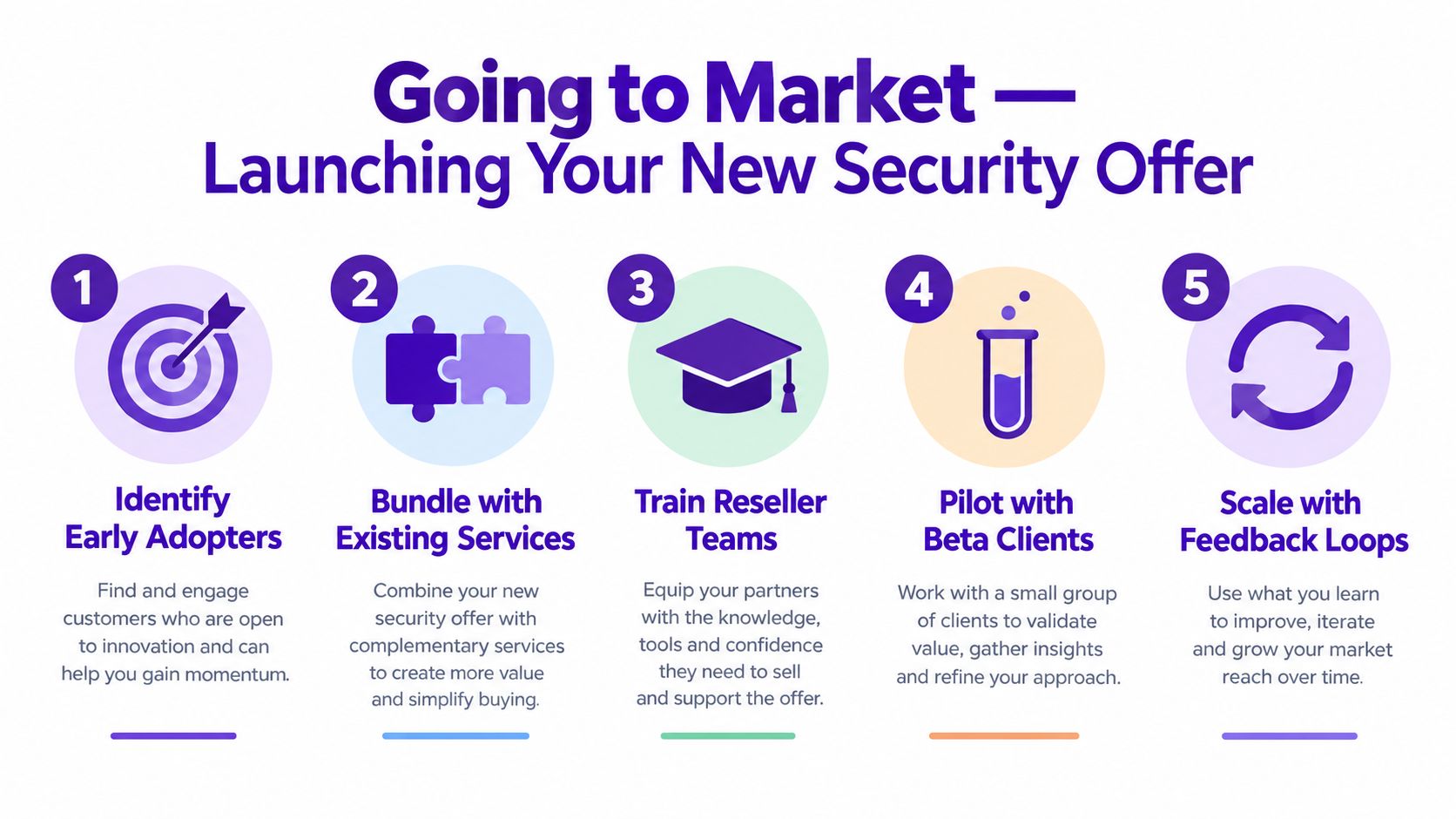
Use a straightforward launch sequence:
- Identify early adopters: Select existing customers with a clear identity, email or domain risk conversation.
- Bundle with existing services: Attach the offer to hosted voice, connectivity, IT support, hosting or web services.
- Train reseller teams: Give sales and support one explanation, one onboarding process and one alert response guide.
- Pilot with beta clients: Test activation, notifications, reporting and escalation with a small customer group.
- Scale with feedback loops: Review customer questions, refine the package and train account managers before wider release.
A short GoSafe Dark Web monitoring security guide can support internal enablement while your team develops its own customer materials. During the first month, check that every monitored asset has approval, alerts reach the right contact, support staff can explain the next action and account managers are recording customer feedback.
The commercial path is clear: choose a fully white-label platform, attach it to services you already sell and make the response process part of your customer care. That turns reseller dark web monitoring into a practical addition rather than a new department.
GoSafe Dark Web monitoring gives service providers continuous scanning for compromised email addresses, exposed passwords and breached domains, with clear alerts and a simple dashboard for customer conversations. Visit GoSafe Dark Web monitoring to explore how you can offer it under your own brand and build a manageable recurring security service.