A client calls your service desk after receiving a dark web alert. The notification lists compromised credentials linked to the business, but it doesn't explain whether the exposure is historical, active, or connected to an administrator. The client asks the only question that matters to them: “Are we about to be breached?”
Raw breach data rarely answers that question. It can create panic when an old, already-reset password appears in a recycled dump, or indifference when a newly exposed privileged account is buried in a long list. For MSPs, the commercial problem is just as real as the technical one. A dark web monitoring service that produces unfiltered findings can generate support tickets, consume analyst time, and weaken confidence in the service.
AI risk scoring provides the translation layer. It evaluates the available context around an exposed email address, password, domain, or account, then presents a prioritised risk level that a technician and a business user can understand. Used properly, it turns dark web intelligence into an operational service that can be monitored, explained, and sold on a monthly basis.
Why AI Risk Scoring Matters for Dark Web Monitoring
The difference between an alert and an actionable alert is context. A list of compromised email addresses may contain a current finance administrator, an old employee mailbox, a generic contact address, and credentials from a breach where every password has already been changed. Treating each finding identically forces the MSP to investigate everything with the same urgency.
That approach doesn't scale. It also makes client conversations difficult because the technician has to interpret raw data manually before giving advice. The customer sees a threat feed, not a clear decision.
From noise to a service conversation
A useful scoring model considers several signals together:
- Recency: A newly appearing credential deserves more attention than an old record with a documented password reset.
- Credential exposure: Plaintext passwords, password hashes, usernames, and partial records represent different forms of exposure.
- Account importance: A standard user account and a privileged administrator shouldn't receive the same treatment.
- Organisational relevance: A finding connected to a monitored business domain matters more than an unrelated address in a broad data set.
- Threat context: The source, activity around the record, and links to known criminal activity can change the recommended response.
The score isn't a guarantee that an attack will happen. It's a prioritisation aid that helps a service provider decide what to investigate first, what to communicate, and which control should follow.
Practical rule: A score should reduce the amount of interpretation required from the technician, not remove human judgement from the response.
This distinction matters particularly in the UK. The Ministry of Justice has used the Offender Assessment System since 2001 to generate AI-assisted risk scores across prison and probation services in England and Wales. Figures obtained in January 2025 showed more than 7 million risk-score records and 9,420 assessments completed in one week, equivalent to over 1,300 assessments per day. Statewatch's reporting on the Ministry of Justice system shows why scale, transparency, and explainability matter when scores influence sensitive decisions.
For an MSP, the lesson is commercial as well as technical. Dark web monitoring for MSPs becomes easier to package when alerts arrive with an understandable reason for their priority. The partner can sell early warning, visibility, and a defined response process instead of selling access to an alarming database.
How AI Risk Scores Are Generated
A dark web monitoring platform starts with messy, unstructured material. It may collect references from paste sites, criminal forums, Telegram channels, ransomware leak sites, marketplaces, and credential dumps. AI extracts useful indicators, links related records, and estimates which findings deserve attention. For an MSP, that turns a noisy stream of breach data into alerts that can be reviewed with a customer and managed through a repeatable service.
The scoring process in practice
A practical process usually includes these steps:
- Collect the finding. The system identifies an email address, domain, password indicator, phone number, or other exposed business data.
- Extract structure. Natural language processing and pattern recognition separate the asset, source, breach reference, record type, and supporting context.
- Assess freshness. The system considers when the data was published or observed. Recent exposure generally deserves closer review than an old record.
- Assess validity and sensitivity. A plaintext password, a hashed password, and an email address alone create different response requirements.
- Match the organisation. The finding is compared with monitored domains, known users, account roles, and other information supplied by the customer or service provider.
- Produce a prioritised result. The platform combines these signals into a risk score and a recommended level of attention.
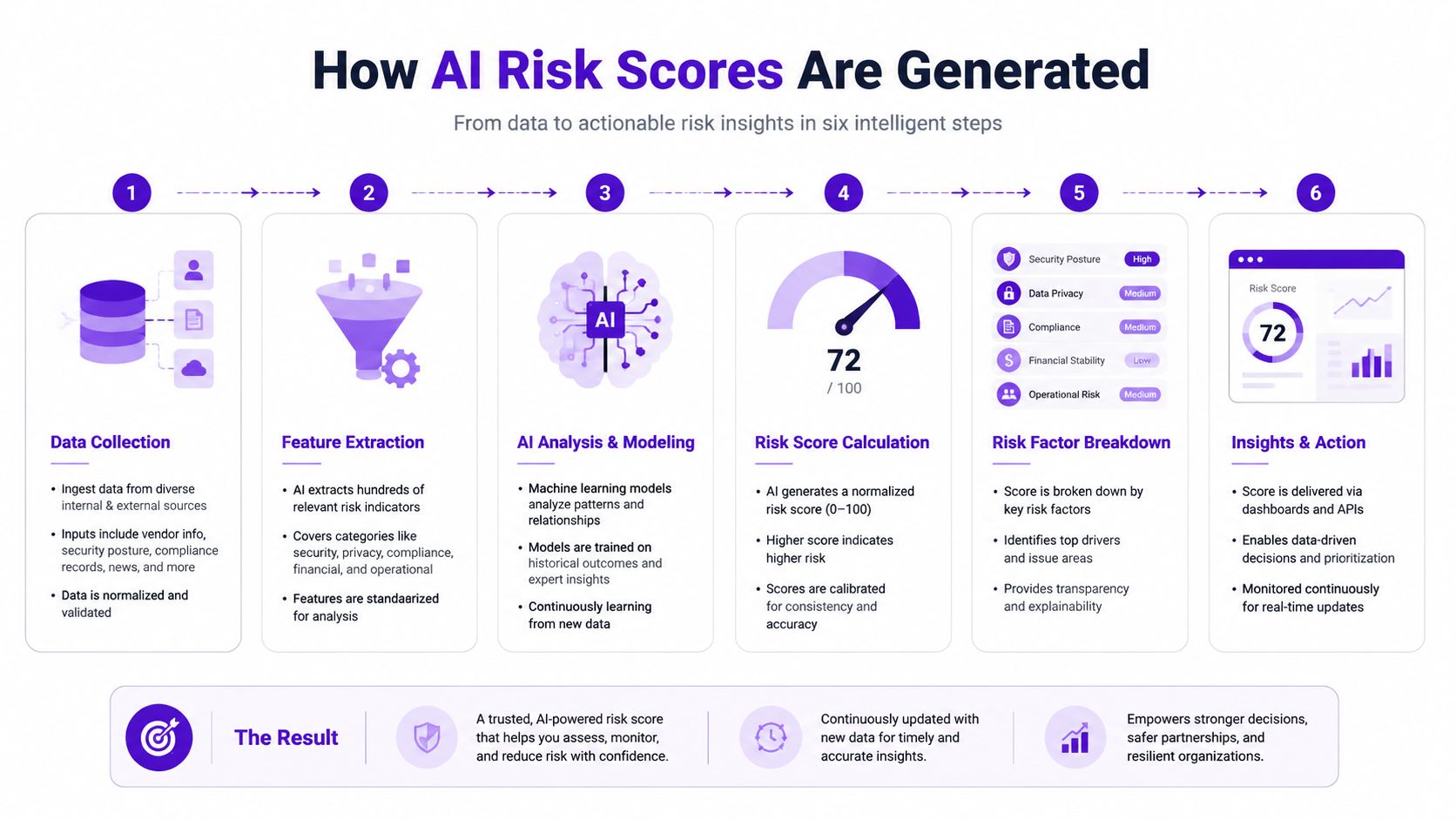
The process shares a useful principle with credit scoring. A lender evaluates payment history, account age, and utilisation together to produce an interpretable result. AI risk scoring applies that approach to exposure data, combining freshness, confidence, breadth, account importance, and business context.
The model's output still depends on its inputs and design. Data quality, weighting logic, the organisation's asset information, and response thresholds all affect the result. The score should be explainable in ordinary language, for instance, “newly observed password linked to a privileged account”, so technicians and business users can understand the reason for its priority.
Service providers should ask how the model is maintained. Static rules may become less useful as attackers change publication channels, dump formats, and credential reuse patterns. A platform that updates detection and scoring logic as new patterns emerge gives an MSP a more dependable basis for client-ready alerts and recurring review. GoSafe's approach is covered in this guide to understanding dark web exposure scores.
Applying AI Risk Scoring in Dark Web Monitoring
A reseller may receive several breach records for one customer in a single day. GoSafe's Dark Web monitoring tool presents cyber risk scores alongside breach history, dark web threats, and real-time alerts. This gives the reseller a client-ready way to discuss urgency, affected identities, and the next action without asking a dedicated security team to interpret every record.
Consider two different scenarios. A recently exposed password associated with a chief executive's account appears on a ransomware group's leak site. For illustration, a service provider might assign that finding a 95/100 risk score because the account is highly privileged, the exposure is fresh, and the source indicates active threat actor interest. A five-year-old employee email in a recycled credential dump might receive 30/100 where the password has already been reset and the source has low confidence.
These examples are not universal scores. They show how context changes priority, even when both findings involve exposed credentials. The score gives a technician a starting point for review and gives the reseller a clearer service conversation with the client.
What the platform should correlate
A useful dark web monitoring service should connect findings with the customer's known environment, including:
- Monitored domains and email addresses, so unrelated records do not dominate the queue.
- Employee and account information, where available, so privileged identities receive appropriate attention.
- Technology context, such as the systems and services associated with the exposed account.
- Related records, so multiple credentials from one breach can be handled as one incident rather than a series of disconnected tickets.
- Sector context, because the business impact of an exposed identity differs between organisations and threat environments.
| Scenario | Key Factors | Risk Score | Recommended Action |
|---|---|---|---|
| Freshly leaked executive password on a ransomware leak site | Recent exposure, privileged account, active criminal source | 95/100 | Force credential rotation, verify session activity, and enforce MFA |
| Older employee email in a recycled credential dump | Historical record, password already reset, lower-confidence source | 30/100 | Confirm the reset, document the finding, and continue monitoring |
| Several accounts from the same known breach | Shared source, multiple affected identities, common remediation path | High priority as one incident | Group the records, confirm password reuse, and coordinate one response |
| Exposed business domain with unclear account status | Organisational relevance, incomplete identity context | Requires review | Validate the affected users and check whether credentials remain active |
Grouping supports practical MSP operations. Twelve compromised credentials from the same breach should not automatically create twelve separate client escalations when the appropriate response is one coordinated password-reset exercise. The platform should show the relationship between the records and leave the technician with a manageable incident, clear evidence, and a defined client update.
Industry context can affect prioritisation. A healthcare or financial services customer may need a more cautious response when an exposed identity provides access to sensitive systems or regulated information. That does not justify inflating every alert. The scoring model should reflect the customer's actual exposure, account importance, and tolerance for unresolved risk.
Interpreting Risk Scores and Acting on Alerts
A score only becomes useful when it maps to a decision. MSPs should define internal response bands before selling the service, then make sure technicians understand what each band means and what evidence they need to record.
A simple operating model can use three ranges. 0 to 30 may indicate lower-risk exposure, such as an old record where credentials have already been rotated. 31 to 70 can signal a finding that needs verification, password-reset confirmation, or a review of reuse. 71 to 100 should prompt immediate remediation, particularly where the identity is privileged or the data is recent.
Those ranges are operating conventions, not proof of safety. A low numerical score linked to a finance administrator still deserves a human review if the account context is uncertain.
| Score Range | Severity | Recommended Action | Client Script Example |
|---|---|---|---|
| 0 to 30 | Lower priority | Confirm the credential has been changed, record the outcome, and maintain monitoring | “We've identified an older exposure. We've checked that the relevant password was changed, so we're recording it and continuing to watch for new activity.” |
| 31 to 70 | Moderate | Verify the account, reset the password if needed, check reuse, and review MFA | “This finding may still be relevant. We're checking the account and asking for a reset and MFA confirmation before closing the alert.” |
| 71 to 100 | Immediate | Escalate promptly, force credential rotation, enforce MFA, and investigate related activity | “This exposure has indicators that require immediate action. We're rotating the credential, checking access, and applying MFA controls now.” |
Give technicians a consistent triage routine
The technician should first validate the identity and source, then review the account's business role. Next, they should confirm whether the password has been reset, whether it was reused elsewhere, and whether the account has MFA enabled. Finally, they should document the action, owner, and closure evidence.
That record matters during quarterly business reviews. Customers need to see more than a list of alerts. They need a clear account of what was found, what was prioritised, which actions were completed, and where a control gap remains.
The logic is similar to sales operations, where teams rank leads by closing probability instead of treating every enquiry as equally valuable. In security operations, the score ranks exposure by response priority, but the technician still validates the underlying context before taking action.
Integrating AI Risk Scoring into MSP Workflows
An MSP doesn't need to build a dedicated security operations centre to make risk scoring useful. The practical requirement is a repeatable path from finding to ticket, customer communication, remediation, and sign-off.
Start with the tools already running the service desk. GoSafe alerts can be routed into PSA platforms such as Autotask or ConnectWise through available integration methods, including API workflows or email-to-ticket parsing. The ticket should carry the customer, affected asset, score, evidence summary, recommended action, and a response deadline.
A workable ticket flow
- Ingest the alert. Create a ticket automatically when a monitored finding reaches the agreed threshold.
- Set priority. Map the score band to the PSA's severity and SLA timer.
- Validate the context. Confirm the identity, account role, source, and credential status.
- Notify the customer. Use a short, plain-English message that explains the risk and requested action.
- Coordinate remediation. Trigger or assign password reset, MFA enrolment, account review, or other relevant work.
- Capture evidence. Record the completion details, affected accounts, and any exceptions.
- Close with approval. Obtain customer confirmation where required and retain the outcome for reporting.

Automation should support judgement, not replace it. A high-priority alert might create a ticket and send a prepared customer message, but the technician should still confirm whether the account is active and whether the customer's change process allows an immediate reset.
The reporting layer creates the recurring revenue case. Include dark web exposure alongside endpoint, email, backup, and identity security measures in monthly or quarterly reports. Customers can then see the monitoring service as an ongoing control with documented activity, not an occasional breach lookup.
This also creates natural commercial conversations. A cluster of high-priority findings may justify a review of MFA adoption, password policy, identity protection, or a broader managed security service. The MSP gains a reason to speak with the customer before an incident, while the customer receives a practical next step instead of a technical dashboard they can't interpret.
Tuning Alerts and Reducing False Positives
A scoring model needs customer-specific tuning. If every historical record produces the same notification, users will stop reading alerts and technicians will spend time explaining findings that don't require urgent work.
Use an initial observation period to understand the customer's baseline. Log all findings internally, but limit customer notifications to the highest-priority alerts until the service team has reviewed the sources, account matches, and likely remediation paths.
Build a controlled tuning loop
- Review historical exposure. Mark records where the password has already been rotated and the account is no longer active.
- Separate shared aliases. Addresses such as
info@may need different treatment from individual employee identities, particularly when no authentication account uses them. - Prioritise sensitive assets. Give greater weight to administrator accounts, finance mailboxes, remote access identities, and domains linked to critical services.
- Record exceptions. Don't hide a finding without documenting why it was suppressed and when that decision should be revisited.
- Review the rules regularly. Compare alert volumes with completed actions and customer feedback, then adjust thresholds where the results show unnecessary noise.
The model should also react to changing exposure. A previously low-priority record may become important if the account is reactivated, the password is reused, or new threat intelligence links the source to an active criminal operation.
Customer trust is built by showing the right alert at the right time, not by displaying every record the platform can find.
A monthly review gives the MSP a sensible cadence for refining domains, asset categories, and data priorities. The team can examine which alerts led to password resets, MFA changes, account closures, or further investigation. That evidence helps separate useful early warning from background noise.
For service providers measuring the commercial effect of this discipline, GoSafe boosts customer value by helping partners present clearer findings and more relevant follow-up. The objective isn't to make the dashboard look empty. It's to ensure each notification gives the customer a credible reason to act.
Business Benefits for Resellers and Service Providers
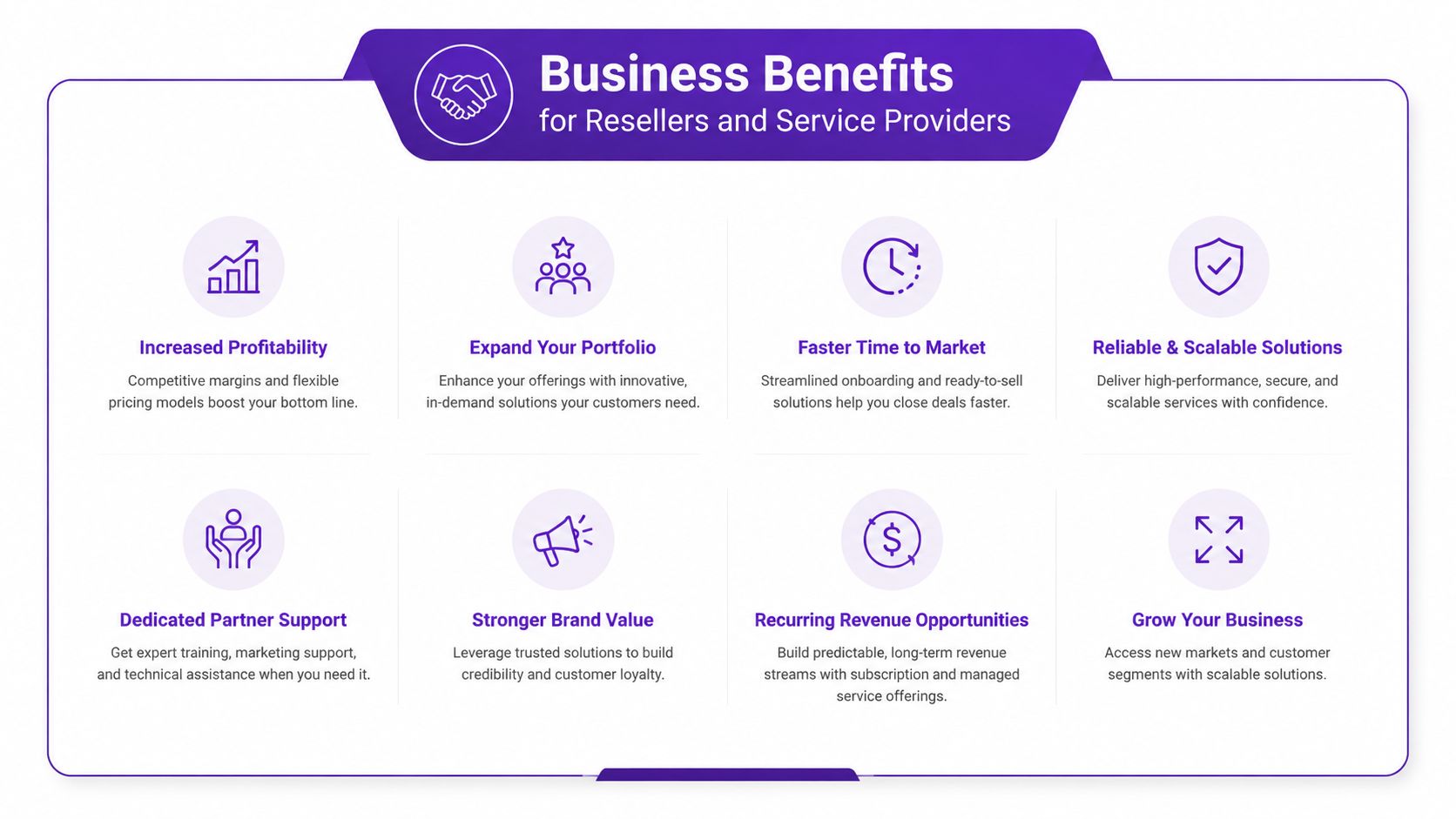
AI risk scoring changes the operating model for dark web monitoring. Instead of selling a raw breach search that creates manual interpretation work, an MSP can offer a dark web monitoring service for businesses with prioritised alerts, defined response bands, and recurring reporting.
That creates several practical advantages:
- Lower operational overhead: Technicians spend less time sorting undifferentiated breach records and more time handling findings that need customer action.
- Simpler onboarding: Service providers can add monitored domains and customer identities without building their own collection, correlation, and scoring engine.
- Easier packaging: The service fits alongside IT support, cloud services, hosting, connectivity, telecom systems, web services, and other monthly offerings.
- Stronger customer relationships: Early alerts give the account team a reason to discuss MFA, password reuse, identity exposure, and response readiness.
- Clearer differentiation: A reseller can offer useful security monitoring without pretending to operate a full security team.
GoSafe is a fully white-label Dark Web monitoring tool. Partners can brand the platform as their own service, sell it under their company name, and include it in their product portfolio without building security tools internally or hiring specialist analysts. The partner keeps ownership of the customer relationship while using continuous dark web scanning to detect compromised email addresses, exposed passwords, and breached domains, with clear alerts designed for business users.
The sensible launch path is controlled. Pilot the service with a small group of existing customers, measure how often alerts lead to a documented action, refine the response bands, and turn the results into a repeatable offer. That gives resellers a practical foundation for recurring revenue security services and a clearer route to upselling identity controls or broader managed protection.
Offer dark web monitoring under your brand and build a client-ready service around prioritised exposure alerts, without creating a security platform of your own.
GoSafe Dark Web monitoring continuously scans for compromised email addresses, exposed passwords, and breached domains, then presents clear alerts and risk context that customers can understand. Visit GoSafe Dark Web monitoring to see how you can add white-label monitoring to your service portfolio and start a practical conversation with existing customers.