A data breach scanner searches dark web marketplaces, forums, paste sites and breach datasets for a customer's email addresses, passwords, domains and phone numbers, then alerts the owner when a match appears. With 43% of UK businesses experiencing a cyber security breach or attack in the previous 12 months, breach scanning is a practical check for service providers and their customers.
The useful output isn't a file full of stolen records. It's an understandable warning that tells a business owner what was exposed, which account needs attention and what to do next.
Why Breach Scanning Has Become a Routine Check
A business doesn't need to be the original breach victim for its accounts to become exposed.
A small company might assume attackers won't notice it. But an employee's details can appear in a breach at an external supplier, professional app or online service, regardless of the size of their employer.
The opening figure comes from the UK Government's Cyber Security Breaches Survey 2025 technical report, which estimated approximately 612,000 affected businesses, with incidents reported by 67% of medium-sized businesses and 74% of large businesses. Those findings describe breaches and attacks generally, not the proportion of businesses with credentials on the dark web.
Exposure can start outside the business
Consider an employee who registers for a third-party service using their work email address. They reuse a password they also use for a business account.
If that service suffers a breach, an attacker could obtain the combination and try it elsewhere. The employer might have no warning from its own systems until someone attempts to sign in.
This is an illustrative pattern, not a reported customer incident. It explains why an external breach can become an internal business concern.
Continuous monitoring makes sense because the first search only establishes what the provider can find at that moment. Later discoveries need a route to someone who can act.
For a service provider, the practical questions are:
- Coverage: Which customer identifiers should be monitored?
- Meaning: Does a match contain an address alone or usable authentication material?
- Ownership: Who receives the alert and takes responsibility?
- Response: What action fits the exposure and the account's importance?
A routine check becomes valuable when the provider connects discovery to an accountable response, rather than merely forwarding a breach notification.
What a Data Breach Scanner Actually Checks
A one-off lookup checks whether an identifier appears in the breach information available when you search. Continuous monitoring keeps a customer's authorised identifiers on a monitored list and alerts when the service discovers a relevant exposure.
That distinction matters commercially. A search can start a customer conversation, but an ongoing service needs a continuing reason to exist: watching for new findings and helping the customer interpret them.
Identifiers and their meaning
The table below describes possible exposure patterns. It isn't a promise that every scanner covers every category, and a match signals a risk to investigate rather than proof that fraud has occurred.
| Identifier | Typical source of exposure | What it signals |
|---|---|---|
| Work email address | Stealer log or third-party service breach | Mailbox or account may be targeted |
| Password, plain or reused | Credential dump or infostealer malware | Takeover is possible on any site reusing it |
| Company domain | Breach at a supplier, app or SaaS provider | Several staff accounts may share the same exposure |
| Mobile phone number | Telecom or app data leak | SIM-swap and text-message phishing risk |
| Personal identity data, such as name, date of birth or ID number | Full-record breach | Identity fraud and targeted phishing |
| Payment card or bank details | Payment or retail breach | Direct financial fraud |
For an email-only finding, the first action might be a phishing warning. For an exposed password, the account owner needs a secure reset process. For financial information, the customer should contact the relevant bank or card issuer.
Linked identifiers change the interpretation. A work address alone provides limited context. The same address alongside a password creates a more direct account-access concern, especially if the password remains in use.
This also affects how you explain domain monitoring. A domain match normally means records associated with addresses under that domain were found. It doesn't automatically mean the organisation's website, network or domain registration was compromised.
What a clean result cannot tell you
A scanner can only report information available through the sources it covers. Private exchanges, insider misuse and unpublished breaches may remain outside that view.
Practical rule: A clean search means no match was found within the available coverage. It doesn't certify that the customer is safe.
A Dark Web Monitoring tool isn't a firewall or endpoint protection product. Keep password controls, multi-factor authentication and account security checks in place, whether the search returns a finding or not.
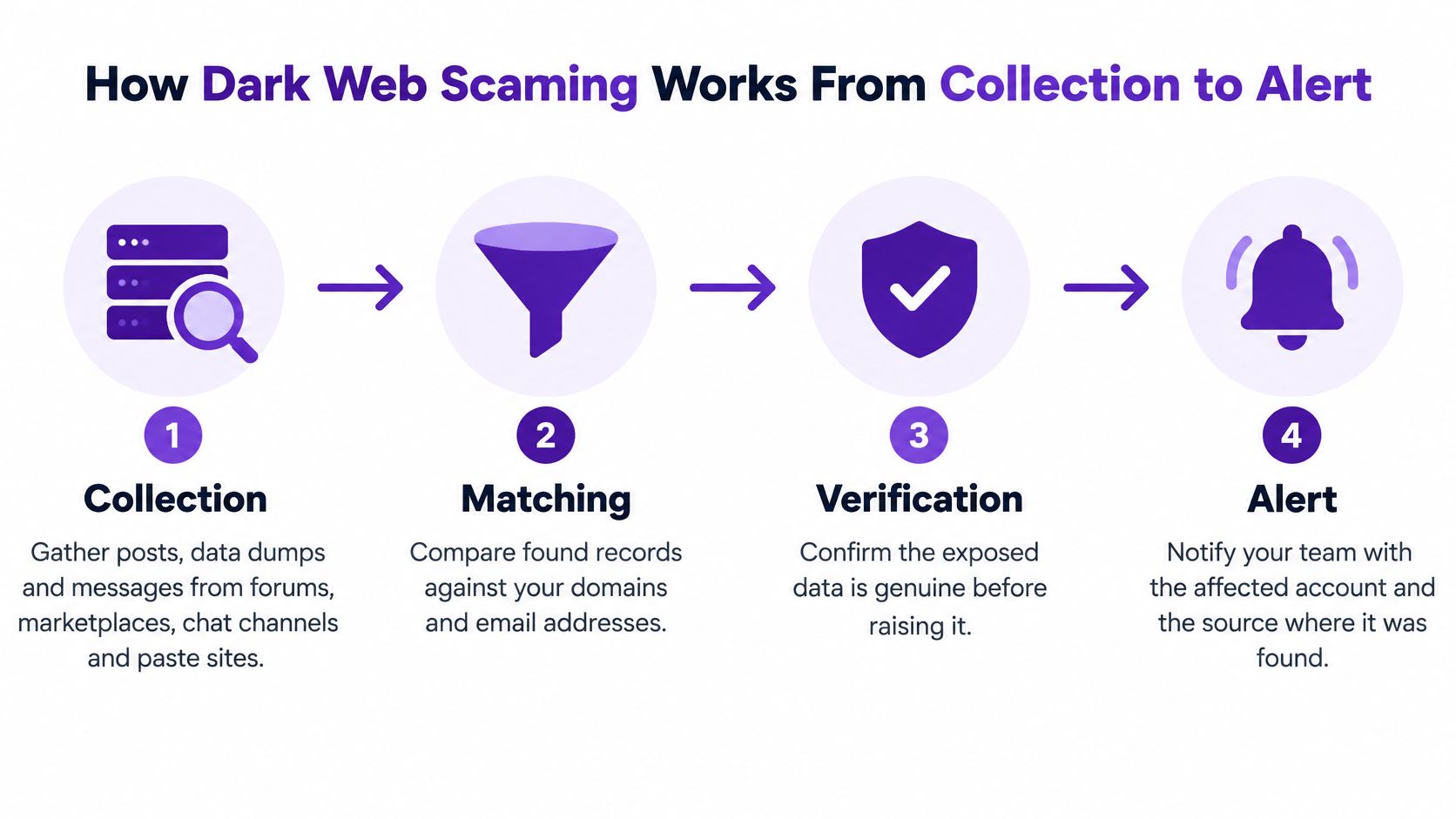
How Dark Web Scanning Works From Collection to Alert
The dark web consists of networks accessed using specialist software. Breach intelligence may also come from open forums, messaging channels, paste sites and markets containing stealer logs, which are records gathered by information-stealing malware.
The distinction is useful because dark web monitoring shouldn't be judged by its name alone. What matters is which sources contribute to the service and how the provider turns those records into reliable alerts.
The operational pipeline
Collect relevant intelligence. A provider gathers breach datasets, marketplace information, stealer logs and published material, either directly or through intelligence suppliers. We rely on third-party breach intelligence providers and infrastructure services, so those dependencies belong in a partner's assessment.
Normalise the identifiers. Records need consistent formatting before comparison. Standardising email-address formatting, removing presentation characters from phone numbers and grouping addresses by domain can help prevent equivalent identifiers from being treated as unrelated records.
Match against the authorised customer list. The service compares discovered identifiers with those the customer has authorised for monitoring. One-way hashed comparisons can support matching without retaining search identifiers in readable form.
Classify and assess the finding. The provider should distinguish an email-only exposure from authentication material, identity information or financial data. Source category, discovery time and confidence help the recipient understand what is known and what still needs checking.
Send an actionable alert. The named recipient needs the affected account, the exposed data categories and the next step. Raw passwords shouldn't be distributed through ordinary notifications merely to demonstrate that a match exists.
The graphic groups these activities into collection, matching, verification and alerting. In practice, normalisation and classification make those stages useful.
Why the dates need explanation
Our platform has scanned 32.5 billion records. That describes the volume processed, not complete visibility into every breach or a guarantee about any particular customer.
An alert's discovery date may differ from the date of the underlying incident or publication. Keep those fields separate, and mark an unknown breach date as unknown rather than guessing.
A customer may otherwise assume an old breach is a new attack, or dismiss a newly discovered password because the original event happened earlier. The useful question is whether the exposure still creates risk.
For the business context behind this process, see GoSafe Dark Web monitoring for businesses.
Turning Exposures Into Ranked Actions
A long list of matches can distract from the account that needs urgent attention. Prioritise consequences, not record counts: an exposed password belonging to a finance approver deserves different handling from an address found without authentication material.
An ICO review of personal-data-breach reports found that human error contributed to 70% of cases examined, incorrect emailing or posting accounted for almost 34%, and unauthorised access represented 17%. These are findings about the reviewed reports, not measures of scanner detection performance.
They reinforce an important distinction: not every exposure has the same cause or needs the same response.
A suggested response agreement
The timings below are proposed service targets, not observed outcomes, statutory deadlines or a regulatory standard. Agree them with each customer, including what happens outside working hours.
| Exposure | Severity | Response | Target timing |
|---|---|---|---|
| Email address only, no password | Low | Monitor and remind staff about phishing | Within 5 working days |
| Phone number only | Medium | Confirm the second-factor method and warn about SMS scams | Within 2 working days |
| Email with password or session token | High | Force reset, revoke sessions and check mailbox rules | Same working day |
| Company domain match across several staff | High | Review all accounts on the domain and enforce multi-factor authentication | Same working day |
| Identity data, such as name, date of birth or ID number | High | Assess UK GDPR notification duty and contact the individual | Start assessment same day |
| Payment card or bank details | Critical | Contact the card issuer or bank and lock affected accounts | Immediately |
Apply judgement rather than following the table mechanically. A phone number used for account recovery could warrant faster action, while a historical password already replaced may require verification rather than another emergency reset.
Role and business importance also matter. An administrator, payroll contact or account with payment approval rights can justify escalation beyond the default severity.
The government's Cyber Security Breaches Survey 2025 findings reported phishing at 37% of businesses, while 65% of businesses reporting breaches or attacks identified phishing as the most disruptive type. Frequency alone therefore isn't a sufficient priority signal.
You can prioritize credential exposures with AI, but someone must still own the containment decision.
Protect sensitive results
Healthcare and adult-oriented service breaches can reveal sensitive associations. We withhold sensitive results until the user completes ownership verification using two-factor authentication linked to the searched email address.
An alert should help protect someone's information, not disclose it to whoever happens to know their address.
Evaluation Criteria for Choosing a Scanner
A data breach scanner is only as useful as its sources and alerts. Compare evidence before price, particularly if you'll put your own company name on the service.
The comparison below separates substantive answers from statements that leave a reseller carrying unanswered questions.
| Criterion | Strong answer | Weak answer |
|---|---|---|
| Source coverage | Names source categories and reviews them regularly | Cites billions of records with no breakdown |
| Monitoring frequency | Continuous, with a timestamp on each finding | Periodic scans with no timing given |
| Identifier types | Email, domain, password, phone and personal data | Email addresses only |
| Alert content | Shows what was exposed, when, and the first action | Reports breach found with no context |
| Data handling | Breach data transformed and stored in unreadable form | Vague statements about security |
| Data retention | Stated retention period with a reason | No retention policy published |
| Sensitive breach controls | Verification before sensitive results appear | Results visible to anyone with the address |
| Third-party reliance | Named intelligence and infrastructure providers | Not disclosed |
| Access and audit | Multi-factor sign-in and audit logging | Shared logins for staff |
| Multi-customer management | Separate views per customer and per-customer alerts | One shared view for all customers |
Treat broader identifier coverage as an evaluation preference, not a reason to monitor unnecessary personal information. The customer's purpose and authorisation should determine the monitored list.

Understand how the provider handles data
Our breach data is transformed with hashing, encryption and obfuscation before storage. Stored breach intelligence is non-human-readable and unusable outside our systems, and users don't submit breach data for storage.
Our security measures include one-way hashing of search identifiers, mandatory multi-factor authentication, and continuous monitoring with audit logging. These controls address different questions: how searches are matched, who can access the service and how activity is recorded.
Retention needs equal attention. We retain transformed breach intelligence for as long as it remains relevant for security and research purposes, rather than promising a fixed deletion interval.
That distinction belongs in your assessment. A stated purpose-based policy isn't the same as a specified retention period.
Take a concrete checklist into the demonstration
Use the demonstration to test the workflow, not just the appearance of the dashboard:
- Coverage evidence: Obtain the source categories in writing and distinguish direct collection from third-party intelligence.
- Sample alert: Check whether a business user can identify the account, exposure and first action without technical interpretation.
- Retention terms: Record how relevance is assessed and what information the policy covers.
- Provider dependencies: Review the intelligence and infrastructure organisations involved in handling data.
- Customer separation: Confirm how staff access, customer views and alert recipients are controlled.
A good demonstration should leave you able to explain the service's limits as confidently as its benefits.
A Worked Example From First Alert to Closure
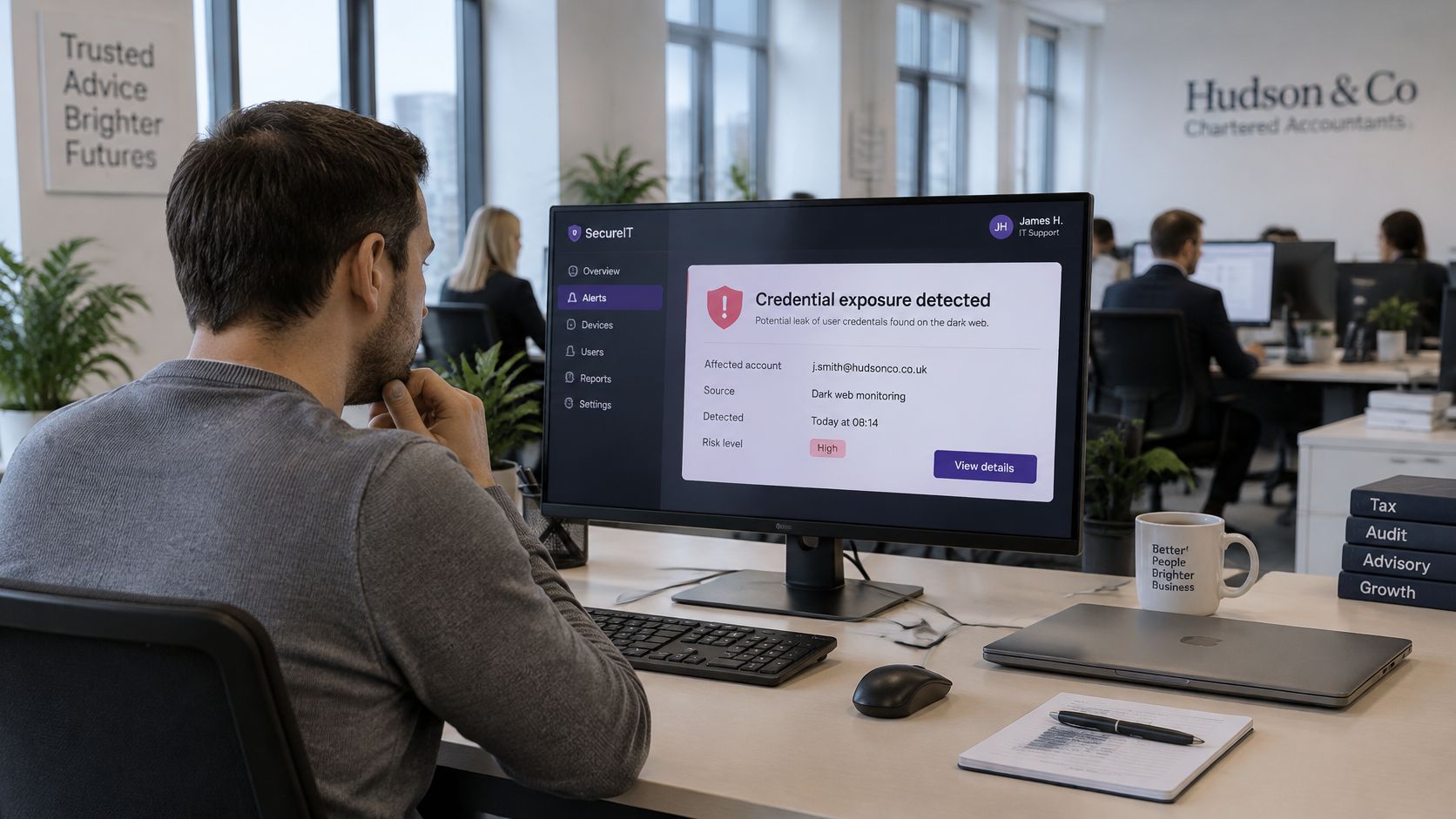
The following is a hypothetical walkthrough, not a customer case study. An MSP supports a 40-person accounting practice, and at 08:17 on a Tuesday it receives an alert about a partner's work email and a password in a third-party accounting-app dataset dated 14 months earlier.
The age of the dataset doesn't settle the risk. The MSP needs to establish whether the credential remains relevant and what access the partner holds.
Contain and investigate
Confirm the account and role. The partner has finance approval rights, so the responder raises the priority and contacts the agreed customer representative.
Secure access. The authorised administrator forces a password reset and revokes active sessions. The partner changes any reused password through the relevant service's genuine sign-in route.
Inspect mailbox settings. The responder checks forwarding and inbox rules for changes the partner doesn't recognise, then records the findings.
Check related exposure. A domain review identifies two more staff associated with the same app. Their accounts enter the assessment rather than being treated as unrelated alerts.
Record the scope and decision. In this example, the available evidence confirms no additional personal data was exposed in the identified records. The responder documents that finding, the alert time, containment actions and any remaining uncertainty.
A reusable incident response template for UK MSPs helps staff maintain a consistent record without turning a straightforward investigation into an improvised exercise.
Does the alert require notification?
An alert doesn't automatically establish a reportable breach of the customer's own systems. It starts an assessment of what happened, what personal data was affected and the likely consequences.
The ICO's breach-response guidance says a notifiable breach must be reported without undue delay and, where feasible, within 72 hours of becoming aware of it, not from the original incident date. Information can be supplied in stages if the investigation remains incomplete, with delays explained.
The ICO's personal-data-breach guide ties notification to likely risk to people's rights and freedoms; high risk also requires notifying affected individuals without undue delay.
In this hypothetical outcome, the MSP completes containment and assessment within the working day. It closes the incident only after documenting the evidence, notification decision and plain-English explanation to the partner.
Decide Whether to Add Breach Scanning to Your Services
MSPs, IT support companies, telecom and VoIP providers, hosting providers, web agencies and technology resellers already have a natural route into this conversation. Cyber consultants and SaaS resellers can also fit monitoring alongside the accounts, applications or advisory services they manage.
The commercial case rests on continuity rather than volume. A monitoring responsibility gives customers a reason to stay in contact, and each alert opens a conversation with a clear next step attached.

Package the responsibility, not just the search
White label dark web monitoring lets a partner add a dark web monitoring service for businesses alongside IT support, cloud services, hosting, connectivity, telecom systems or web services. It's an understandable addition: monitor agreed identifiers, notify the right contact and explain the response.
The service works like a fire alarm contract. Your job is making sure the right person hears the bell and knows what to do next, and the customer pays for that ongoing readiness, not for a single search result.
Before launch, separate monitoring and notification from hands-on incident response. State whether password resets, mailbox investigation and out-of-hours work are included or separately agreed.
A practical launch path is:
- Map existing customers. List the domains and accounts you already manage, then obtain the necessary monitoring authorisation.
- Define the package. Decide who receives the service and whether it stands alone or sits within an existing support agreement.
- Assign responsibility. Agree alert recipients, escalation routes and response targets.
- Complete provider checks. Use the evaluation criteria to document coverage, handling and operational limits.
- Pilot before expanding. Test the customer explanation and response process with a small customer group.
Keep delivery proportionate
GoSafe is a fully white-label Dark Web Monitoring tool. Partners can brand the platform as their own service, sell it under their own company name and retain ownership of the customer relationship, without building security tools internally.
Investigation and containment still need named owners, so agree who acts on each alert before the first one arrives.
For businesses considering recurring revenue security services, the strongest proposition is straightforward: meaningful visibility, understandable alerts and a response the customer can trust. Reseller dark web monitoring should strengthen the service relationship, not create an unexplained stream of warnings.
GoSafe Dark Web monitoring offers continuous credential monitoring and clear alerts that help turn exposure findings into practical customer conversations. Visit GoSafe Dark Web monitoring to understand the service, then explore the reseller programme and arrange a demonstration to Offer dark web monitoring under your own brand.