
A client calls at 4pm on a Friday. They've spotted suspicious logins, the usual technical contact is away, and the person answering the phone can't find the latest incident response plan template. The file is somewhere in a shared drive, but nobody knows whether the contact details are current or who has authority to decide what happens next.
That situation is more common than most service providers admit. An effective plan isn't a long policy document. It's a short, operational playbook that an on-call engineer, service desk lead, or account manager can use without waiting for the security team. For UK businesses, it also needs clear escalation, communications, evidence handling, and regulatory decision points.
Why Most Incident Response Plans Fail When It Matters
A Friday call can expose a process failure before a technical one. The MSP may have monitoring, backups, endpoint protection, and experienced engineers, yet the first response turns into a search through old documents, chat messages, and personal contact lists. Someone asks whether the customer's solicitor should be involved. Another person checks whether the affected account can access personal data. Nobody knows who may approve isolation.
On-call teams at small and mid-sized MSPs frequently cannot locate current plan documents during active incidents. Generic templates create this problem because they prioritise completeness over use. Phrases such as “notify stakeholders” and “investigate the incident” leave out the responsible person, approved communication channel, and threshold for raising the response level. Under pressure, vague instructions create delay.
The UK Cyber Security Breaches Survey 2025 estimates that only 23% of businesses have a formal incident response plan, while 43% reported a breach or attack in the previous 12 months. The survey's technical report also records that 75% of large businesses have plans, highlighting the preparedness gap smaller organisations face.
A document people can execute
A minimum viable plan must serve whoever is available, including an on-call engineer handling an out-of-hours incident. Keep current contacts, two ways to reach key people, a simple decision tree, and clear instructions for preserving evidence before anyone changes systems.
White-label dark web monitoring can add an early-warning layer before a customer reports suspicious activity. An MSP can review exposed credentials or company details, confirm whether an alert warrants escalation, and start the relevant workflow. That information belongs in the same operational process, with an owner and response threshold, rather than in a separate dashboard nobody checks.
The plan must account for the UK GDPR reporting window. The Information Commissioner's Office explains that certain personal data breaches must be reported without undue delay and, where feasible, within 72 hours of awareness. That clock continues while an MSP confirms approval authority.
Practical rule: If an engineer cannot quickly find the owner, severity definition, next action, and escalation contact, the plan is not operational.
A communications document can support the technical workflow. A free crisis plan template can organise stakeholder messaging, but it does not replace containment, evidence preservation, legal review, customer updates, or recovery actions.
Building a UK-Aligned Incident Response Plan Structure
The NCSC has treated incident response planning as a formal part of UK cyber guidance since at least 19 September 2019, when it published its incident management collection and guidance on cyber incident response processes. Its basic plan requirements are practical rather than decorative. They include named contacts for the incident response team, IT, senior management, legal, PR, HR, and insurance, along with resilience measures that prevent one unavailable person from stopping the response. The NCSC guidance sets out these planning requirements.
Start with a front page that an on-call employee can use immediately. Include the plan owner, version date, document location, emergency conference details, and the first actions for reporting a suspected incident. Keep sensitive credentials out of the document, but make sure authorised staff know where approved access information is stored.
The core sections to include
Use the NCSC's five-stage response and recovery structure as the spine of the document: prepare, identify what's happening, resolve the incident, report it to wider stakeholders, and learn from it. The NCSC response and recovery guide also stresses role ownership and contact arrangements, so each stage should identify who acts, who approves, and who receives updates.
Your incident response plan template should contain:
- Contact register: List the incident response team, IT, senior management, legal, PR, HR, and insurance contacts. Record at least two contact methods and more than one person or group detail where possible.
- Severity model: Define what makes an event routine, serious, or critical. Tie each level to containment authority, communications, legal review, customer notification, and external support.
- Lifecycle flowchart: Show the route from detection and triage through containment, eradication, recovery, reporting, and lessons learned.
- Decision authority: State who can isolate a device, disable an account, engage a specialist, approve customer communications, and contact regulators.
- Communications process: Include the always-available conference number, approved channels, message ownership, update frequency, and a record of decisions.
- Regulatory guidance: Explain when the ICO, NCSC, directors, insurers, suppliers, or other third parties must be considered.
The plan should link to business continuity, disaster recovery, and crisis management documents. The NCSC says roles must be understood, staff trained, and the plan regularly reviewed as organisational structures change. Its incident management guidance supports treating the plan as maintained operational infrastructure, not a file created once for an audit.
Defining Roles and Escalation Paths That Work Under Pressure
During a live breach, a small MSP cannot wait for a perfect org chart. It needs named ownership, backup contacts, and permission to act. One person may hold several roles, but document each responsibility separately so work does not stall through assumption.
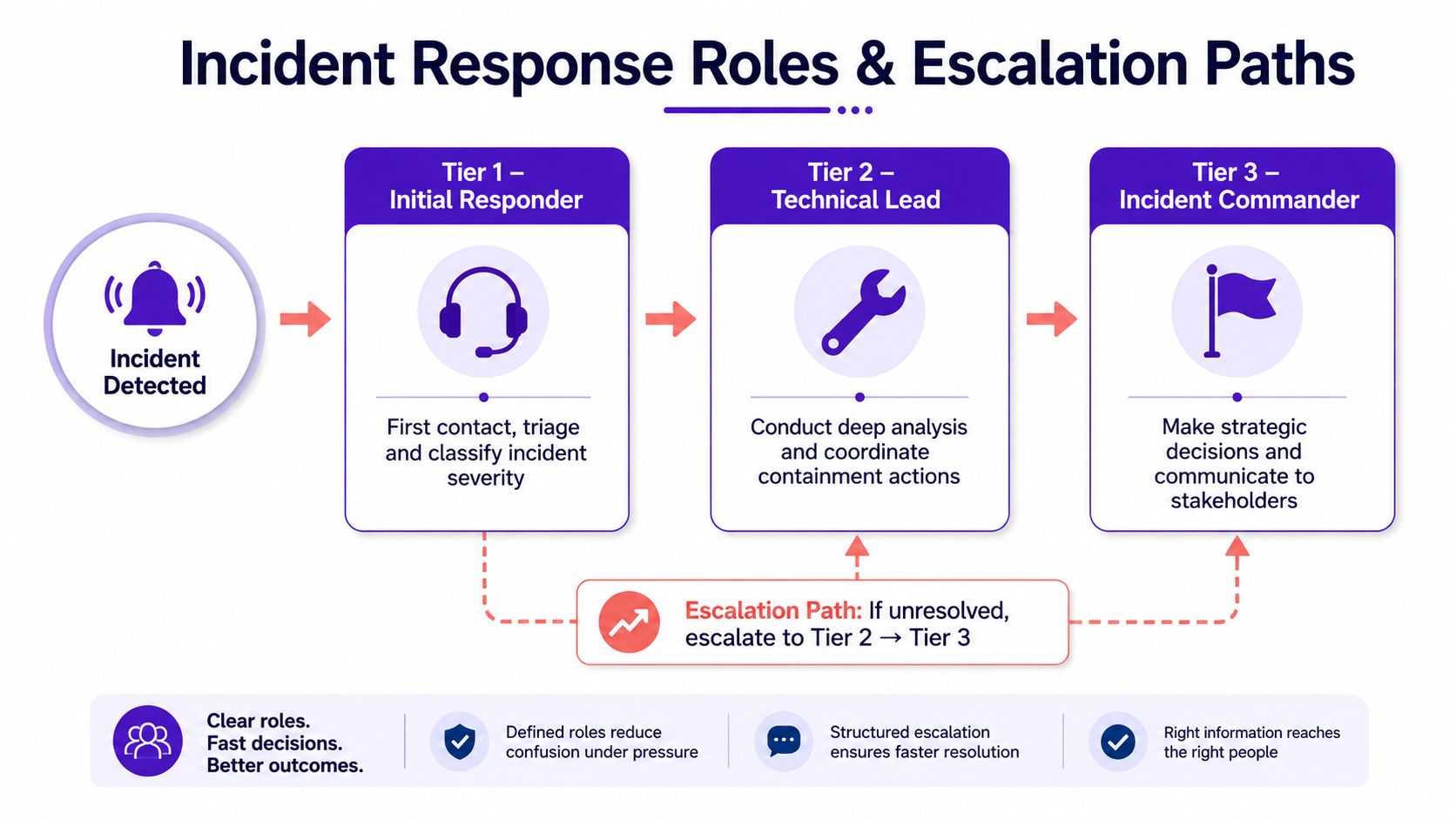
The incident commander sets priorities, keeps the timeline, approves decisions within delegated authority, and prevents technical actions from running ahead of legal or customer communications. The technical lead directs investigation, containment, evidence preservation, and recovery. A communications coordinator controls internal updates and customer messages. A legal liaison reviews reporting, contractual, privacy, and insurer requirements.
Make escalation conditional, not personal
“Escalate to management if necessary” gives a responder no usable test. Define triggers they can recognise, such as suspected personal data exposure, a privileged account compromise, malware spreading between systems, failed containment, impact across multiple customers, or a supplier event affecting shared infrastructure.
Write the authority beside each trigger. The on-call engineer may disable an account or isolate a device. The incident commander may pause a service, approve customer communications, or engage a specialist. Legal or a director should handle regulatory and contractual decisions where required. Keep a deputy for every role, with a clear hand-off rule if the primary contact is unavailable.
The plan should also specify who can contact external forensics, specialist incident response, legal counsel, insurers, or national support. The NCSC Annual Review 2025 records 1,727 incident tips, 429 incidents requiring support, and 204 highly significant or significant incidents. An MSP needs a route that separates routine credential containment from an incident requiring wider assistance.
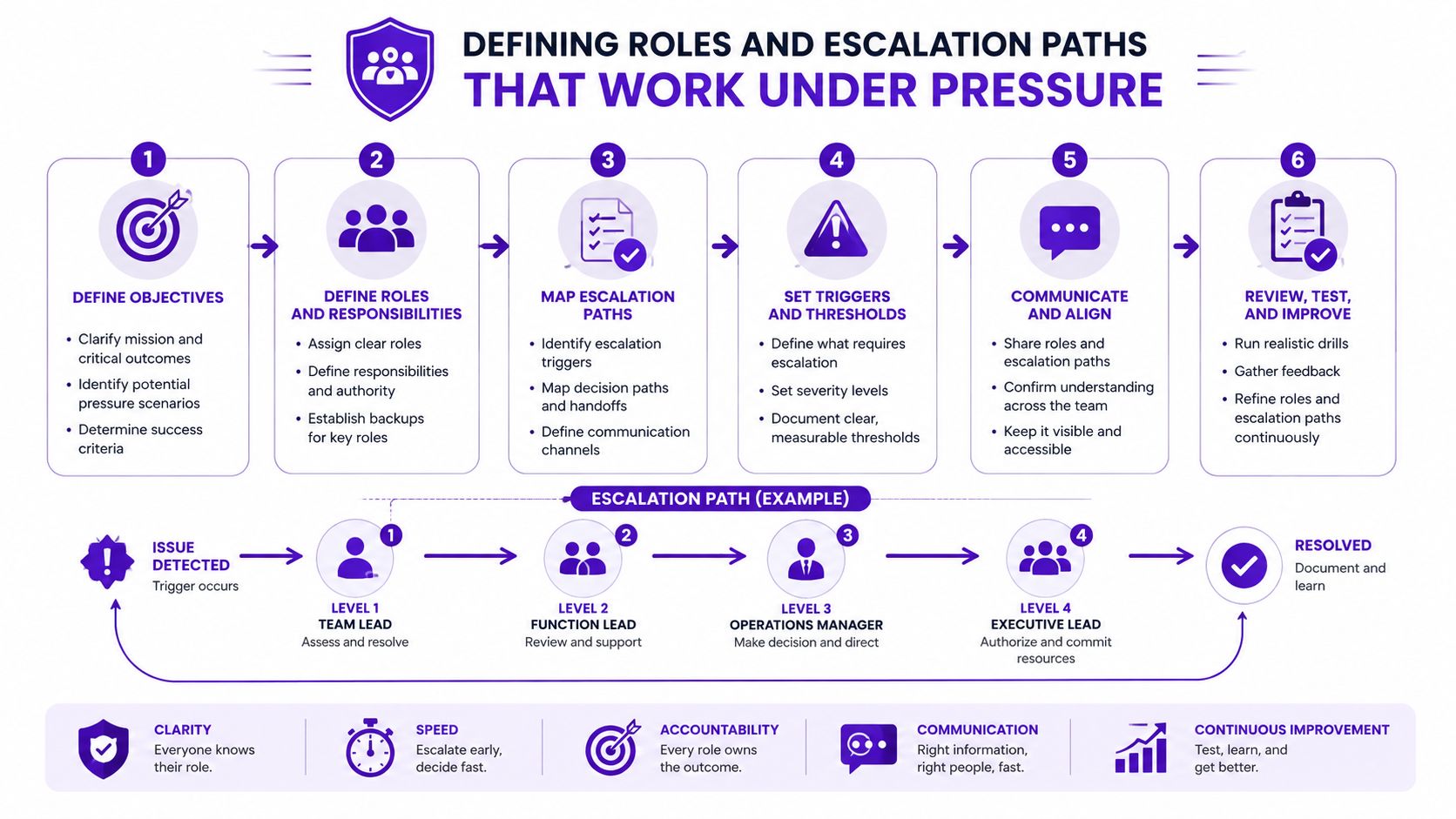
Use the service desk for initial triage, a senior engineer as technical lead, and a director as incident commander and communications approver. White-label dark web monitoring can feed exposed credentials into that triage queue, giving the team an early warning before an alert becomes a confirmed compromise.
Record decisions as they happen. The incident log should capture the time, person, observation, action, approval, evidence location, and next review point. A busy chat thread is not an adequate record.
Sample Playbooks for Common Breach Scenarios
A template becomes useful when it tells people what to do next. The following playbooks are deliberately compact, so an MSP can adapt them for each client without turning the response document into an encyclopaedia. Keep client-specific details, system owners, insurer information, and approved messages close to the relevant playbook.
Credential compromise detected through monitoring
First, validate the alert without spreading the exposed information. Identify the account, affected domain, system access, privilege level, and whether the password remains in use. Disable or protect the account according to the client's approved procedure, revoke active sessions where appropriate, preserve the alert and relevant logs, and check for suspicious activity.
The customer message should be direct: “We've identified an exposure associated with this account. We recommend confirming the account owner, resetting the password through the approved process, reviewing authentication activity, and enabling stronger authentication controls where available.” Avoid sending exposed passwords by email or placing sensitive data in a general ticket.
Data exfiltration attempt
Preserve evidence before making disruptive changes, unless immediate isolation is necessary to prevent continuing harm. The technical lead should identify affected hosts, accounts, data stores, transfer paths, and timestamps, then isolate systems under the authority defined in the plan.
Engage specialist support when the scope can't be established, evidence may be challenged, privileged systems are involved, or the provider lacks the capability to investigate safely. The legal liaison should assess whether personal data is involved and whether notification decisions must be made within the UK GDPR timeframe.
Phishing campaign
Capture the message, sender details, links, attachments, recipients, and reported user actions. Remove matching messages where possible, block indicators through approved controls, identify users who clicked or entered credentials, and protect affected accounts.
Don't assume a deleted email ends the incident. Review sign-in activity, mailbox rules, forwarding settings, and other indicators that credentials may have been harvested. For broader context on the operational impact of major cyber events, Lighthouse Consultants cyber threat insights provides useful material for discussion with customers.
| Breach Type | First Hour Actions | 24-Hour Milestones | External Notifications |
|---|---|---|---|
| Credential compromise | Validate alert, protect account, preserve evidence, review access | Confirm reset, assess related activity, update customer | Consider customer, insurer, supplier, or regulator notification based on impact |
| Data exfiltration attempt | Preserve evidence, identify scope, isolate affected systems | Establish likely data and systems affected, appoint specialist support if needed | Consider ICO, NCSC, legal counsel, insurer, customers, and suppliers |
| Phishing campaign | Preserve message, contain indicators, protect exposed accounts | Review affected users, mailbox activity, and control changes | Notify affected customers or regulators when the assessment requires it |
For a broader operational treatment, use this incident response for MSPs and resellers resource to shape client-facing procedures and service boundaries.
Integrating Dark Web Monitoring into Your Response Workflow
A response plan that only begins after a customer reports suspicious activity starts too late. Dark web monitoring adds an early-warning layer by identifying compromised email addresses, exposed passwords, and breached domains before a customer notices misuse. It doesn't replace endpoint monitoring, identity controls, backups, or human investigation, but it can provide a clear trigger for a defined playbook.
For service providers, the value depends on the alert workflow. Every alert should create an ownership decision, not another unread notification. A domain exposure might trigger an account review and customer contact. An exposed privileged address should receive faster escalation. A historic breach may require validation rather than an emergency response.
Turn an alert into an action
Write the alert path into the incident response plan template:
- Receive and validate: Confirm the monitored domain, address, breach context, and available evidence.
- Classify: Assess whether the account is active, privileged, customer-facing, or linked to sensitive systems.
- Contain: Reset credentials, revoke sessions, review access, or apply other approved controls.
- Investigate: Check authentication records, mailbox activity, endpoint signals, and related accounts.
- Communicate: Use a plain-language message that explains the risk and the required customer action.
- Close or escalate: Record the decision, owner, evidence, and reason for moving to the next stage.
Businesses generally want understandable warnings, not a complicated security dashboard. A compromised credential detection service can support that conversation when the output is tied to an owner, a response time, and a customer-approved action.

There's also a commercial reason to design this carefully. MSPs, IT support firms, hosting providers, telecom companies, VoIP providers, and SaaS resellers can package monitoring as a monthly service alongside existing support. A white label dark web monitoring offer gives the provider ownership of the customer relationship, while the response plan turns alerts into a managed service rather than a one-off warning.
Testing Your Plan Through Tabletop Exercises
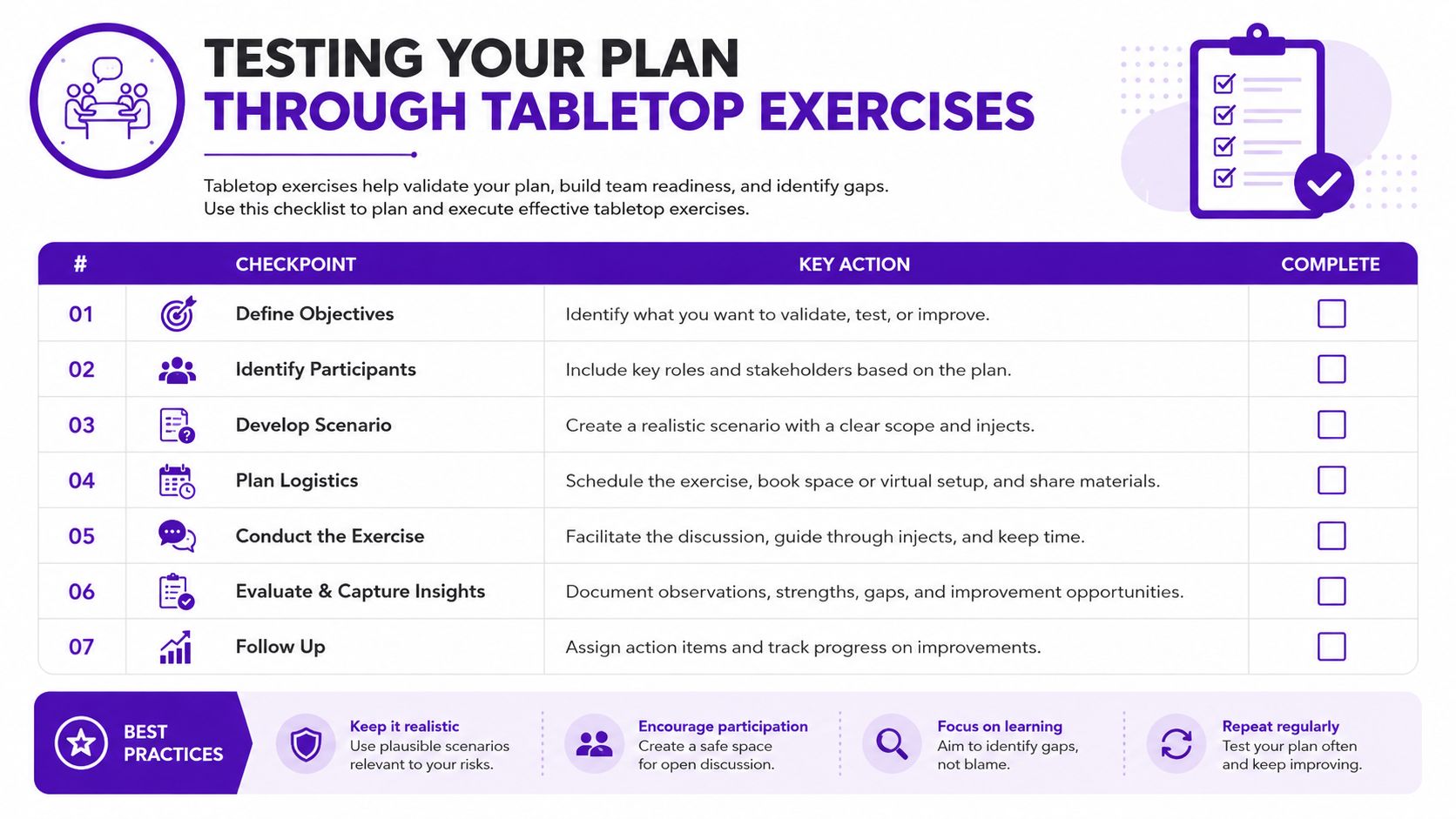
An untested incident response plan is a hypothesis. Tabletop exercises reveal whether the emergency number works, whether the incident commander can make a decision, and whether the technical lead can obtain the information needed to contain the event.
Begin with a short scenario and a facilitator who doesn't run the response. Use an account compromise for a basic exercise, a ransomware event affecting several systems for a more demanding simulation, and a supply-chain breach that raises regulatory and customer notification questions for the most complex session.
Use injects to test judgement
Facilitators should introduce complications instead of letting the group follow a perfect script. An unavailable contact, conflicting customer information, a suspected personal data record, or a supplier asking for immediate access can expose weak authority and communication paths.
Assess the exercise against observable outcomes:
- Contact resilience: Can the team reach the necessary roles through the documented methods?
- Decision clarity: Does someone know who can isolate systems, engage specialists, and approve notifications?
- Evidence discipline: Do responders record actions and preserve relevant information before changing systems?
- Customer communication: Can the communications owner issue a clear update without exposing unnecessary sensitive detail?
- Regulatory awareness: Does the team recognise when the ICO, NCSC, insurer, directors, or suppliers need consideration?
- Recovery control: Can the team define what must be checked before returning systems to normal?
- Learning quality: Does the review produce assigned improvements rather than general observations?
The facilitator should finish with an after-action record containing the scenario, timeline, decisions, missed steps, outdated contacts, control gaps, and named owners for corrective work. Update the plan, playbooks, training material, and customer responsibilities while the discussion is still fresh.
A useful exercise isn't designed to make the team look prepared. It's designed to show where the plan depends on memory, goodwill, or one unavailable person.
Turning Incident Response into a Service Offering
For a service provider, incident response planning can move from an internal cost centre to a structured customer service. The minimum viable offer includes a client-specific contact register, severity and escalation rules, technical playbooks, communications ownership, regulatory decision points, evidence handling, recovery dependencies, and a review process.
Package the work around the customer's existing environment. An IT support provider might include plan maintenance and exercises in a managed support agreement. A hosting or connectivity provider might add service-specific escalation and supplier communications. A cyber consultant can provide the planning layer, while an MSP delivers the day-to-day monitoring and first response.
White-label dark web monitoring strengthens the model because it creates an ongoing reason to speak with customers before a crisis. A detected compromised email address or exposed password can open a practical conversation about identity protection, access review, phishing readiness, and incident responsibilities. It also supports recurring revenue security services without requiring the reseller to build security tools internally or maintain a specialist security team.
The commercial model works best when the boundaries are explicit. State what the monthly service monitors, who receives alerts, what response is included, when out-of-scope investigation begins, and how customers approve account or system changes. A fully branded white-label cyber risk platform can sit within that portfolio, provided the provider remains responsible for customer communication, service quality, and the incident decisions described in its plan.
Start by adapting the incident response plan template for one representative client, run a tabletop exercise, and turn the findings into a repeatable service package. Then assess whether white-label security services and reseller dark web monitoring fit alongside your existing support, cloud, hosting, connectivity, telecom, web, or SaaS offers.
GoSafe Dark Web monitoring continuously scans for compromised email addresses, exposed passwords, and breached domains, then delivers clear alerts that business users can understand. Visit GoSafe Dark Web monitoring to explore a practical early-warning service that can support your incident response workflow and help you offer branded monthly monitoring to customers.