
A client calls after seeing a breach in the news. They want to know whether their accounts are exposed, whether their staff are at risk, and what you can do about it. If your answer is limited to “we can recommend a firewall”, you're leaving both a customer need and a recurring revenue opportunity on the table.
The strongest solutions for cyber security aren't always the largest platforms. For many MSPs, IT support companies, telecom providers, hosting businesses and technology resellers, the practical choice is a service that's easy to explain, simple to deploy and useful every month. That's where white-label dark web monitoring earns its place alongside existing support, cloud, connectivity and web services.
Why Your Clients Are Asking About Cyber Security Now
A client rarely starts with a technical question. They ask whether someone has stolen a password, whether an employee's email address has appeared in a breach, or whether their business could be the next target. Your commercial challenge is to turn that concern into a clear service, not a long list of security products that nobody has time to manage.
The UK threat picture supports that demand. The government's Cyber Security Breaches Survey 2025/2026 estimated approximately 5.19 million cyber crimes against UK businesses in the previous 12 months, alongside about 525,000 cyber crimes against charities. It also reported that 43% of businesses and 30% of charities experienced a breach or attack, affecting roughly 612,000 businesses.
Phishing remains the most common attack type in that survey, affecting 38% of businesses. An independent summary of the same survey states that phishing was involved in around 85% of cyber incidents reported by UK businesses (NexusOS phishing simulation training). These figures point to a straightforward operational problem. Attackers often want credentials first, because stolen credentials can provide a cheaper route into cloud services, email accounts, remote access systems and internal applications.
The expectation has changed
Customers increasingly expect their IT provider to identify risk before it becomes an incident. They may not know the difference between endpoint protection, identity security and credential monitoring, but they understand an alert that says an employee's account has been exposed.
That expectation creates pressure for smaller service providers. The UK cyber security market reached an estimated £14.7 billion in annual revenue in 2026, with 2,603 cyber security firms and about 69,600 full-time equivalent roles, according to the UK government's Cyber Security Breaches Survey 2025/2026 analysis. The same analysis estimated gross value added at about £9.1 billion. Cyber security is now a substantial UK industry, not a specialist add-on reserved for large enterprises.
Commercial reality: customers don't need another abstract risk presentation. They need a provider who can show what is exposed and explain the next action.
Where providers can add value
You don't need to become a security operations centre to offer meaningful protection. You do need a service that fits your delivery model and creates a sensible conversation with existing accounts.
Dark web monitoring works well because the question is immediate. A provider can discuss exposed domains, compromised email addresses and leaked passwords without asking a small business to understand a complex dashboard. That makes it suitable for dark web monitoring for MSPs, reseller dark web monitoring and white-label security services.
Doing nothing is becoming harder to defend. The best response isn't to sell every security tool available. It's to select practical controls that customers can understand, that your team can support and that create measurable monthly value.
The Main Categories of Cyber Security Solutions for Service Providers
Service providers should judge a security product by more than its technical feature list. The right questions are commercial: how much onboarding does it require, who handles alerts, how clearly can a customer understand the outcome, and can you charge for it every month?
Endpoint protection covers laptops, desktops and servers. It can be valuable, but deployment, policy management, exclusions, remediation and support can create meaningful operational work. Network security has a similar profile. Firewalls, secure access, segmentation and monitoring can produce strong contracts, yet they often require technical expertise and careful ongoing administration.
Email filtering sits between infrastructure and user protection. It can reduce malicious messages and fit naturally into managed IT packages, but customers may only notice its value when something gets blocked. Security awareness training is easier to package, particularly when it includes phishing simulations, but training alone doesn't reveal whether credentials have already been exposed. Independent UK training material places phishing at 36.5% of reported cyber incidents to the ICO, ahead of ransomware at 31.2% (UK phishing guide).
Dark web monitoring occupies a useful position. It doesn't replace endpoint, email or network controls. Instead, it identifies evidence that credentials or business data may already be circulating, giving the provider a clear reason to contact the customer and recommend action.
A practical comparison
| Solution Category | Deployment Complexity | Recurring Revenue Fit | Customer Ease of Understanding |
|---|---|---|---|
| Endpoint protection | Medium to high | Strong when bundled with managed support | Medium |
| Network security | High | Strong, often linked to infrastructure contracts | Medium |
| Email filtering | Medium | Good as a managed add-on | High |
| Security awareness training | Low to medium | Good when delivered as an ongoing programme | High |
| Dark web monitoring | Low | Strong as a monthly subscription | High |
The table is a commercial guide, not a ranking of technical effectiveness. A customer may need several layers. Your job is to avoid adding a layer that your team can't operate reliably.
For a broader view of how smaller organisations can approach security planning, find IT security for SMEs in London provides useful context. You can also use an MSP attack surface assessment to identify where a monitoring service should sit within your existing portfolio.
Why dark web monitoring is often the entry point
Dark web monitoring has a short sales explanation: “We check whether your business accounts or domains appear in known leaked data and alert you when we find exposure.” It doesn't demand a major infrastructure project, and it gives customers something concrete to discuss.
That low friction matters for providers without a dedicated security team. You can start with monitoring, define a simple response process and expand into broader controls when the findings justify them. This is a better route than leading with an enterprise suite that generates alerts your organisation can't triage.
How White-Label Dark Web Monitoring Works as a Service
A dark web monitoring tool should make the operational path clear. The service scans relevant underground sources and breach data, matches findings against the customer's approved domains or accounts, and sends an alert when it identifies exposure.
The workflow is straightforward:
- Define the scope. Add the customer's business domains and the accounts they want monitored. Keep the scope aligned with what the customer has authorised.
- Run continuous scanning. The platform checks for compromised email addresses, exposed passwords, breached domains and related credential data.
- Review the alert. A useful notification identifies what has been exposed without forcing the customer to interpret technical jargon.
- Take action. The customer can reset credentials, investigate affected accounts, review access and decide whether wider remediation is needed.
- Record the outcome. Keep a clear history of alerts and actions so the service supports an ongoing customer conversation.
GoSafe is positioned as a Dark Web Monitoring tool with continuous dark web scanning, compromised email address detection, exposed password detection, breached domain monitoring and early alerts when credentials appear on the dark web. Its alerts are designed to be clear and understandable for business users, rather than presenting customers with a complicated security operations dashboard.
White-label delivery changes the economics
Fully white-label delivery means you can brand the platform as your own service, sell it under your company name and include it in your own product portfolio. You own the customer relationship, decide how the service fits your contracts and choose how to present the monthly subscription.
That distinction matters. You're not referring a customer to another supplier. You're adding a service to your commercial stack while keeping the account conversation with your own team.
You don't need to build security tools internally, hire a specialist security team or develop a complex deployment project. GoSafe is designed for service providers that want to launch a branded security offer alongside IT support, cloud services, hosting, connectivity, telecom systems or web services.
The result is a practical white label dark web monitoring model. You supply the relationship, onboarding and response guidance. The monitoring platform supplies the scanning and alerts.
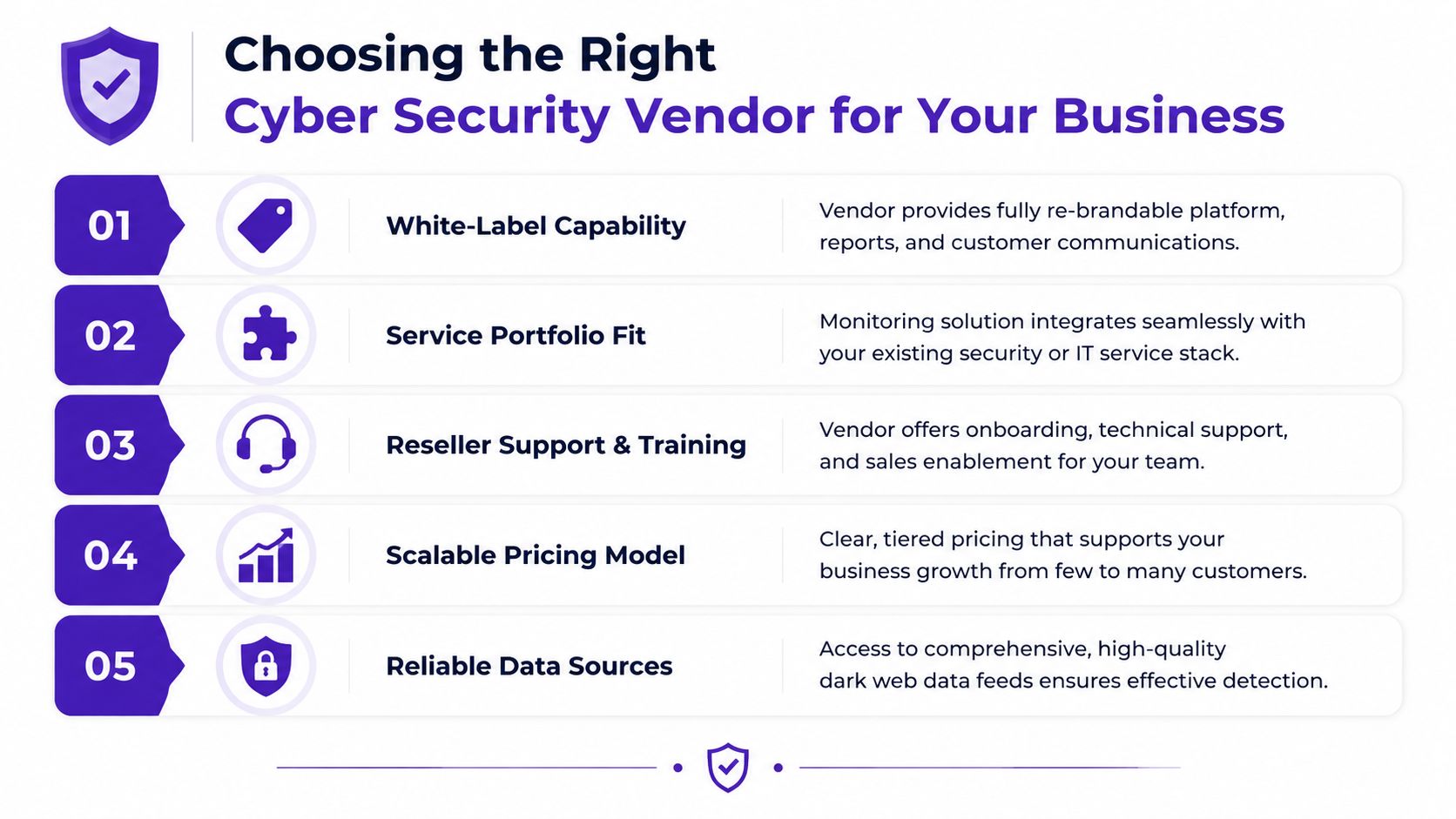
Choosing the Right Cyber Security Vendor for Your Business
A reseller vendor should be judged by the work it removes from your operation. A product that looks powerful but requires specialist administration, custom integration and constant interpretation can destroy margin through support time.
Start with branding. If the vendor can't provide a re-brandable experience, you may struggle to position the service as part of your own portfolio. Check the customer portal, alerts, reports and communications, not just the partner logo on a sales page.
Use a reseller decision matrix
| Evaluation criterion | What to check | Warning sign |
|---|---|---|
| White-label capability | Your branding appears across the customer experience | Customers are pushed to the vendor brand |
| Deployment | You can onboard a customer without a lengthy project | Each customer needs bespoke technical work |
| Alert quality | Findings are clear and tied to practical actions | Alerts require specialist interpretation |
| Support model | The vendor supports partner delivery and escalation | Your team becomes first-line product support |
| Commercial terms | Pricing allows a sustainable monthly margin | Costs are unclear or difficult to forecast |
| Trust signals | The vendor demonstrates relevant security practices | Claims are broad and difficult to verify |
Customer-facing simplicity should be a hard requirement. If a customer receives an alert about an exposed password, they should know what to do next. If the alert merely adds another technical term to the conversation, your support desk inherits the confusion.
Check credibility and fit
UK focus can help with trust, especially when customers want a provider that understands local operating conditions. GoSafe is Cyber Essentials accredited and designed with UK businesses in mind, while its platform is used by organisations globally. Those details don't remove the need for your own due diligence, but they give your sales team a clearer basis for the conversation.
The vendor should also fit your service boundaries. Dark web monitoring identifies exposure. It shouldn't pretend to replace endpoint protection, email security, incident response or access governance. A credible partner makes those boundaries clear and helps you build a sensible escalation path.
The UK skills picture reinforces the need for low-friction tools. The UK cyber security skills in the labour market report says the workforce gap stabilised at about 3,800 people, while 49% of businesses reported a basic technical skills gap and 30% reported gaps in advanced skills. It also states that 32% of businesses and 40% of charities lacked confidence dealing with breaches and had not outsourced that function.

Choose the vendor that makes the right action obvious. Every unclear alert becomes a support ticket, and every unnecessary support ticket reduces your margin.
Implementation Checklist for Launching Dark Web Monitoring
Launch the service as a product, not as an informal favour for a customer. A short, repeatable process protects delivery quality and gives your sales team something easy to present.
Set up the commercial foundation
Begin by joining a reseller programme and confirming the basics of your offer. Decide who the service is for, which existing contracts make good targets and how you'll describe monitoring in plain English.
Your service description should explain that the platform continuously checks for compromised email addresses, exposed passwords and breached domains, then provides an early alert when relevant credentials appear. Avoid claiming that monitoring prevents every breach. It provides visibility and an opportunity to act before exposed access is misused.
Configure the delivery workflow
Use this operational sequence:
- Prepare the branded service. Apply your company name, colours and customer-facing language. Keep the offer recognisable as part of your existing portfolio.
- Create an onboarding form. Capture the customer's authorised domains, monitored accounts and preferred contacts. Record consent and scope clearly.
- Define alert ownership. Decide whether your team receives alerts first, whether the customer receives them directly, or whether both parties receive a notification.
- Write the response playbook. For an exposed credential, the first actions may include resetting the password, checking reuse, reviewing sign-in activity and confirming that multifactor authentication is enabled where appropriate.
- Set the communication standard. Explain the finding without panic. Tell the customer what appeared, why it matters and what action you recommend.
Handle the first finding properly
An initial alert can create anxiety, particularly if the customer assumes exposure means an active compromise. Your team should distinguish between evidence of leaked data and evidence of current unauthorised access. Don't minimise the finding, but don't overstate it either.
A short breach summary works better than a technical dump. State the affected domain or account, the type of information identified, the practical risk and the next action. Record what the customer did and schedule a review if the finding needs further investigation.
Position the service beside existing contracts. An IT support customer can receive monitoring as a managed add-on. A hosting or web customer can add domain monitoring. A telecom or VoIP customer can receive it as part of a broader business resilience package. The value comes from making the service visible and actionable, not from burying it in a long catalogue.
Measuring ROI and Building Recurring Revenue from Security Services
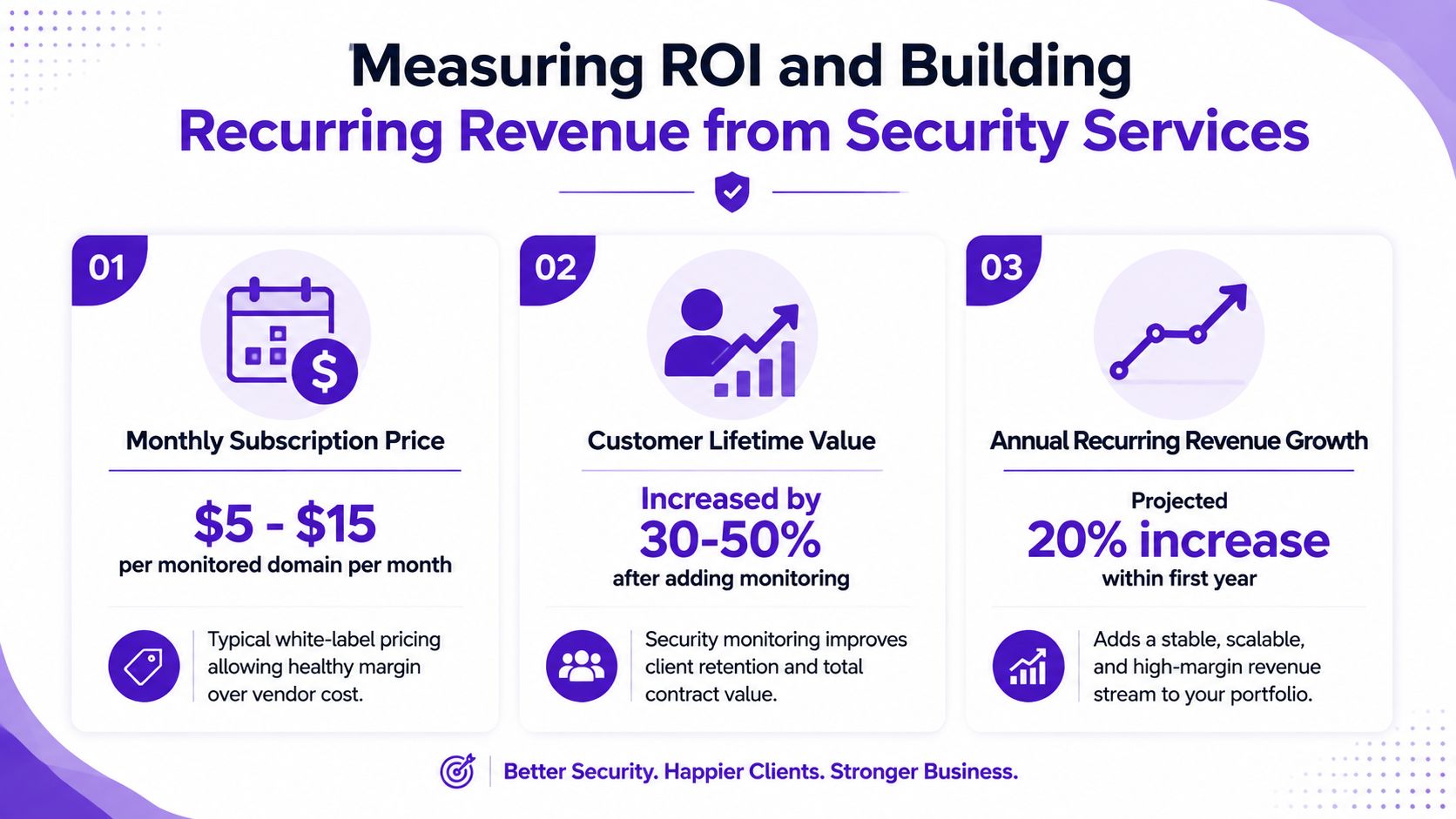
The commercial case for dark web monitoring rests on repeatable value. Customers pay monthly because the exposure picture changes, new credentials can appear and the provider remains responsible for helping them respond.
Start with a simple subscription model. Charge per monitored customer, domain or service tier according to your costs and the amount of support included. Don't copy a competitor's price without understanding your own onboarding, alert handling and account management effort.
Track the numbers that reflect delivery, not vanity:
- Active subscriptions: Count customers receiving the service each month.
- Monitored scope: Record the domains and accounts covered under each subscription.
- Actionable alerts: Measure findings that led to a password reset, investigation or other customer action.
- Expansion: Track customers that add monitoring to IT support, cloud, hosting, connectivity or telecom contracts.
- Retention: Compare renewal behaviour between customers with monitoring and those without it, using your own account data rather than an assumed benchmark.
Why the upsell is credible
Many businesses may already have compromised credentials circulating without knowing it. That makes the opening conversation more direct than a generic security pitch. You aren't asking a customer to imagine an abstract future. You're offering to check whether their existing domain and accounts have appeared in known exposed data.
The value also extends beyond the first alert. A finding can prompt a broader review of password reuse, privileged access, staff awareness, email filtering and incident response. That doesn't mean you should use fear to sell unrelated products. It means a specific finding can reveal where your existing services need strengthening.
Dark web monitoring can also improve service stickiness because it gives customers a regular reason to engage with you. A monthly alert, review or summary keeps security present in the relationship and reinforces your role as an adviser rather than a ticket-handling supplier.

Avoid the margin trap
A low price isn't automatically a good offer. If every alert requires manual analysis by a senior engineer, the service will create operational drag. Build boundaries into the package, use clear escalation rules and make sure customers understand what monitoring includes.
The provider should own the commercial relationship while the customer remains responsible for authorised access decisions and internal remediation. That division keeps the service useful without making your team responsible for every aspect of the customer's security estate.
Recurring revenue security services work when the monthly charge reflects continuing work and continuing visibility. Dark web monitoring is a sensible option because it can run in the background while creating specific, customer-facing moments that justify the subscription.
Next Steps to Start Selling Dark Web Monitoring Under Your Own Brand
The best cyber security offer for a service provider is the one the team can sell consistently and deliver without creating a new support department. Endpoint, network, email and training products all have a place, but they can carry more deployment or management effort. Dark web monitoring gives MSPs, IT companies, telecom providers, hosting businesses, web agencies and resellers a simpler entry point.
The offer is easy to explain. It checks for compromised email addresses, exposed passwords and breached domains, then produces clear alerts when relevant exposure appears. It can sit beside IT support, cloud services, hosting, connectivity, telecom systems and web services as a monthly subscription.
GoSafe is fully white-label. Partners can sell under their own company name, brand the customer experience as their own service and retain ownership of the customer relationship without building security tools internally. The platform is designed for low-friction delivery, so you can offer security services under your brand without requiring a specialist security team.
Join the GoSafe reseller programme, review the commercial model and prepare a simple first offer for your existing customers. Start with accounts where you already have trust, define who handles alerts and make the next action clear. That approach gives you a practical route into dark web monitoring service for businesses without taking on an enterprise security suite you can't operationalise.
GoSafe Dark Web monitoring provides continuous scanning for compromised email addresses, exposed passwords and breached domains, with clear alerts that business users can understand. Visit GoSafe Dark Web monitoring to see how it can support a white-label recurring service for your customers and strengthen your cyber security portfolio.