You've probably had this conversation already. A customer wants a security service, you don't want to build it from scratch, and you'd rather keep the relationship under your own brand than send them elsewhere.
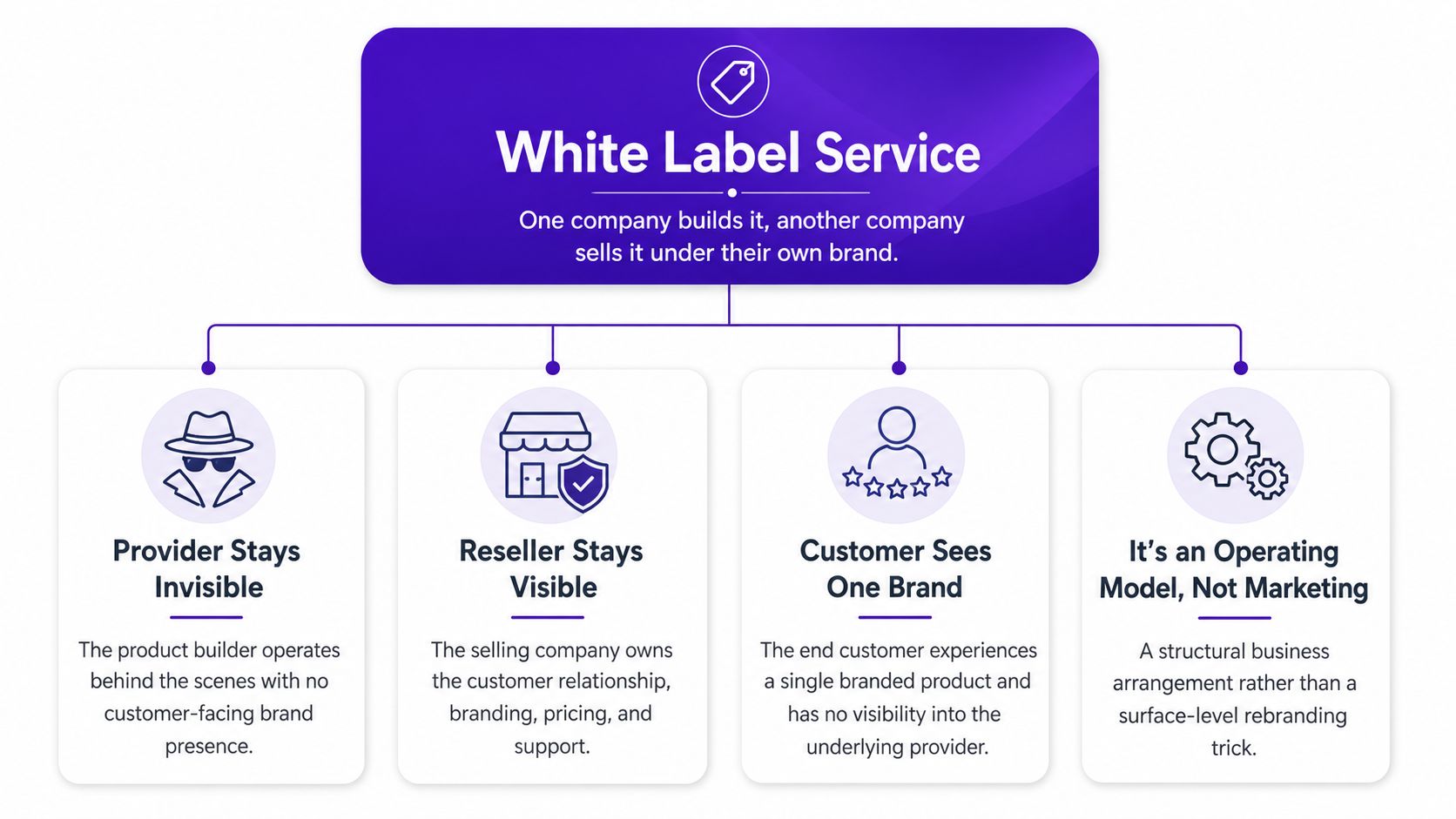
That's where what is a white label service stops being a theory question and becomes a commercial one. For an MSP, telecom provider, SaaS reseller, or cyber consultant, a white label service is a product or service that one company builds and runs while another company sells it under its own brand. The customer sees your name, your support tone, and your pricing. The underlying provider stays out of sight.
Used properly, it's not a marketing trick. It's an operating model. In the UK, that matters because regulated outsourcing and branded third-party delivery are already normal in financial services and adjacent sectors, with open banking showing how a service can scale through third-party infrastructure while remaining invisible to the end user. The model works because it lets you expand your offer without trying to become a software vendor overnight.
A Working Definition for Service Providers
A reseller owner doesn't usually ask for a dictionary definition. They ask a blunt question, can I sell this, support it, and make money from it without hiring a team I can't afford?
That's the definition of a white label service. One company does the hard work of building, maintaining, and updating the product. Another company sells it under its own brand, sets the customer relationship, and packages it into its own commercial offer. The end customer sees one provider, even though two businesses are involved behind the scenes.
The part most people miss
White labelling is not just a re-skin. It changes how you go to market. You're not buying a generic tool and hoping customers tolerate it. You're taking an already-built service and putting your brand, pricing, and support layer on top of it.
That distinction matters for channel businesses. If you sell IT support, hosting, connectivity, or SaaS, the white label model lets you widen your portfolio without forcing your team to become specialists in every adjacent category. In practice, that means you keep the customer-facing role while the underlying provider carries the operational load. That separation is why white labelling is so useful in regulated or technically dense markets.
Commercial rule: if you can't explain the offer in one sentence to a non-technical buyer, it's too complicated to resell.
For UK businesses, that simplicity is part of the appeal. The FCA's open-banking reporting shows how branded services can be delivered at scale through third-party infrastructure, with 10.36 million active open-banking users by 31 March 2025 and 22.1 million payments made in March 2025 alone, all while the underlying infrastructure stays mostly invisible to the customer (EBA white labelling report). That scale is exactly why the model is worth paying attention to.
How White Labelling Actually Works
The cleanest way to think about white labelling is engine and showroom. The provider builds and maintains the engine. The reseller controls the showroom, including the branding, the commercial pitch, the billing, and the customer conversation.
Who owns what
The provider usually owns the infrastructure, the platform updates, the underlying workflows, and the technical maintenance. The reseller usually owns the customer relationship, the price list, the packaging, the support tone, and the contract. In a strong white label setup, the reseller can also shape dashboards, email wording, alert templates, and reports so the service feels native to their brand.
That's why this model works so well for MSPs and SaaS resellers. You don't need to hire a full product team to launch another service line. You need a provider that can do the technical heavy lifting while you handle positioning, sales, and account management.
What the customer actually experiences
The customer shouldn't have to think about the underlying vendor. They should see one brand, one dashboard, one set of alerts, and one support route. If the service still feels like a partner product bolted onto your stack, the white label arrangement is too shallow.
In UK financial and telecom channels, that clarity matters because the reseller wants to keep the customer-facing experience consistent even when the technical delivery sits elsewhere. That's also why white labelling is most effective when the provider handles maintenance and infrastructure centrally, while the reseller controls what the customer sees day to day. The architecture is straightforward, but the commercial effect is powerful.
For a practical explainer on how to position this in a service business, the IT services sales playbook is a useful way to think about buyer language, packaging, and conversation flow. If you're mapping the operating model to recurring offers, the GoSafe Dark Web monitoring reseller guide is also worth a look: GoSafe Dark Web monitoring reseller guide.
Commercial Benefits for Resellers and MSPs
The reason white labelling keeps winning attention is simple. It helps you add revenue without adding the same level of operational complexity you'd face if you built the service yourself.
Why it works commercially
First, it gives you a way to launch a new offer without waiting on a full development cycle. Second, it fits naturally into monthly subscription billing, which is how most service businesses already sell. Third, it keeps overhead low because you're not carrying the full cost of product engineering, infrastructure, or specialist hiring just to test demand.
That matters even more in a crowded UK channel market. If a customer already trusts you for IT support, cloud, hosting, or connectivity, you can extend that relationship with a service that is easy to explain and easy to bundle. Security monitoring is especially good for this because it creates a sensible add-on rather than forcing a separate buying decision.
Dark web monitoring is a good reseller product
Dark web monitoring is commercially useful because it's easy to describe in plain English. You're not selling a complex platform. You're selling early warning, visibility, and peace of mind when compromised credentials show up in the wrong place.
That makes it ideal for recurring revenue security services. It also shortens the sales conversation, because a non-technical buyer understands the risk immediately. If you want a deeper look at the recurring model around this category, the article on recurring revenue from dark web scanning ties the commercial logic to the channel opportunity.
Buyers don't want another dashboard they'll ignore. They want alerts they can understand and act on quickly.
The wider market context helps too. The UK Cyber Security Breaches Survey 2025 found that 43% of UK businesses and 30% of charities experienced a cyber breach or attack in the previous 12 months, with the figures rising to 67% for medium businesses and 74% for large businesses, while phishing affected 84% of businesses that experienced a breach or attack (UK Cyber Security Breaches Survey 2025). That's a strong commercial backdrop for branded security services that can be sold and explained quickly.
Risks and Accountability Gaps to Plan For
This is the part too many white label pitches gloss over. Delivery may sit with the provider, but the reseller usually still carries the customer relationship, and in the UK that can mean serious accountability.

UK GDPR does not care about your branding
If your white label partner handles personal data or security events, your contracts need to say exactly who does what. Under UK GDPR, a personal data breach must be reported to the Information Commissioner's Office within 72 hours of becoming aware of it, unless the breach is unlikely to create a risk to individuals' rights and freedoms (UK GDPR breach reporting guidance). That deadline doesn't soften because the service is outsourced.
The ICO can also fine organisations up to £17.5 million or 4% of global turnover for serious breaches, which is why vague contracts are a bad idea in a white label service chain (UK GDPR accountability discussion). If you're reselling any service touching personal data, you need breach workflows, escalation paths, and SLA wording that reflect UK expectations rather than a generic template.
Ask the awkward questions before you sign
The most useful questions are not about branding. They're about dependency. What happens if the provider changes pricing? What happens if they're acquired? What happens during an outage? What support do they commit to when a customer rings your team first, not theirs?
If you're comparing commercial models, the merchant of record definition is a helpful contrast, because it shows how responsibility can sit with different parties in different operating models. White labelling isn't the same thing, but the comparison is useful: you need to know exactly who is carrying the commercial and legal load.
For security services, the practical rule is simple. Don't buy a white label offer unless the contract clearly covers data handling, incident response, uptime commitments, exit terms, and who speaks to the customer when something goes wrong. If the provider dodges those questions, walk away.
White Label Dark Web Monitoring in Practice
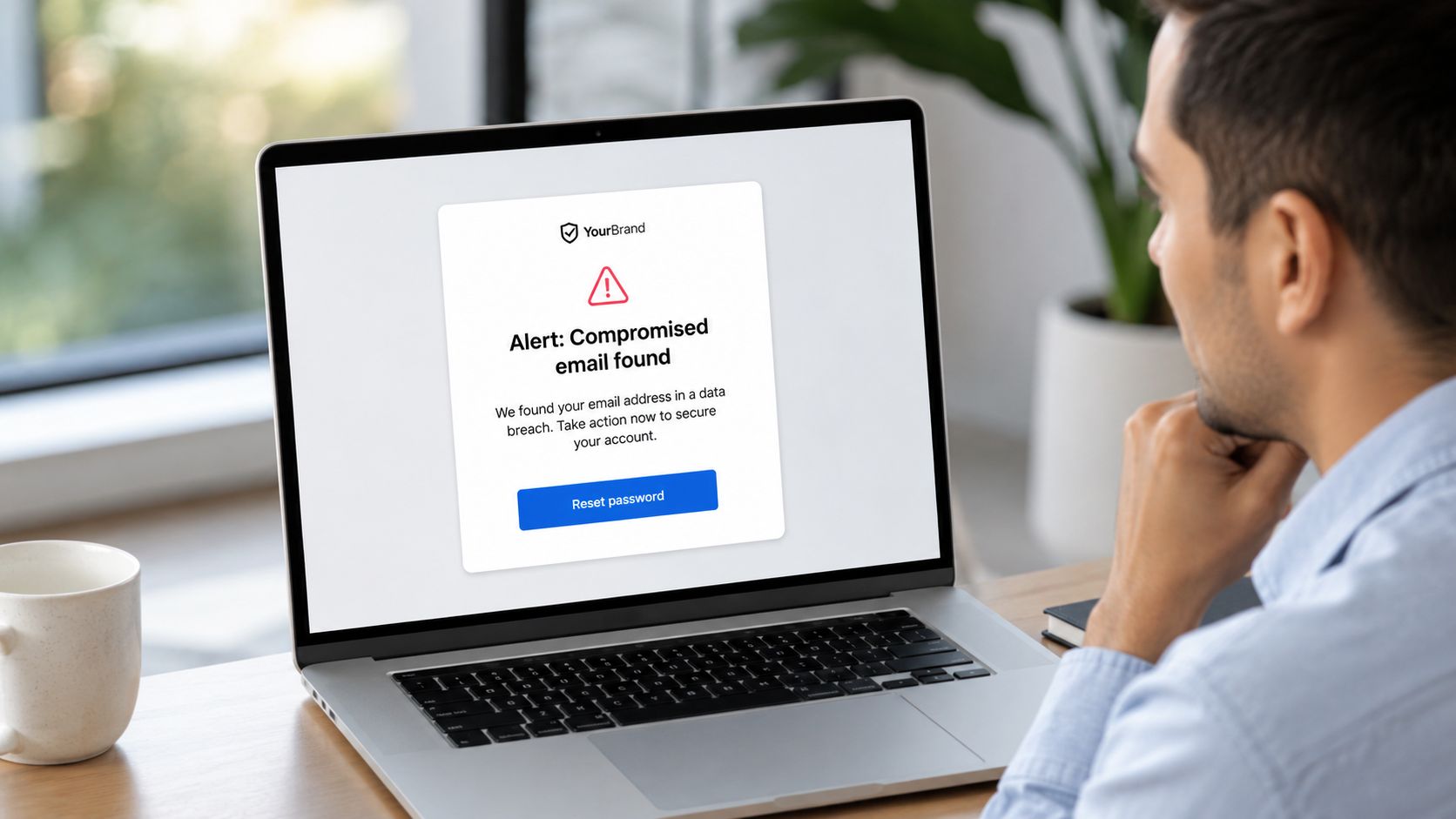
Dark web monitoring is one of the cleanest white label offers you can sell because the value is obvious and the outcome is easy to explain. The reseller sells a branded service that continuously scans for compromised email addresses, exposed passwords, breached domains, and early signs that staff credentials have appeared where they shouldn't.
What the customer buys
The customer isn't buying threat intelligence jargon. They're buying simple alerts that tell them when a business email address, password, or domain has shown up in exposed data. The good version of this service does one job well, it watches continuously and tells the customer early enough to act before credentials are reused.
That's exactly why white label dark web monitoring is such a practical fit for MSPs and SaaS resellers. It gives you a service that can sit alongside managed support, hosting, VoIP, or cloud contracts without adding a heavy support burden. The customer gets visibility and peace of mind. You get a product that is easy to package under your own name.
GoSafe is one example of a fully white-label dark web monitoring platform built for this use case, with continuous scanning, exposed credential detection, and clear alerts. It's not a broad security suite, and that's the point. Resellers need something they can explain quickly and deliver without specialist security knowledge.
Why it sells
This type of offer works because it starts useful conversations with existing customers. You're not trying to convince them to buy cybersecurity in the abstract. You're pointing to a specific risk, exposed credentials, and offering an understandable monthly service to watch for it.
The UK angle matters here too. The Government's Cyber Security Breaches Survey 2024 found that 50% of businesses and 32% of charities reported a cyber breach or attack in the previous 12 months, with phishing remaining the most common attack vector (Cyber Security Breaches Survey 2024 summary). The NCSC also says phishing remains the most common attack type seen by CiSP, and it warns that credential theft is often used as the entry point to wider compromise (NCSC phishing and credential theft review). That's exactly the kind of threat dark web monitoring helps surface early.
For channel businesses looking to understand the revenue angle behind this category, the article on recurring revenue from dark web scanning is a useful companion. It shows why this offer fits recurring billing better than one-off incident response.
How to Evaluate a White Label Solution
Don't buy a white label product because the demo looked polished. Buy it because it fits your commercial model.
The questions that matter
Start with branding depth. Can you re-skin the dashboard, alerts, reports, and emails, or are you just putting your logo on top of someone else's interface? Then check onboarding speed. If setup drags for weeks, your sales team will lose momentum and your customers will lose interest.
Next, be honest about the support model. Who handles first-line queries, who handles technical issues, and how fast do they respond when a customer is unhappy? If the answers are unclear, the product isn't really white label in a commercial sense. It's just outsourced software with your logo attached.
If the provider can't explain their handoff in plain English, they'll be hard to work with when a customer is under pressure.
A short buying checklist
- Branding control: Can you present the service fully under your own company name?
- Customer ownership: Do you keep the direct relationship, billing, and renewal cycle?
- Operational load: Do you need a security specialist, or can your existing team run it?
- Pricing transparency: Can you see your margin clearly before you commit?
- Exit terms: Can you leave without losing your customer base or operational continuity?
For a dark web monitoring service, good answers should sound boring in the best possible way. You want straightforward branding, simple alerts, predictable billing, and no need to build your own security tooling. If the product needs a long technical explanation before you can sell it, it probably isn't the right fit for a reseller-led business.
Launching Your Branded Service
Start small and launch properly. Confirm the positioning, apply your branding to the dashboard and alerts, set a monthly subscription price, and write a one-page customer explainer that a non-technical buyer can understand. Then test it with a small group of existing customers before you roll it out more widely.
If you're planning the commercial launch, the RevOps go-to-market tactics framework is useful for thinking about targeting, sequencing, and how the offer enters your current portfolio. Keep the launch tight. Don't overcomplicate the offer, and don't let internal debate delay the first sale.
Use the GoSafe Dark Web monitoring reseller plan here: GoSafe Dark Web monitoring reseller plan. If you want a fully white-label dark web monitoring platform that fits an existing service stack, that is the place to start.
GoSafe Dark Web monitoring gives you a white-label way to sell continuous dark web monitoring under your own brand, with clear alerts for compromised emails, exposed passwords, and breached domains. If you want to offer a practical security service without building the tooling yourself, visit GoSafe Dark Web monitoring and see how the reseller programme fits your portfolio.