For your clients, data leak prevention is not just another IT term. It is a practical strategy that combines technology, company processes, and staff training to prevent sensitive information from being exposed without authorisation.
Think of it less like a firewall and more like a comprehensive security system for their most valuable digital assets, protecting them from both accidental mistakes and deliberate theft.
Understanding the Core of Data Leak Prevention
When speaking with clients, it is best to avoid technical jargon. Frame data leak prevention (DLP) in terms they understand: business resilience.
It helps to use an analogy. Imagine their business data is stored in a digital vault. A basic firewall is like the lock on the front door—it is a good start, but it is not enough. A proper DLP strategy goes much further.
It is like having a security guard who constantly checks who has the keys, whether those keys have been copied and sold, and sends an alert the second a key is lost or appears somewhere it should not—like on the dark web. This helps clients grasp that security is not a one-off setup; it is a continuous process of vigilance and control.
Why It Matters to Your Clients
The need for effective data leak prevention comes from real-world risks that can damage a business's profitability. The reality is that many organisations already have compromised credentials available online, creating an open door for an attack.
A robust DLP strategy protects your clients by:
- Guarding Sensitive Information: This covers everything from customer lists and financial records to confidential business plans.
- Ensuring Regulatory Compliance: Adhering to standards like the UK GDPR is non-negotiable if they want to avoid significant fines and reputational damage.
- Preventing Business Disruption: A major leak can bring operations to a halt, destroy customer trust, and lead to very expensive recovery efforts.
The purpose of modern data leak prevention is to shift from a reactive mindset—cleaning up after a breach—to a proactive one. It’s about finding the unlocked doors and lost keys before a criminal does.
The Role of Proactive Monitoring
Traditional security tools often miss the most common cause of a breach—stolen credentials. This is where proactive monitoring becomes your most effective first line of defence.
Services that continuously scan the web for exposed employee details provide the early warning needed to neutralise a threat. By spotting a leaked password or email address before it is used in an attack, you give your clients the power to act, not just react. This changes the security conversation from one of fear to one of empowerment.
For telecom and IT providers, offering white label dark web monitoring is the most direct way to deliver this value. It is a high-impact service that is easy for clients to understand and straightforward for you to sell.
The True Commercial Cost of a Data Leak

When discussing security with a client, the conversation can feel abstract—until you put a price on the risk. A data leak is not just an IT problem; it is a major commercial blow with immediate, painful costs and long-term consequences that can harm a small or medium-sized business.
Understanding these figures is crucial for telecom and IT providers. It helps you shift the conversation from a technical one to a commercial one, reframing proactive security like data leak prevention as a critical business investment.
The Immediate Financial Impact
The first wave of costs is immediate and significant. These are the real-world expenses a business must cover right after a data leak, and they accumulate quickly.
For any UK business, the biggest threat is regulatory fines. Under the UK GDPR, penalties can reach £17.5 million or 4% of annual global turnover—whichever is higher. Even a small incident can trigger a large fine if the Information Commissioner's Office (ICO) decides the correct protections were not in place.
But the fines are just the start. There are other direct costs to consider:
- Remediation Services: It is likely you will need to hire external experts to contain the breach, determine how it happened, and restore your systems. This is not cheap.
- Customer Notification: Legally, you must inform affected customers about what happened. This means setting up call centres, paying for postage, and often offering credit monitoring services—all costly and complex.
- Legal Fees: It is common for businesses to face legal action from customers or partners after a breach, leading to lengthy and expensive court proceedings.
The Long-Term Commercial Damage
While the initial impact is painful, the long-term damage to a company's health is often far worse. This is where the true cost of a data leak emerges, lingering for years after the incident.
A company's reputation is its most valuable asset, and a data leak can destroy it. Customers lose trust, and once that trust is gone, it is incredibly difficult to regain. This leads directly to customer churn, as clients move to competitors they perceive as safer.
The economic fallout is enormous. Recent government data revealed that 43% of UK businesses—over 600,000 firms—suffered a breach in the last year. These attacks contributed to an estimated £27 billion in annual costs. The research also directly linked these breaches to 437,000 fraud victims and £755 million in yearly expenses, showing the real-world impact on individuals and businesses. You can read the full government research on the economic impact of cyber attacks to see the full scale of the problem.
A data leak erodes more than just data; it erodes customer confidence, competitive advantage, and future revenue. The cost is not a one-time event but a long-term commercial burden.
For telecom and IT providers, putting these risks into numbers is key to demonstrating your value. By presenting a clear business case, you can prove to clients that proactive services like dark web monitoring are not just about security—they are about protecting the financial future of their business.
How Data Leaks Happen in a Business Context
Forget the cinematic image of a master hacker in a dark room. The reality of a data leak for most UK businesses is far less dramatic and far more common. Most breaches do not start with a complex, brute-force attack but with a simple mistake or a moment of carelessness.
Understanding these everyday causes is the first real step in building a data leak prevention strategy that works. For telecom and IT providers, this knowledge helps you show your clients where their biggest weaknesses truly lie. It turns out that most incidents trace back to two areas: external threats that exploit human trust and internal risks that come from human error.
External Threats That Target People, Not Systems
Attackers are pragmatic. They know that trying to break through a digital firewall is much harder than simply tricking an employee into opening the door for them. This is the world of social engineering.
Phishing and Spear Phishing: These are the fraudulent emails we have all seen. A standard phishing attempt might pretend to be from Microsoft or a delivery company, trying to get someone to click a link to a fake login page. Spear phishing is much more personal, perhaps an email that appears to be from a senior manager asking for an urgent file transfer. You can find out more about how to protect against social engineering in our dedicated guide.
Credential Stuffing: This is not a direct attack on your client's business, but a dangerous side effect of other companies being breached. Hackers take huge lists of leaked usernames and passwords from other website breaches and try them against your client's accounts, relying on the fact that people reuse the same credentials everywhere.
Internal Risks and Accidental Exposure
Just as dangerous as any outside attack are the risks that come from inside the business. These are usually accidents, but the damage can be just as severe. Human error is a major factor in data exposure.
The Information Commissioner's Office (ICO) consistently reports on this, and its findings paint a clear picture. While the exact numbers change, human error is always a leading cause of breaches. This aligns with wider industry data showing the human element is involved in around 60% of breaches. It is a significant problem for UK firms, with 35% of micro-businesses affected in the last year alone. You can review the data security incident trends published by the ICO for a closer look.
A data leak often starts small—a single compromised password or one email sent to the wrong person. It seems minor, but that is the foothold an attacker needs to access valuable information.
Here are the most common internal mistakes:
- Weak or Reused Passwords: When staff use easy-to-guess passwords like "Summer2024!" or use the same one for their work email and a shopping app, one breach elsewhere can unlock everything.
- Accidental Data Sharing: This happens more often than anyone wants to admit. An employee accidentally attaches a sensitive spreadsheet to the wrong email or misconfigures a cloud folder, leaving it open to the public internet.
- Lost or Stolen Devices: A company laptop left in a taxi or a phone stolen from a café is a goldmine. If it is not encrypted, it contains everything from emails to client lists, ready for the taking.
Ultimately, these everyday scenarios prove that effective data leak prevention is not just about buying more software. It is about understanding that compromised credentials and simple mistakes are where most data leaks begin, which makes proactive monitoring essential.
Building a Practical Data Leak Prevention Strategy
Knowing how data leaks happen is one thing. Building a strategy your clients can actually use is another challenge.
A truly effective data leak prevention plan does not need to be overly complex. For most small and medium-sized businesses, a straightforward approach built on three pillars—People, Processes, and Technology—is far more effective than an expensive, convoluted security suite.
This structure allows you, as their IT or telecom provider, to deliver a practical and scalable security plan. It addresses the most common points of failure—human error and outdated procedures—while layering in essential technology for a robust defence. Let's break down how to put this strategy together for your clients.
The People Pillar: Strengthening the Human Defence
Employees can be the weakest link in the security chain. However, with the right training and awareness, they can also become a company’s strongest asset. The 'People' pillar is about turning staff from a potential risk into your first line of defence.
This requires more than just an annual training video. A practical approach includes:
- Continuous Awareness Training: Regular, concise sessions that cover current threats like phishing, the importance of strong passwords, and how to handle sensitive data responsibly.
- Simulated Phishing Tests: These controlled tests are an excellent way to see which employees are most likely to click on a malicious email. The results are not for punishment; they provide valuable coaching opportunities to help your team spot real threats. GoSafe’s platform includes phishing simulations to make this easy to manage.
The Process Pillar: Defining the Rules of Engagement
Clear processes remove guesswork and dramatically reduce the chance of accidental data exposure. This pillar is about creating simple, documented rules for how data is handled, stored, and protected. It is about setting clear expectations for everyone.
Key processes to establish include:
- A Simple Data Handling Policy: This does not need to be a 50-page legal document. It should clearly define what counts as sensitive data and outline basic rules, like not sending client lists to personal email addresses or sharing passwords.
- An Incident Response Plan: What happens when you suspect a data leak? A simple plan outlining who to contact and what to do first ensures a calm, organised response instead of a panic that could make things worse.
The Technology Pillar: The Essential Toolkit
Technology provides the critical visibility and control needed to enforce your policies and detect threats that slip past human defences. The goal is not to overwhelm a business with dozens of tools, but to implement a few high-impact solutions that tackle the biggest risks.
A successful technology stack for data leak prevention is not about having the most tools; it is about having the right tools. It all starts with proactive monitoring to spot the earliest signs of trouble—compromised credentials on the dark web.
This is where white-label dark web monitoring becomes your foundation. A service like GoSafe provides that crucial early-warning system. It continuously scans for your clients' email addresses, passwords, and domains on the dark web, alerting you the moment a credential leak is found.
This proactive visibility lets you reset a compromised password before an attacker can use it, effectively stopping a breach before it starts. Because GoSafe is designed for the channel, you do not need specialist security knowledge to manage it, and it delivers clear, non-technical alerts your customers can understand. It is the easiest way to add a meaningful security service to your stack.
To help guide your client conversations, here is a simple checklist breaking down these three pillars into actionable steps.
Data Leak Prevention Strategy Checklist
| Pillar | Action Item | Key Benefit |
|---|---|---|
| People | Implement regular, simulated phishing tests for all staff. | Identifies training gaps and builds a more resilient human firewall against real-world attacks. |
| People | Conduct ongoing security awareness training sessions. | Keeps security top-of-mind and educates employees on the latest threats and best practices. |
| Processes | Create a clear, simple data handling policy. | Reduces accidental data exposure by providing straightforward rules for managing sensitive information. |
| Processes | Develop a basic incident response plan. | Ensures a swift and organised reaction to a potential breach, minimising potential damage. |
| Technology | Implement a password manager across the organisation. | Eliminates weak and reused passwords, one of the most common entry points for attackers. |
| Technology | Deploy continuous dark web monitoring. | Provides an essential early-warning system by detecting compromised credentials before they are exploited. |
By building a strategy around these core pillars, you can provide a complete and practical data leak prevention service that is easy for your clients to understand and for you to deliver.
Ready to provide this essential layer of protection? Add white-label dark web monitoring to your service stack.
Why Dark Web Monitoring Is a Modern Necessity
For too long, security tools have focused on reacting to incidents after a breach has already occurred. But in a world where stolen credentials are a cybercriminal's preferred tool, waiting for an alarm is no longer sufficient. Modern data leak prevention must be proactive. It is less about building higher walls and more about spotting threats gathering outside them.
This is where continuous dark web monitoring is essential. It is not just another tool; it is the cornerstone of a practical, forward-thinking security strategy. Think of it as your early-warning system, giving you and your clients a view into a world you would not otherwise see. Long before a criminal uses a stolen password to access a system, that same credential often appears for sale on a hidden marketplace.
From Reactive to Proactive Defence
A fire extinguisher is a vital tool, but a smoke detector is what gives you the precious seconds to prevent a small problem from becoming a catastrophe. Dark web monitoring works in the same way for your clients’ digital identities.
It constantly scans the parts of the internet where stolen data is bought and sold, searching for compromised employee credentials, email addresses, and company domains. The moment it finds a match, it triggers an alert.
The real value here is simple. Dark web monitoring changes the dynamic. It gives you the same intelligence the criminals have, letting you act first by changing a compromised password before it can be used against you.
This single, proactive step closes the most common entry point for attackers and is fundamental to any robust data leak prevention plan. A solid strategy must be built on three pillars: people, processes, and technology.
This diagram shows how a complete DLP strategy pulls together people, processes, and technology into one unified plan.
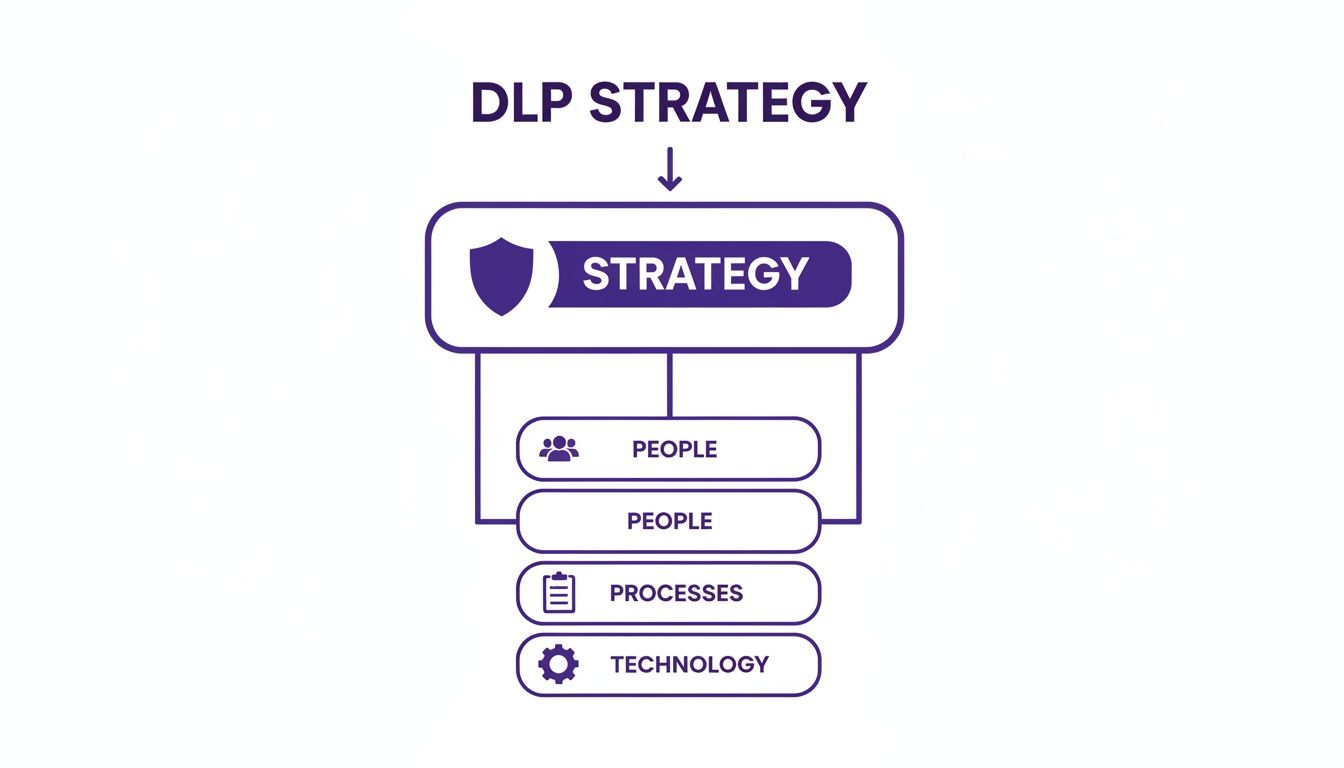
As you can see, technology like dark web monitoring is not just a standalone product—it is the foundation that supports and enforces the policies and training you put in place.
Meeting a Critical Market Need
This is not a theoretical threat; it is a significant commercial reality for UK businesses. According to the UK's Cyber Security Breaches Survey, 43% of businesses—over 600,000 organisations—suffered a cyber breach or attack in the past year. A large number of these incidents involved data leaks that could have been stopped with early detection.
This constant threat has created a large, underserved need in the market. Small and medium-sized businesses are often the most affected, but they typically lack the time, budget, or in-house expertise for complex security solutions. They need something that is effective, easy to understand, and makes commercial sense.
For telecom and IT partners, this presents a clear opportunity. A service like GoSafe provides the ideal solution. It is fully white labelled, so you can offer a branded dark web monitoring service under your own name. It requires no specialist security knowledge to manage and delivers clear, actionable alerts that you and your clients can understand immediately. If you want to understand the different hidden parts of the internet, you can check out our guide on the Deep Web vs Dark Web.
By offering this service, you empower your clients to get ahead of threats, moving them away from a costly, reactive model. You are not just selling another product; you are providing a high-impact solution that solves a proven market demand, strengthening your position as a trusted advisor.
Ready to offer this essential protection? Book a demo of GoSafe’s white-label dark web monitoring.
Easily Add Data Leak Prevention to Your Services
If you are a telecom provider, MSP, or IT reseller, the conversation around data leak prevention is more than just a security trend—it is a significant commercial opportunity. Your clients know the threats are real, but most lack the in-house expertise or budget to tackle them directly. They are looking to you, their trusted technology partner, for a simple and effective solution.
This is your chance to meet that demand with a service that is not only high-margin but also has a low operational overhead. The ideal offering is easy to sell, simple to run, and delivers immediate, obvious value. This is exactly where a white-label platform is most effective.
Offer a Branded Service Without the Complexity
You do not need to build a security operations centre or hire a team of analysts to offer a powerful data leak prevention service. A solution like GoSafe lets you launch a fully branded dark web monitoring service under your own name with minimal setup.
This approach removes technical complexities and operational overhead. The platform works automatically in the background, scanning for your clients' compromised credentials and sending simple, non-technical alerts that both you and your customers can understand and act on. It is a natural upsell that fits perfectly into your existing service stack, whether you provide broadband, VoIP, or managed IT support.
The benefits for your business are clear:
- Create Predictable Recurring Revenue: Add a new, high-margin monthly service that clients will quickly see as essential.
- Increase Customer Loyalty: When you proactively protect a client from a breach, you move from being a supplier to an indispensable partner, which helps to reduce churn.
- Strengthen Your Offering: Differentiate from the competition by providing a security service that directly addresses one of your clients’ biggest concerns.
Ultimately, offering a branded dark web monitoring service is the most direct way to start meaningful security conversations, deepen client relationships, and build a more resilient revenue stream for your own business.
Ready to see how simple it is to get started? Add white-label dark web monitoring to your service stack by viewing the GoSafe reseller programme.
Frequently Asked Questions
If you are an IT or telecom provider considering adding security services to your portfolio, you may have some practical questions. This is a common scenario. Let's address some of the most frequent queries we hear about offering data leak prevention and dark web monitoring.
Do I need a dedicated security team to offer this?
No. This is one of the biggest misconceptions.
Modern platforms like GoSafe’s white-label dark web monitoring are designed specifically for telecom and IT providers, not cybersecurity specialists. The entire system is automated, sending you and your clients simple, clear alerts that are easy to understand. You can see the risk and act on it without needing a team of security experts. It provides a high-value security service without the operational overhead.
How do I explain dark web monitoring to my clients?
Keep it simple. Frame it as an early-warning system.
Explain that countless businesses already have compromised credentials on the dark web without knowing it. The service finds these exposed details before a criminal does, preventing them from being used for fraud, ransomware, or data theft.
It’s a proactive alarm that gives them a chance to lock the doors before an intruder gets in, rather than reacting after a break-in. This way, you are not talking about technical specifications; you are talking about practical business protection, which is what your clients care about.
Will this be difficult to integrate with my existing services?
Not at all. A white-label solution like GoSafe is designed to be a natural, seamless add-on to what you already offer, whether that is connectivity, VoIP, or managed IT support. There is no complex integration required—you can have it running quickly.
You can brand it as your own service and bundle it with your core offerings to:
- Increase your Average Revenue Per User (ARPU).
- Reduce customer churn by making your service more valuable.
- Offer a more complete and competitive solution.
Ultimately, it reinforces your role as their trusted advisor, proving you are proactively looking out for one of their biggest business risks.
Ready to add this essential layer of protection for your clients? With GoSafe, you can offer a powerful, branded security service without the complexity.