
Many people get this wrong.
The difference between the deep web and the dark web is not just a technical detail—it is the difference between a private online bank account and a hidden marketplace selling stolen data. One is normal and necessary; the other is a genuine threat to your business.
Defining The Hidden Layers Of The Internet
For telecom providers and MSPs, explaining the deep web vs dark web is not just about sounding informed. It is a crucial first step in showing clients where real business risks lie. When you clarify the confusion, you can start a practical conversation about high-value security services.
The Deep Web Is Not The Dark Web
Let’s be clear: the deep web is massive, making up roughly 90% of everything online. It is simply the part of the internet that search engines like Google cannot see. It is not sinister; it is just private.
You use the deep web every day for perfectly normal, legitimate activities. Consider:
Logging into your online banking
Accessing your company’s internal intranet
Using private cloud storage like Dropbox or OneDrive
Viewing medical records or legal documents
Reading paywalled academic journals
In short, the deep web is where confidential information is kept safe by design. It is a vital part of the internet, protecting sensitive data from public view.
This quick comparison breaks down the key differences between the unindexed deep web and the anonymous dark web.
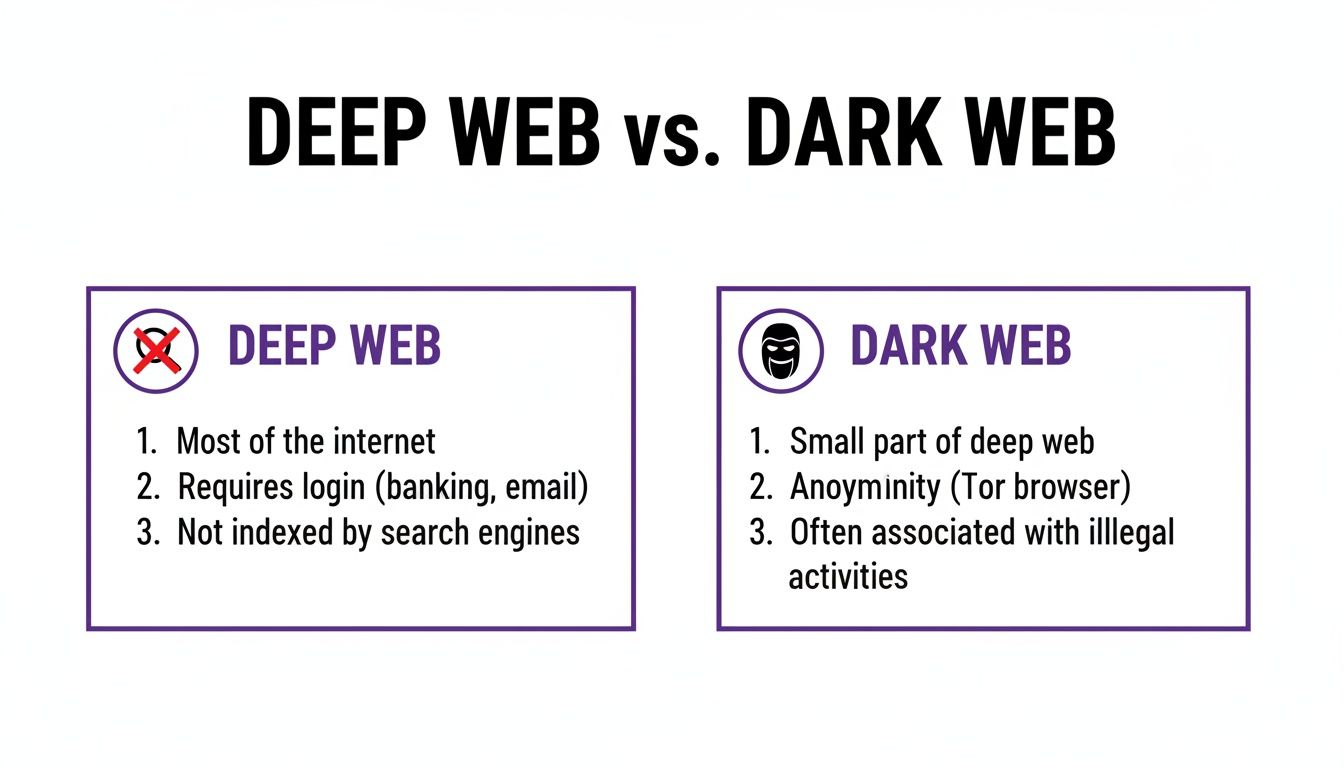
As you can see, while both are hidden from standard search engines, their scale, purpose, and how you access them are worlds apart.
To give you a clearer picture, here is a quick breakdown.
Deep Web vs Dark Web At A Glance
| Characteristic | Deep Web | Dark Web |
|---|---|---|
| Size | Makes up ~90% of the internet. | A very small fraction of the deep web. |
| Accessibility | Requires a standard login (e.g., username/password). | Requires special software like the Tor browser. |
| Primary Content | Private data: emails, bank accounts, corporate portals. | Anonymous forums, illegal marketplaces, hidden services. |
| Legality | Perfectly legal and used for everyday activities. | Hosts significant illegal activity alongside legitimate uses. |
This table shows that while your data lives safely on the deep web, it becomes a high-risk commodity if it ends up on the dark web.
What Makes The Dark Web A Threat
The dark web is a small, intentionally hidden corner of the deep web. It's built for anonymity, requiring specialised tools like the Tor browser to access its ".onion" websites. While this anonymity has some valid uses, it has also created the perfect environment for cybercriminals.
This is where the risk to your customers becomes real. Stolen company data, compromised email accounts, and entire customer databases are bought and sold every day in these hidden markets. In fact, some estimates suggest 56.8% of dark web content is illegal. It’s a problem UK law enforcement takes seriously, shutting down major operations like the DarkMarket in 2020. To dig deeper into the numbers, check out the latest research from Panda Security.
For MSPs and telecom providers, this is the key takeaway for your customers: their sensitive data belongs on the deep web. Once it is breached and ends up on the dark web, it becomes a weapon criminals can use against them.
Assessing The Commercial Threat To Your Customers
Knowing the difference between the deep and dark web is one thing. Understanding the very real commercial threat it poses to your customers is another. For UK-based telecom providers and MSPs, this is where the security conversation becomes commercially relevant. The dark web is not some far-off concept; it is an active marketplace where your customers' most valuable assets are bought and sold every day.

The biggest risk comes from compromised business data being sold. This is not just a problem for large corporations; small and medium-sized businesses are prime targets because they are often perceived as having weaker security. Cybercriminals package up stolen information and sell it quickly to other malicious groups.
What Is Being Sold On The Dark Web?
The items for sale on these illegal marketplaces are a direct reflection of how attackers breach business networks. And it is rarely a complex hack. Most breaches start with something much simpler—a stolen password.
Commonly traded assets include:
Employee Credentials: Email addresses and passwords, often lifted from third-party website breaches, are the top commodity. Criminals buy them to launch credential stuffing attacks and force their way into corporate accounts.
Customer Databases: Entire lists of customer names, emails, and phone numbers are sold to the highest bidder. These are then used for targeted phishing campaigns and identity theft.
Access-as-a-Service: Why hack when you can buy your way in? Criminals sell direct access to a company's compromised network, such as a single login for a remote desktop (RDP) or VPN.
Intellectual Property: Confidential documents, product designs, and internal financial reports are all available. This data can be used for corporate espionage or simple extortion.
This ecosystem creates a constant, persistent threat. A single exposed email and password from a data leak that a business was unaware of can quickly spiral into a full-blown network compromise or a devastating ransomware attack.
How a Single Leaked Credential Escalates
Let’s walk through a typical scenario. An employee at one of your customers' businesses uses their work email to sign up for a marketing tool. That tool gets hacked, and the employee’s email and password—which they have reused for their main work account—are put up for sale on a dark web forum.
Within hours, an attacker buys those credentials. They immediately start testing them against common business platforms like Microsoft 365 or the company's VPN. Once they are in, the damage can be severe, from reading private emails to deploying malware across the entire network. Most customers have no idea this is happening until it is far too late.
This is where a proactive security service proves its worth. It is not about preventing the breach of a third-party site—it is about getting an early warning that a customer’s credentials are out in the open. This gives you a critical window to act before they are used maliciously.
UK businesses are a major target. Cybercrime costs the UK economy an estimated £27 billion annually, and the dark web is a key part of that machine. When UK law enforcement took down the DarkMarket in 2020, it had over 2,400 vendors and nearly 500,000 users. Figures like these show why continuous dark web monitoring is no longer a luxury—it is a basic necessity. You can learn more about these trends from recent dark web research.
For telecom and IT partners, this presents a clear opportunity. By offering a simple, white-label dark web monitoring service, you can provide a high-value security layer that directly tackles this commercial threat, helping you start security conversations and build stronger customer relationships.
How Proactive Dark Web Monitoring Works
Knowing the dark web is a threat is one thing; having a practical way to deal with it is another. For telecom and IT partners, the goal is not to suddenly become a cybersecurity firm. It is about adding a simple, high-value service that protects customers without adding operational complexity. That is exactly where proactive dark web monitoring comes in.
It is a specific type of monitoring that directly tackles the business risks we have discussed.

Think of dark web monitoring as an automated early warning system. It is a service that runs quietly in the background, continuously scanning hidden marketplaces, criminal forums, and data leak sites. The objective is clear: find compromised company credentials before criminals get a chance to use them.
This process eliminates any need for manual, time-consuming searches. A dedicated platform like GoSafe handles all the heavy lifting, automating the entire discovery process from start to finish.
The Scanning and Detection Process
The monitoring process is built for efficiency, requiring no hands-on management from you or your customers. It runs on a continuous loop to ensure threats are flagged the moment they surface.
This cycle breaks down into three key stages:
Data Source Aggregation: The system constantly pulls in intelligence from a vast number of sources across the dark web. This includes newly discovered data breaches, illicit forums, and marketplaces where credentials are sold.
Automated Scanning: The platform then sifts through this aggregated data, looking specifically for any mention of your customer’s assets. The focus is mainly on their company domain (e.g., yourcustomer.co.uk) and any associated employee email addresses.
Instant Alerting: When a match is found—for instance, an employee’s email and password turn up in a new data dump—an alert is generated immediately.
This proactive method means you are notified the second a customer's data is exposed, rather than finding out after a security incident has already occurred. For MSPs looking to provide real value, that distinction is everything.
Simplicity for the Channel Partner
The real benefit for telecom and IT providers is the operational simplicity. Offering a Dark Web Monitoring tool like GoSafe does not mean you need to hire specialist security analysts or invest in complex infrastructure. The whole service is designed to be managed with minimal overhead.
The alerts are non-technical and simple to understand. They are designed to be passed straight to your customer with clear, actionable advice, such as: "We've found this email and password for sale online; the password needs to be changed immediately."
This simplicity turns a complex security problem into a manageable service you can sell with confidence. You can learn more about the specifics of what is dark web monitoring and how it functions as a service. It empowers you to start security conversations with customers, positioning you as a proactive partner invested in their protection.
By offering a fully white-labelled solution, you can brand this service as your own. This reinforces your value and embeds a critical security layer into your existing offerings, whether that is connectivity, VoIP, or managed IT support. There is no complex setup, just a straightforward way to add a predictable, recurring revenue stream. It's a service that is easy to explain, easy to sell, and easy for your customers to see the value in. This helps you to increase ARPU and reduce customer churn, all while strengthening your customer relationships.
The Commercial Opportunity For Channel Partners
Understanding the deep web vs dark web is not just a technical exercise; it is the key to unlocking a significant commercial opportunity for IT and telecom providers. For your customers, the dark web is a real and present danger. For your business, it is a simple way to add a new, predictable recurring revenue stream.

The reality is, most small and medium-sized businesses have no idea that their company credentials might already be available on criminal marketplaces. This blind spot creates an immediate need for a service that is easy to explain, straightforward to sell, and delivers obvious, immediate value.
Generate Predictable Recurring Revenue
Dark web monitoring is the perfect service to sell on a monthly recurring basis. You can price it per user or as a flat fee for the entire business, creating a predictable and scalable revenue model that slots neatly alongside your existing services like connectivity, VoIP, or managed IT support.
One of the biggest advantages is the low operational overhead. A white-label Dark Web Monitoring tool like GoSafe runs automated scans around the clock, meaning there is no hands-on management needed from your team. You get to add a high-margin service without the difficulty of hiring specialist security staff or investing in complex new infrastructure.
By offering this service, you shift from being a reactive IT provider to a proactive security partner. This simple change in positioning significantly increases your value in the eyes of your customers, making your services more integral and reducing churn.
It is a natural add-on that makes your core offerings stronger. When you bundle dark web monitoring with an IT support or business broadband package, it gives customers a compelling reason to remain with you as a single, trusted provider.
Strengthen Customer Relationships and Reduce Churn
Introducing dark web monitoring is one of the easiest ways to start a security conversation. The idea of "finding out if your passwords are for sale online" is something any non-technical business owner can instantly understand. It shows you are committed to their security beyond just keeping the Wi-Fi on.
This proactive approach builds a great deal of trust and deepens customer relationships. Instead of only hearing from you when something is broken, they get tangible proof that you are actively protecting their business behind the scenes.
The benefits of adding this service are clear, and they affect your bottom line directly. Here is a quick breakdown of the commercial advantages for MSPs and Telecom providers.
Benefits Of Adding Dark Web Monitoring To Your Services
| Partner Benefit | How GoSafe Delivers | Impact On Your Business |
|---|---|---|
| New Revenue Stream | Simple, per-user monthly billing. | Adds predictable, high-margin recurring income. |
| Easy Upsell | Non-technical concept with high perceived value. | Increases Average Revenue Per User (ARPU). |
| Low Operational Overhead | Fully automated scanning and simple alerts. | No need for specialist security staff or training. |
| Brand Building | Fully white-labelled platform. | Offer a branded security service under your name. |
| Reduced Churn | Embeds a critical, proactive security layer. | Makes your services indispensable to customers. |
By embedding a service like this, you become a much more integral part of your customer's day-to-day operations. It makes it far harder for a competitor to tempt them away with a slightly cheaper broadband deal when you are also providing a critical security function they rely on.
Differentiate Your Business in a Crowded Market
Many MSPs and telecom providers offer very similar core services. Proactive security services are a powerful way to stand out. While your competitors are stuck in a reactive support cycle, you can position your business as a forward-thinking partner that helps customers get ahead of threats.
Offering a fully white-labelled solution lets you build your own brand's authority in the security space without significant development costs. You can market and sell your own dark web monitoring service, all powered by GoSafe's technology in the background. It is a simple but effective way to stand out. Find out how you can add dark web monitoring to your service portfolio under your own brand.
Ultimately, it gives you a low-effort, high-impact way to boost your value proposition, increase revenue, and secure long-term customer loyalty.
How To Position And Sell The Service To Customers
Selling dark web monitoring effectively does not mean you need to be a technical expert on the difference between the deep and dark web. It is about using simple, direct language that speaks to the real-world concerns of a small business owner. The key is to position it as a straightforward early warning system, not another piece of complex cybersecurity technology.
The best approach is to focus on the immediate, tangible benefit: early detection. Most of your customers have no idea that their company data might already be for sale on criminal marketplaces. Your job is simply to highlight this blind spot and offer a simple fix.
Crafting The Perfect Pitch
When you start the conversation about security, avoid technical jargon. Instead, use relatable talking points that any non-technical decision-maker can understand immediately. Your message should be about proactive prevention, not reactive clean-up.
Here are a few lines that work time and time again:
"We can find out if your company passwords are for sale online before criminals get a chance to use them against you."
"Think of this service as a smoke alarm for your digital credentials—it alerts you at the first sign of danger."
"Most data breaches start with a single stolen password. We watch the places these get sold, so you can lock the door before anyone tries to get in."
These statements cut through the noise and show immediate value. They take the conversation from a vague, distant threat to a specific, preventable problem, making the service an easy concept for customers to say yes to.
The core message is simple: you are offering them visibility into a threat they currently cannot see. It is a proactive service that strengthens their security posture without requiring any effort on their part—a compelling proposition for any busy business owner.
Bundling For Increased ARPU and Stickiness
One of the most effective strategies is to bundle dark web monitoring with the services you already provide. When you position it as a natural add-on to connectivity, VoIP, or managed IT support packages, it becomes an easy upsell that significantly boosts your Average Revenue Per User (ARPU).
This approach works well because it weaves security directly into the services your customers already know and trust. It also strengthens your position as their go-to technology partner.
Consider these bundling options:
With Managed IT Support: Frame it as a standard feature of your 'proactive support' tier. This instantly sets you apart from competitors still offering reactive, break-fix services.
With Business Connectivity: Package it as 'secure business broadband'. This reframes security as an essential layer of their internet service, not just an optional extra.
With VoIP and Cloud Services: As businesses shift their communications and data to the cloud, protecting the credentials used to access those services is essential. Monitoring is a logical and necessary addition.
By embedding this service into your core offerings, you make them more integral to the customer. A customer is far less likely to move to another provider for a small cost saving if it means losing a critical security function they have come to rely on. It is a low-effort, high-value way to add dark web monitoring to your service portfolio, reduce churn, and build a more resilient recurring revenue stream.
Why a White-Label Solution is the Smart Choice
For telecom and IT partners, the question is not if you should offer dark web monitoring, but how. You could try to build a service from scratch or resell a cumbersome enterprise platform, but there is a much simpler, more commercially sound way to enter the market.
A purpose-built, white-label solution removes the operational headaches. It lets you focus on what you do best: selling valuable services to your customers.
A platform like GoSafe is designed from the ground up for the channel. It is a market-ready service you can put your own brand on and start selling from day one, with no development costs or complicated setup. This keeps you in full control of your customer relationships and brand identity, cementing your role as their trusted technology advisor.
Low Overhead, High Margin
The real advantage of a white-label Dark Web Monitoring tool is its efficiency. The service runs on continuous, automated scanning that needs no hands-on management from your team. You do not have to hire specialist security analysts or invest money in expensive infrastructure just to deliver a high-value security service.
This low-touch model contributes directly to higher profit margins. You can add a predictable, recurring revenue stream without the usual increase in operational costs that comes with launching a new technical service. The alerts are straightforward, non-technical, and designed to be passed straight to your customers, empowering you to offer proactive security without needing to become a security company.
A white-label solution gives you the best of both worlds: the credibility of offering a sophisticated security service under your own brand, combined with the simplicity and profitability of a fully managed, automated platform.
Speed to Market and Commercial Focus
Trying to build a comparable service from the ground up would be a massive drain on time, money, and specialist expertise. On the other hand, trying to adapt a complex enterprise security platform for the SME market usually leaves you with a product that is too expensive and too confusing for your customers.
A white-label service avoids all that. It is a commercially savvy choice that lets you add a valuable, in-demand security offering to your portfolio in days, not months. You can start conversations with existing customers right away, bundle it with core services like VoIP and connectivity, and start generating revenue. For more on this, you can find further information on white label dark web monitoring and its advantages for channel partners.
This strategy lets you quickly stand out from the competition, increase your average revenue per user (ARPU), and reduce churn by embedding a critical security function your customers will genuinely value and understand.
Your Questions Answered
Understanding the difference between the deep and dark web is one thing. But what does it mean for your IT or telecoms business? Here are a few common questions we get from partners looking to add a monitoring service.
Do I Need Specialist Security Staff To Offer Dark Web Monitoring?
No, you do not. A key benefit of a white-label solution like GoSafe is its simplicity. The platform was designed to be managed without needing a team of cybersecurity experts.
It just works. The system runs automated scans 24/7 and sends out simple, jargon-free alerts when it finds compromised data. You can forward these directly to your customers, giving them a high-value security service without the significant overhead of hiring or training specialist staff.
The entire point is simplicity. It is a service that delivers high perceived value with very little operational effort. That makes it a smart, commercially sound addition for any partner looking to start having security conversations with their customers.
How Do I Explain The Value Of This To A Non-Technical Customer?
Forget the technology and focus on the outcome. The easiest way to frame it is as an early warning system that spots risks your customers cannot see.
Try saying something like this: "We continuously monitor criminal marketplaces online to see if any of your company's email addresses or passwords have been stolen. This lets us alert you immediately, so you can change your passwords before criminals have a chance to use them." It is a simple, proactive message that any business owner will immediately understand and appreciate.
Is This Service Difficult To Set Up For New Customers?
Not at all. The setup is fast and designed to be straightforward. Onboarding a new customer is as simple as adding their company domain and a few key email addresses to the platform.
There is no software to install on their machines and no complicated settings to configure. You can get a new customer protected in minutes, making it incredibly easy to roll into your standard onboarding for connectivity, VoIP, or managed IT support.
Offer a simple security service your customers already understand. See how GoSafe makes it easy to add white-label dark web monitoring to your service portfolio. Learn more at https://go-safe.ai/resellerprogram/
1 Comment
How to Identify Phishing Emails: A Guide for MSPs and Their Clients | GoSafe - Dark Web Monitoring
February 4, 2026[…] better understand how these online threats are connected, our guide explaining the difference between the deep web vs dark web is an excellent starting point. It helps you position yourself not just as a reactive IT support […]