
To stop social engineering, you need more than just good software. The most effective defence is a multi-layered strategy that combines continuous employee education, strict internal processes, and smart technical safeguards.
This approach turns your staff from a potential vulnerability into your most valuable security asset: a ‘human firewall’. After all, technology alone cannot stop a threat that targets human psychology, preying on our natural instincts of trust, urgency, and authority.
Your People Are Your First Line of Defence
Firewalls and antivirus software are essential, but they cannot stop an attacker who simply persuades an employee to open the door for them. Social engineering is not about hacking systems; it is about hacking people. Attackers bypass technical defences by exploiting human nature.
They will create a false sense of urgency or impersonate a trusted figure, compelling a team member to click a malicious link, transfer funds, or reveal sensitive credentials. This human element is precisely why any real prevention has to start with your people. For UK businesses, the financial and reputational damage from these attacks is significant, making a robust human firewall a core part of business continuity—not just an IT issue.
The Overwhelming Threat of Phishing
This threat is not just theoretical; it is a daily reality. Phishing remains the dominant social engineering tactic in the UK, accounting for a massive 93% of cyber crimes among businesses that experienced a breach in the last 12 months.
That staggering figure drives home why prevention must start with solid employee training. The stakes are incredibly high. Just look at the 2025 breach at Marks & Spencer, where Scattered Spider hackers used social engineering on helpdesk staff. The attack is projected to cost the company £300 million in lost profits through July 2025. You can dig into the full findings in the government's Cyber Security Breaches Survey 2025.
For telecom and IT partners, this reality presents a clear opportunity. You can position proactive security services—like training and monitoring—as essential tools that protect your clients' bottom line while cementing your role as a trusted advisor. To do that well, you need to understand the attacker's playbook. You can explore the different types of social engineering attacks in our detailed guide.
The visual below breaks down the core pillars of an effective prevention strategy.
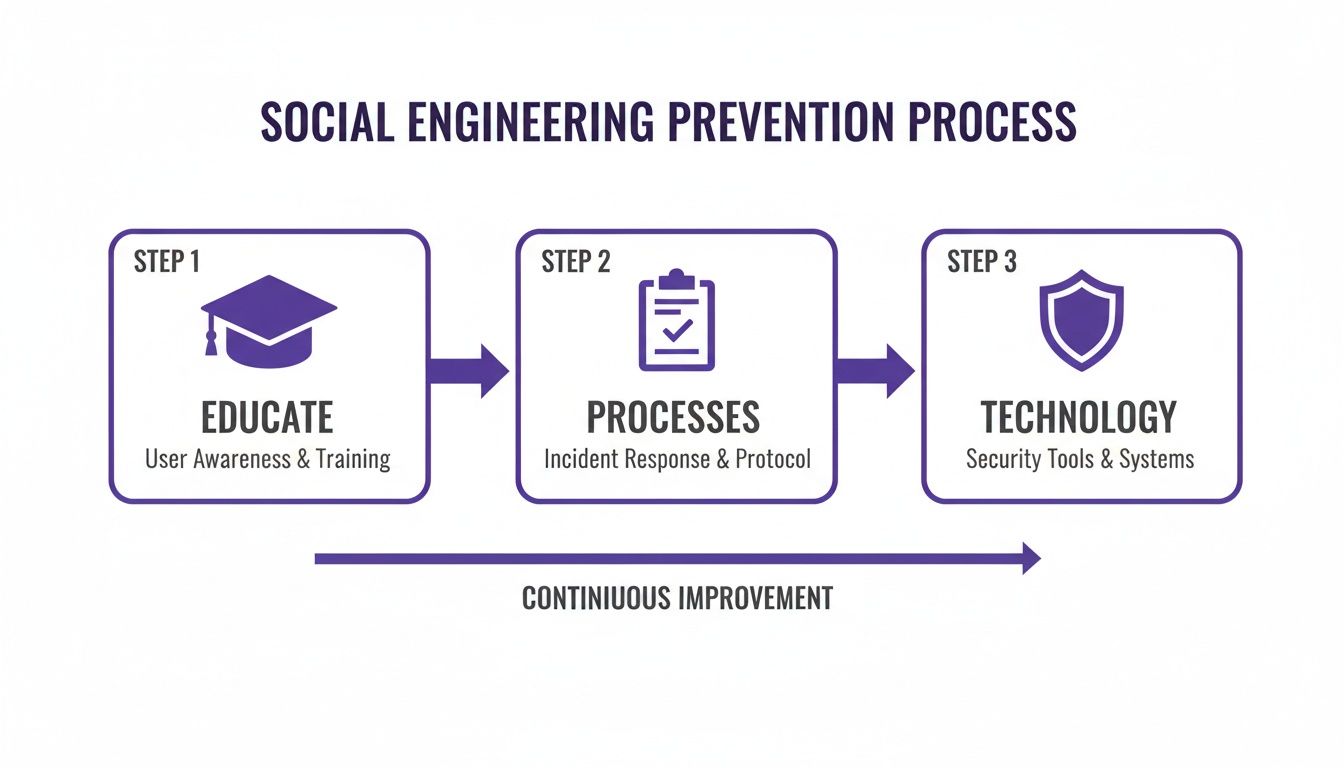
As the flowchart shows, a successful defence relies on the synergy between educating your team, establishing clear processes, and implementing the right technology to back them up.
Core Social Engineering Prevention Pillars
To build a comprehensive defence, businesses must implement key strategies across three critical pillars. Each one addresses a different aspect of the threat, from human behaviour to technical gaps. The table below provides a quick summary.
| Pillar | Objective | Key Action |
|---|---|---|
| Education | Empower employees to recognise and report threats. | Conduct regular security awareness training and phishing simulations. |
| Processes | Create procedural safeguards to disrupt attacks. | Enforce multi-channel verification for sensitive requests. |
| Technology | Provide a safety net to catch human error. | Deploy MFA, email filtering, and continuous dark web monitoring. |
These pillars work together to create layers of resilience. It is not about achieving perfection but making a successful attack significantly more difficult for a cybercriminal.
This integrated strategy helps move your clients from a reactive to a proactive security posture. Rather than just responding to incidents, they can actively reduce their attack surface. For managed service providers, offering services that build this "human firewall" is a powerful way to deliver tangible value and generate predictable recurring revenue. It allows you to start meaningful security conversations, strengthen customer relationships, and differentiate from competitors.
Building Resilience With Security Awareness Training

Technical controls are a great start, but they will only get you so far. The real strength of your defence comes from your people—your human firewall. But you cannot build that resilience with a single, one-off training session.
Effective security awareness is not a tick-box exercise. It is an ongoing programme designed to create real, lasting behavioural change. It starts with making sure your team understands the common threats they are up against, from phishing and business email compromise to vishing and pretexting.
But knowing about threats is not the same as being prepared for them. True resilience is forged through practice, which is why active learning is so essential. Live phishing simulations are incredibly powerful here. They give your team a safe, controlled space to make mistakes, click a dubious link, and learn from the experience without any of the real-world damage.
Designing Realistic and Role-Specific Simulations
Generic, easy-to-spot phishing tests are not going to be effective. To make training stick, simulations need to feel real. They should mimic the genuine, sophisticated threats your team will actually face in their day-to-day work. Forget the "You've won a prize!" emails.
Think about creating scenarios tailored to specific job roles:
- For your finance team: A simulated email from a known supplier, complete with their branding, pointing to a "new payment portal" designed to steal their login details.
- For HR staff: An urgent request that looks like it is from a senior manager, asking them to review an "updated employee salary list" on a fake cloud service.
- For your helpdesk and IT team: A very convincing password reset notification from a major software provider, leading to a perfectly spoofed login page.
These targeted simulations test how an employee responds in the context of their own job, making the lesson far more memorable and effective.
For managed service providers, this practical approach offers real commercial advantages. It showcases your value by visibly strengthening a client's security posture month after month, turning simulations into a high-margin, recurring revenue service.
The Proven Impact of Consistent Training
The data from UK businesses is clear: consistent training really does work. Recent figures show the success rate of phishing attacks against small businesses dropped from 49% to 42% after security awareness programmes became more common. Even though 31% of businesses still see weekly attempts, awareness is a powerful preventative tool.
High-profile incidents, like the 2025 breach at the Legal Aid Agency which exposed decades of data through a likely social engineering attack, are a stark reminder of the costs of doing nothing. You can see more UK-specific data and discover the latest cyber crime statistics to get a better sense of the current threat landscape.
Good training turns your employees from potential targets into your first line of defence. It fosters a culture where people feel confident questioning odd requests and know exactly how to report suspicious activity. When your team understands the enemy's tactics, they become much better at spotting them. To get a deeper understanding of this specific threat, you can learn more about how to identify phishing emails in our dedicated guide.
Building Robust Processes and Verification Policies
Well-trained employees are an excellent first line of defence, but even the sharpest person can be manipulated under pressure. This is where solid processes and clear-cut policies become your non-negotiable safety net. They take the guesswork out of high-risk situations, giving your team a structured path to follow that protects them and the business.
Think of formal, written policies for things like financial transfers, data access requests, and password resets as an essential backstop. They are designed to deliberately disrupt a social engineering attack by creating a predictable, secure workflow. This means security does not hinge on an employee's ability to spot a sophisticated scam in the heat of the moment.
Without these procedures in place, your staff are left making gut decisions, often while being pressured to act fast. A cleverly worded email or an urgent-sounding phone call can easily lead to a very expensive mistake. Documented processes introduce just enough friction to slow down an attack and give people time to think.
The Power of Multi-Channel Verification
One of the most effective strategies you can implement is multi-channel verification. It is a simple but incredibly powerful rule: any unusual or high-risk request made through one channel must be confirmed through a different, pre-agreed channel.
This single policy neutralises many common social engineering tactics. For instance, if a fraudster spoofs the CEO's email to demand an urgent wire transfer, they are counting on the finance team acting on that email alone. A verification policy breaks that attack chain instantly.
Here is how it works in the real world:
- Financial Request: An email lands from the "Managing Director" asking for an immediate payment to a new supplier. Your policy dictates that the employee must call the MD on their known mobile number (never a number from the email) to verbally confirm the request before any money moves.
- Password Reset: The IT helpdesk gets a call from someone claiming to be a senior executive who is locked out of their account. Before resetting anything, the policy requires the agent to send a confirmation link to the executive's official company email or verify their identity through another trusted system.
- Data Access: An HR manager gets a message on Teams from a "department head" asking for a sensitive employee report. The policy requires the HR manager to confirm this by walking over to their desk or starting a quick video call.
Yes, these steps add a tiny delay. But it is a delay that completely derails an attacker's plan.
By implementing and enforcing multi-channel verification, you build a procedural wall that attackers cannot just talk their way through. It shifts security from being one person's responsibility to a company-wide process.
Establishing Clear Lines of Authority
Another crucial process is defining exactly who has the authority to approve certain actions. Social engineers thrive on creating confusion about who is in charge. Your policies need to eliminate that ambiguity entirely.
A simple approval matrix for sensitive tasks can work wonders:
| Action | Required Authorisation | Verification Method |
|---|---|---|
| Payments over £5,000 | Finance Director | Phone call to registered mobile |
| Changing supplier bank details | Two senior finance team members | Signed form and phone verification |
| Admin access to key systems | Head of IT | Ticketed request and verbal check-in |
This kind of structure makes it far harder for an attacker to impersonate someone and push through a fraudulent request. It also empowers your employees, giving them the confidence to push back on anything that does not follow the proper procedure, no matter how "urgent" it seems.
For telecom and IT providers, helping clients build these simple but effective policies is a great way to add value. It shows you have a deep understanding of practical security and positions you as a strategic partner, not just another supplier. These policies are the perfect complement to the technical services you already offer, like white label dark web monitoring, which provides early warnings of compromised credentials that could be used in these very attacks.
Using Technical Controls to Support Your People
While training your team is the foundation of a good defence, technology is the safety net that catches what people miss. Think of it as reinforcing your human firewall. These controls are not about replacing judgement; they are about adding automated defences that work around the clock to back your people up.
For MSPs and telecom providers, these tools are more than just security measures—they are straightforward, high-value services that are easy to roll out for your clients. They solve clear, understandable risks, giving businesses a tangible layer of protection they are happy to pay for.
The goal is to make an attacker's job as difficult as possible. By layering these technical safeguards, you make it far less likely that one mistake turns into a costly data breach.
The Non-Negotiable Power of MFA
If you do just one thing on this list, make it Multi-Factor Authentication (MFA). It is the single most effective way to shut down attacks that rely on stolen passwords, which is the end goal of most social engineering scams.
MFA is like a digital deadbolt on your front door. Even if an attacker tricks an employee into revealing their password, it is useless on its own. The attack stops right there because the criminal does not have the second factor—be it a code from an authenticator app, a push notification, or a physical security key.
For UK businesses, where phishing makes up a staggering 93% of cyber crimes, MFA is not a 'nice-to-have' anymore. It is a foundational security measure that slams the door on the most common attack method.
Rolling out MFA across all your critical systems—email, cloud apps, VPNs—is a simple, commercially smart move. For IT partners, it is a low-effort, high-impact service that delivers an immediate and noticeable security boost for your clients.
Filtering the Noise with Advanced Email Security
The overwhelming majority of social engineering attacks arrive as an email. That makes your email gateway the most important checkpoint you have. Modern email security goes way beyond old-school spam filters, using several layers to spot and block malicious messages before they even land in an inbox.
These systems use sender authentication to prove an email is really from who it says it is.
- SPF (Sender Policy Framework): Checks that the email was sent from an approved server.
- DKIM (DomainKeys Identified Mail): Adds a digital signature to prove the email has not been altered.
- DMARC (Domain-based Message Authentication, Reporting & Conformance): Tells email servers what to do with messages that fail SPF or DKIM checks, like blocking them completely.
Getting these protocols configured correctly makes it incredibly difficult for criminals to spoof a client’s domain or impersonate their suppliers. From a business perspective, offering managed email security with a proper SPF, DKIM, and DMARC setup is a perfect add-on for any provider of VoIP, connectivity, or IT support.
Gaining an Early Warning with Dark Web Monitoring
While MFA and email filtering are powerful real-time defences, a truly proactive strategy means looking beyond your own network. You need to know when your defences might be at risk before an attack even starts. This is where dark web monitoring comes in.
Countless businesses already have employee credentials circulating on the dark web from past third-party data breaches, and they have no idea. Attackers buy these lists of emails and passwords to launch highly targeted social engineering campaigns.
A white label dark web monitoring tool like GoSafe acts as your early warning system. It constantly scans these hidden marketplaces and alerts you the moment a client's credentials show up. This gives you a vital head start to force a password reset and lock down the account long before a criminal gets a chance to use the stolen data.
It is a high-value, easy-to-sell service that proves its worth month after month, helping you start meaningful security conversations and build stronger client relationships. To see how simple it is to add this proactive layer of protection to your service stack, Add white-label dark web monitoring to your service stack.
Proactive Detection and Incident Response
Having strong technical controls and clear policies in place is a great start, but it is only half the battle. If you are just sitting back and waiting for an attack to happen, you are playing a losing game. To really add value for your clients, you need to shift the conversation from reacting to a breach to proactively spotting the warning signs.
The uncomfortable truth is that attackers often have the keys to the kingdom long before they decide to turn the lock. Credentials stolen from old, forgotten third-party breaches are constantly being bought and sold on hidden marketplaces. For a cybercriminal, this is a treasure trove of ammunition for their next social engineering campaign.
This is where you can step in and move beyond simple prevention. It is time to talk about early detection and having a plan ready to go. It is all about knowing your risks before they can be used against you.
Continuous Dark Web Monitoring
This is where a proactive security posture really comes to life. Think of continuous dark web monitoring as an early-warning system. It is constantly scanning illicit forums, marketplaces, and data dumps for any credentials linked to your clients' domains.
When an employee's email and password pop up for sale, that is not a hypothetical risk—it is a clear signal that a targeted attack could be just around the corner. For telecom and IT partners, adding this capability to your services is a powerful way to demonstrate your value.
By offering a white label dark web monitoring service, you can give your clients simple, non-technical alerts the second their data is found. It is incredibly straightforward to set up and does not require you to have a team of security analysts on standby. You can discover more about how dark web monitoring works and see just how neatly it fits into a modern security strategy.
Instead of waiting for a client to report a suspicious email, you can proactively inform them that a specific user's credentials are out there and help them reset the password immediately. That one simple action can neutralise a major threat before it even has a chance to materialise.
Planning Your Response Before a Crisis Hits
Early warnings are excellent, but they are only useful if you know exactly what to do with them. That is why having a simple, pre-defined Incident Response Plan (IRP) is so important. This does not need to be a hundred-page document that gathers dust. It should be a clear, concise guide that tells everyone—your team and your clients—what to do when something goes wrong.
Knowing the right steps to take when an employee reports a phishing attempt, or when your monitoring flags exposed data, takes the panic out of the situation. It helps contain the damage, shows you are in control, and reinforces your value as a competent partner. The plan just needs to cover the basics: who to contact, how to isolate affected systems, and when to start changing credentials.
The consequences of getting this wrong can be devastating. We have seen social engineering attacks like business email compromise (BEC) and vishing hit UK retailers particularly hard. Groups like Scattered Spider have targeted company helpdesks to bypass MFA, a tactic seen in 2025 attacks on Marks & Spencer, Harrods, and Co-op which cost M&S an estimated £300 million in profits. They exploit the natural trust employees have in IT staff—a critical lesson for MSPs and telecom resellers. And the threats keep evolving; a recent deepfake video call scam tricked one firm into transferring a staggering £20 million. You can learn more about these costly social engineering attacks on retailers and the hard lessons they offer.
Incident Response Quick-Action Checklist
When an employee suspects they have been targeted, hesitation is the enemy. A simple checklist empowers them to take the right actions immediately, reducing confusion and containing the threat before it can spread.
| Step | Action | Reason |
|---|---|---|
| 1. Disconnect | Immediately disconnect the affected device from the network (unplug the cable or turn off Wi-Fi). | This prevents any potential malware from spreading to other computers or servers on the network. |
| 2. Do Not Engage | Do not reply to the suspicious email, click any further links, or provide any more information. | Engaging with the attacker can confirm your details are active, leading to more targeted attacks. |
| 3. Report It | Report the incident immediately to your designated IT contact or line manager, following the company’s IRP. | This triggers the formal response process, allowing the security team to assess and contain the threat. |
| 4. Change Passwords | Change your password for the affected account and any other accounts that use the same or similar passwords. | If credentials were compromised, this step immediately locks the attacker out of your accounts. |
For MSPs, providing clients with these proactive tools and straightforward response plans is a powerful differentiator. It elevates your service from a simple utility to a core part of their business resilience. Best of all, you can offer this advanced protection under your own brand, without needing to build a dedicated security team from the ground up.
Offer Proactive Security Your Clients Will Value
Knowing the theory of how to prevent social engineering is one thing. But turning that knowledge into a simple, effective service for your clients is where the real opportunity lies.
For MSPs and telecom providers, all the strategies we have covered—from awareness training to proactive detection—open up a significant commercial opportunity. You are in the perfect position to offer these security layers to clients who need help but do not have the in-house team to manage it themselves.
This is not about suddenly becoming a specialist cybersecurity firm. It is about adding high-value, low-effort services to what you already do. Proactive tools like dark web monitoring and phishing simulations are not operationally intensive. They are straightforward to deploy and manage, and they generate predictable, recurring revenue with minimal operational overhead.

Start Meaningful Security Conversations
The real value of these services is in the conversations they start. Instead of waiting for a client to get hit by a breach, you can show them their risks before it happens.
Imagine getting an alert from a white label dark web monitoring tool that shows an executive's credentials are for sale online. That is a powerful, tangible way to start a conversation. It immediately proves your value and shifts your relationship from a simple supplier to a strategic partner who is genuinely invested in keeping their business safe.
With this approach, you can:
- Increase ARPU: Add a high-margin, recurring service that clients instantly understand and are happy to pay for.
- Reduce Churn: When you become an essential part of a client’s security posture, your services become much more integral.
- Strengthen Relationships: You are no longer just selling a product; you are a trusted advisor on business security.
The message to your clients is simple: you are offering them a vital early warning system. By finding compromised credentials before an attacker can use them, you are actively stopping incidents from ever happening, not just cleaning up the mess afterwards.
Deliver Security Under Your Own Brand
You do not need to build a specialist security practice from the ground up.
Solutions like GoSafe are built specifically for the channel. They let you offer sophisticated protection that is entirely branded as your own. The platform provides clear, non-technical alerts perfect for end customers, reinforcing your brand’s value without you needing any deep security expertise.
This model lets you meet the huge demand for security services without the usual cost and complexity. You can easily add dark web monitoring for MSPs or telecom providers to your stack, positioning it as a natural add-on to your existing connectivity, VoIP, or IT support packages.
Ultimately, it is about making proactive security both accessible and profitable. You can give your clients the early warnings they need, strengthen their defences, and secure your position as their essential technology partner.
Ready to offer a security service your clients will genuinely value? To see just how easily you can add these capabilities to your portfolio, book a demo of GoSafe’s white-label dark web monitoring and explore the reseller programme today.
Frequently Asked Questions
When you're trying to prevent social engineering, it helps to get inside an attacker's head and understand exactly how these scams work in the real world. Here are a few common questions we hear from businesses and the IT partners who support them.
How Do Social Engineering Attacks on IT Support Teams Begin?
It almost always starts with research. The attacker will scout a target, usually someone with high-level access like a senior IT administrator. They can find this information surprisingly easily on public sites like LinkedIn.
Next, they will call the IT helpdesk, pretending to be that employee. They will invent an urgent problem—"I'm locked out and need to get into a server for an emergency patch"—and ask for a password reset. The final step is convincing the helpdesk to temporarily switch off Multi-Factor Authentication (MFA), giving them an open door to the account.
What Are the Common Red Flags of a Social Engineering Attack?
There are a few classic tell-tale signs that should set alarm bells ringing, even if a call or email seems to come from a trusted source. Building a culture of healthy scepticism is one of the best defences you can have.
Keep an eye out for these warning signs:
- Unusual Urgency: Attackers love to create a sense of panic to force you into acting without thinking.
- Requests for Sensitive Information: A legitimate bank, supplier, or IT department will almost never ask for your password over email.
- Suspicious Senders: Look for tiny details, like a single letter being wrong in an email address or domain name.
- Unexpected Attachments or Links: If you did not ask for that invoice or file, do not open it.
Why Is MFA Not Always Enough to Stop These Attacks?
Multi-Factor Authentication is an excellent security control, but it is not a silver bullet. Clever attackers have shifted their focus from trying to break MFA to tricking a human into turning it off for them. They will target the helpdesk, convince them to deactivate MFA on a user's account, and then add their own MFA device to take over completely.
This really gets to the heart of the issue: great technology is useless if your human processes are weak. You absolutely need to pair technical tools like MFA with strict, non-negotiable identity verification rules for high-risk actions like account resets.
How Can Dark Web Monitoring Help Prevent Social Engineering?
It is all about getting an early warning. A Dark Web Monitoring tool scans illicit marketplaces for your employees' credentials, which often surface after a data breach at a completely different company. This gives you a heads-up that a password has been compromised.
With that intelligence, you can force a password reset before an attacker has the chance to use those stolen details in a targeted campaign against your business.
For MSPs and telecom providers, offering white label dark web monitoring is a high-value service that is easy to add to your service stack. It helps you move your clients from a reactive "wait-and-see" approach to a proactive security posture, proving your worth as a trusted advisor.
At GoSafe, we provide a fully white-labelled dark web monitoring platform built specifically for the IT and telecom channel. It lets you offer proactive security services under your own brand, with no specialist security knowledge needed. Add white-label dark web monitoring to your service stack.