Think of a data breach as a digital break-in. It is like a thief getting past your office security, but instead of taking laptops, they are copying every sensitive client file, employee record, and financial statement you hold.
Put simply, a data breach is any incident where confidential information falls into unauthorised hands.
So, What Is a Data Breach, Really?
At its core, a data breach is a security failure. It is the moment your defences are broken, exposing data that was supposed to stay private. This is not just a problem for large corporations—small and medium-sized businesses (SMBs) are prime targets, often because attackers assume they have weaker security.
For telecom providers and MSPs, framing this in simple business terms is the first step. You need to help your clients see the real-world risk. A breach is not always a highly sophisticated hack from an organised crime group. It is often much simpler.
A data breach can happen in many ways, both technical and non-technical. Here are the core scenarios at a glance.
A Quick Look at Data Breach Scenarios
| Breach Scenario | What Happens | Common Cause |
|---|---|---|
| Accidental Leak | An employee sends sensitive data to an unauthorised person by mistake. | Attaching the wrong file to an email or sending it to the wrong "John Smith" in their contacts. |
| Lost or Stolen Device | A company laptop, phone, or USB drive goes missing. | Leaving a device in a taxi or having a bag stolen. If it's not encrypted, the data is wide open. |
| Credential Theft | A cybercriminal gains access using a stolen username and password. | A successful phishing email, or an employee reusing a password that was exposed in another company's breach. |
| Misconfiguration | Sensitive files are left publicly accessible on the internet. | An IT administrator sets up a cloud storage bucket incorrectly, without realising it’s open to anyone. |
As you can see, the cause is often human error, not just a brute-force attack. The consequences, however, are just as severe, affecting your business, your customers, and anyone whose data you hold.
The Scale of the Threat in the UK
In the UK, these incidents are no longer a rare occurrence; they are a common operational hazard. The official Cyber Security Breaches Survey reveals that 43% of businesses suffered a breach or attack in the last 12 months.
But that average figure hides a crucial detail. For medium-sized businesses, the rate was 67%, and for large businesses, it was a staggering 74%. The message is clear: the larger the business, the bigger the target. You can read the full findings on the UK government's website.
This reality is both a challenge and an opportunity for IT and telecom partners. Your clients know the threat is real, but they often lack the in-house expertise to handle it. They need straightforward solutions that provide an early warning without adding complexity.
This is exactly where services like white label dark web monitoring come in. It is a practical tool that helps you start meaningful security conversations and deliver a service that addresses the problem directly.
The Most Common Causes of Data Breaches
To understand what a data breach is, you need to see how they happen. The large, complex cyber-attacks get all the media attention, but for most businesses—especially SMEs—the reality is far simpler. Breaches often start with a preventable mistake.
For IT and telecom partners, explaining these entry points is the first step in helping clients see the risks they face every day. These incidents are not just technical problems; they are business problems with roots in human behaviour, system weaknesses, and the tactics criminals use.
Phishing and Social Engineering
The most common way a breach starts is not with a sophisticated piece of code, but with a simple trick. Phishing remains the number one attack method, where criminals send convincing emails designed to fool employees into giving up sensitive information, like their login details. An attacker might pretend to be a known supplier, a senior manager, or even a trusted service like Microsoft.
For example, an employee receives an email that looks like an official alert from Microsoft 365. It asks them to verify their account because of a "security issue". They click the link, land on a fake login page that looks identical to the real one, and enter their username and password. Just like that, the attacker has the keys.
From there, the criminal can access company data, send fake invoices to clients, or work their way deeper into the network.
Analysis of UK data breach incidents shows how dominant these human-focused attacks are. Phishing is behind a staggering 93% of cyber crimes against businesses. For UK SMEs, 84% of those who reported a breach were hit by phishing attacks.
Weak or Stolen Credentials
Many data breaches succeed for one simple reason: poor password practices. Employees often reuse the same password for everything, from their work email to personal streaming accounts. When one of those other services is breached, the stolen credentials—email addresses and passwords—are bundled up and sold on the dark web.
Cybercriminals buy these lists and use automated software to try them on business systems like email, VPNs, and cloud applications. This is a numbers game called credential stuffing. If an employee reused a password from a breached site, the attacker gets straight in. No phishing is required.
This is why having visibility of exposed credentials through white label dark web monitoring is so important. It is about spotting the danger before an incident occurs.
The infographic below shows how the chance of a breach grows with the size of the business, making strong password security non-negotiable as a company expands.
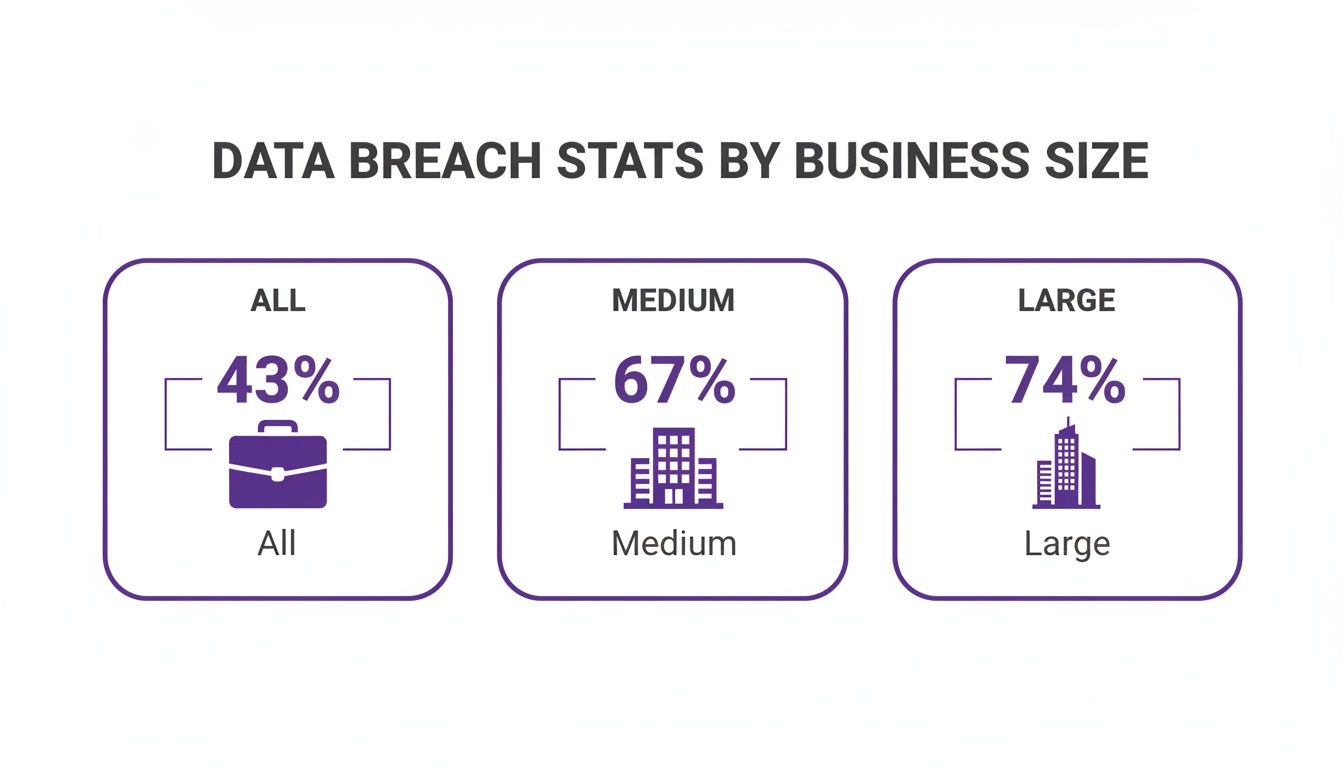
As businesses grow, they become more attractive targets with more ways to gain access, making them far more vulnerable to breaches.
Ransomware Attacks
Ransomware is a type of malware that locks up a company's files by encrypting them, making everything inaccessible. The attackers then demand a ransom, usually in cryptocurrency, to provide the decryption key. These attacks are devastating, often shutting a business down for days or weeks.
A ransomware attack is the digital equivalent of someone changing the locks on your office and holding the only key. Everything grinds to a halt until you can get back inside—and the criminals are betting you will pay to make that happen.
Most ransomware gets in through a successful phishing email or an employee downloading a malicious file. In the UK, ransomware attacks have increased by 70% in recent years, proving how profitable they are for criminal groups.
As an IT or telecom provider, offering services that prevent that initial mistake is one of the most effective ways to protect your clients from this threat. A good starting point is our guide on how to identify phishing emails.
Calculating the True Cost of a Data Breach
When explaining what a data breach is, the next question is almost always: "So, what will it cost me?" It is a fair question, and the answer goes far beyond the initial clean-up. For telecom and IT providers, getting this part right helps reframe security not as an overhead, but as an essential investment in business continuity.
The real cost of a breach is never just one number. It is a combination of immediate, upfront expenses and slower, hidden damages that can affect a business for years. Let's break down what that looks like.
Immediate Financial Costs
The first wave of costs hits quickly after a breach is discovered. These are the tangible, out-of-pocket expenses required to contain the incident.
- Forensic Investigation: Your first call is usually to external experts. You need to know what happened, how they got in, and what they took. That digital forensics work is not cheap.
- Remediation and Recovery: This is the hands-on technical work. It means patching the vulnerability, removing malware from your systems, and restoring everything from backups. Every minute your systems are down is a minute you are losing money.
- Regulatory Fines: In the UK, the Information Commissioner's Office (ICO) can issue significant penalties. Fines for failing to protect personal data can climb as high as £17.5 million or 4% of your global annual turnover—whichever is higher.
- Legal Fees and Notification Costs: You are legally required to inform people about what happened—customers, staff, and regulators. That means paying for legal advice, running communication campaigns, and often covering the cost of credit monitoring services for victims.
The Hidden Long-Term Damage
While the initial bills are painful, it is the long-term consequences that often do the most damage. These are the costs that do not appear on an invoice but can cripple an organisation.
Operational downtime is one of the most underestimated impacts. For every hour your systems are offline, you are not taking orders, serving clients, or generating revenue. Recent UK data shows a sharp rise in breaches causing real-world disruption, with 7% of businesses reporting a temporary loss of access to files or networks, up from just 4% previously.
A data breach is like an iceberg. The initial financial hit is the part you see above the water. The vast, hidden mass of reputational damage, customer churn, and operational disruption lurking below the surface is what can truly cause lasting harm.
Then there is your reputation. A breach shatters customer trust, and once that is gone, it is incredibly difficult to earn back. Customers may take their business to a competitor they feel is safer, leading to a direct, sustained drop in revenue. That loss of confidence also makes it harder to attract new clients, partners, and employees. On top of that, your insurance premiums will likely increase, as you are now considered a higher risk.
The financial fallout for UK businesses is stark. The average cost of a cyber crime (excluding phishing) is £990, but that number jumps to £1,970 when you filter out the businesses that reported no direct loss. Cyber-facilitated fraud is even worse, averaging £5,900 per incident. The threat is real and growing, with an estimated 19,000 UK organisations hit by ransomware attacks alone. You can find more detail on these trends in the UK Cyber Security Breaches Survey 2025 report.
For MSPs and telecom providers, these numbers are not just statistics; they are the commercial reality your clients need to understand. By offering services like white label dark web monitoring, you can help them get ahead of the threats that lead to these outcomes.
Practical Steps to Prevent a Data Breach
Once you understand what a data breach is and how much it can cost, the next question is how to stop one. While no defence is completely impenetrable, a few foundational security controls can dramatically reduce the risk for your clients, making them far less appealing targets for criminals.
Prevention will always be cheaper than the cure. As an IT or telecom partner, you can provide significant value by steering clients towards practical, high-impact measures. These are the non-negotiable layers of security that form the bedrock of any sensible defence strategy.
Strengthen Access Controls
The easiest way for an attacker to get in is to use a stolen key. Time and again, weak and reused passwords are the number one cause of a data breach. Implementing strong access controls is the single most effective step you can take.
This boils down to two key components working together:
- Strong Password Policies: Insist on long, complex, and unique passwords for every application. Emphasise the message to never reuse passwords, because a breach at one service can quickly lead to a compromise of others.
- Multi-Factor Authentication (MFA): This is a critical security layer that is no longer optional. MFA forces users to provide a second form of proof—like a code from their phone—alongside their password. Even if a criminal steals a password, they are stopped because they do not have that second piece of the puzzle.
For your clients, think of MFA as the deadbolt on the front door. A password is just the standard lock, which can be picked. The MFA code is a second, completely different key that the thief does not have.
Maintain and Patch Systems Promptly
Software vulnerabilities are another common entry point for attackers. These are flaws in the code of an operating system or application that criminals exploit to gain access. Vendors are constantly releasing security updates, or "patches," to fix these weaknesses as they are discovered.
The problem is, many businesses fall behind on applying them. An unpatched system is an open invitation for intruders. Establishing a routine of promptly applying security patches across all servers, laptops, and software is fundamental to closing these security gaps.
Implement Continuous Security Awareness Training
Technology alone cannot stop a data breach. Your clients' employees are a crucial part of their defence, especially since phishing and social engineering are the root cause of most breaches. Training staff to recognise and report suspicious activity is essential. You can learn more about how to prevent social engineering in our detailed guide.
This cannot be a tick-box exercise once a year. To be effective, training needs to be an ongoing process that keeps security at the forefront of everyone's minds.
Key training topics should always include:
- Spotting Phishing Emails: Teach everyone how to spot the red flags, like unusual sender addresses, urgent demands for information, and links that point to unfamiliar websites.
- Safe Internet Habits: Advise against downloading software from untrusted sources or using unsecured public Wi-Fi for work-related activities.
- Reporting Procedures: Create a simple, blame-free process for employees to report anything that feels even slightly suspicious. Make it easy for them to do the right thing.
By putting these three practical controls in place, MSPs and IT providers can build a robust defensive wall for their clients, significantly lowering the odds of a successful data breach.
Using Dark Web Monitoring for Early Detection
Even with the best defences in place, data breaches can still happen. A trusted supplier might be compromised, or a determined attacker could find a new way in. This is where the focus shifts from pure prevention to proactive detection—spotting the danger signs before an attack has a chance to succeed. That is the role of dark web monitoring.
The dark web is a part of the internet that is not indexed by search engines and requires special software to access. This anonymity has turned it into a marketplace for cybercriminals to buy, sell, and trade stolen information—including the employee email addresses and passwords they need to launch attacks.
This makes it an invaluable source of threat intelligence. By continuously scanning these illicit marketplaces, you can discover if your clients' credentials have been exposed in a breach elsewhere. Finding that information gives you a crucial early warning, allowing you to secure the account before criminals can use those stolen logins.
From Reactive to Proactive Security
Traditionally, many businesses only discover a breach after the damage is done—when ransomware locks their files or a customer reports fraud. Dark web monitoring changes this. It is an essential early-warning system.
The moment a set of credentials appears for sale on the dark web is your first and best chance to stop a future data breach. It is the digital equivalent of seeing a thief checking the locks on a building before they try to break in.
This proactive approach is exactly what small and medium-sized businesses need. Most do not have the budget for a dedicated security team, so an automated service that flags immediate risks is highly valuable. It provides a simple, actionable alert that lets them take one powerful step: change the password. You can find out more in our guide explaining what dark web monitoring is.
The Channel Opportunity for Telecoms and MSPs
For telecom providers, MSPs, and IT support companies, dark web monitoring is not just a security tool; it is a significant commercial opportunity. The reality is that many of your clients probably have exposed credentials on the dark web right now without knowing it. Offering a monitoring service is a powerful way to show immediate value and open a conversation about their security.
A white-label tool like GoSafe is built specifically for the IT and telecom channel, letting you offer this protection under your own brand.
Key benefits for partners include:
- No Specialist Knowledge Needed: The tool is designed to be simple. You do not need a team of security analysts to offer a high-value security service.
- Easy to Explain and Sell: The concept is straightforward for customers to understand. Finding their own credentials on the dark web makes the threat real and the need for action obvious.
- Low Operational Overhead: GoSafe runs continuously in the background with minimal intervention. Alerts are clear and non-technical, making them easy to pass on to clients with straightforward instructions.
By adding a service like this, you are not just selling another product; you are positioning yourself as a proactive security partner. It is a natural fit alongside existing offerings like connectivity, VoIP, and managed IT services, helping you increase customer loyalty and build a predictable recurring revenue stream. You can address the very real threat of a data breach, providing peace of mind for your clients and a commercial advantage for your business.
Building a Recurring Revenue Service with GoSafe
Knowing what a data breach is and the dangers it brings is one thing. Turning that knowledge into a service that protects your clients and grows your business is another. For telecom providers, MSPs, and IT resellers, dark web monitoring is the foundation of a profitable, high-value recurring revenue service.
The challenge for many IT partners is finding security services that are easy to sell, simple to manage, and do not require a dedicated team of security experts. GoSafe’s white-label dark web monitoring platform was built to solve this, offering a clear path to generating predictable monthly income.
Turning Proactive Security into Recurring Revenue
The commercial model is simple. You package GoSafe's continuous dark web scanning under your own brand and offer it to your clients as a monthly subscription. This creates a win-win for both you and your customers.
- For Your Business: You generate a new, reliable revenue stream with high-profit margins and low operational overhead. Because the service runs automatically, it requires very little hands-on management from your team.
- For Your Clients: They get a vital early-warning system that flags exposed credentials before they can be used in an attack. The value is immediate and easy for any business owner to understand.
This approach is an effective way to increase the average revenue per user (ARPU) across your client base. It is a natural add-on to the managed IT, connectivity, and VoIP packages you already sell.
Strengthen Client Relationships and Reduce Churn
Offering proactive security services like white label dark web monitoring changes your relationship with your clients. You are no longer just the reactive support they call when something breaks; you become a strategic partner actively working to prevent problems. This makes your business "stickier."
When you can show a client that their credentials have been found on the dark web—and help them fix the issue before it leads to a breach—you demonstrate undeniable value. This builds trust and loyalty, making it far less likely they will look at a competitor. It is a powerful differentiator that sets you apart from providers who only offer basic IT support.
GoSafe provides the perfect conversation starter. The initial scan often reveals existing exposures, making the threat real and the need for ongoing monitoring obvious. It moves the conversation from a "what if" risk to a practical, immediate solution.
Ultimately, building a service around GoSafe allows you to start meaningful security conversations without needing to become a full-blown cybersecurity company. You can give your clients the visibility and early warnings they want, all under your own brand.
This is not about selling complex dashboards or generating confusing reports. It is about delivering a simple, effective service that tackles one of the most common causes of a data breach. It is a high-value, low-effort service that belongs in your portfolio.
Ready to see how simple it can be to offer this protection to your clients? Add white-label dark web monitoring to your service stack by joining the GoSafe Reseller Programme.
Your Questions, Answered
Here are a few of the common questions Managed Service Providers, telecom providers, and their clients ask about data breaches and how to stay one step ahead.
I Think We Have Been Breached. What Is the First Thing I Should Do?
If you suspect a breach, time is critical. The first step is to contain the damage—disconnect the affected machines or systems from your network immediately. This stops the problem from spreading.
Once contained, you need to quickly assess what has happened. What data was accessed? Who is affected? Get your IT provider or internal team involved straight away. Remember, in the UK, you might have a legal duty to report the breach to the Information Commissioner's Office (ICO) within 72 hours, especially if it puts people's rights and freedoms at risk.
How Can Dark Web Monitoring Help If My Data Is Already Out There?
Dark web monitoring acts as your early-warning system. Just because a cybercriminal has stolen a set of credentials does not mean they have used them yet. Often, that data is bundled up and sold on dark web marketplaces first.
A tool like GoSafe continuously scans these parts of the internet for your company’s domains or your clients' data. When it spots exposed credentials, you get an instant alert. That gives you a crucial window to change the compromised passwords and lock down accounts before an attacker can use them to break into your network or launch a ransomware attack.
Is Offering Dark Web Monitoring a Heavy Lift for an IT Provider?
Not at all, especially if you use a white-label tool built specifically for the channel. Platforms like GoSafe are designed to be simple. There is no complex setup or need for a dedicated team of security analysts. You can brand the service as your own and add it to your existing client packages.
The alerts are written in plain English, so they are easy to explain to your customers. It is one of the most straightforward ways for MSPs and telecom providers to add a high-value, recurring revenue security service without significant operational overhead.
Ready to see how easy it is to add this layer of protection to your client offerings? With GoSafe, you can open up meaningful security conversations and prove your value from day one. Add white-label dark web monitoring to your service stack today.