
Approximately 40,000 UK businesses experienced cyber-facilitated fraud in the previous year, according to the Government's Cyber Security Breaches Survey 2025. For a telecom reseller, that makes customer security more than a separate IT conversation. A suspicious call, a stolen password and an attempted account takeover can reach the same support desk, even when different suppliers handle the underlying services.
The commercial opportunity is to organise that relationship properly: sell useful services, put clear responsibilities behind them and collect recurring revenue without letting support costs consume the margin.
What a Telecom Reseller Does and Who It Suits
A telecom reseller buys network capacity or communications services from an infrastructure operator and sells fixed, mobile and data services to customers. In a branded arrangement, the reseller handles the customer contract, billing and support without owning the physical network.
Think of a high-street shop. The retailer chooses its stock, sets out the offer and serves the customer, but doesn't run the factory. A telecom reseller does something similar with broadband, hosted voice and mobile services.

Distribution matters more than infrastructure
IBISWorld's UK telecommunications-reseller analysis estimates an industry worth approximately £5.5 billion in 2026, comprising around 360 businesses, with business numbers growing at a compound annual rate of approximately 0.1% between 2021 and 2026. These are industry-analysis estimates, not official government statistics.
That broadly stable supplier base is a useful commercial signal. Opening another reseller business isn't differentiation by itself. You need a better way to reach customers, package services or resolve their problems.
Say an IT support firm adds hosted telephony to an existing managed-service contract. Its wholesale partner provisions the voice service, while the IT firm handles user changes, invoices and first-line troubleshooting. The customer buys a working communications service, not an introduction to a carrier.
Practical rule: Your value is the work customers no longer have to coordinate themselves.
Who the model suits
The natural channel includes VoIP providers, connectivity brokers, IT support firms and managed service providers. Hosting providers, web agencies, cyber consultants and SaaS or technology resellers can also participate where they already have a trusted business relationship.
The strongest fit isn't a large contact list. It's an existing reason for customers to call you when something needs changing or fixing.
Run a quick self-test:
- Contract: Do you hold the customer's service agreement?
- Invoice: Do you collect payment and explain the charges?
- Support: Does the customer contact your team first?
If those responsibilities already sit with you, you're operating part of the reseller model. The next decision is how much delivery responsibility and commercial control you want to retain.
Telecom Reseller Models Compared Side by Side
Telecom reseller models compared
| Model | Network contract held by | Customer relationship held by | Upfront commitment | Main trade-off |
|---|---|---|---|---|
| Referral or agent | Supplier | Supplier, with reseller introducing | Minimal | Commission only, little control over price or service |
| Authorised reseller | Supplier | Shared, with reseller handling day-to-day contact | Low | Terms and pricing set by the supplier |
| Branded (white-label) reseller | Supplier | Reseller | Moderate: billing, support and brand | Needs a support desk and billing set-up |
| Full MVNO or wholesale operator | Reseller | Reseller | High: network access, regulation and scale | Heaviest operational and compliance load |
The scale of wholesale distribution is substantial: Ofcom's Communications Market Report 2025 describes Openreach supplying approximately 650 retail internet service providers, and reports £34.0 billion in UK telecoms revenue in 2024, including £14.4 billion retail fixed, £14.1 billion retail mobile and £5.4 billion wholesale revenue. In the same report, mobile represented 49.5% of total retail telecoms revenue, slightly less than half.
Choose responsibility before choosing commission
A referral or agent model suits a business that can identify demand but doesn't want to provision services or handle billing disputes. The supplier closes and services the account. Your commercial exposure is limited, but so is your influence when something goes wrong.
An authorised reseller takes a more active customer-facing role. You can help customers select and use the service, but supplier terms constrain what you can promise. Establish who handles complaints before your sales team starts describing the offer as fully managed.
A branded reseller controls the presentation, invoice and everyday relationship. That gives you room to package services around a customer's business, but customers will expect your team to solve problems even when the underlying fault belongs to the carrier.
A full MVNO, or mobile virtual network operator, takes on a deeper mobile operating role under its own wholesale arrangements. It isn't a white-label account with a different logo. Network integration, operational capability and compliance need a credible business case.
Match the connection to the application
Don't choose the access service solely from a wholesale price list. For a customer connecting an entry system, Nimbio's Wi-Fi vs LTE gate security comparison is a useful discussion resource for assessing local connectivity against cellular access.
The rule of thumb is straightforward: the less you own, the less you control. As you take ownership, make sure your support desk can carry the customer expectations that follow.
Where the Money Comes From in Reseller Businesses
Reseller revenue comes from more than the difference between a carrier's price and your selling price. A workable account model separates the income streams so you can see which activities contribute.
- Connectivity and voice margin: The difference between the customer charge and the wholesale service cost.
- Onboarding and installation: Charges for migration, equipment configuration, site work and user training.
- Recurring managed add-ons: Monthly fees for services such as monitoring, administration or reporting.
- Bundled packages: A combined subscription covering communications and defined managed services.
Installation income pays for a specific piece of work. Recurring income keeps contributing while the customer remains subscribed, although it still requires delivery and retention effort. Don't treat either as profit until you've allocated its costs.
An illustrative subscription calculation
Consider a hypothetical reseller with 400 business customers, offering an additional service at £10 per month. These are modelling assumptions, not supplier prices or adoption benchmarks.
| Illustrative take-up | Calculation | Monthly revenue before costs |
|---|---|---|
| 10% | 400 × 10% × £10 | £400 |
| 20% | 400 × 20% × £10 | £800 |
| 30% | 400 × 30% × £10 | £1,200 |
At the middle assumption, 80 subscribers × £10 produces £800 monthly, or £9,600 annually before costs. That arithmetic tells you the revenue opportunity, not the margin.
Subtract the supplier subscription, billing administration, payment costs, support time and any minimum commitment. Allocate onboarding work too, even if you choose not to charge customers separately for it.
A subscription that looks attractive on the invoice can still lose money if nobody prices the follow-up work.
Test the sales moment
Your attach rate is the proportion of eligible customers who buy the add-on. Offering it during a new-service sale may produce a different result from introducing it at renewal, so test those routes separately.
Use the GoSafe Dark Web monitoring telecom guide to consider where monitoring belongs within a wider value-added service offer. Then measure paid adoption, cancellations and support effort rather than counting expressions of interest.
Don't commit to supplier minimums using your most optimistic scenario. Build the account economics around a take-up level your sales process can support.
Operational Duties You Take On as a Reseller
Responsibility split by operational area
| Area | Reseller | Platform provider |
|---|---|---|
| Data controller status | Independent controller for its own customers | GoBig Online LTD has no direct contract with reseller end users |
| Lawful basis for searches | Must confirm a lawful basis and provide notices | Supplies the service; doesn't replace the reseller's lawful-basis assessment |
| Alert routing | Routes alerts to the customer and support desk | Sends real-time alerts from the dashboard |
Treat the data-controller and lawful-basis entries as a planning checklist to confirm with legal counsel before searches begin. They aren't a substitute for reviewing your actual contracts, processing activities and customer notices.
Separate supplier dependency from service ownership
The Federation of Communication Services' response published by Ofcom states that there is no general right to wholesale access to mobile services and highlights the difficulty and cost of switching wholesale providers. That's an industry submission, rather than a statement that every reseller faces identical contract restrictions.
The operational lesson is to avoid tying every customer-facing service to the same carrier arrangement. A portable, software-led monitoring service can remain in place when you change connectivity suppliers.
Keep customer-facing security applications separate from carrier infrastructure. Use role-based access, separate customer records and auditable workflows so staff can identify who reviewed an alert, what action they took and what they told the customer.
Make data handling explicit
Our resellers act as independent data controllers for their own customers, and GoBig Online LTD has no direct contractual relationship with reseller end users. Resellers must ensure there's a lawful basis for processing information about anyone they search and that appropriate notices have been provided.
A business customer authorising domain monitoring doesn't remove the need to assess how you process information about individual users. Record the authorised scope and avoid collecting exposed information when it's available.
Our GoSafe Dark Web Monitoring tool provides a shared dashboard for risk scores, breach history, dark web threats and real-time alerts across customers. Continuous scanning detects compromised email addresses, exposed passwords and breached-domain information, giving business users clear, understandable early alerts when credentials appear on the dark web.
The tool requires no complex setup, internal security-tool development or specialist security team for routine operation. However, minimal platform management isn't the same as an incident-response service. Your contract must explain what happens after an alert and which work attracts an additional charge.
Before launch, settle these operational questions:
- Alert recipients: Who receives the notification, and who covers an absent contact?
- Reset decision: When does a suspicious call or confirmed exposure trigger a password reset or account verification?
- Communication owner: Who updates the customer and records the outcome?
Join a Partner Programme and Choose Your Route
Start with the customer base you can serve properly, not an ambitious catalogue. The right programme fits your existing contracts, billing process and support capability.
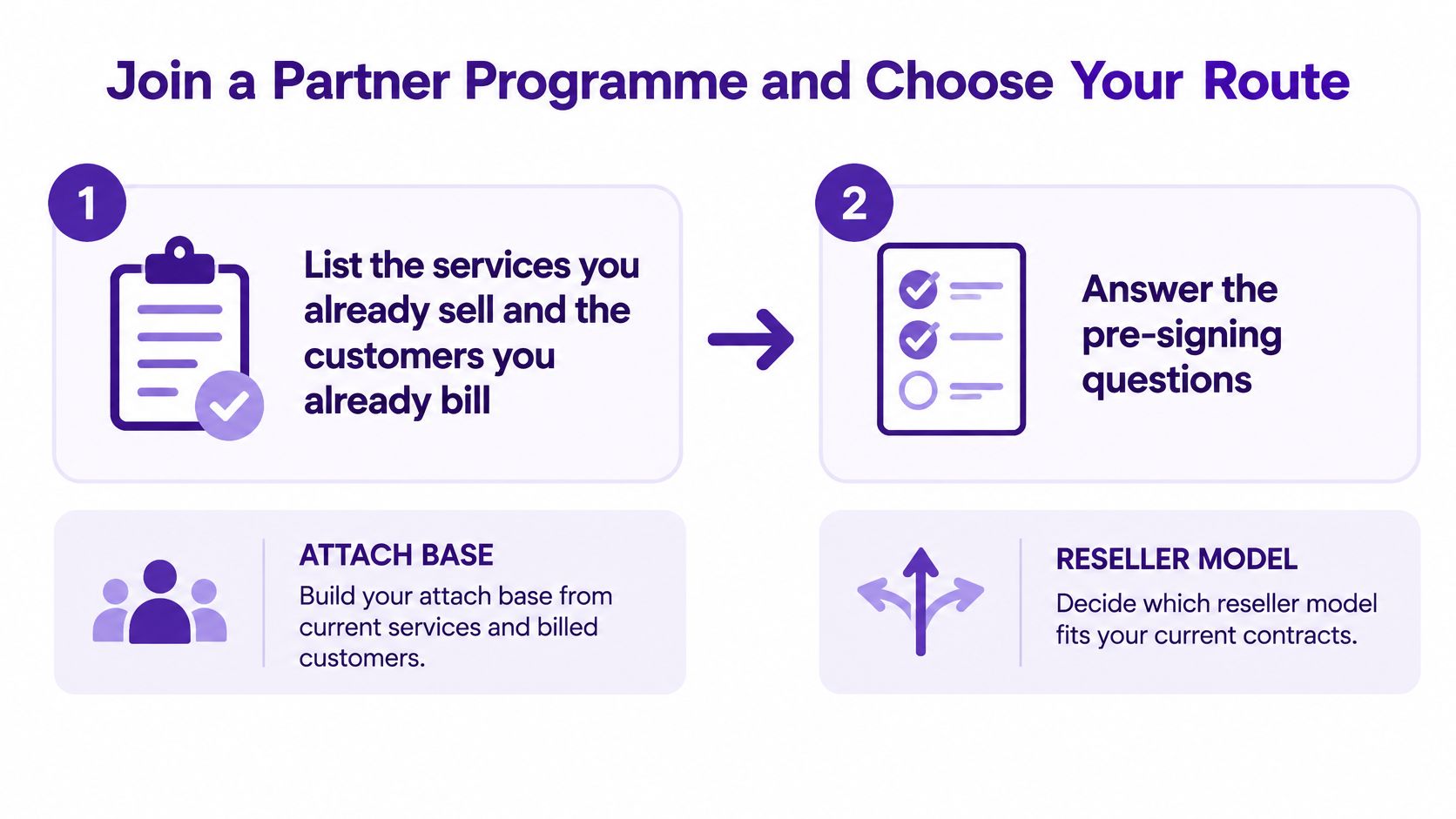
Build the commercial route
List the services you already sell and the customers you already bill. That's your attach base. Include connectivity, telecom systems, IT support, cloud services, hosting and web services, then identify who owns each account internally.
Answer the pre-signing questions. Decide which reseller model fits your contracts, who owns the customer and invoice, and what your support desk can handle. Establish the minimum commitment and plan to review paid take-up after an initial pilot period.
Compare programme terms rather than headline margin. Examine wholesale charges, minimum commitments, branding rights and exit clauses together. A lower unit cost can be poor value if you must keep paying for unused capacity.
Confirm how your brand appears. We're fully white-labelled, so MSPs and IT providers can sell dark web monitoring under their own brand and company name. The partner keeps the customer relationship and includes the service within its own portfolio.
Prepare billing, onboarding and customer contracts. State what's included, how cancellation works and where monitoring ends and remediation begins. Put these documents under your own name rather than leaving customers to interpret an upstream supplier agreement.
Train the support desk in plain-English explanations. Staff should explain what was found, what remains uncertain and what the customer should do next. Business users need a usable instruction, not an unexplained risk score.
Pilot before wider rollout. Select customers with reachable decision-makers and clear account ownership. If your team can't yet support a branded service, begin with a referral or authorised arrangement where available rather than making an unsupported managed-service promise.
Check delivery before expanding
For accounts that also need a connectivity review, SwiftNet Wifi's business internet speed and coverage comparisons can help structure the initial requirements discussion. Validate local availability and the customer's actual application needs before presenting a package.
We help MSPs protect over 15,000 businesses worldwide. Customer feedback describes GoSafe as built specifically for resellers, easy to roll out and offering strong margins, but that's a customer assessment, not a guaranteed return for your business.
Pilot discipline: Review support tickets alongside subscription sales. A successful launch needs both.
The support case is clear: the Northern Ireland Cyber Security Centre's summary of the 2025 UK survey reports that 84% of businesses experiencing a cyber security breach or attack identified phishing, while only 22% of businesses had an incident response plan. These measures describe different groups, so don't interpret them as the same denominator.
That creates a practical role for dark web monitoring for MSPs: connect exposure alerts with password resets, user education and, where separately included, phishing simulations. Monitoring alone doesn't supply the customer's response plan.
View the GoSafe Dark Web monitoring reseller program to assess the partner route and discuss how it would fit your existing support and billing arrangements.
Bundling Monitoring With Telecom Fraud Protection
Monitoring doesn't block fraudulent calls or stop every breach. A credible bundle separates call protection from credential monitoring, then brings their follow-up into the same customer relationship.
For a hosted-voice customer, a convincing caller might impersonate the telecom support desk and ask an employee to approve an account change. Exposed credentials could make that approach more persuasive, but the presence of breach data doesn't prove who placed the call.
Give each part a defined job
- Telecom protection: The voice supplier and reseller handle available call-level controls, suspicious traffic investigations and fraud reporting.
- Credential monitoring: The monitoring service surfaces exposed business email addresses and passwords for authorised review.
- Shared support: Your desk links relevant reports, verifies the customer's identity and coordinates corrective action.
Sell the convenience of one support relationship and one recurring invoice, not the fiction that every risk is handled by one technical system. Call barring, credential resets and customer communications may still have different owners.
Use a shared escalation routine
- Log the call report against the customer account, including what the caller requested and whether anyone disclosed information.
- Review authorised alerts for relevant customer identities or credentials. Don't search an alleged caller's personal information without a lawful basis.
- Reset affected credentials where exposure is confirmed, and escalate suspected account compromise through the customer's agreed response process.
- Record the outcome and tell the customer who acted, what changed and what remains outstanding.
Don't automatically reset an entire organisation's passwords after every suspicious call. Verify the report through a trusted contact route and assess the affected account.
The commercial case for recurring security revenue for telecom resellers is strongest when the bundle removes coordination work. Before selling it, name the party responsible for each action and explain which incidents require specialist assistance.
Selling a Recurring Security Add-On to Existing Customers
Which tier does this customer need? Start there, rather than offering the same security package to every account. Assess reliance on business-domain credentials, email-dependent workflows, user numbers and the need for documented incident response.
A small organisation handling sensitive transactions may need more support than a larger business with limited email use. Company size is a starting point, not a complete risk assessment.

Which tier suits each customer segment
| Segment | Buyer profile | Tier | What the tier includes |
|---|---|---|---|
| Microbusiness | Few users, light reliance on business email | Basic monitoring | Alerts on exposed email addresses and passwords |
| Small firm | Several users, email-dependent operations | Alert handling and password resets | Monitoring plus handled follow-up |
| Regulated or higher-value account | Many users, need for documented incident response | Reporting and phishing simulation | Monitoring, reporting and phishing simulation |
These are illustrative service packages, not published plans. Reporting, simulations and handled remediation need their own delivery scope and price.
Sell readiness rather than fear
The Government's Cyber Security Breaches Survey 2025 technical report accompanies findings that 43% of businesses experienced a breach or attack, while small-business use of formal cyber-risk policies rose from 51% in 2024 to 59% in 2025, and continuity plans covering cyber risk rose from 44% to 53%; cyber-facilitated fraud affected approximately 3% of businesses.
That supports a more measured offer than suggesting fraud is inevitable. Customers may value visibility, governance and a clear response process even when they haven't suffered a financial loss.
For customers operating in Australia, ABS Insurance Brokers Pty Ltd's discussion of breach reporting duties for small businesses offers jurisdiction-specific context. Don't apply Australian reporting guidance to UK customers or imply that monitoring itself fulfils notification duties.
Keep the promise measurable
A dark web monitoring service for businesses identifies exposure; it doesn't guarantee prevention. An alert can start a valuable customer conversation without proving that an attack is imminent.
Build your MRR calculator around eligible accounts, paid attach rate and monthly selling price, then deduct delivery costs. For reseller dark web monitoring and other white label security services, use an escalation commitment your desk can meet.
That's how recurring revenue security services become sustainable: a clear service, a suitable customer and a support promise priced into the subscription.
GoSafe Dark Web monitoring offers fully white-label credential monitoring that telecom resellers can package alongside connectivity and voice under their own brand. Visit GoSafe Dark Web monitoring to learn how it works, then add white-label dark web monitoring to your services through the reseller programme and discuss a demo for your business.