Searching for mobile number tracking free often means wanting something simple. They type in a number, expect a live map pin, and assume the internet can reveal where a phone is. That expectation is wrong more often than not, because a phone number by itself does not give lawful access to live GPS location, and public tools usually only infer coarse metadata such as carrier, region, or line type from a number, not continuous coordinates (source).
For UK resellers and MSPs, that confusion matters commercially. Ofcom reported 6.4 million mobile numbers were unexpectedly or incorrectly ported in 2023/24, which is a useful reminder that number-based identity data is operationally fluid, not a fixed locator (Ofcom reference). Add in the fact that 96% of mobile users said mobile coverage mattered to them, and it's clear why phone numbers sit at the centre of everyday business communication, and why lookups attract both legitimate demand and misuse risk (Ofcom reference).
Why Free Mobile Number Tracking Rarely Delivers
A phone number is not a hidden GPS feed. If a site claims you can paste in a number and watch a person move across a map for free, it is promising something the technology and the law do not support. In practice, legitimate consumer tracking depends on prior consent, account access, or an installed app, not the number itself (source).

What people think they are buying
The phrase mobile number tracking free is usually interpreted as real-time location tracing. That's the wrong mental model. Free tools can sometimes return a carrier name, a rough region, or a line type, but that's metadata, not geolocation. For a client asking whether a person is at home, in a warehouse, or on a train platform, that distinction is decisive.
Practical rule: if the tool doesn't have permission from the device owner or access through a lawful process, it isn't doing live tracking.
MSPs hear the same complaint repeatedly. The user tries one site after another, gets a partial result, and then finds a payment wall before anything useful appears. That pattern is not an accident, it's the business model of many so-called free trackers.
Why the promise breaks down
Third-party apps can't harvest GPS data without user authorisation, because the device OS controls access. On top of that, location precision gets worse when signal is weak, coverage is poor, or buildings block the view to the network. Even where an estimate exists, consumer tools often provide a basic map pin or delayed update rather than anything live (source).
That's why the better question isn't, “Can I track a number for free?” It's, “What kind of information can a number reveal without consent?” For most business use cases, the answer is limited metadata, not a location feed.
Location Tracing Versus Data Exposure Explained
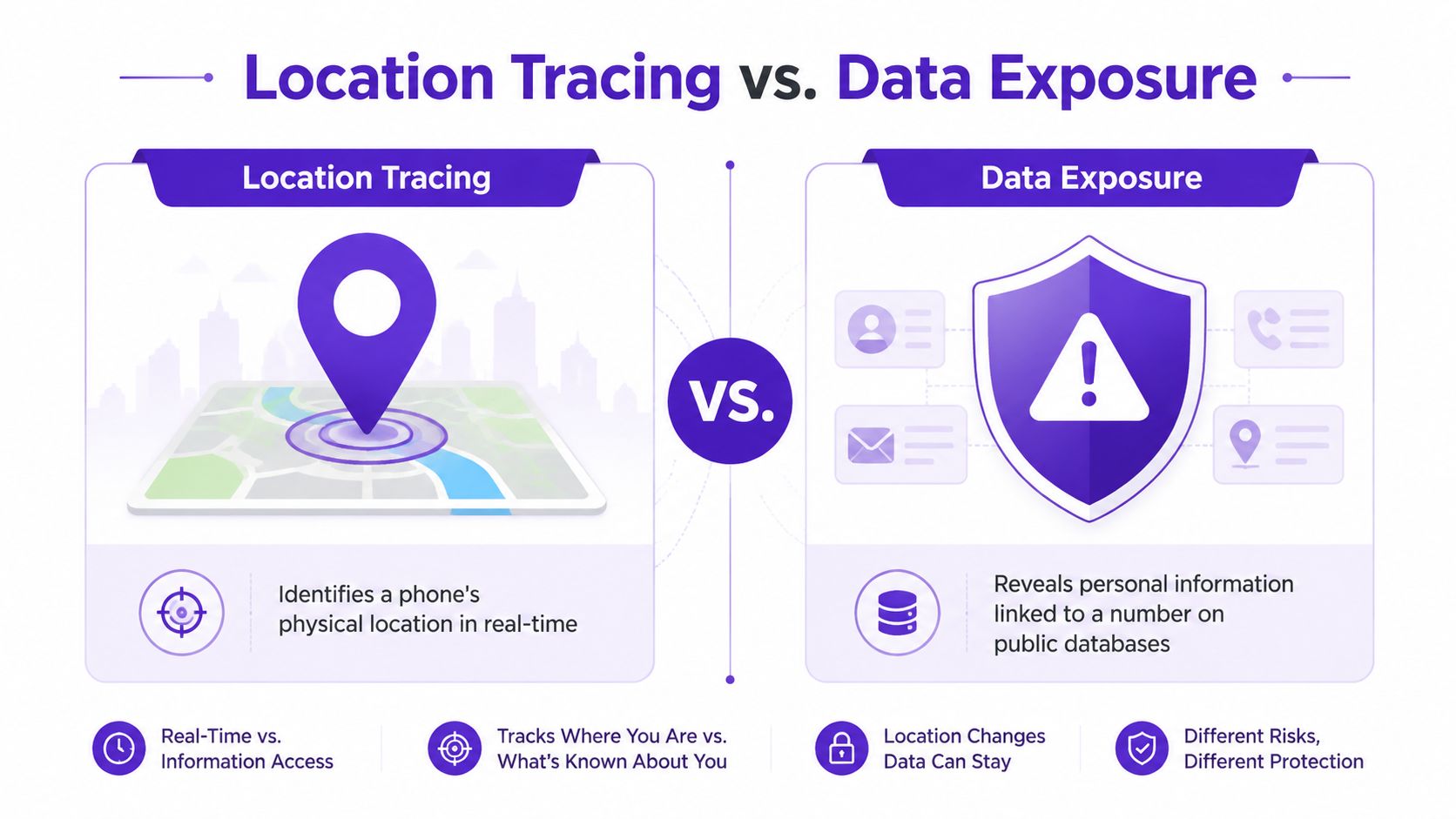
The phrase mobile number tracking gets used for two very different jobs, and clients often mix them up. One is location tracing, which tries to identify where a handset physically is. The other is data exposure tracking, which looks for whether a number appears in leaked databases, breach dumps, or other exposed records. The first is about movement, the second is about risk.
The technical boundary
Location tracing depends on network operator data or an installed app with explicit consent. In other words, the handset or the operator knows where the device is, and a third party only sees that information if it has been authorised to access it. Consumer-facing free tools don't have that privileged access, which is why claims about number-only live tracking are misleading.
Data exposure tracking works differently. A number can be matched against public records, breached lists, or dark web material to see whether it's been exposed alongside other identifiers. That's a security check, not a movement check.
The legal boundary
UK privacy rules make covert location tracing especially sensitive. Only the authorities can legally trace a phone number in the sense of identifying or locating the device through network data, while consumer-facing reverse-lookup tools can only match a number against public records. Currys is direct about the risk, warning that free phone tracing sites are probably scams (Currys guidance).
For resellers, that gives you a clean explanation to use with customers. A phone number lookup is a metadata problem unless consent or lawful authority exists. If a client wants real-time coordinates, free number-based tools won't solve it. If they want to know whether their number has been exposed, a different class of service is required.
Free Tracking Methods and Their Real Limitations
The free methods clients encounter fall into four groups, and none of them do the same job. Some are useful for family safety. Some are little more than directory lookups. Some trade on confusion. That's where MSPs need to be blunt, because the wrong recommendation wastes time and creates false confidence.
What each method really returns
| Method | What It Actually Returns | Consent Required | Live Location |
|---|---|---|---|
| Carrier family locator services | Approximate location for family plan members, often based on cell-tower data | Yes | Limited |
| Reverse-lookup websites | Public-record matches, sometimes carrier or line-type details | No, but accuracy is limited | No |
| Google and WhatsApp location sharing | The other party's shared position, if they choose to send it | Yes | Yes, while sharing is active |
| Third-party tracking apps | Usually device-based data, if the user installs the app and authorises access | Yes | Only if the app is legitimately configured |
Carrier tools are the closest thing to “free” location support, but they're tied to family accounts and are not designed for covert tracing. Reverse-lookup websites are the most common dead end. They can help identify an unknown caller, but they're not a live map.
What the legitimate free options are
The safest free options are device-account based, not number based. That means Find My Device on Android or Find My iPhone on Apple devices, where the account holder has the right permissions and the device has been set up in advance. Independent guidance consistently points to those tools because they work through account access, not magical number tracing (source).
Operational note: if the user didn't set up device tracking before the issue arose, the free route usually ends there.
For support desks, that matters because you can reset the conversation. A caller asking for “free mobile number tracking” usually needs either account-based device recovery steps or reassurance that their real problem is exposure, not location. That's where you move the conversation from impossible promises to a service you can deliver.
Scams and Privacy Risks to Warn Your Clients About
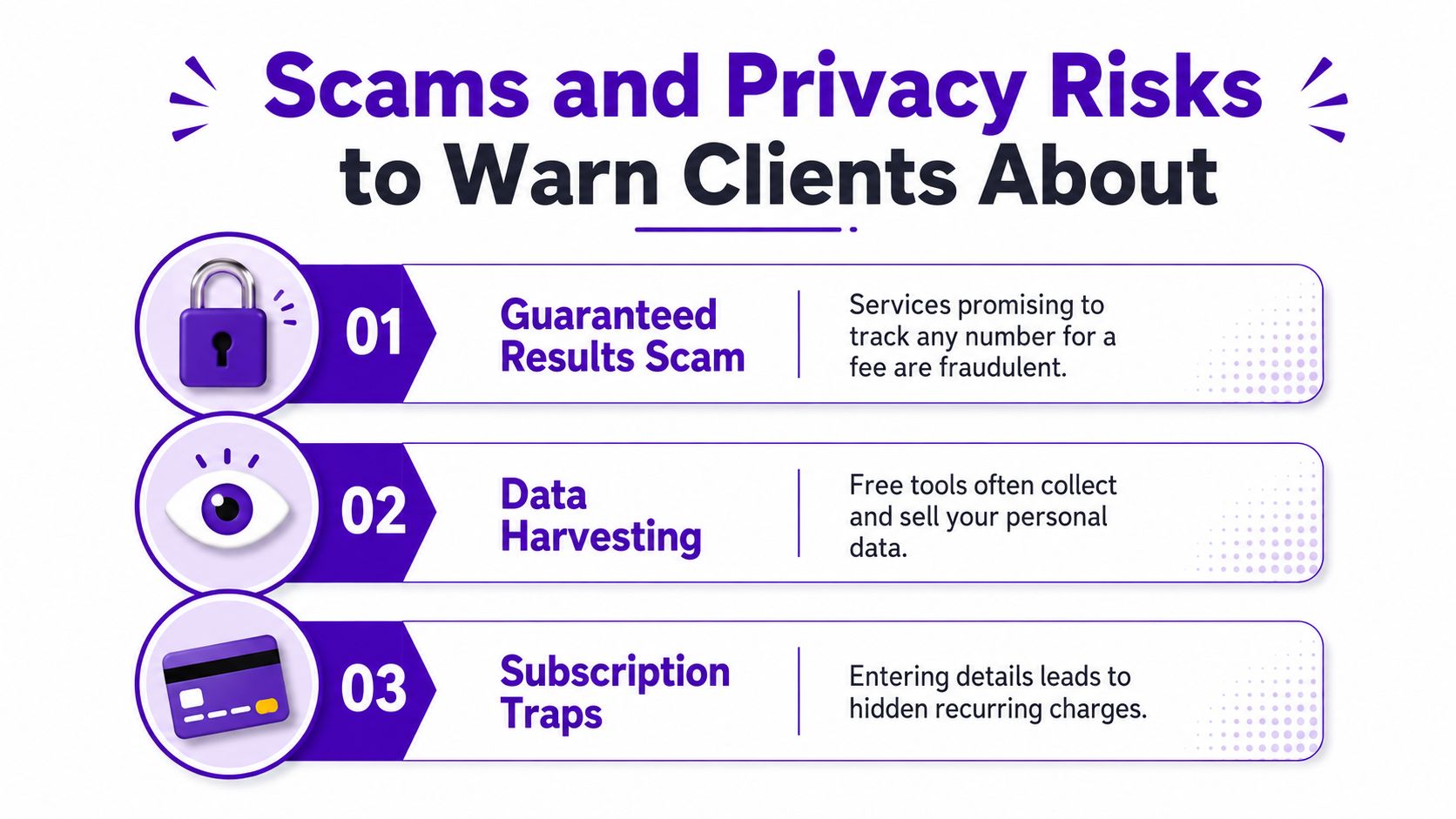
A common scam starts with a simple search. A client lands on a site that claims it can track any number for free, enters a mobile number, and is told the result is just a step away. Then the site asks for personal details, pushes advertising, or reveals the “answer” only after a payment page appears. In some cases, the site is really harvesting the searcher's own device data, not tracking the target at all.
The red flags are easy to spot
Guaranteed results are the first warning sign. If a site says it can trace any number, that's a legal and technical impossibility for consumers. Data harvesting is the second. Free tools often collect contact details or device data, then monetise that information through ads or resale. Subscription traps are the third, where the trial is cheap or apparently free, but the user is pushed into recurring billing once they've committed.
Currys' warning that free tracing sites are probably scams is worth repeating to customers because it's simple and memorable (Currys guidance). The other practical message is that UK numbers move around. Ofcom's figure of 6.4 million unexpectedly or incorrectly ported numbers in 2023/24 shows why number identity claims can be shaky even before you get to the scam layer (Ofcom reference).
What to tell clients to do instead
If they need to check whether a number or email has been exposed, steer them towards services built for exposure monitoring, not fake geolocation. If they need outreach governance, a useful reference is compliance for B2B outreach, because privacy handling and contact-source hygiene matter whenever a company starts using phone data operationally.
For firms that also handle voice-based fraud risk, it's sensible to protect clients from voice phishing with GoSafe. That gives them a broader view of why exposed numbers matter beyond simple lookup curiosity.
How MSPs Can Offer Reliable Phone Number Monitoring
Once the client understands that free location tracing is a dead end, the commercial alternative becomes easier to position. Phone number monitoring through dark web scanning tells a different story. It looks for numbers that appear in breached databases, underground forums, or leaked credential sets, then alerts when new exposures appear. That's a practical service, and it fits the way MSPs already package recurring protection.
What the service actually does
A useful model is to monitor the number as an exposure indicator rather than a location marker. If a mobile number turns up with a password, email address, or other identity detail, that can signal account risk, impersonation risk, or a wider breach footprint. GoSafe's Dark Web Monitoring works in this category, continuously scanning for compromised email addresses, exposed passwords, and breached domains, while also monitoring phone numbers for exposure signals.
That matters because customers usually do not want a dashboard full of noise. They want a simple alert they can understand and act on. The value is in the early warning, not in pretending to be a tracking app.
How to package it commercially
This sits neatly beside IT support, connectivity, hosting, cloud services, telecom systems, and web services. For a reseller, it's an easy add-on rather than a new business line. If you need a starting point, the phone number enrichment tool shows how adjacent services can support number intelligence without pretending to provide live tracking.
If you want to formalise that offer, the reseller program for MSPs is the model to examine. A white label security services approach lets partners sell dark web monitoring under their own brand, own the customer relationship, and avoid building security tooling in-house.
Commercial reality: clients buy reassurance and early alerts more readily than they buy a complicated security dashboard.
That's why recurring revenue security services around exposure monitoring tend to be easier to explain than fake phone trackers. They solve a real risk, they don't overpromise, and they can be delivered without specialist security staff.
Next Steps for Adding Dark Web Monitoring to Your Services
The practical move is straightforward. Start by treating mobile number tracking free searches as a sales signal, not a technical request. If a customer asks for live tracking, clarify the legal and technical limits, then offer a legitimate exposure-monitoring service that watches for leaked phone numbers, breached domains, passwords, and related credentials. If they want a broader view of how providers package this sort of offer, the MSP dark web monitoring solutions resource is a useful comparator.
For resellers, the commercial case is clear enough. You can sell dark web monitoring as a monthly subscription, attach it to existing support contracts, and keep overhead low because the platform does the scanning and alerting without needing a security team. For a broader service context, IT services security is a helpful reminder that buyers increasingly expect security to sit alongside everyday IT delivery, not as a separate, complicated purchase.
The final step is operational, not theoretical. Choose a white-label platform, map it to your current customer base, and package the alerts in plain English so non-technical clients understand what's exposed and what to do next. That's how you turn confusion around free tracking into a service line that earns trust.
GoSafe Dark Web monitoring gives you a way to monitor exposed phone numbers, passwords, email addresses, and breached domains without pretending a number can reveal live location. If you want to offer that under your own brand, visit GoSafe Dark Web monitoring and see how it fits into your service stack.