
The UK Government's Cyber Security Breaches Survey 2025 found that 43% of UK businesses experienced at least one cyber security breach or attack during the previous 12 months, representing an estimated 612,000 businesses across the UK. That's the context for cyber security UK decisions today. Incidents aren't confined to large enterprises, and resellers who can map each obligation to evidence will have clearer, more honest conversations than those who just sell another dashboard.
UK Cyber Security Rules and Who Must Follow Them
Cyber security UK duties overlap. Which ones bind a business depends on the data it holds, the services it sells and the contracts it wants, so scope comes before tooling.
UK GDPR and the Data Protection Act 2018 reach almost every customer because almost every customer processes personal data. The Network and Information Systems Regulations 2018 are narrower and focus on essential and relevant digital services. Cyber Essentials is voluntary for most firms but required for some central government contracts. PECR matters for your own cross-selling as well as your customer's security posture.
Where monitoring fits and where it doesn't
| Framework | Applies to | Core requirement | Enforced by | Where monitoring fits |
|---|---|---|---|---|
| UK GDPR and Data Protection Act 2018 | Any organisation processing personal data | Protect personal data with appropriate security and meet breach duties | Information Commissioner's Office | Flags exposed credentials and personal data; the customer keeps the reporting duty |
| Network and Information Systems Regulations 2018 | Operators of essential services and relevant digital service providers | Manage security risks and report significant incidents | Sector competent authorities and the ICO for digital providers | Early alerts provide evidence for incident timelines; regulatory reporting stays with the customer |
| Cyber Essentials | Most organisations; required for some central government contracts | Five technical controls verified by assessment | Accredited certification bodies | Credential monitoring supports user access control; policy and assessment stay with the customer |
| PECR | Businesses sending electronic marketing | Consent before marketing emails and texts | Information Commissioner's Office | Monitoring does not cover marketing consent; the provider must obtain it for its own cross-sell |
| Cyber Security and Resilience Bill | Operators of essential services and digital providers (proposed) | Expected to update NIS duties; check current status | Parliament, then designated regulators | Too early to map; confirm status before advising |
For UK GDPR, the higher maximum fines are set as the greater of a fixed sum or a percentage of worldwide annual turnover, so evidence matters to any director asking about exposure. You don't need to lead with penalty figures in a sales meeting, but you do need a straight answer when a board member asks what a breach could cost. The same applies when insurance enters the discussion, and GoSafe Dark Web monitoring explains insurance requirements for providers who need that context.
The practical test is simple. List each customer type you serve, tick the rows that apply, and use that list to decide which services to offer first. A hosting provider, a VoIP reseller and a web agency won't have identical exposure, even when they share the same office park.
Practical rule: Sell monitoring as evidence for identity and data exposure. Don't sell it as proof that policy, consent, assessment or regulatory reporting has been done.
That boundary protects you commercially. Dark web monitoring can show that credentials linked to a domain have appeared in breach material. It can't write the customer's data protection policy, obtain marketing consent or submit a regulatory report.
The Five Cyber Essentials Controls Explained
Cyber Essentials works because it's narrow. An assessor checks five technical controls, and most failures come from basic administration rather than missing specialist products. That also makes the scheme easy to scope for a managed service: each control either produces evidence you can collect, or names a duty that stays with the customer.
Firewalls must block unapproved inbound and outbound traffic, and default administrative passwords must be changed. Secure configuration means removing unnecessary services, accounts and default settings. User access control requires least-privilege accounts, named administrators and no shared logins.
Malware protection must be current on every device in scope. Security update management means software stays supported and critical or high-risk patches are applied within the timescale the scheme sets. Patching cadence is an operational duty. No monitoring product can apply an update on the customer's behalf, so your job is to make the gap visible and chase it until it's closed.
Controls and common failures
| Control | What it covers | Common failure |
|---|---|---|
| Firewalls | Boundary devices block unapproved traffic | Default admin password left in place |
| Secure configuration | Unneeded services and accounts removed | Factory settings and open ports |
| User access control | Least privilege and named admin accounts | Shared logins on line-of-business systems |
| Malware protection | Current anti-malware on every in-scope device | Disabled or expired protection |
| Security update management | Supported software patched within required timescales | Unsupported operating systems |
The identity layer deserves separate attention. The National Cyber Security Centre's 2025 Annual Review recorded 204 nationally significant incidents, up from 89 the previous year, and reports that attackers are increasingly targeting user identity rather than individual devices, including helpdesk impersonation to reset credentials and phishing for valid identity-provider access.
That changes how you review user access control. A leaked username and password pair can become the route in, while a convincing helpdesk call can bypass endpoint controls altogether. Monitoring corporate domains for exposed credentials gives you early warning and produces evidence you can show an assessor. What it can't do is enforce multi-factor authentication, verify password resets or log administrator actions. Those sit with the customer, and saying so plainly protects the relationship.
I would run a one-hour audit on one customer before offering this widely. Score each control as pass, partial or fail, note the evidence you'd show an assessor, and fix shared accounts and factory passwords first. They're cheap to correct and easy for a customer to understand.
How to Get Cyber Essentials Certified
Certification fails most often on scope, not technology. If the device and service list is incomplete, good controls on the listed systems still won't be enough.
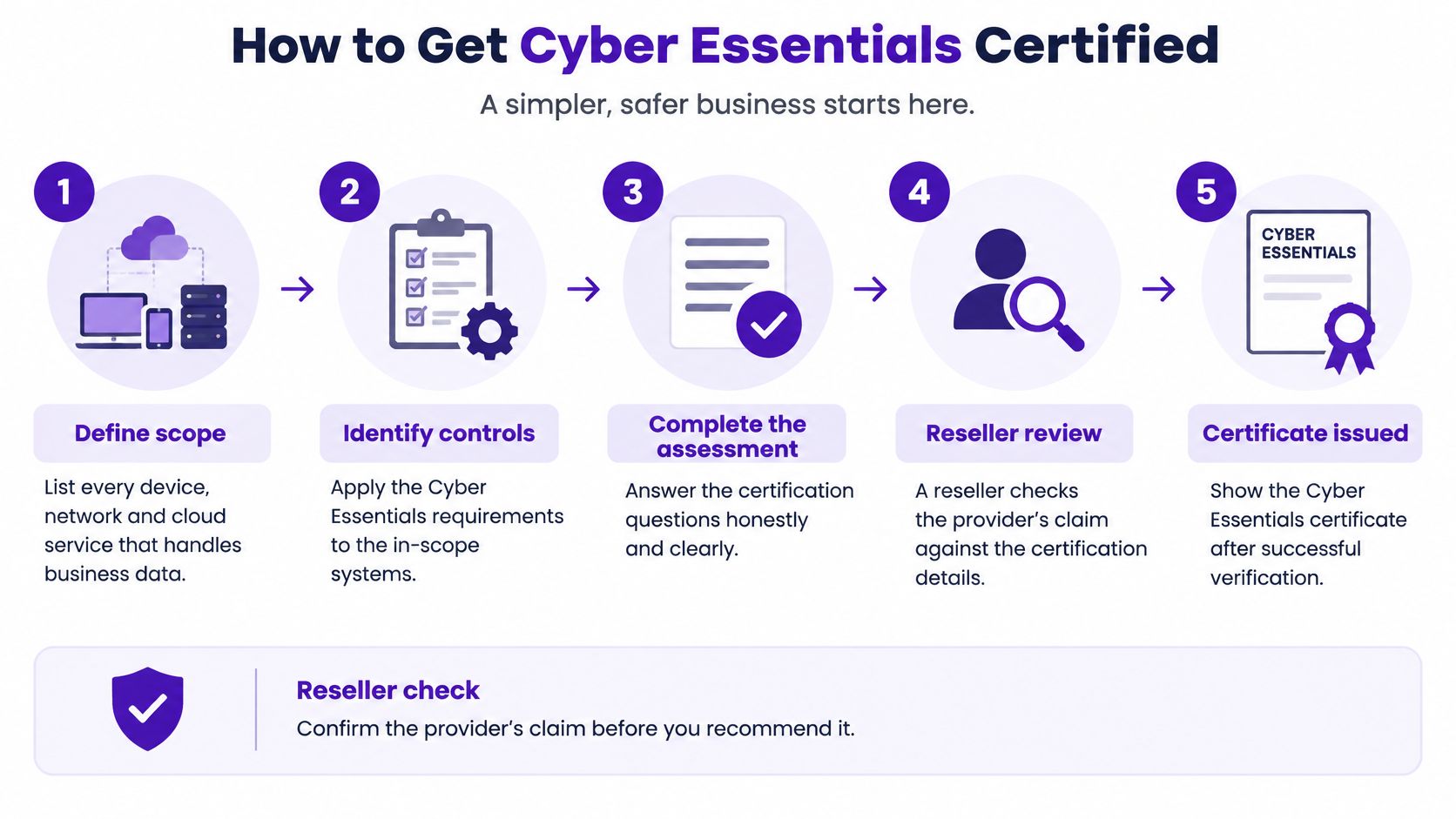
Route from scope to certificate
- Define scope: List every device, network and cloud service that handles business data. Don't exclude anything you can't justify in writing.
- Check the five controls: Work through each in-scope device and collect evidence, including patch records, firewall settings and administrator account lists.
- Choose the level: Cyber Essentials uses a self-assessment questionnaire. Cyber Essentials Plus adds independent technical testing of a sample of devices.
- Submit through an accredited certification body: Complete the questionnaire accurately and keep the evidence behind each answer.
- Answer assessor questions: Fix non-conformities within the deadline the assessor gives and record what changed.
- Receive and diarise: The certificate is valid for 12 months, so set the renewal date before the project team moves on.
For context on our own position, GoSafe is Cyber Essentials accredited, a government-backed certification. That doesn't remove the need for a customer to certify its own environment, because its scope, devices and accounts are different.
Verify a provider's claim before you rely on it
Ask for the certificate number, check it against the certifying body's register and confirm the scope covers the service being sold. A logo on a proposal isn't evidence.
Say a web agency buys hosting from a provider that claims Cyber Essentials. The agency should request the certificate and scope document, then confirm the hosted platform sits inside that scope before signing. If the certificate covers only a head office network, it says little about the hosting service.
Ask what the certificate covers, not just whether a provider has one.
That one question will save difficult conversations during customer questionnaires and procurement reviews.
UK GDPR Breach Reporting Deadlines and Duties
Start with the clock. The 72-hour reporting period runs from when the controller becomes aware of a breach, not when the investigation ends. If the report is late, the controller must explain the delay.
Say a phishing email gives an attacker access to a customer's mailbox at 16:00 on Monday and exposes client records. If the breach meets the reporting threshold, the report to the ICO is due by 16:00 on Thursday. Waiting for a complete forensic picture before starting the report is how teams miss the deadline.
The two reporting tests
- Report to the ICO: Required when a breach is likely to risk individuals' rights and freedoms.
- Inform affected individuals: Required without undue delay when the risk is high.
- Record every breach: Keep an internal record even when neither external notification test is met.
| Obligation | Timing | Trigger | What to include |
|---|---|---|---|
| Report breach to the ICO | Within 72 hours of becoming aware | Likely risk to individuals' rights and freedoms | Reasons for any delay |
| Inform affected individuals | Without undue delay | High risk to individuals | Likely consequences and steps taken |
| Record every breach | Always, internally | Every breach, reportable or not | Facts, effects and remedial action |
| Processor notifies controller | Without undue delay | Processor becomes aware of a breach | Timing and contact set in the contract |
Roles decide who acts. A controller decides why and how personal data is processed. A processor acts on the controller's instructions and must notify the controller without undue delay after becoming aware of a breach. Your contract should name the contact, the notification route and who speaks to the end customer.
For GoSafe, GoBig Online LTD is the Data Controller under UK GDPR. When data is processed or stored outside the UK or EEA, safeguards such as adequacy decisions and standard contractual clauses are used. State arrangements like these plainly in your own service documentation rather than leaving customers to infer them.
External context can help teams plan response playbooks, including wider data breach trends and numbers from Statlyst. Use that material for context, not as a substitute for your own incident record.
The reseller's job is to shorten the time between discovery and decision. A clear alert naming the affected account and exposure type helps. Deciding whether the legal threshold is met, and making the ICO report, stays with the controller unless your contract expressly allocates tasks and you can evidence them.
Why Governance Gaps Drive UK Demand
The strongest case for a managed service is the gap between exposure and ownership inside the customer's business.

The UK Government's Cyber Security Breaches Survey 2025 found that only 27% of UK businesses reported that a board member had specific responsibility for cyber security, down from 38% in 2021.
That is the governance problem in plain terms. Named accountability at board level is shrinking, and in many smaller firms the owner is also the escalation route, the budget holder and the person who takes the customer calls after an incident. When an alert arrives, there is often no agreed answer to who reads it first.
Turn the numbers into a useful conversation
Don't open with a dashboard. Ask three questions:
- Who owns cyber risk here: Name the person who would approve password resets, account lockouts and customer notifications.
- What would you want to know first: Agree whether the director needs the affected accounts, likely impact or recommended action at the top of an alert.
- How will we review it: Set a monthly summary that a non-technical director can act on in minutes.
A structured customer asset inventory and threat modelling exercise gives those questions substance. It connects domains, mailboxes and key systems to the people accountable for them, so an alert reaches someone who can act.
Each answer maps to evidence the service should produce. The named owner becomes the alert recipient. The agreed priority shapes what sits at the top of the summary. The monthly review becomes a standing habit rather than a post-incident scramble. GoSafe's User Dashboard brings a business's cyber risk score, security alerts and breach history together in one view, which makes that review workable for a director with no security background.
Providers who want wider commercial context can also review data on cybersecurity market spending from Rankozo. Spending figures help with planning, but a customer-specific exposure finding and a clear next step are what move a conversation to a signature.
Customers don't need more security noise. They need a plain statement of what was exposed, who's affected and what happens next.
That is why white label security services can work for MSPs and telecoms resellers. You supply continuous visibility and a familiar point of contact where the client has no dedicated security leader, and GoSafe already supports MSPs protecting over 15,000 businesses worldwide on that basis. The recurring value comes from the structure of the gap itself. The monitoring surfaces exposure and prompts the review, while the decision to act, the remediation work and any regulator notification stay with the customer. That boundary keeps the service's scope honest, and honest scope is what survives contract renewal.
What Dark Web Monitoring Covers and Where It Stops
White label dark web monitoring should be described narrowly and accurately. It provides continuous dark web scanning for compromised email addresses, exposed passwords and breached domains, then sends early alerts when credentials appear.
A useful alert names four things: the affected account, the exposure type, when it was found and the suggested next step. If your team has to interpret a raw breach dump before calling the customer, the service will create work instead of reducing it.
Why email-only checks are too narrow
The Office for National Statistics report on fraud and computer misuse found that, among reported hacking incidents, offenders accessed information held in a company or organisation customer database in 28% of cases, while email accounts accounted for 16%. Monitoring therefore needs to consider domains and related identifiers, not just one mailbox list.
Each finding maps to a duty. Exposed credentials support action under user access control. A confirmed personal data exposure may start the customer's GDPR assessment and reporting process. The alert is evidence and a prompt, not the legal decision itself.
Monitoring doesn't enforce MFA, verify helpdesk password resets, train staff or write policy. It also doesn't create an incident response plan. The Northern Ireland Cyber Security Centre statistics report that only 22% of businesses had an incident response plan, which is why every alert needs a documented escalation route agreed in the service contract.
State that limit before the first sale. You'll keep trust when an alert requires action outside the monitoring platform.
Sell Dark Web Monitoring as a Recurring Service
Dark web monitoring for MSPs works commercially when it's sold as a monthly subscription, attached to a relationship you already own. It doesn't need a new security department, but it does need an owner inside your business.

Choose the resale model deliberately
| Model | Who owns the customer | Revenue pattern | Effort to start |
|---|---|---|---|
| Referral to a third-party provider | The provider | One-off referral fee or none | Low |
| Bundled into managed IT | You | Included in the monthly plan or a small uplift | Medium |
| Own-brand standalone subscription | You | Separate monthly fee per domain or user | Medium to high |
Referral is easy, but you give away the relationship and the recurring margin. Bundling suits IT support, hosting, connectivity and telecoms contracts because customers already review risk at renewal. Own-brand standalone gives you the clearest product identity and the strongest stickiness, provided you can run onboarding and monthly reviews consistently.
The economics are cumulative. As a worked example, if 200 customers each pay a modest monthly fee per domain or user, you've built a predictable revenue base that stacks on existing contracts rather than replacing project income. Keep the offer simple enough for account managers to explain without a security engineer in the room.
Staffing is the constraint for many providers. The UK Government's Cyber Security Skills in the UK Labour Market 2025 report states that approximately 143,000 people were employed in cyber security roles across the UK economy in 2024. Recruiting specialists is therefore slow and costly for a regional MSP or VoIP provider. Reseller dark web monitoring lets you use an existing platform while keeping the customer relationship.
GoSafe helps MSPs protect over 15,000 businesses worldwide. For your own launch, judge any platform on operational fit: branded customer portals, centralised licence management, bulk onboarding and clear, simple alerts that business users can understand.
Launch without building a security team
- Choose the model: Match referral, bundled or own-brand to your staffing and contract structure.
- Set the service before selling: Define the alert format, escalation route, monthly review and promised service level.
- Pilot with a small group: Review a sample alert with each customer and track renewals, response times and upsell conversions.
- Launch under your brand: Sell dark web monitoring under your own brand through the white-label reseller program for MSPs and review the terms before onboarding customers.
I would start bundled if you already have managed contracts, then move proven customers to a named own-brand tier. That gives you recurring revenue security services income without forcing a hard sell on day one. It's also easier to prove value when the first alert arrives during a routine service review.
If you're ready to offer a dark web monitoring service for businesses without building the underlying tool, GoSafe Dark Web monitoring gives you continuous scanning and clear alerts you can sell under your own name. Book a demo, review the reseller terms and add white-label dark web monitoring to your existing services with a clear boundary around what it evidences and what your customers still own.