A long-standing customer asks during a quarterly review whether you also look after security. You explain the antivirus, backups and firewall. Then they ask whether you'd know if someone had stolen their employees' passwords. That's where a familiar account review becomes a product decision.
For MSPs, telecoms providers and technology resellers, the question isn't which cybersecurity tools detect threats. It's which ones you can package, support and sell without adding an unmanageable workload. A branded customer portal, a usable ticket integration and sensible wholesale terms can matter more commercially than another dashboard.
The exposure is real. The UK Government's Cyber Security Breaches Survey 2025 found that 43% of UK businesses reported a breach or attack during the preceding twelve months. Customers reviewing data breach numbers for small firms need a clear explanation of what your service covers, not a promise that monitoring prevents every incident.
Buying principle: Choose the service you can reliably deliver, not the product with the longest feature list.
These ten options focus on credential exposure, dark web intelligence and related external-risk monitoring. They're assessed through a reseller lens: white-label control, pricing transparency, PSA/API fit, operational overhead and scope beyond basic breach alerts. None replaces endpoint protection, identity security, backups or an agreed incident-response process.
1. GoSafe Dark Web monitoring
GoSafe is a fully white-label Dark Web Monitoring tool for MSPs, IT providers, telecoms and VoIP resellers, and technology distributors. Partners can brand the service as their own, sell it under their company name and retain the customer relationship.
Our continuous dark web scanning detects compromised email addresses, exposed passwords and breached company-domain information. Clear, simple alerts help business users understand what's been found, while breach histories, redacted exposure examples and AI risk scores provide context beyond a basic breach notification.
A subscription service without building the software
Branded customer portals, centralised licence management and bulk onboarding support reseller delivery. There's no complex technical setup, and operating the monitoring service doesn't require specialist security knowledge or an internal security team.
- Customer visibility: Our dashboards show risk scores, security alerts and breach history across customer accounts.
- Complementary tools: Built-in phishing simulations, password tools and suspicious-email analysis through DeepCheck AI support wider customer conversations.
- Response context: Breach Breakdown explains exposed domain information and suggested actions, with incident-response support and GDPR resources also available.
Our tool runs in the background with minimal management. That makes it straightforward to explain and offer alongside IT support, connectivity, cloud services, hosting or telecom systems as a monthly subscription.
The commercial caveat is pricing. Wholesale pricing is described as competitive, but specific prices aren't published, so you can't calculate margins from a public rate card. Nor should straightforward deployment be confused with unlimited incident remediation: define what your subscription includes.
GoSafe is Cyber Essentials accredited. For providers prioritising white label dark web monitoring and customer ownership, the reseller programme explains how to offer cybersecurity monitoring under your brand without developing security software internally.
2. Arx Sentinel
If your customers pay for interpretation rather than just notification, Arx Sentinel deserves consideration. UK-based Arx Risk describes its white-label service as combining dark web monitoring with broader threat intelligence and human-validated findings.
That positioning suits MSSPs and cyber consultancies selling higher-touch advisory services. The client-facing portal, reports and service can carry the partner's brand, allowing intelligence to sit within an existing consulting relationship rather than appearing as an unrelated subscription.
Where the analyst layer matters
Human validation is useful when it helps your team distinguish relevant exposure from material that doesn't warrant immediate escalation. However, that phrase alone doesn't establish response times, investigation depth or whether every finding receives the same treatment.
- Strength: Partner branding extends across the customer-facing service, not merely an exported report.
- Flexibility: The vendor states there's no minimum-volume commitment and no requirement to white-label every service.
- Commercial limitation: Public pricing and detailed monitoring coverage aren't provided on the product page.
Ask for a sample finding alongside its analyst commentary. Then establish which service tier includes that work and what happens when a customer challenges the assessment.
Best fit: security consultancies and MSSPs that can charge for contextual advice. For a telecoms reseller seeking a simple automated credential-alert subscription, the advisory model may introduce more service design than necessary.
3. SOS Intelligence
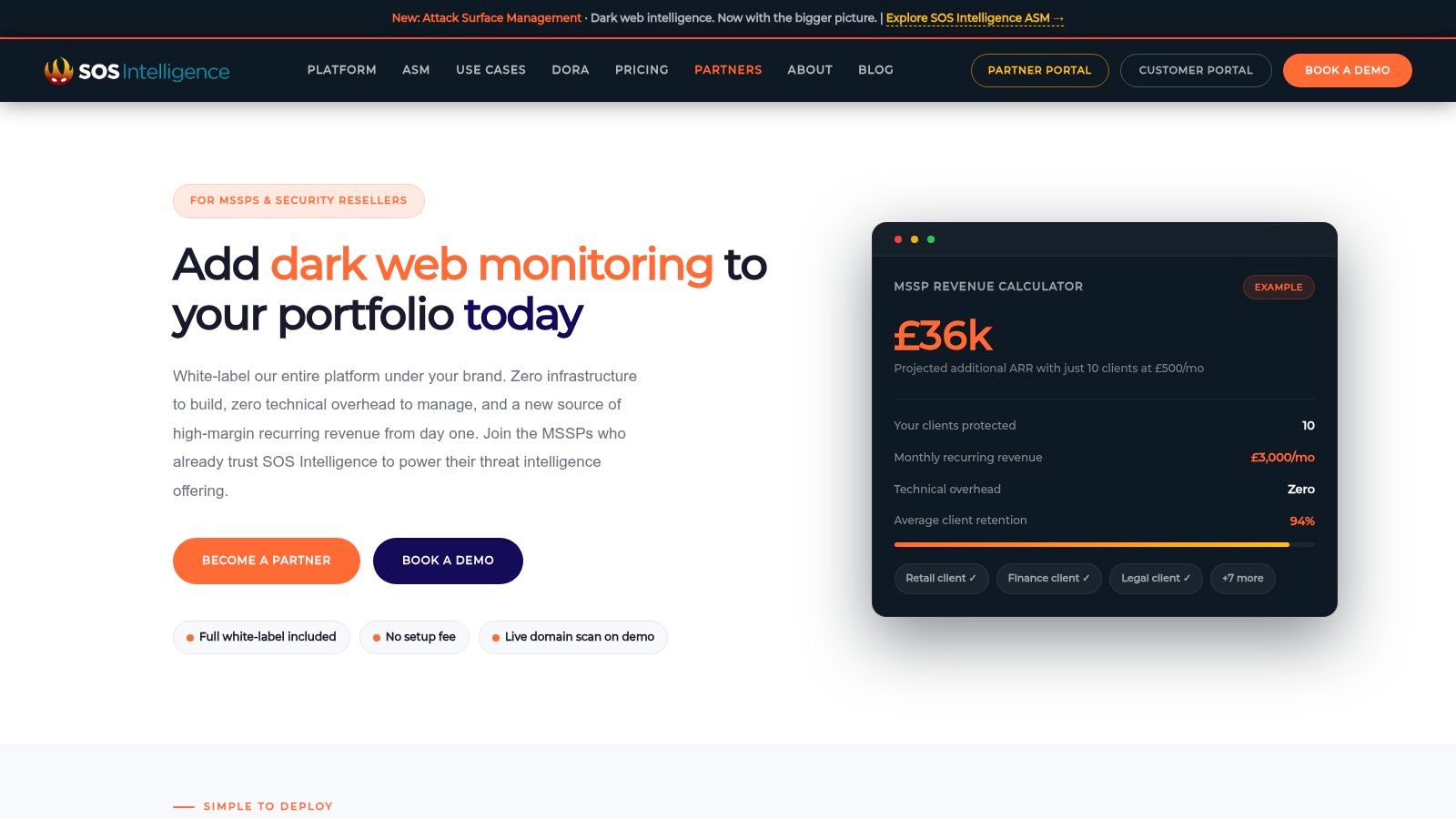
A branded experience matters when customers buy security from you, not from your supplier. SOS Intelligence's MSSP offering puts white-label delivery and a partner portal at the centre of its proposition, alongside dark web monitoring and credential-exposure alerts.
The UK-based provider also offers threat intelligence and attack-surface management capabilities. That creates room to develop a wider service, although partners should distinguish the monitoring package they're quoting from additional capabilities available elsewhere in the portfolio.
For UK-focused MSPs and security resellers, the combination is relevant. Local positioning, however, shouldn't replace a proper review of processing arrangements, access controls and contractual responsibilities.
A partner portal demonstrates administration. A customer demonstration establishes whether the service is understandable enough to sell.
The vendor offers partner support and a live domain scan during the sales process. Use that opportunity to examine the actual alert content: what was exposed, how the finding is explained and which action your service desk would take.
Pricing requires an enquiry, so compare the complete partner proposal rather than assuming the entry package includes every advertised capability. Confirm monitoring coverage, alert cadence, customer-branding rights and partner service levels.
SOS Intelligence is a sensible shortlist candidate for providers wanting white label security services with room to expand into intelligence-led work. Its operational fit depends on whether the supplied findings match your team's ability to interpret and resolve them.
4. CyberLab

A customer with exposed credentials may also have vulnerable internet-facing assets or supplier concerns. CyberLab suits providers that want to address those conversations together, rather than sell dark web alerts as an isolated product.
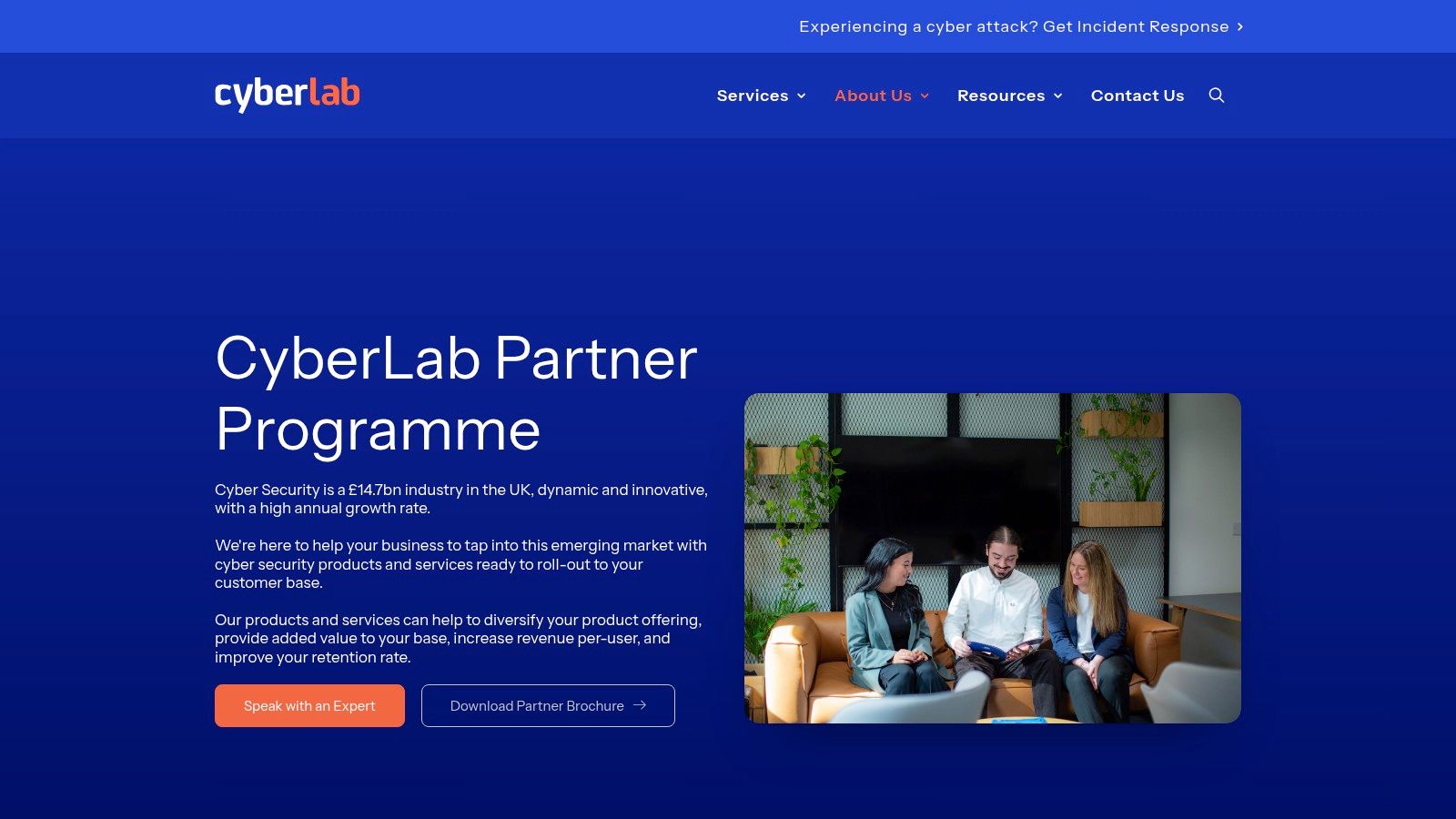
CyberLab's partner programme describes white-label branding and bespoke partner packages. Its wider proposition includes dark web monitoring, vulnerability and external attack-surface monitoring, and supply-chain security capabilities, with potential access to testing and managed security services.
Broader coverage needs a broader service definition
The supplier angle deserves attention: the NCSC Annual Review 2025 reported that only 14% of UK businesses reviewed the cyber risk of their immediate suppliers during the preceding twelve months.
That doesn't mean every customer needs a full assessment package. It means an MSP offering supplier-risk work should explain what it reviews, how it prioritises findings and who follows up.
- Advantage: A wider portfolio can support exposure reviews and additional assessment services.
- Trade-off: More findings can mean more interpretation, customer communication and remediation coordination.
- Pricing position: A clearly comparable public price for a standard partner package isn't available.
CyberLab is therefore more compelling for an IT provider building a broader security practice than for a web agency wanting a lightweight add-on. Confirm package inclusions, branding boundaries and escalation ownership before bundling several capabilities into a single monthly fee.
5. Kaseya Dark Web ID
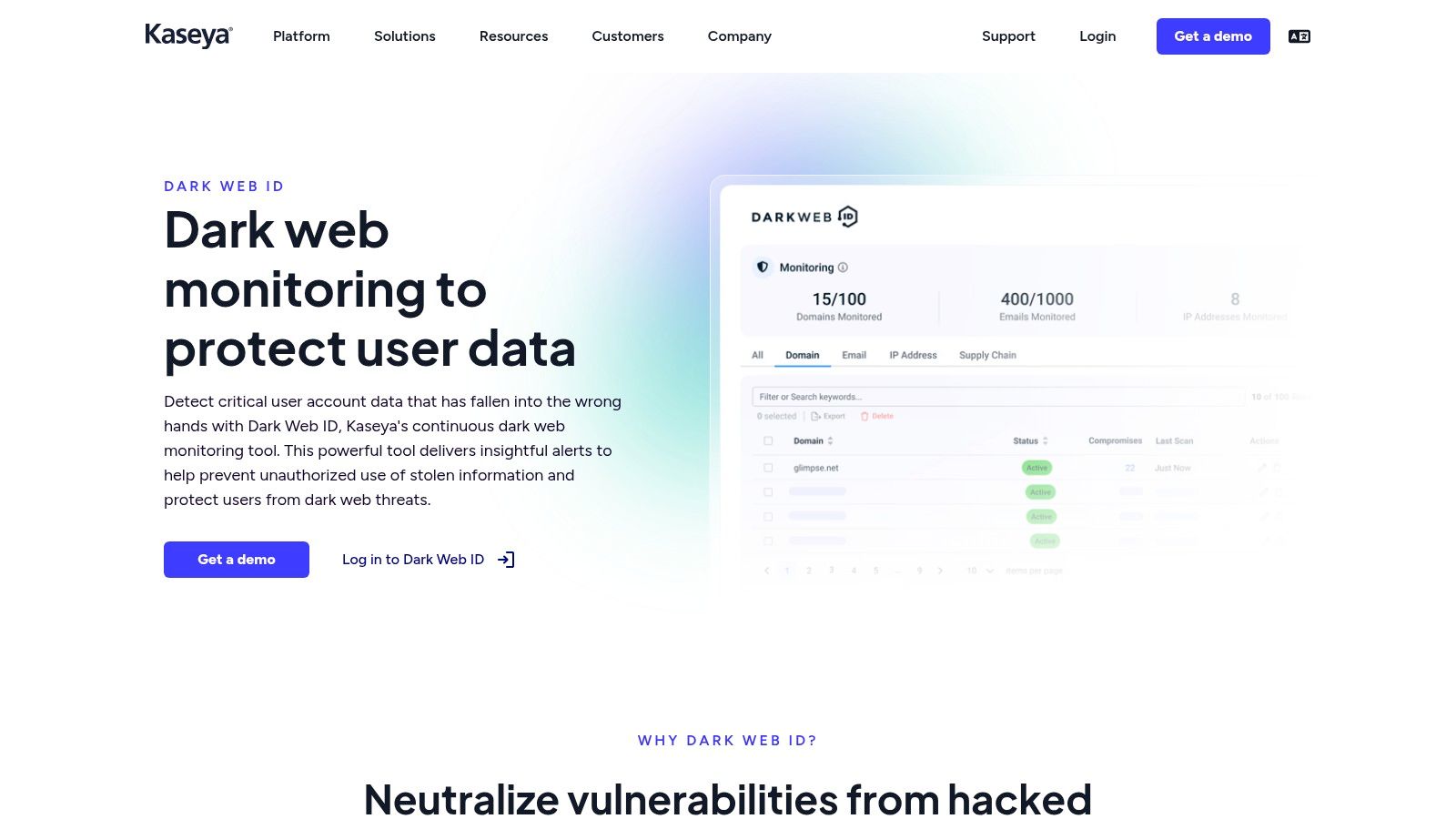
Start with the ticket queue if that's where your technicians already work. Kaseya Dark Web ID provides continuous compromised-account monitoring, compromise reports and mitigation information, with published PSA integrations including Kaseya BMS, Autotask and ConnectWise Manage.
For an MSP already using those systems, workflow fit is a credible reason to evaluate it. An exposure alert is more useful operationally when a technician can assign ownership, record remediation and bring evidence into a client review.
The integration still needs testing. A connector appearing on a product page doesn't establish how customer mapping, duplicate findings, reassignment or ticket closure behave in your configuration.
Ticket automation versus customer branding
Dark Web ID is a focused credential-exposure product, not a complete endpoint-security suite. It also shouldn't be assumed to provide the same fully white-label customer experience as a reseller-first branded portal.
- Operational strength: Published PSA integrations can help route findings into established service processes.
- Branding caveat: Confirm client-facing presentation, notification branding and reporting permissions.
- Commercial caveat: Public pricing isn't listed on the product page.
A useful demonstration starts with a finding and ends with a resolved ticket. Ask the vendor to show the steps between them, including what the customer sees.
Best fit: MSPs prioritising alignment with an existing Kaseya or supported PSA environment. Evaluate contractual terms and support effort alongside licence cost, rather than treating an existing supplier relationship as sufficient justification.
6. usecure uBreach
A breach finding can open a productive customer conversation about password reuse, phishing and account protection. usecure uBreach is particularly relevant when you already sell security-awareness services, because its exposure monitoring connects with usecure's broader human-risk offering.
The uBreach product page describes scheduled account scans and domain monitoring, depending on product level, together with alerts, redacted exposure snippets and remediation tracking. Branded breach reports and prospecting scans are listed among uBreach Pro capabilities.
Connect detection to behaviour
The commercial opportunity is a joined-up service: explain an exposure, help the customer secure the account and use training or phishing simulation to reinforce safer behaviour. Don't imply that completing training guarantees credentials won't be exposed again.
That distinction matters because the UK Government's Cyber Security Longitudinal Study, Wave Five found that 56% of businesses reported email impersonation scams during the previous twelve months.
The vendor advertises trial and not-for-resale access, but an NFR licence isn't a commercial entitlement to deploy the product for paying customers. Establish the paid MSP package and branding rights separately.
Public product comparisons help narrow the evaluation, while vendor-published ratings and customer figures can provide background rather than prove suitability. The decisive test is whether your team can move from a breach finding to a documented customer action without duplicating administration across monitoring and awareness tools.
7. MSP Dark Web
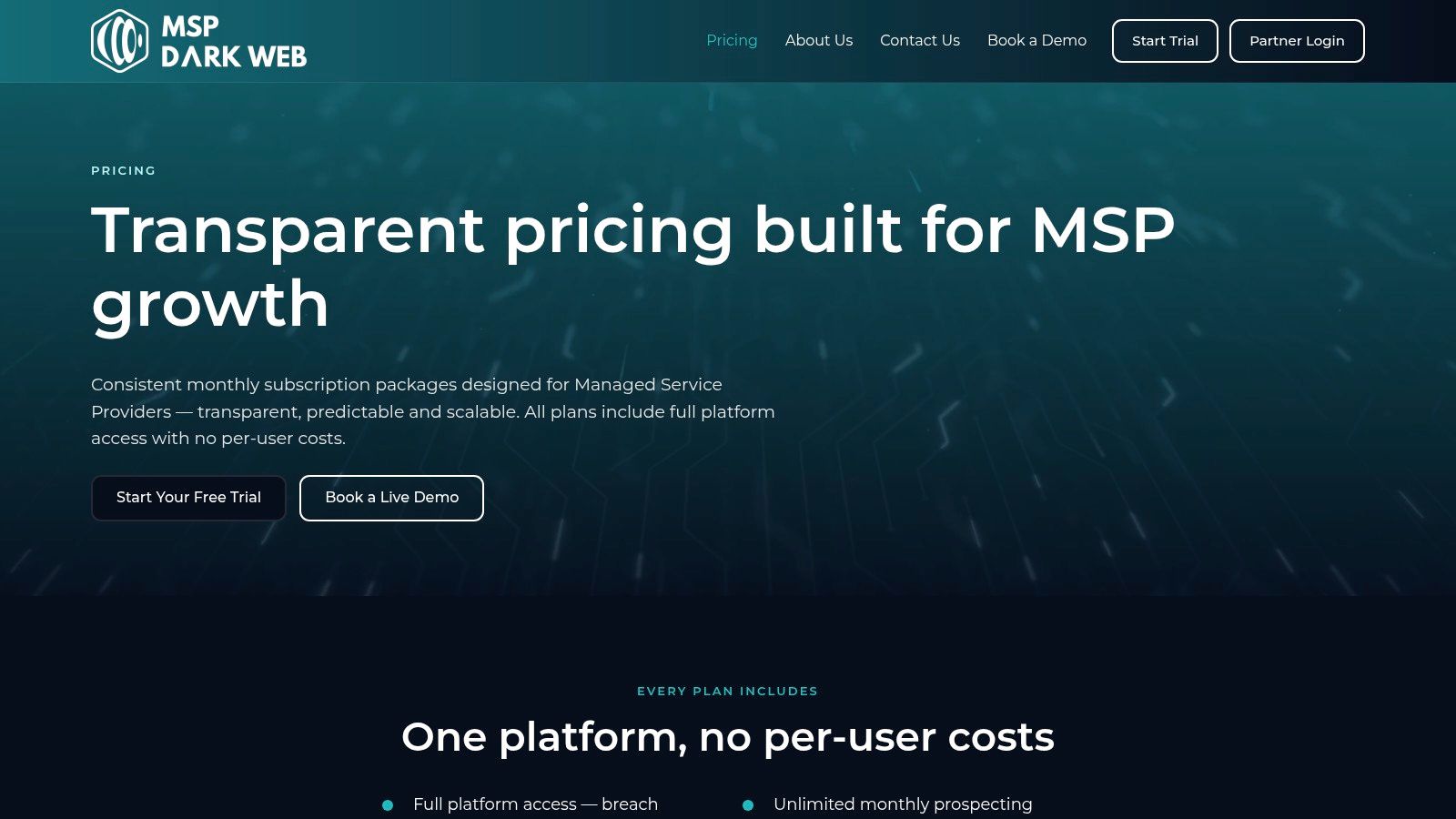
MSP Dark Web offers a clearer budgeting starting point than quote-only products. Its public pricing page describes domain-based packages, month-to-month terms, unlimited platform users and prospecting scans, alongside an advertised 30-day trial without a credit card.
Packages scale across monitored domains, personal email accounts and IPs, with breach intelligence, alerting and reporting. The practical attraction is being able to model an initial deployment before entering a partner negotiation.
Public pricing doesn't remove the need for commercial due diligence. The published pricing details use US dollars, so UK providers should establish billing currency, exchange-rate exposure and any applicable charges before setting a sterling subscription.
Price the customer, not just the domain
A domain-count model is convenient until customers bring multiple trading brands, acquired domains or additional monitored identifiers. Model those circumstances before assuming every customer has the same delivery cost.
- Budgeting advantage: Published packages make initial cost comparisons easier.
- Sales utility: Prospecting scans can support authorised exposure conversations with potential customers.
- Branding uncertainty: Confirm customer-portal functionality and whether the service can meet your white-label requirements.
The advertised upgrade and downgrade flexibility is useful, but check how changes affect billing and monitored assets. Our guide to monthly cybersecurity monitoring for resellers provides context for packaging monitoring as an ongoing service.
Best fit: providers prioritising transparent entry costs and prospecting workflows. Branding control and customer communication still need separate evaluation.
8. NullSight
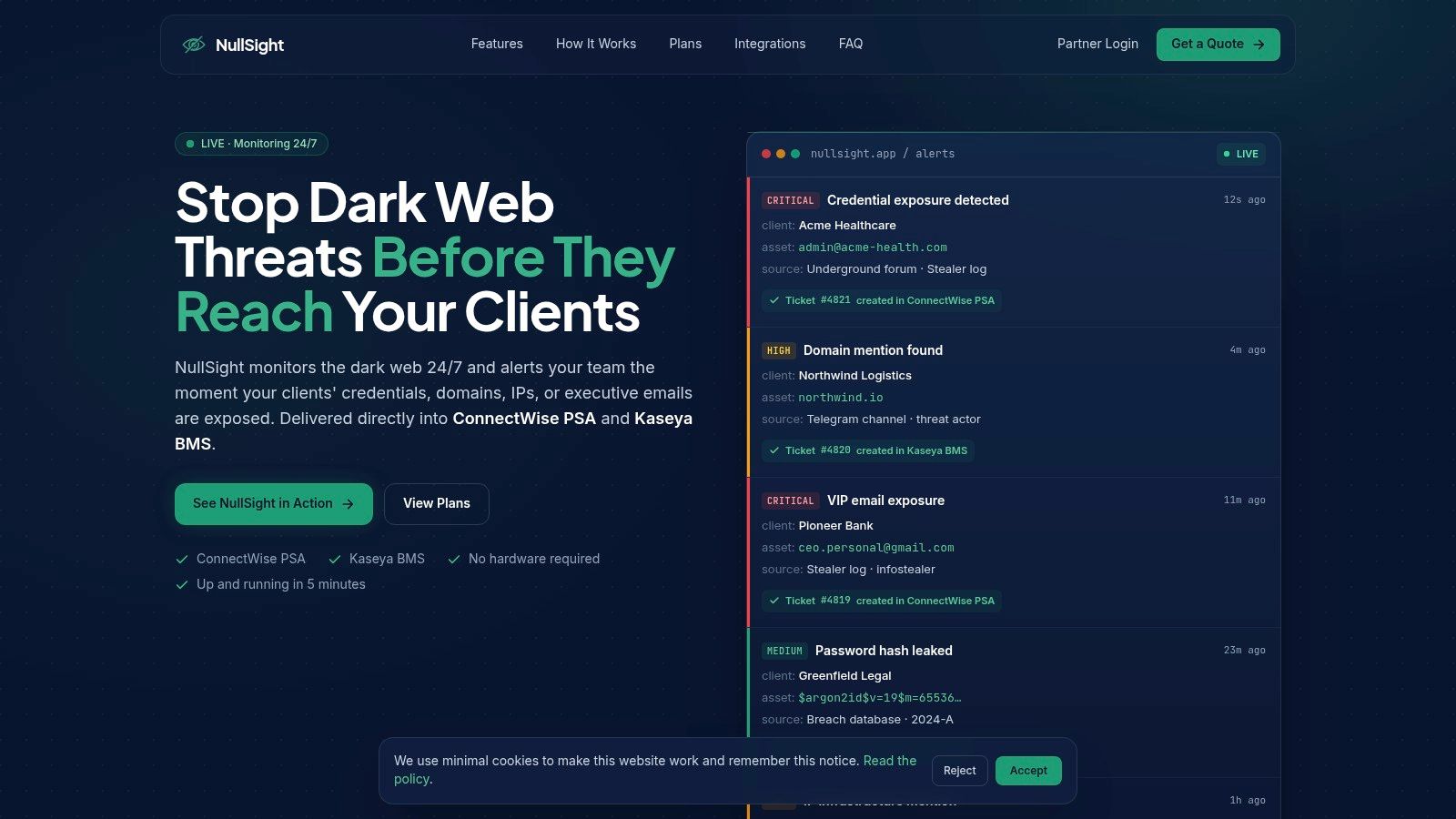
Not every customer needs another login. NullSight takes an MSP-managed approach, with customer assets and findings handled through the provider's dashboard rather than a client-facing portal.
NullSight describes monitoring for domains, IPs and registered user accounts, with alerts able to create tickets in ConnectWise PSA or Kaseya BMS. The vendor says clients don't need to install software, which supports a service delivered through the MSP's existing relationship.
That model can suit customers who expect their IT provider to handle the detail. It's less suitable if a branded self-service portal is central to your sales proposition.
Operational distinction: A customer portal is a delivery choice, not proof that an alert will receive a response.
NullSight also describes a compliance-oriented plan with reporting and documentation. Treat those outputs as supporting evidence, not as a guarantee that a customer meets its contractual or regulatory obligations.
The vendor advertises a free check on an authorised client domain. Use it to inspect ticket quality, asset registration and the amount of explanation your technician must add before notifying the customer.
Public pricing isn't available on the product page, and the exact scope of white-label options needs confirmation. The main buying question is straightforward: do you want customers interacting with the monitoring product, or do you want your service desk to be the customer's interface?
9. Breachsense
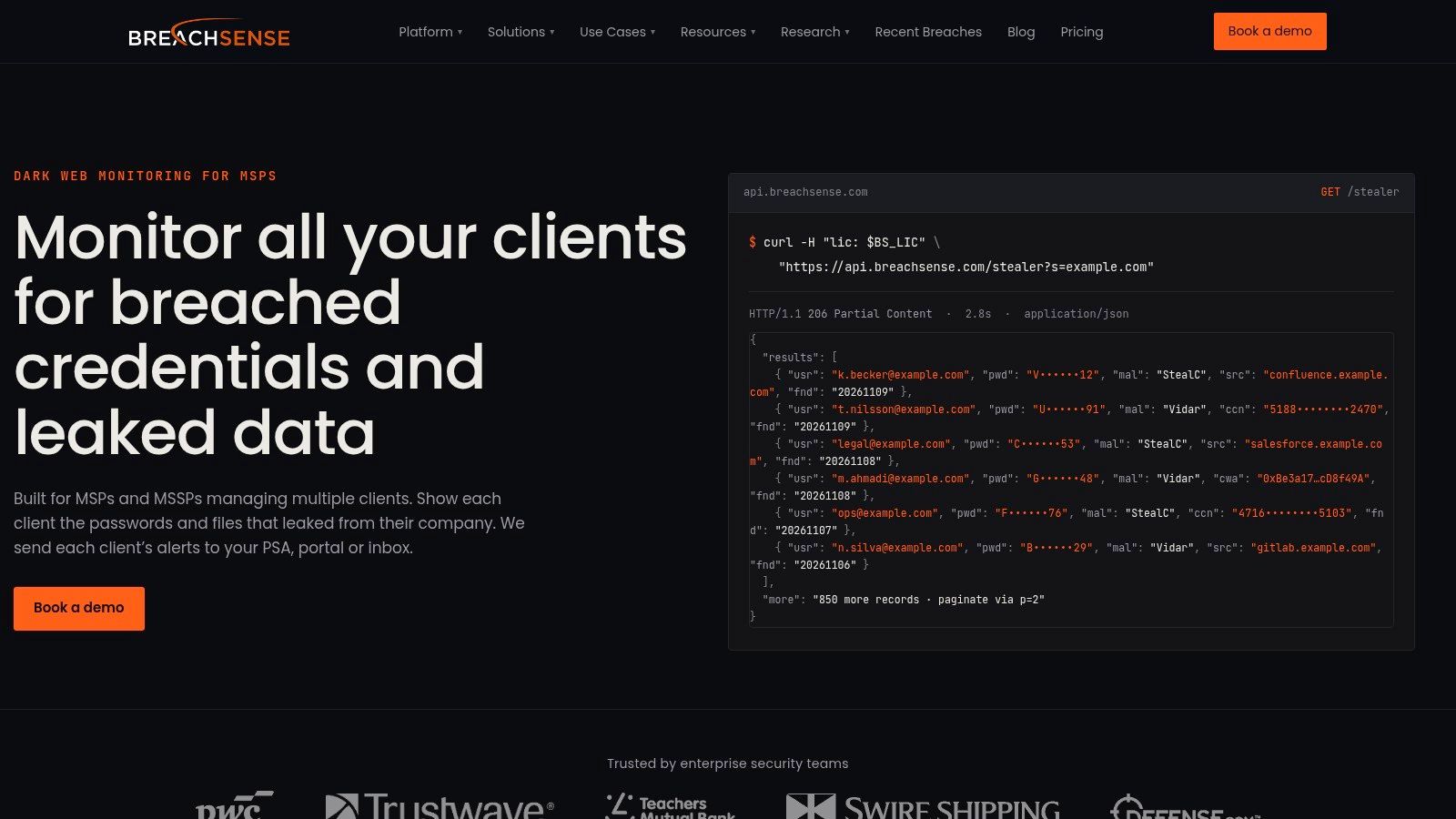
For technically capable MSPs, API access can matter more than a ready-made branded portal. Breachsense's MSP offering describes multi-client workspaces, per-client alert routing, a REST API and webhook alerts.
Its published coverage includes exposed credentials, infostealer data, ransomware leak sites and forum mentions. Historical data access and remediation-oriented workflows make it relevant to providers integrating exposure intelligence into their own dashboards, SIEM/SOAR tools or service processes.
Integration flexibility carries a delivery cost
API-led delivery lets you shape the customer experience, but your team must maintain the connection. Authentication changes, failed deliveries, duplicate events and customer separation become implementation responsibilities, not merely procurement questions.
- Strength: Webhooks and API access support workflows beyond a standalone console.
- Separation: Multi-client workspaces and alert routing address MSP tenancy requirements.
- Trade-off: Pricing depends on watchlist size and API usage, requiring a commercial conversation.
Before connecting sensitive findings to downstream systems, establish what data will be copied into tickets, who can access it and how long it will remain there. Never validate an exposed password by attempting to sign in to a customer's account.
The same evaluation discipline applies when choosing a dark web breach scanner: assess the route from finding to safe remediation, not just search coverage.
Best fit: MSPs with integration capacity and a defined destination for intelligence. Providers seeking minimal administration may prefer a complete branded delivery experience.
10. HackRisk
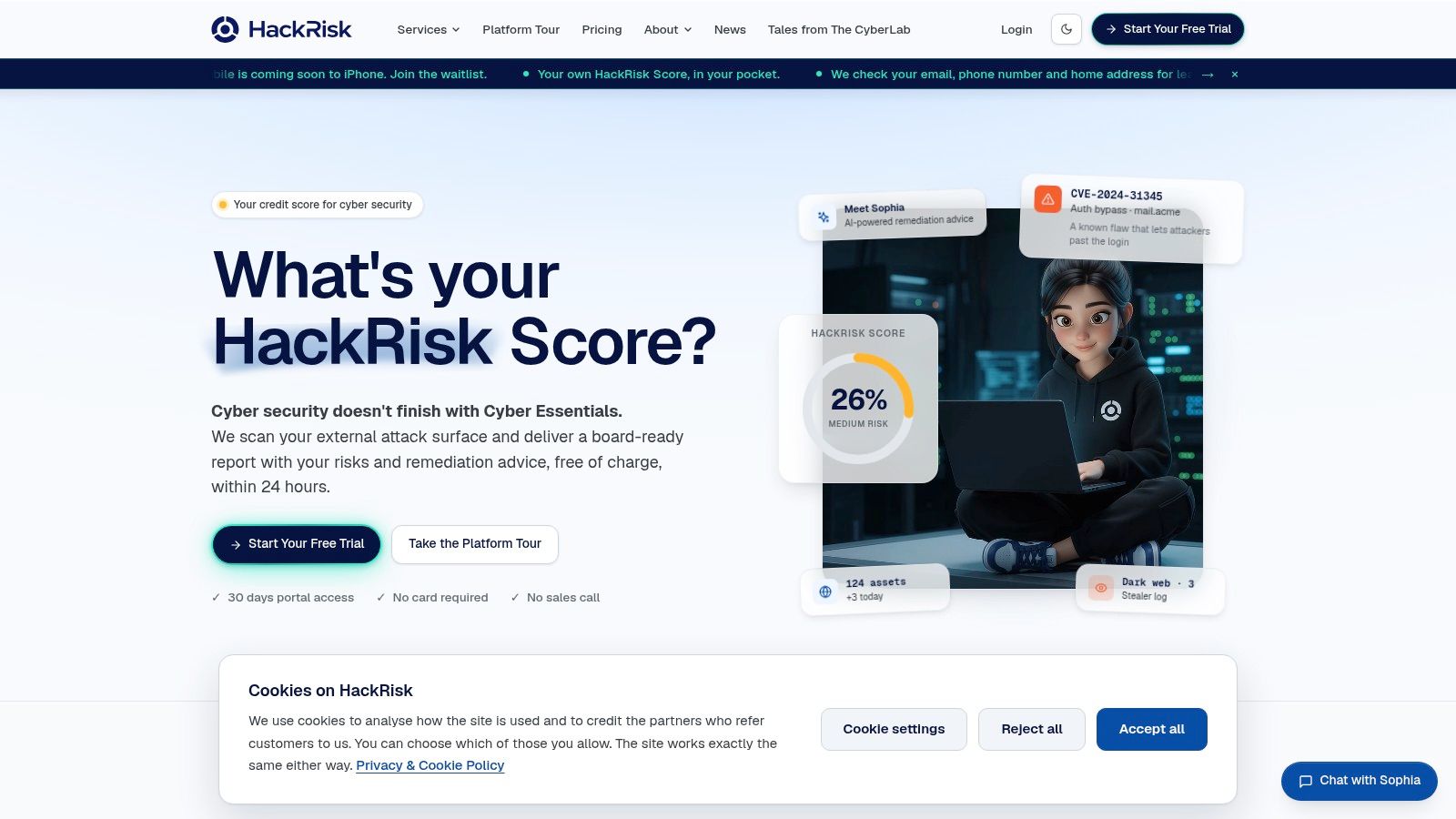
A customer security review often needs more than a list of exposed email addresses. HackRisk combines external-risk checks that can help providers discuss internet-facing assets, vulnerabilities and supplier exposure alongside dark web findings.
HackRisk's published proposition includes reconnaissance and external asset discovery, dark web and vulnerability scanning, supply-chain checks, and exportable reports with actionable recommendations. It also advertises an initial free report and an MSP/partner route.
That makes it worth considering for consultants and MSPs selling structured exposure reviews. A broader report can support prioritisation, provided the customer understands what was assessed and which assets were outside scope.
Assessment isn't automatically continuous monitoring
The main caveat is service frequency. A report describing exposure at the time of a scan isn't necessarily equivalent to an ongoing alerting service.
- Useful breadth: Multiple external-risk checks can support a wider customer discussion.
- Integration caution: Some integrations are described as forthcoming, so confirm what's operational rather than on the roadmap.
- Commercial gap: Public pricing details aren't available in the published material.
Ask for a demonstration of repeat scans, change detection and alert delivery before positioning it as a monthly monitoring subscription. Also establish whether your proposed package includes dark web monitoring continuously or only within an assessment.
Best fit: providers building client-facing external-risk reviews. For a dedicated dark web monitoring service for businesses, confirm the ongoing coverage before treating reporting breadth as a substitute.
Cybersecurity Tools Compared for MSP and Reseller Fit
| Tool | Best fit | White-label strength | Pricing visibility | PSA/API fit | Extra capability |
|---|---|---|---|---|---|
| GoSafe Dark Web monitoring | MSPs, IT providers and telecom resellers | Strong: branded portals, bulk onboarding and licence management | Wholesale pricing by enquiry | Reseller-focused; specific PSA/API integrations not stated | Phishing simulations, email analysis, password tools and incident response |
| Arx Sentinel | MSSPs and security consultancies wanting analyst-led intelligence | Strong: branded portal, reports and service | Not published; enquire | Partner delivery; specific PSA/API integrations not stated | Human-validated threat intelligence |
| SOS Intelligence | UK-focused MSSPs and security resellers | Strong: white-label platform and partner portal | Partner pricing by enquiry | Reseller-focused; specific PSA/API integrations not stated | Threat intelligence and attack-surface management |
| CyberLab | MSPs packaging exposure monitoring with broader security services | White-label branding available through partner programme | Standard pricing not clearly available | Partner programme; specific PSA/API integrations not stated | Vulnerability, attack-surface and supply-chain security |
| Kaseya Dark Web ID | MSPs, especially existing Kaseya users | Limited or unclear; confirm client-facing branding options | Not published | Integrates with Kaseya BMS, Autotask and ConnectWise Manage | Compromise reports and mitigation information |
| usecure uBreach | MSPs combining breach alerts with security awareness | Branded reports available on uBreach Pro; commercial rights need confirmation | Product details public; commercial terms to confirm | Specific PSA/API integrations not stated | Security-awareness training and phishing simulations |
| MSP Dark Web | MSPs wanting transparent, domain-based plans and prospecting tools | Confirm branding and customer-portal options | Public pricing; listed in USD | MSP-oriented; specific PSA/API integrations not stated | Unlimited users and prospecting scans advertised |
| NullSight | MSPs managing exposure alerts and remediation through existing workflows | Unclear; no client-facing portal, confirm white-label options | Not published | ConnectWise PSA and Kaseya BMS ticketing | Compliance-oriented reporting and documentation |
| Breachsense | Technical MSPs integrating threat data into their own systems | Multi-client workspaces; branded portal strength not stated | Enquiry-based; scales with watchlists and API usage | REST API, webhooks and per-client alert routing | Infostealer, ransomware leak-site and forum monitoring |
| HackRisk | MSPs seeking broad external-risk reports for client reviews | Partner/MSP route; white-label strength not stated | Not found in reviewed material | Integrations described as forthcoming; verify status | Recon, vulnerability scanning and supply-chain checks |
Choose the Tool That Fits Your Service Model
A consultancy selling interpretation, a telecoms reseller adding a subscription and an MSP managing a PSA queue need different cybersecurity tools. Start with the service you intend to deliver, then check whether the product's branding, integrations and commercial terms support it.
Dark web alerts need a clear response boundary. A compromised credential does not prove an active breach, or that the password is still usable. Decide who will verify an alert, contact the customer and handle remediation before adding monitoring to your service catalogue.
Shortlist by delivery model
First, define the customer experience. A fully branded portal suits providers selling under their own name. PSA ticketing matters when technicians manage alerts through service workflows; an API may fit better if you are building your own delivery layer. Confirm the actual integration and branding options with each supplier.
Assess pricing transparency separately from price. A public rate card helps with budgeting, while a wholesale proposal may better reflect licensing, branding, onboarding and support costs.
Test an authorised customer domain
Second, run a controlled check with written customer authorisation. Review the exposed identifiers, breach context, redaction and customer notification process. Agree who resets passwords, checks MFA and access logs, and preserves evidence.
The NCSC incident-management review records 429 supported incidents in the year to August 2025. Set a response boundary: routine credential remediation and a specialist investigation are different services, with different workloads and costs.
Don't sell an alert as a completed security outcome. Define the monitoring and response service customers will receive.
Price the work you'll actually deliver
Third, price for the support your service includes. Account for licences, onboarding, triage, customer communication and reporting. Specify whether password resets, investigations and emergency incident response are included or charged separately.
Hosting providers and web agencies may add monitoring to an existing customer relationship. If reviewing that wider service portfolio, you can explore Cybrancee's hosting options, while keeping hosting provision and security-monitoring responsibilities distinct.
Recurring revenue depends on customers understanding the service and partners understanding its workload. Dark web monitoring can provide early warning and visibility, but it should not be presented as complete protection.
GoSafe Dark Web monitoring is a fully white-label option for service providers, with branded customer portals and complementary phishing and password tools. View the GoSafe reseller programme to review the branded offering and discuss commercial terms with GoSafe.
GoSafe scans the dark web 24/7 for leaked passwords and stolen company data, and alerts users when compromised information is discovered. Its AI risk scoring gives businesses a view of their cyber exposure. Visit GoSafe Dark Web monitoring to see how the service could fit alongside your existing offer.