The vulnerability management lifecycle is the engine room of proactive cybersecurity. It is a structured, repeatable process for finding, prioritising, fixing, and confirming security weaknesses across all of a company’s IT assets. This is not a one-off project; it is a continuous cycle designed to shrink a company's attack surface before threats find a foothold.
Understanding The Vulnerability Management Lifecycle
For many IT providers and their clients, security feels like a constant state of firefighting. A problem appears, you scramble to fix it, and then you wait for the next incident. The vulnerability management lifecycle changes that model entirely. It provides a formal framework to get ahead of issues and show clients tangible, ongoing improvements to their security.
Think of it like maintaining a commercial building. You would not wait for the roof to collapse before calling a builder. You would have a schedule for regular checks: inspecting for leaks, checking structural integrity, and spotting minor safety hazards. You fix the small issues before they spiral into expensive, business-halting disasters. That is exactly the logic the vulnerability management lifecycle applies to a company’s digital infrastructure.
What Is a Business Vulnerability?
When we talk about a "vulnerability" in a business context, it is any weakness an attacker could potentially exploit. This goes far beyond simple unpatched software. A vulnerability could be anything from:
- Compromised employee credentials being sold on the dark web.
- Outdated software or firmware with known security holes.
- Poorly configured cloud services or open firewall ports.
- Staff using weak or reused passwords across multiple critical systems.
A proper management process has to see the whole picture and account for all of these risks, not just the technical flaws a network scanner might find. For telecom and IT providers, offering a service that tackles these real-world weaknesses—especially exposed credentials—is a powerful way to start a meaningful security conversation. If you are looking to see how this fits into a bigger strategy, it is worth learning more about creating a system security plan.
This diagram breaks down the four core stages of a successful vulnerability management programme.
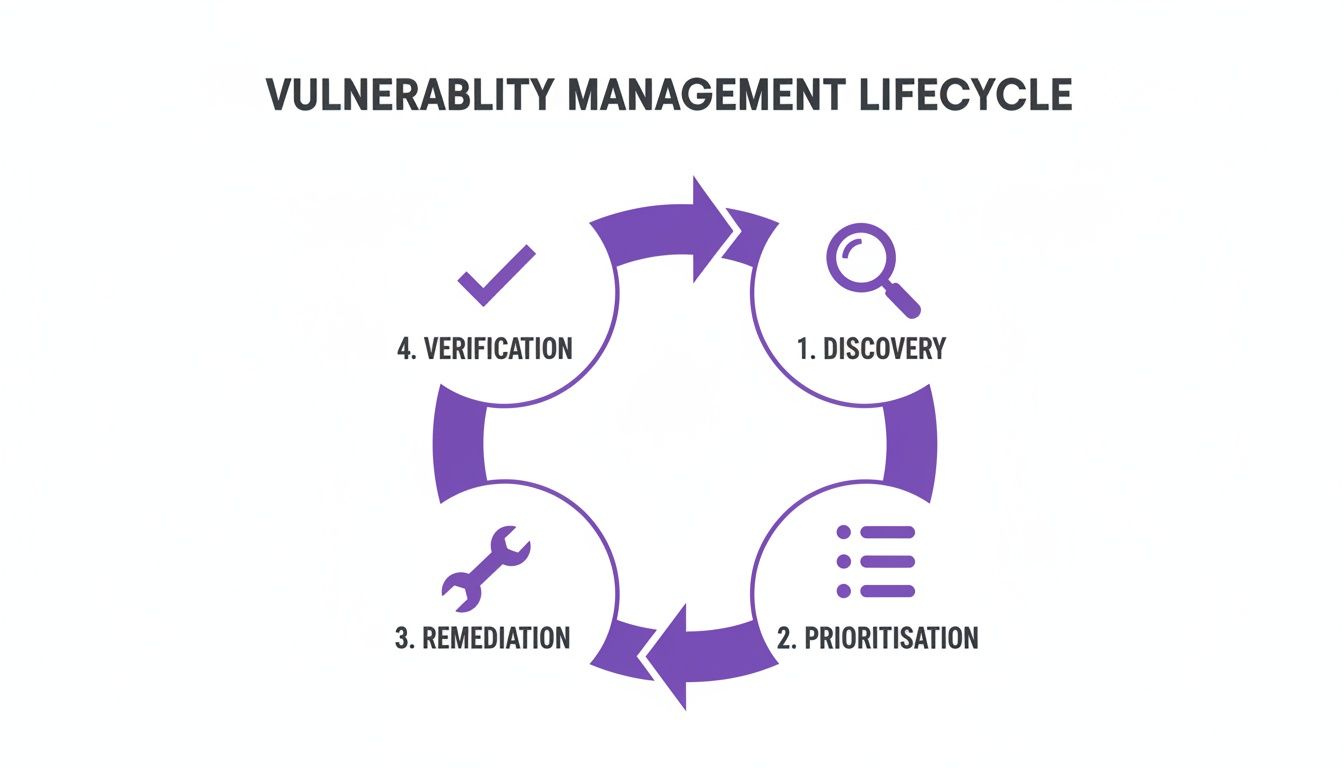
As the graphic shows, this is not a linear checklist. It is an ongoing cycle where each step feeds into the next, constantly refining and strengthening a client's security posture.
Why a Formal Lifecycle Matters for IT Providers
By adopting this structured approach, you can change security from an unpredictable cost centre into a predictable, high-value managed service. Instead of just reacting to incidents, you are delivering a proactive programme that systematically makes your clients safer.
This methodical process allows MSPs and telecom resellers to build a recurring revenue stream around security. By managing this lifecycle for clients, you provide clear, demonstrable value without needing a dedicated team of cybersecurity specialists.
Discovering and Prioritising Your Client's Real-World Risks

The vulnerability management lifecycle begins with two critical steps that turn vague uncertainty into a solid action plan: Discovery and Prioritisation. Getting this right is not about finding the longest possible list of problems. It is about finding the right problems and knowing exactly which ones to fix first.
For IT providers and MSPs, this is where you elevate your service. Mastering these first two phases is what separates a generic break-fix service from a high-value advisory partnership. You stop just reacting to tickets and start proactively mapping your client’s genuine business risks, giving them a logical, commercially-sensible roadmap to stay safe.
Stage 1: Discovery – Looking Beyond the Network Perimeter
The discovery phase is all about finding weaknesses. Traditionally, this meant running vulnerability scans across a client’s network to find things like unpatched software or insecure firewall rules. While these internal scans are still a piece of the puzzle, they only show a fraction of the real-world risk.
Think about it from an attacker's perspective. Why bother with a complex network breach when you can just walk in the front door? Their preferred method is far simpler: using stolen employee credentials. If a staff member’s email and password get exposed in a third-party data breach and sold on the dark web, a criminal can often just log straight into company systems.
This is precisely why a modern discovery process has to look beyond the firewall.
Key Insight: A proper discovery process needs to combine internal vulnerability scanning with external threat monitoring. If you ignore credentials available on the dark web, you are leaving the front door wide open, no matter how strong the locks are.
This is where tools designed for the IT channel, like white-label dark web monitoring, become essential. These services continuously scan illicit marketplaces for your clients’ email domains, addresses, and passwords. When a match is found, it is not a theoretical risk—it is a confirmed, high-impact vulnerability that needs dealing with immediately. You can get the full picture in our guide on what dark web monitoring is.
Stage 2: Prioritisation – Cutting Through the Noise
Once you have your list of vulnerabilities—both technical ones and exposed credentials—it is time to prioritise. This is arguably the most important stage of the whole lifecycle, as it determines where you spend your time, effort, and your client’s budget.
Simply fixing everything that a scanner flags as "critical" is a recipe for wasted resources. A vulnerability with a high technical severity rating (like a CVSS score) might be completely irrelevant if it is on an isolated, non-critical machine. On the other hand, a seemingly low-risk issue on a core business system could be far more dangerous.
Effective prioritisation is all about business context. Here is a practical way for MSPs to think about it:
- Asset Importance: Which system is affected? A vulnerability on the main finance server is a world away from one on a spare marketing laptop.
- Threat Intelligence: Are cybercriminals actively exploiting this specific weakness right now? Exposed credentials being actively traded on forums should go straight to the top of the list.
- Potential Impact: What is the worst that could happen if this weakness is exploited? Think about data loss, financial damage, operational downtime, and the impact on their reputation.
The reality is that UK businesses are often slow to act. Recent data shows that third-party involvement in breaches has doubled to nearly 30%, and the exploitation of known vulnerabilities has increased by 34% as a way for attackers to gain access. Despite this, only 54% of vulnerabilities on perimeter devices were fully fixed, with an average time of 32 days, leaving a huge window of opportunity for attackers. For MSPs, this is a clear opening to offer a proactive service that closes these gaps.
By combining raw discovery data with real business context, you create a prioritised action plan. This plan does not just list technical jargon; it tells your client a clear story: "Here are your three biggest risks, here is why they matter to your business, and here is our plan to sort them out." That is how you prove your value and become a true partner.
Taking Action with Remediation and Verification

So, you have found the weak spots and worked out which ones pose a genuine threat. Now the vulnerability management lifecycle shifts from planning to action. This is where the real work begins, covering the crucial stages of Remediation and Verification.
It is the part of the cycle where you actively shrink your client's attack surface and—just as importantly—prove you have done it.
For any telecom or IT partner, getting these stages right is how you deliver real, tangible value. It is one thing to tell a client they have got a problem; it is another thing entirely to show them a clear before-and-after of how you fixed it. This is how you build trust and show them exactly why they need your ongoing security services.
Stage 3: Remediation – The Fix
Remediation is simply the process of fixing the vulnerabilities you have found and prioritised. The goal here is to plug the security gaps efficiently, with a clear plan that causes the least possible disruption to your client’s day-to-day operations.
What you actually do will depend on the type of vulnerability.
For a classic technical flaw, your checklist might include actions like:
- Applying software patches to get applications or operating systems up to date.
- Hardening system configurations by turning off services or ports that are not needed.
- Implementing tighter controls, like more restrictive firewall rules or better network segmentation.
But when you are dealing with stolen login details found through dark web monitoring, the fix is far more direct. It is not a complex system tweak; it is an immediate, human-level intervention.
If an employee's password turns up on the dark web, the only real fix is to force an immediate password reset on that account. This must be paired with enabling multi-factor authentication (MFA) to ensure that even if another password gets stolen, the account itself stays secure.
This is a high-impact, easy-to-understand action that MSPs can deliver. You are not just fixing a machine; you are protecting a person and their access to the company’s key assets. Having a clear remediation plan shows you are a professional and ensures everyone, from your technical team to the client's staff, knows what they need to do.
Stage 4: Verification – Closing the Loop
Verification is the final, critical step in the active part of the lifecycle. It is also the one that gets missed most often. It answers a simple but vital question: "Did the fix actually work?"
Without this step, you are just assuming the problem is gone, leaving a dangerous blind spot and a false sense of security.
This phase is all about confirming the fix was successful and the vulnerability has been properly eliminated. It is not enough to apply a patch and close the ticket. You have to go back and actively test and rescan to be sure. This is how you close the loop on the vulnerability management lifecycle and leave no stone unturned.
Practical ways to verify include:
- Rescanning Systems: Run the exact same vulnerability scan again. The weakness you found before should no longer be on the report.
- Re-testing Controls: Manually check that the new firewall rules or system settings are behaving as expected.
- Confirming Credential Resets: Make sure users have actually changed their compromised passwords and that MFA is now active and working on their accounts.
For MSPs and IT resellers, this stage is a powerful commercial tool. It lets you produce crystal-clear reports that prove your worth. You can show a client a report from the discovery phase highlighting a critical risk, followed by another report showing it has gone. This evidence-based approach turns abstract risk into a concrete, solved problem, strengthening your position as a trusted advisor. To see how simple reporting can be, you can offer dark web monitoring under your own brand.
Building a Commercial Vulnerability Management Service
Knowing the theory behind the vulnerability management lifecycle is one thing. Turning it into a recurring revenue service that sells is something else entirely. For MSPs and telecom providers, this is a significant commercial opportunity to graduate from reactive, break-fix support to a proactive, high-value security partnership.
The key is to package the whole process in a way that is simple for your clients to understand and even simpler for you to deliver.
This is not about trying to become a full-blown cybersecurity firm overnight. It is about building a practical, scalable service that tackles your clients' most immediate risks without needing a team of dedicated security analysts. By focusing on real-world outcomes, you can add a valuable new service layer, increase your average revenue per user (ARPU), and make your core offerings much stickier.
Start with a High-Value Foundation
The most effective way to launch a vulnerability management service is to lead with a component that is both high-impact and easy to explain. This is where white-label dark web monitoring is particularly effective. While a traditional network scan can generate a report full of technical jargon, a dark web alert is direct and powerful: "Your company's login details have been found in a data breach and are for sale to criminals."
That clear, non-technical message gets a client’s attention instantly. It frames security not as an abstract IT problem, but as a direct threat to their business.
By leading with dark web monitoring, you sidestep complex technical conversations. You are showing clients a risk they never knew they had and offering a straightforward way to fix it—demonstrating immediate value.
This creates the perfect entry point into the wider vulnerability management lifecycle. Once you have earned that initial trust, it becomes far easier to talk about the other parts of their security posture.
Structuring Your Managed Service Offering
A successful commercial service needs a clear, repeatable structure. You need a simple process for onboarding clients and delivering ongoing value, which keeps your own operational overheads low and ensures a consistent experience.
Your packaged service could look something like this:
- Client Onboarding & Initial Scan: It all starts by adding the client's domains and email addresses to your white-label dark web monitoring platform. The first scan almost always finds existing exposures, giving you an immediate "win" and proving the service's worth from day one.
- Ongoing Monitoring & Alerting: This is the core of your recurring service. The platform works quietly in the background, continuously scanning for new breaches. When a credential leak is found, an automated alert is triggered, letting you proactively contact the client with a plan.
- Regular Reporting & Reviews: Send out simple monthly or quarterly reports that summarise alerts, the actions you took, and the overall improvement in their security. The key here is to focus on business outcomes—like "number of compromised logins secured"—not technical details.
- Advisory & Upsell Opportunities: Use the insights from your monitoring to start bigger security conversations. For example, if you find a high number of credential leaks, it is the perfect justification to recommend implementing multi-factor authentication (MFA) or running some staff security awareness training.
Talk Business Outcomes, Not Technical Jargon
Remember, your clients are business owners, not security engineers. They are not concerned about CVSS scores or CVE numbers. They just want to know that their operations are protected, their data is safe, and they can get on with running their business without disruption.
When you talk about your service, focus on these business-centric benefits:
- An Early Warning System: Explain that your service is like a smoke alarm for their data, giving them a heads-up before a small problem becomes a major incident.
- Risk Reduction: Frame your work in terms of lowering the odds of a costly data breach or a crippling ransomware attack.
- Operational Resilience: Emphasise that by securing their credentials, you are helping to ensure their business can keep running smoothly, no matter what.
By adopting this commercial mindset, you transform the vulnerability management lifecycle from a technical checklist into a compelling business solution. You do not need in-house security specialists; you just need the right channel-focused tools and a clear message. The goal is to deliver a service that has a high perceived value for the client but a low operational burden for your team.
This approach not only drives new recurring revenue but also deepens customer relationships, making you an indispensable partner in their success. To see how straightforward it is to add this capability, you can view the GoSafe reseller programme and learn how to offer a powerful security service under your own brand.
Common Vulnerability Management Pitfalls
Running a tight vulnerability management lifecycle is one of the most effective things an IT provider can do to deliver real, proactive security. Get it right, and you are a hero. Get it wrong, and it becomes a frustrating, time-consuming exercise for both you and your client.
Knowing the common tripwires is the first step to avoiding them. By sidestepping these classic mistakes, you can build a service that is not just effective but also profitable—cementing your role as the trusted advisor who cuts through the noise for your clients.
Mistaking Severity for Actual Risk
This is the most common pitfall. It is very easy to get fixated on vulnerabilities with a ‘critical’ CVSS score while letting the ‘medium’ or ‘low’ ones slide. But that is a flawed approach because it completely ignores business context.
Think about it: a critical vulnerability on an isolated test server that nobody uses is far less of a threat than a ‘medium’ one on your client’s main finance system. Attackers know this. They often chain together a few lower-risk flaws to eventually get to the most valuable assets.
A much smarter way to work is to prioritise based on a mix of severity, how important the asset is, and what criminals are actually doing right now. The most important question is often: "Is this actively being exploited in the wild?" That is usually a better indicator of risk than any technical score.
Maintaining an Incomplete Asset Inventory
You cannot protect what you do not know you have. It is one of the oldest rules in security for a reason. Many vulnerability management programmes are ineffective from the start because they are built on a shaky, incomplete list of a client's assets.
This is not just about servers and laptops. It is cloud services, software, and, critically, employee credentials.
If your discovery process only scans for network devices, you are missing one of the single biggest and most frequently attacked assets of all: your client’s digital identities. This is where integrating a service like continuous dark web monitoring becomes non-negotiable for a complete picture of risk.
Overwhelming Clients with Technical Data
Another classic pitfall is simply dumping raw data on your clients. Handing a business owner a 50-page report packed with CVE numbers and technical jargon is worse than useless—it is actively counterproductive. It creates confusion and makes it impossible for them to see the value you are providing.
Your job is to be the translator. Turn complex data into simple business outcomes. Instead of listing flaws, talk about what you fixed. For example: "This month, we found and secured three employee accounts whose passwords were leaked on the dark web, preventing a potential breach of your systems." Simple and powerful.
Failing to Verify Fixes
Finally, many IT providers fall into the ‘patch and dash’ trap. They deploy a fix, close the ticket, and move on, assuming the job is done. But that is a dangerous assumption. What if the patch failed to install correctly? What if a configuration change was not applied properly?
You have to close the loop. Always rescan or re-test to confirm that the vulnerability is actually gone. This does not just keep the client secure; it gives you concrete proof of the value you delivered. And that proof is gold when it comes to demonstrating ROI and strengthening your client relationships.
To help you put this into practice, here is a quick summary of these common issues and how to solve them.
Common Vulnerability Management Pitfalls and Solutions
| Common Pitfall | Why It Happens | Practical Solution For MSPs |
|---|---|---|
| Focusing only on 'critical' scores | It is easy to sort a list by severity, but this ignores the business impact and real-world exploitability of a flaw. | Prioritise vulnerabilities based on a blend of CVSS score, asset criticality (e.g., finance server vs. test machine), and active threat intelligence. |
| Having an incomplete asset inventory | Traditional network scans miss cloud services, SaaS platforms, and, most importantly, compromised employee credentials on the dark web. | Combine network discovery tools with a continuous dark web monitoring service to get a full picture of all assets, including digital identities. |
| Reporting with technical jargon | IT specialists forget that business owners do not speak in CVEs. Raw data dumps overwhelm clients and hide the value of the service. | Translate technical findings into business risks and outcomes. Create simple, executive-level summaries that focus on actions taken and risks neutralised. |
| Not verifying remediation | Technicians are busy and assume a patch or fix has worked as intended without checking, leading to a false sense of security. | Always include a verification step in your workflow. Rescan the asset after remediation to confirm the vulnerability is closed and document the result. |
By actively avoiding these pitfalls, you can build a service that does not just tick a box but delivers tangible security and demonstrable value.
Add white-label dark web monitoring to your service stack to build a service that avoids these common pitfalls.
Your Top Vulnerability Management Questions, Answered
Even with a solid grasp of the vulnerability management lifecycle, turning theory into practice raises many questions. We understand. Here are the most common queries we hear from MSPs, telecom providers, and IT resellers, with some straightforward answers to help you build and sell a service that works.
How Often Should We Run This Process?
This is a key question, but the answer is surprisingly simple. The vulnerability management lifecycle is not a one-off project or an annual check-up; it is a constant, rolling process. Cyber threats do not stick to a 9-to-5 schedule, so your defences cannot afford to either.
For technical weak spots in systems and software, running automated scans at least monthly is a solid baseline. Many providers opt for weekly or even continuous scanning on their clients' most critical assets. But for external threats like credential leaks found on the dark web, the monitoring has to be 24/7.
As an MSP, this is your recurring revenue sweet spot. Package it as an ongoing service with monthly or quarterly reports that show what you have found, what you have fixed, and how much safer your client is. It is the perfect way to demonstrate constant value and justify that monthly fee.
Is This Not Too Complicated For My Small Business Clients?
Yes, it is. And that is precisely why they need you. Most small and medium-sized businesses are completely focused on running their actual business—they do not have the time, the in-house skills, or the expensive tools to do this themselves.
Your job as their IT partner is to take all that complexity off their plate.
By using white-label tools designed specifically for the IT channel, you can deliver an enterprise-grade vulnerability management programme without burying your clients in technical detail. You handle the discovery, prioritisation, and verification work behind the scenes and present them with simple, clear reports and advice.
The sales pitch is simple: they get top-tier protection, fully managed by you, for a predictable monthly cost. It is an easy decision for any business owner who understands risk.
What Is The Difference Between Vulnerability Scanning And Dark Web Monitoring?
This is a very important distinction. Think of them as two halves of the ‘Discovery’ phase, each looking in a completely different direction.
Vulnerability Scanning: This looks ‘inward’ at a client's own technology. It probes their servers, firewalls, and applications to find technical holes like unpatched software or risky configurations that an attacker could break through.
Dark Web Monitoring: This looks ‘outward’. It continuously scours criminal forums and illegal marketplaces on the dark web, looking for company data that has already been stolen—things like employee emails and passwords leaked from other websites.
A proper security service needs both. A client’s network could be perfectly secure, but if an employee’s password is for sale online, an attacker can often just walk right in through the front door. Combining both gives you a far more realistic picture of your client's actual risk.
How Can I Sell This If I Am Not A Cybersecurity Specialist?
You do not have to be. You just need to be an expert in your clients' business and the risks they face. The approach is to partner with a vendor whose tools are built from the ground up for the IT and telecom channel—tools that are white-labelled, easy to deploy, and do not require specialist security knowledge to operate.
You are not selling CVE numbers or complex threat intelligence. You are selling a business outcome.
Forget talking about CVSS scores. Talk about protecting them from downtime, financial loss, and the reputational damage of a breach. A simple, direct statement is far more powerful: "We will constantly check the dark web for your company's leaked passwords. If we find anything, we will alert you instantly so we can fix it before criminals use it." That is a value proposition any business owner understands immediately.
At GoSafe, we provide a fully white-labelled dark web monitoring platform that empowers MSPs and telecom providers to offer high-value security services without the complexity. Strengthen client relationships, increase ARPU, and build a predictable recurring revenue stream under your own brand.
Book a demo of GoSafe’s white-label dark web monitoring to see how easily you can add this service to your stack.
4 Comments
Building a Security Managed Service That Sells | GoSafe - Dark Web Monitoring
February 19, 2026[…] Vulnerability management is about finding and fixing weaknesses in a client's systems before they can be exploited. This means regular scanning and assessment to find security gaps. To learn more, read our guide on understanding the vulnerability management lifecycle. […]
SSL TLS VPN: A Practical Guide for Service Providers | GoSafe - Dark Web Monitoring
March 20, 2026[…] and address the gaps that encryption cannot. A good starting point is understanding the full vulnerability management lifecycle to see where these weaknesses […]
Your Guide: what is zero day vulnerability? | GoSafe - Dark Web Monitoring
May 4, 2026[…] guide is a solid reference point. For a broader service-led view of remediation stages, the GoSafe vulnerability management guide is also useful […]
What Is an Exploit: A 2026 Guide for MSPs | GoSafe - Dark Web Monitoring
June 21, 2026[…] opportunity: Businesses need help managing the path from vulnerability discovery to remediation, not just a list of missing […]