
Phishing was involved in approximately 85% of reported UK breaches, yet only 18% of UK businesses conduct mock exercises. That gap matters because it shows the issue is not just exposure, but readiness.
Phishing simulation training is a controlled way to test how people behave when a realistic lure lands in their inbox, on their phone, or in a workflow they trust. For MSPs and service providers, it's also one of the few security services that can be packaged, repeated, and measured without needing a large internal security team.
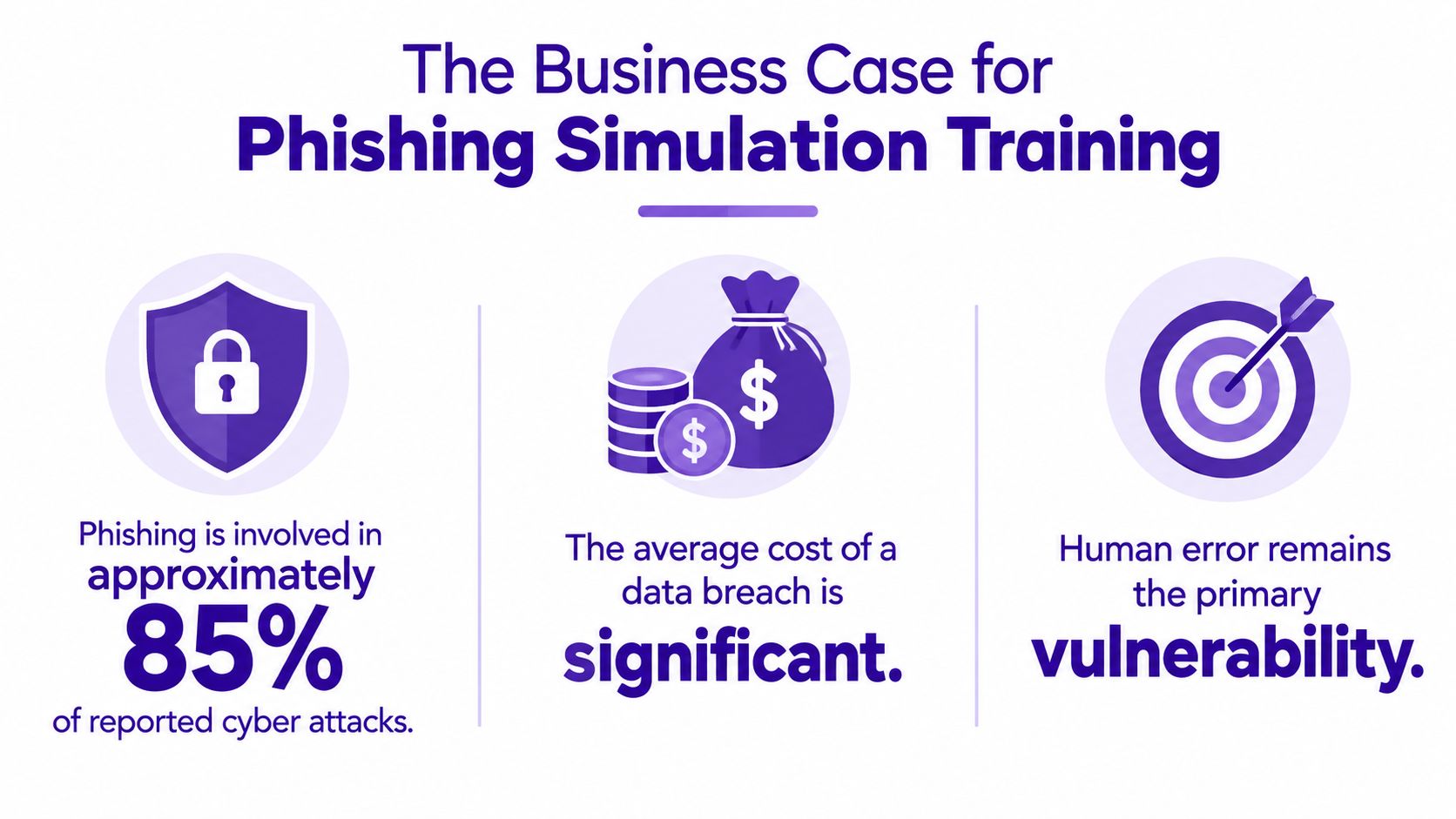
The Business Case for Phishing Simulation Training
The UK threat picture makes the case plainly. The Government's Cyber Security Breaches Survey 2025 found that 43% of UK businesses experienced a cyber breach or attack in the previous year, and phishing was involved in approximately 85% of reported breaches. At the same time, only 18% of businesses ran mock phishing exercises, which means the most common breach mechanism is still being met with a minority response (UK Government survey summary).
Phishing simulation training is useful because it tests behaviour, not just policy awareness. A live campaign can show whether staff click a link, submit information, or report a suspicious message, which gives you organisation-specific risk data instead of a generic awareness score. That's especially relevant where employees handle payments, credentials, customer data, or privileged systems.
Practical rule: if you only measure email filtering, you're testing the control stack, not the people who can still approve a payment, enter credentials, or forward a malicious message.
Technical controls still matter, but they don't cover the full human layer. Email gateways, filtering, and authentication help reduce volume, yet they don't tell you who will trust a convincing internal-looking request. If a team also shares files or credentials badly, resources like protect data when sharing files can support better day-to-day habits alongside simulation.
For MSPs and resellers, the commercial value is simple. Phishing simulation training gives you a recurring conversation with customers, a measurable service to report on, and a reason to move beyond one-off awareness slides. If you serve clients through a dark web security for MSP resellers offer, the same account motion can support a broader risk programme rather than a single isolated exercise.
How Phishing Simulation Campaigns Are Designed
A good campaign doesn't start with a clever email. It starts with deciding what behaviour you want to observe, who you want to test, and how realistic the scenario needs to be for that audience. The mechanics are straightforward once you separate the test design from the delivery tool.
Proofpoint's analysis of more than 212 million phishing simulations in 2024 shows why variety matters. Link-based tests made up 60% of simulations, data-entry tests made up 30%, and attachment-based tests made up 9%. Attachment scenarios produced the highest failure rate at 6.59%, while data-entry scenarios produced the lowest at 2.46% (Proofpoint analysis).
Three scenario types to use deliberately
A link test is the cleanest starting point. It usually checks whether a user clicks through to a fake landing page, which makes it useful for baseline measurement and early-stage programmes. A data-entry test goes a step further, because it measures whether someone will submit credentials or complete a risky form after the click.
Attachment scenarios deserve more care. They feel more invasive to staff and can be more disruptive if your message design is poor, but they also reflect a common real-world route into compromise. The higher failure rate in Proofpoint's data suggests attachments are worth testing, provided the campaign is professional and the landing page feedback is immediate.
A practical programme doesn't rely on one lure type. It rotates between scenarios so employees don't learn the template instead of learning the behaviour. The fail action should always match the story, so a credential-harvesting page tests credential submission, while a document-based lure tests file-opening judgement.
A campaign that only tests links will miss how people behave when a message asks for action, attachment handling, or form entry.
For service providers, a MSP phishing testing revenue conversation becomes credible. The product is not the email itself, it's the repeatable test cycle, the reporting, and the follow-up training that sits around it. If you also build training video production companies into your content stack, the lesson materials can be concise and role-specific rather than generic.
Ethical Considerations and the Pitfalls of Punitive Training
Punishment is the easiest response to a failed simulation, and often the worst one. It creates a short-term appearance of control, but it can also make staff hide mistakes instead of reporting them. That's a problem, because reporting is the behaviour you need during a real attack.
CREST's research points to a more useful approach. It found that simulated phishing improved behaviour across interventions, but mandatory training and punishment were perceived as unfair and increased state anxiety, while brief, timely training reduced susceptibility without reducing productivity or causing anxiety (CREST research).
Supportive feedback beats shaming
That finding changes how a programme should feel to employees. A person who clicks a test message should get a short, contextual explanation of what gave the lure away, then return to work quickly. The point is not to embarrass them, it's to improve their judgement the next time a similar message arrives.
The SPEC project reaches a similar operational conclusion. It found sanctions in more than 90% of organisations surveyed, but it also showed that forced just-in-time training, a short lean training message, and punishment through loss of performance payment all reduced susceptibility. The difference is in how you use that insight. The first two fit a psychologically safer programme, while the third may satisfy a managerial instinct without building trust (SPEC project).
A useful rule is to reserve stronger intervention for repeated risky behaviour, not first-time mistakes. That keeps the programme fair and avoids turning every failed click into a disciplinary event. It also helps remote staff, contractors, and teams with accessibility or language needs, where a blunt campaign can easily feel like a trap rather than a test.
If employees fear the test more than the threat, the programme is working against itself.
The commercial implication matters too. MSPs and consultants who pitch punitive phishing simulation training risk damaging their client's culture and their own credibility. A supportive model is easier to defend, easier to renew, and better aligned with how people learn under pressure.
Measuring Success with NCSC-Aligned Metrics
A single click rate is too blunt to guide a programme. It tells you some people interacted with a lure, but it doesn't tell you whether they reported it, how quickly they reported it, or whether the lesson changed future behaviour. The UK National Cyber Security Centre is clear that simulations should measure susceptibility to specific message types, not pretend that one score proves every employee can spot every phishing attempt (NCSC phishing guidance).
What to track instead
You need a dashboard that separates delivery, interaction, and user-reported message events. That keeps a falling click rate from being misread as success when people may be ignoring messages or leaning on filtering. It also gives you a way to compare teams without flattening everything into one organisation-wide percentage.
The most useful metrics are practical, not decorative.
- Reporting rate: who reported the message, and how often
- Time to report: how quickly suspicious mail reached the right channel
- Repeat interaction rate: who keeps failing across multiple campaigns
- Credential submission attempts: who moved past the click and into risk
- Department-level trends: where coaching or workflow changes are needed
Those figures are more useful because they support action. A faster reporting time suggests better detection and containment. A reduction in repeat failures after a targeted micro-lesson suggests the training was effective.
NCSC also warns against treating simulations as a standalone control. User training is only one layer of phishing defence, so the metrics should feed into mailbox reporting processes, access-control reviews, and incident-response exercises rather than staying in a dashboard no one uses. That's especially important for MSPs, because clients want evidence that the service improves behaviour, not just a monthly report that says the click rate moved.
The strongest programmes track improvement by cohort. Finance, HR, and executive support often face different lure types, so the data should be read by role, not only by organisation. That creates a more defensible commercial story, because you can show where the client was weak, what changed, and what still needs work.
Implementing Training as a White-Label Service
For MSPs and resellers, phishing simulation training is commercially attractive because it can be sold as a branded, recurring service with low overhead. The customer gets a visible security activity, and the provider keeps an ongoing reason to stay involved beyond tickets and infrastructure.
GoSafe is one example of a white label security services platform that supports that model. It is positioned as a Dark Web Monitoring tool, and it also includes live phishing simulations, so partners can combine exposed-credential monitoring with staff testing in a single client conversation. Because it is white-label, the partner can sell it under their own name without building the tooling in-house. If you are reviewing the GoSafe reseller programme, the details are here: https://go-safe.ai/resellerprogram/.
Why the reseller model fits this service
This service is easy to explain. You are not asking a customer to buy a complicated security suite. You are offering clear alerts, a recurring test programme, and reporting that non-specialists can read without much context. That makes it easier to bundle alongside IT support, cloud services, hosting, connectivity, or telecom work.
The operational burden stays light when the platform handles the mechanics. The partner owns the customer relationship, while the service runs in the background. That matters for smaller providers, because it turns security from a one-off project into a monthly line item without forcing them to hire a security team first.
A practical way to sell it is as a conversation starter. A campaign shows where people are vulnerable, then the next discussion is about training, mailbox controls, or privileged-access workflows. That gives you a natural path to expand the account without pushing a hard upsell. It also pairs well with partner services such as training video production companies, where customer-facing material can reinforce the same behaviour changes.
The strongest recurring revenue security services are the ones customers can understand quickly and renew without a long internal debate.
If you want the programme to feel credible, keep the packaging simple. Offer the service under your brand, report on behaviour trends, and use the result to open further security work. A branded model works better when it also lets you offer branded dark web monitoring through a clear service line, because customers see one security story instead of disconnected tools.
Your Phasing Rollout Plan
Start with approval and scope. HR should know how the programme works, who sees the results, and how staff will be treated after a failure. That matters because the exercise affects trust as much as it affects clicking behaviour.
Then establish a baseline. Run one controlled campaign with a clear reporting path and a short, non-punitive explanation page for people who interact with the lure. The first round is not about catching anyone out, it's about learning what normal looks like in your client's environment.
Roll out in sensible stages
- Pick the target group carefully. Start with one department or one client cohort rather than everyone at once.
- Use one or two realistic templates. Keep the pretext professional and relevant to the work.
- Measure reporting and response speed. Don't stop at clicks, because that misses the key control point.
- Give immediate feedback. The lesson should arrive while the email is still fresh.
- Review the result with stakeholders. Show patterns, not personal shame.
- Repeat with a different scenario. Build consistency, then expand variety.
After that, move into a steady cycle. Vary the scenarios, watch for repeated failure patterns, and adjust the level of challenge by role. If a team improves, you've got evidence that the programme is teaching behaviour rather than just producing temporary compliance.
Keep the commercial reporting simple. Customers care about whether people report faster, whether repeat failures fall away, and whether the service helps them manage risk without friction. That makes the programme easier to renew, easier to expand, and easier to justify alongside other managed services.
If you're ready to offer phishing simulation training as a branded service, review the GoSafe reseller programme and decide how it fits into your existing stack. Then take the next step and add GoSafe Dark Web monitoring to the conversation, so you can combine credential exposure visibility with a practical staff training service that customers can understand and keep.