
A client calls your MSP late on a Friday. An employee has clicked a suspicious link, a mailbox may have been accessed, and nobody can yet say which records were exposed. The incident might turn out to be harmless, but the organisation's reporting obligations depend on when it became aware of a qualifying personal data breach, not on when the attacker first gained access.
That distinction creates operational pressure for IT support companies, cyber consultants and other service providers. A spreadsheet, a shared inbox and a chain of informal messages won't reliably preserve decisions, ownership or timestamps while people are working across evenings, weekends and public holidays. A well-designed data breach notification management system gives the team a controlled way to detect, assess, escalate, document and communicate an incident.
For an MSP, that system can also become part of a broader recurring service. Combine notification workflow with clear customer reporting and white label dark web monitoring, and breach management stops being only a compliance cost. It becomes a practical security service that customers understand and service providers can deliver consistently.
The Reality of the 72-Hour Breach Reporting Clock
A Friday evening incident can expose weak breach processes within minutes. The service desk logs the call, an engineer checks the account, an account manager requests an update, and a director receives a forwarded email. By Monday, several people may hold different accounts of the event. The organisation may still lack a reliable record of when it first became aware of a possible breach.
For a notifiable personal data breach under the UK GDPR, the organisation must notify the Information Commissioner's Office without undue delay and, where feasible, within 72 hours of becoming aware of the breach. The ICO's guide to personal data breaches says the notification should cover details including the breach's nature, the categories and approximate number of affected individuals, and the categories and approximate number of personal data records involved. MSPs can also point clients to GoSafe Dark Web monitoring compliance when explaining how monitoring supports a wider compliance process.
The clock runs outside normal office hours. Awareness may begin during an evening, weekend or public holiday, and the time the organisation discovers the issue is different from the time the breach occurred. A notification tracking process must preserve both timestamps, then show who assessed the incident and when each decision was made.
Practical rule: Record the awareness timestamp automatically before anyone debates severity.
Why manual tracking fails
Manual tools can support a small retrospective review, but they become unreliable during a live incident. A spreadsheet may not alert the right decision-maker as a deadline approaches. An email chain rarely provides a dependable audit trail showing who accepted responsibility, which evidence was reviewed, or why notification was judged unnecessary.
The problem grows when an MSP supports several customers. Each client can have different contacts, contractual duties, data types and escalation routes. A centralised data breach notification management system should isolate customer records while applying a repeatable process across the service.
The ICO publishes incident data by calendar year and quarter. Independent UK reporting based on ICO data describes sustained reporting volumes, including Q4 2025 recording 3,600 reports, up 16% year on year, in the UK reporting on breach volumes. For an MSP, the operational point is clear: breach handling is recurring work, not an occasional project reserved for a legal team.
A workable managed service needs automated intake, classification, evidence capture and escalation. It also needs defined service boundaries, so clients receive dependable support while the provider avoids assigning engineers to investigate every alert manually. That combination creates a controlled compliance workflow and a service that can support recurring revenue through consistent delivery, reporting and white-label security options.
Designing a Compliant Triage and Escalation Workflow
A compliant workflow should answer five questions immediately: when was the issue detected, who owns the assessment, what information is involved, what decision was reached, and what happens next? Those answers should remain visible in one record rather than being reconstructed from separate tools.
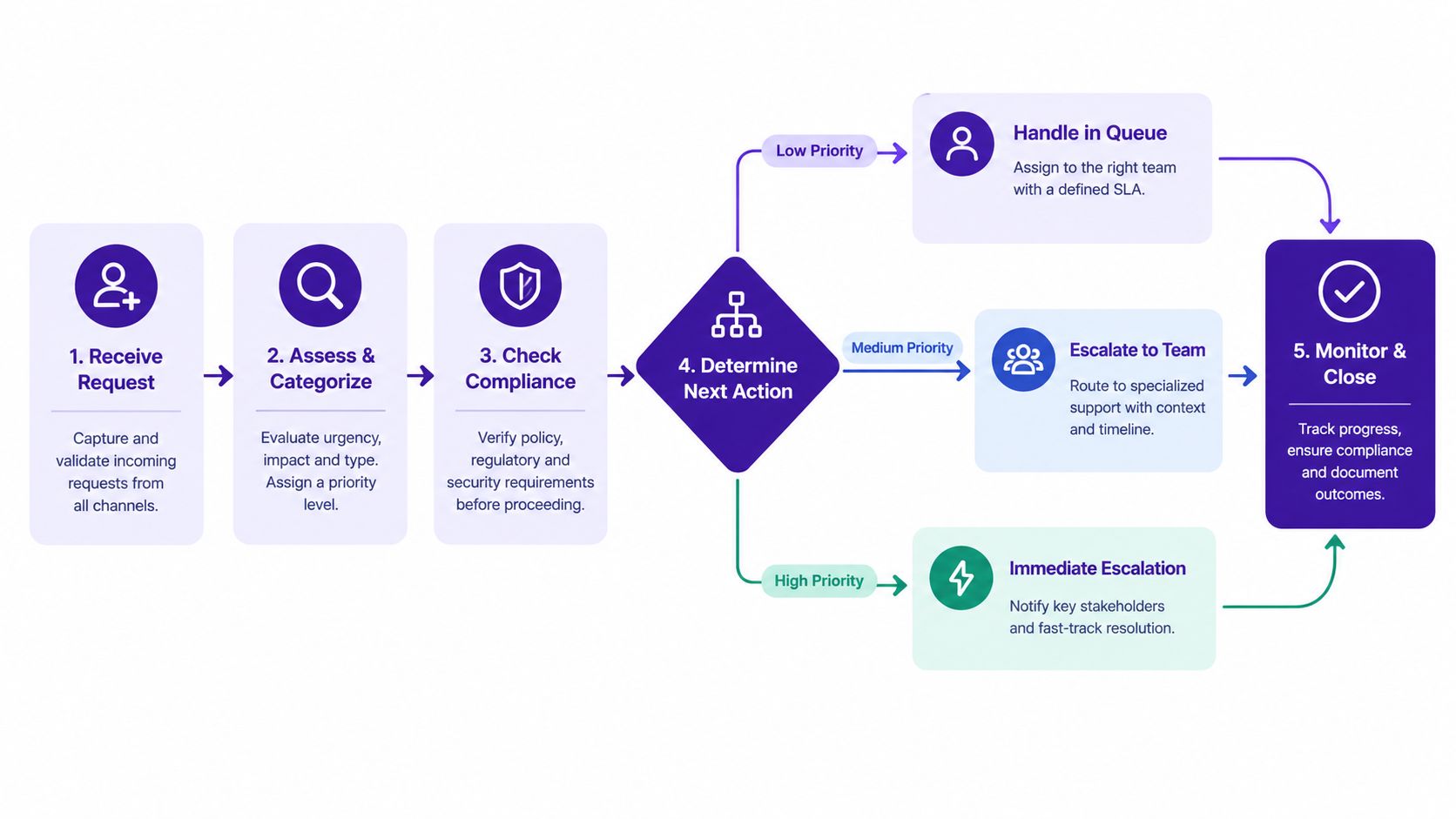
Five controls that matter
-
Capture the first signal. Create an incident record from a service desk request, monitoring alert, telephone report or customer email. Preserve the original source, date, time and reporter. Don't let an engineer's later note overwrite the first awareness event.
-
Classify before escalating. Record whether the event involves personal data, confidential business information, credentials, system availability or a suspected false positive. The system should allow the assessor to document uncertainty, because early investigations rarely provide a complete picture.
-
Route ownership clearly. Assign the case to a named person, with an escalation path for the client contact, technical lead, data protection adviser and senior decision-maker. Providers that want a broader operational reference can review guidance on how to manage support escalations efficiently, especially where multiple customer teams share responsibility.
-
Track both regulatory clocks. Personal data breaches requiring ICO notification follow the 72-hour requirement described in the ICO's personal data breach guidance. eIDAS-related security breaches with significant impact require notification within 24 hours, so the workflow needs separate rules, timers and escalation routes rather than one generic breach status.
-
Close with evidence. Store the facts considered, people consulted, containment actions, notification decision, submitted forms and follow-up tasks. A decision not to report needs a rationale too. If the case is later challenged, the record should show the assessment made at the time, not a polished explanation written from memory.
The system should generate regulator-ready records from structured fields, while still allowing attachments and narrative notes. It should also show elapsed time since awareness, the remaining response window and every handover.
For a practical reference on technical handling and MSP breach response steps, keep containment and notification linked but separate. The technical team may still be investigating while the privacy lead decides whether the threshold for reporting has been met. Treating those as separate workstreams prevents the notification decision from waiting for a perfect forensic conclusion.
Integrating Dark Web Monitoring for Early Detection
A notification workflow can't compensate for poor visibility. If a business only learns about exposed credentials after an account is misused, the MSP starts the conversation during a crisis. Continuous dark web scanning changes the service from a purely reactive reporting process into an early-warning capability.
A useful dark web monitoring tool checks for compromised email addresses, exposed passwords and breached domains. It should present the result in language a business user can understand, rather than forcing a customer contact to interpret an elaborate security dashboard. The practical alert is simple: which account or domain appeared, what type of exposure was identified, what risk it may create, and which action should happen first.

Connect detection to action
The value comes from the hand-off. A dark web alert should create or update a case in the notification management workflow, assign an owner and preserve the alert timestamp. The team can then check whether the exposed credential remains active, whether the account has access to personal data and whether containment or customer notification is needed.
That doesn't mean every credential exposure is automatically a reportable personal data breach. It means the provider has an auditable trigger for assessment, instead of relying on a customer to discover the problem first. The assessor can record the evidence, the risk context and the reason for escalating or closing the case.
For businesses handling sensitive files, access control and document hygiene still matter. Resources such as PDFKing's guidance on document security can complement monitoring by helping teams think about how exposed documents and credentials should be protected and managed.
Make the alert commercially useful
Many businesses don't want a complex cybersecurity dashboard. They want to know whether their people or domain have appeared in a breach and what they should do next. That simplicity makes dark web monitoring easier for an MSP to explain alongside IT support, cloud services, hosting, connectivity, telecoms or web services.
A partner can use a breach alert as the starting point for a short remediation conversation. The next action might involve resetting credentials, reviewing account access, checking affected systems or arranging staff training. Over time, the provider can use the history of alerts to recommend additional protection without turning every customer conversation into a high-pressure sales exercise.
Providers exploring recurring revenue from dark web data should keep the boundary clear. Monitoring provides visibility and early warning. It doesn't replace incident investigation, legal judgement or a complete security programme. That honest positioning builds trust and makes the monthly service easier to retain.
Building Notification Templates and Client Communication
A technically correct incident record can still create trouble if the client communication is vague, alarmist or inconsistent. MSPs need templates that help customers understand the event without claiming facts the investigation hasn't established.
Start with a short internal notification. It should identify the customer, the affected system or account, the first awareness time, the current confidence level and the person responsible for the next review. Avoid copying raw logs or full exposed data into an email. Keep sensitive evidence in the controlled incident record.
Use a layered message
A practical client communication can follow this sequence:
- State what is known: Explain how the issue was identified and which account, domain or service is involved.
- Separate facts from possibilities: Use clear language for confirmed exposure, suspected access and information still under investigation.
- Describe the data category: Say whether the concern involves credentials, contact information, business documents or other personal data. Don't include unnecessary sensitive content.
- Give an immediate action: Recommend a password change, account review, access restriction or other containment step where appropriate.
- Set the next update: Tell the customer who owns the response and when they'll receive further information.
The wording should support a decision, not create false certainty. A redacted breach preview can show the type of material involved without circulating complete credentials or sensitive records. A risk score can help prioritise cases, but it shouldn't replace the written reasoning behind the decision.
Communication principle: A client should finish the first message knowing what happened, what remains uncertain and who is doing what next.
Define escalation ownership
Templates work best when they connect to named roles. The service desk can acknowledge the report, the technical lead can investigate and contain, the privacy or compliance contact can assess notification requirements, and the account manager can coordinate customer communication. Smaller providers may combine roles, but they shouldn't leave ownership implied.
Create separate templates for an initial holding message, a request for information, an internal escalation, a regulator notification record and a closure summary. Each should include version control and an approval route. Legal review may be appropriate for high-risk incidents, but waiting for a bespoke message before recording the facts wastes time.
The client-facing service should also explain what the MSP is and isn't providing. A notification management service can organise evidence, deadlines and communications, but the customer remains responsible for its own legal decisions unless the contract expressly provides otherwise. Clear scope protects the relationship and gives the provider a repeatable operating model.
Scaling Security Services Through White-Label Platforms
Building a notification and monitoring stack internally sounds attractive until the work becomes visible. Someone must maintain detection sources, create customer portals, manage access, update reporting logic, support branding, handle alerts, train staff and keep the service usable as the client base grows. An MSP can spend its margin maintaining plumbing instead of speaking to customers.
A fully white-label platform offers a different route. The partner brands the service as its own, sells it under its company name and includes it in its existing product portfolio. The partner owns the customer relationship, while the platform provides the underlying dark web monitoring capability and operational interface.

Sell a service, not a dashboard
The commercial offer should be easy to describe. A customer receives continuous dark web scanning for compromised email addresses, exposed passwords and breached domains, with clear alerts when credentials appear. The MSP provides the context, customer support and recommended next steps.
That structure works for dark web monitoring for MSPs, telecom providers, VoIP companies, hosting providers, web agencies, SaaS resellers and technology resellers because it fits existing account relationships. The service can sit beside connectivity, cloud management, IT support or hosted communications without requiring the partner to create a separate security brand.
The partner also avoids several common barriers:
- No internal product build: There's no need to develop security tools internally.
- Low operational overhead: The service can be managed without creating a dedicated security team.
- Accessible customer language: Clear alerts make the offer easier to explain than complex security software.
- Repeatable delivery: Standard notifications and workflows support consistent service across customers.
- Flexible packaging: The provider can position it as a monthly subscription within a wider support agreement.
GoSafe Dark Web monitoring is one example of a white-label dark web monitoring tool that continuously scans for compromised email addresses, exposed passwords and breached domains, then provides alerts through email and a user-friendly dashboard. Its partner model allows service providers to brand the platform as their own service without needing specialist cybersecurity knowledge.
Protect the recurring revenue model
Recurring revenue security services need more than a login. They need a clear onboarding process, a defined support boundary and a reason for the customer to keep engaging. Start with a domain or a selected group of business email addresses, explain how alerts are handled, and agree who receives escalations.
Don't promise that monitoring prevents every breach. Promise a defined operational response to relevant findings. That distinction makes the service credible and gives the account team a natural reason to review exposure, discuss remediation and identify adjacent needs such as phishing simulations or broader incident readiness.
White-label delivery also helps the reseller retain brand control. The customer sees the service as part of the provider's own portfolio, while the provider can build its own packaging, billing and relationship model around the platform.
Operational Best Practices and Next Steps
A profitable breach notification service depends on disciplined operations. Technology can capture signals and track deadlines, while staff review risk, contact customers and make accountable decisions. The workable model combines a centralised dashboard, named responsibilities and a commercial process that turns relevant findings into recurring customer value.
Define the service before selling it. Specify what counts as an alert, which events the MSP investigates, when the customer receives a call and where the customer's legal or privacy adviser takes over. Put those boundaries in the contract, then repeat them during onboarding. This protects delivery margins while keeping compliance responsibilities clear.
Build a repeatable operating rhythm
Use a regular review cycle instead of waiting for a serious incident.
- Review open cases: Check ownership, case age, missing evidence and upcoming escalation points.
- Audit closed decisions: Confirm that the record explains reporting and non-reporting outcomes.
- Train the service desk: Staff must recognise possible breaches and capture the first awareness time.
- Test customer contacts: Keep escalation details current and verify out-of-hours routes.
- Measure service quality: Track time to triage, documentation completeness, response ownership and customer follow-up.
The volume of personal data breach notifications recorded by the ICO has risen, reinforcing the pressure on manual handling. As noted earlier, that workload becomes harder to defend when each case depends on individual inboxes, spreadsheets or undocumented judgment.
Do not judge the service by alert volume alone. Review whether the MSP triaged promptly, preserved relevant evidence, gave the customer a clear next action and maintained a defensible record. These measures connect compliance work with customer experience and show where automation is improving delivery.
Turn findings into account value
An alert can start a practical service review. The account manager might discuss credential hygiene, access controls, staff awareness or live phishing simulations. The conversation should follow the evidence and the customer's risk, rather than an arbitrary sales script.
This approach gives customers a reason to keep engaging and gives the MSP a structured route to recurring revenue. The provider can offer reseller dark web monitoring as a monthly service, instead of treating every incident as an unplanned support burden.
Choose a platform that business users can operate, that records the decisions needed for compliance work and that supports your brand. Then train the team, document escalation ownership and make the first customer offer specific. A defined onboarding process, support boundary and review cadence will matter as much as the software itself.
GoSafe Dark Web monitoring continuously scans for compromised email addresses, exposed passwords and breached domains. Alerts can feed a practical breach notification workflow, while service providers can present the platform under their own brand. Visit GoSafe Dark Web monitoring to assess how it could support a recurring security service within existing customer relationships.