
43% of UK businesses experienced a cyber security breach or attack during the previous 12 months. A cyber security platform such as GoSafe helps MSPs detect compromised credentials before criminals exploit them.
That figure changes the commercial conversation. Customers aren't asking whether cyber risk exists. They're asking what their IT provider can see, what needs attention first, and how quickly someone will tell them when an account or domain appears in exposed data.
For an MSP, telecom provider, hosting company, VoIP provider or technology reseller, this creates a practical service opportunity. White-label dark web monitoring can sit alongside IT support, cloud services, connectivity or web hosting, giving customers an early warning service without requiring the partner to build a security team.
Why Cyber Security Platforms Matter for Service Providers
The UK Government's Cyber Security Breaches Survey 2025 found that 43% of UK businesses reported experiencing a cyber security breach or attack during the previous 12 months. Phishing affected 37% of organisations, while 74% of large businesses reported an incident.
For an MSP, those figures aren't an abstract national warning. They're reflected in familiar support conversations. A customer discovers that an employee's password has appeared in a breach, a mailbox starts sending suspicious messages, or a supplier reports that credentials connected to a shared account were exposed. The first question is usually simple: “What does this mean for us?”
The provider then has to turn incomplete information into a useful response. Which account is affected? Was the password reused? Does the exposed address belong to a current employee, former employee or supplier? Should the customer reset one password, investigate a wider group of accounts, or review access to a business application?

The gap between awareness and action
Most customers don't want another complicated dashboard. They want an understandable alert, a clear indication of severity and a short list of actions they can take immediately.
That matters because many businesses have neither the time nor the specialist skills to interpret every warning. UK Government research found that 49% of businesses had a basic technical cyber-skills gap, while 32% lacked confidence in dealing with breaches or attacks and hadn't outsourced that function. The same research found that only 14% formally reviewed immediate-supplier cyber risk, leaving obvious room for guidance that extends beyond the customer's own systems. The UK cyber-skills research puts the partner's role into context.
A cyber security platform gives the service provider a repeatable way to identify exposed credentials and explain the response. It doesn't replace endpoint protection, identity controls, secure configuration or incident response. It adds visibility where a conventional IT support contract may otherwise begin only after a customer reports a problem.
Practical rule: Sell the conversation, not the fear. Customers respond better to “we found an exposed business address and here's what to do” than to a warning that gives them no next step.
Dark web monitoring for MSPs fits naturally here. A fully white-label service can be branded as the partner's own offering, sold under the partner's company name and included in its existing portfolio. The partner owns the customer relationship, while the platform provides the monitoring and alerting layer.
What a Cyber Security Platform Actually Does
A useful cyber security platform follows a straightforward loop: collect signals, identify exposure, prioritise risk, alert the right person and support remediation.
In the context of GoSafe, that loop centres on dark web monitoring rather than a broad enterprise security stack. The tool continuously scans for compromised email addresses, exposed passwords, breached domains and other leaked business data. When it identifies a relevant match, it presents the finding through clear alerts and a simple dashboard.

Four steps that make the service useful
Monitor identifiers: Add company domains, business email addresses, user accounts and mobile numbers that matter to the customer. Monitoring several identifiers is more useful than checking one mailbox in isolation.
Detect exposure: The platform identifies when credentials or company data appear in leaked datasets, forums, marketplaces or other dark web sources. A match doesn't automatically prove an active compromise, but it gives the provider a specific lead to investigate.
Prioritise the finding: Risk scoring helps separate a stale, low-context exposure from a finding that deserves immediate attention. The score should support judgement, not pretend to replace it.
Explain the response: A good alert tells a business user what appeared, why it matters and what to do next. Typical actions include changing affected passwords, checking reuse, enabling multi-factor authentication and reviewing related accounts.
The easiest client explanation is a smoke alarm analogy. The service doesn't guarantee that a fire will never happen. It gives the customer an earlier signal that something may be wrong, before an attacker turns a leaked credential into account access.
This distinction also helps service providers position the product responsibly. Dark web monitoring isn't a complete cyber security programme, and it shouldn't be sold as one. It is a practical detection and risk-awareness service that complements identity protection, email security, backup, patching and staff education.
Providers assessing wider security delivery models may also find this overview of outsourcing cybersecurity for enterprises useful when deciding which responsibilities should remain internal and which can be delivered through a partner.
For providers interested in productising the offer, add recurring revenue with GoSafe by treating monitoring as a defined service rather than an informal extra included in support hours.
Key Capabilities Every Platform Should Offer
The right feature set is the one that helps a partner deliver a clear customer outcome. More modules don't automatically create a better service. A platform should detect relevant exposure, explain its significance and make the next action obvious.
The NCSC's 2025 Annual Review reported that its Takedown Service removed more than 1.2 million phishing campaigns, with half removed within one hour of detection. That reinforces a practical point for resellers: threat information loses value when alerts arrive late or require lengthy manual interpretation.
The core capability checklist
Continuous dark web scanning: Monitoring should run continuously for compromised email addresses, exposed passwords and leaked business data. A one-off breach check can answer a question today, but ongoing monitoring creates a service customers can understand as a monthly subscription.
Domain breach detection: A customer may monitor individual addresses and still miss exposure connected to its wider company domain. Domain monitoring helps the partner identify patterns across staff accounts, shared mailboxes and former users.
Actionable risk scoring: A score should help an account manager or support engineer decide what to discuss first. It needs supporting context, including the identifier involved, the type of exposure and the recommended response.
Live phishing simulations: Simulations test whether employees recognise realistic lures. Results should be separated from confirmed compromise, then used to target training, phishing-resistant MFA, password-manager adoption and email protection.
Breach Breakdown reports: Customers need a plain-English explanation of what data was exposed and what actions follow. Redacted previews can provide useful context without displaying complete sensitive information.
Multi-identifier monitoring: Email addresses, domains, user accounts and mobile phone numbers can reveal different parts of the risk picture. The platform should make these identifiers manageable within the same customer view.
A practical comparison
| Capability | White-label Monitoring Platform | Generic Enterprise Suite |
|---|---|---|
| Customer experience | Clear alerts and focused remediation guidance | Broad dashboards that may require specialist interpretation |
| Deployment | Designed for quick addition to an existing service portfolio | Often involves wider architecture, configuration and operational planning |
| Branding | Can be presented under the partner's own company name | Usually associated with the original vendor |
| Operating model | Suitable for monthly monitoring delivered by an MSP or reseller | Often assumes an internal security function |
| Commercial use | Supports packaged subscriptions and customer conversations | Primarily designed around internal security operations |
| Scope | Focuses on exposed credentials, domains and breach intelligence | May cover many security functions, with greater complexity |
The trade-off is important. An enterprise suite may offer deeper breadth, but breadth can create training, ownership and support demands that don't fit a small service provider. A focused reseller dark web monitoring service is easier to explain when the customer sees one clear outcome: identify exposed business data and act before it creates a larger problem.
Providers comparing adjacent detection categories can use an XDR vs SIEM EDR comparison to clarify where dark web monitoring sits alongside endpoint and event-monitoring products.
The Commercial Case for MSPs and Resellers
IBM reports an average breach cost of £3,550. For an MSP or reseller, that matters less as a scare line than as a buying trigger. Customers may delay a larger security project, but many will approve a service that helps spot exposed credentials, domains, or contact details early and gives them a clear response path.
That is why dark web monitoring works commercially. It fits how service providers already sell and support accounts. You can package it as a monthly service, add it to a managed support tier, or bundle it with cloud, hosting, connectivity, telecoms, or web services. The conversation starts with what the customer wants watched and who should act on an alert, not with a long architecture review.
Why partner-led delivery matters
The commercial value is not the alert alone. It is the provider's ability to interpret it, decide whether it is relevant, and turn it into action the customer can follow.
I have seen clients ignore a breach notice because they were unsure whether the account was still active, whether the password had been reused, or whether the issue sat with a supplier. A partner closes that gap. The provider checks whether the identifier belongs to the customer, explains the likely exposure, and gives the customer a practical next step instead of a raw feed of data.

Handling the monthly-value objection
Customers often ask why they should pay every month for a service they may not use every day. The answer is ongoing visibility, plus a defined support process when something appears. That is familiar territory for MSPs. The customer is not buying a dashboard. They are buying monitoring, triage, and help dealing with findings through an existing relationship.
A workable monthly service usually includes:
- Confirming the identifier: Check whether the email, domain, account, or phone number belongs to the customer and whether it is still active.
- Explaining the exposure: Use a redacted breach preview and risk score to show what needs attention without passing around sensitive data.
- Managing remediation: Help the customer reset passwords, enforce multi-factor authentication, and review connected accounts.
- Recording the response: Keep a support history so the customer can see what happened and what was done.
This model suits white-label delivery because the provider keeps control of the customer account, billing, and service position. It also supports recurring revenue without asking the partner to build a security operations function from scratch. That makes it attractive for resellers and smaller MSPs that want to add security revenue inside an account base they already know well.
Price should reflect delivery effort, customer size, and how much review the provider includes. Position the service as an early-warning and response-support layer, not a promise to prevent every incident. Where customers also need wider assurance and compliance context, the SOC2Auditors auditor comparison platform can help them see how audit and assurance tools sit alongside operational monitoring services.
GoSafe Dark Web monitoring can be offered as a fully white-label service. Partners can brand the platform as their own, sell it under their company name, and retain ownership of the customer relationship without building the monitoring capability internally.
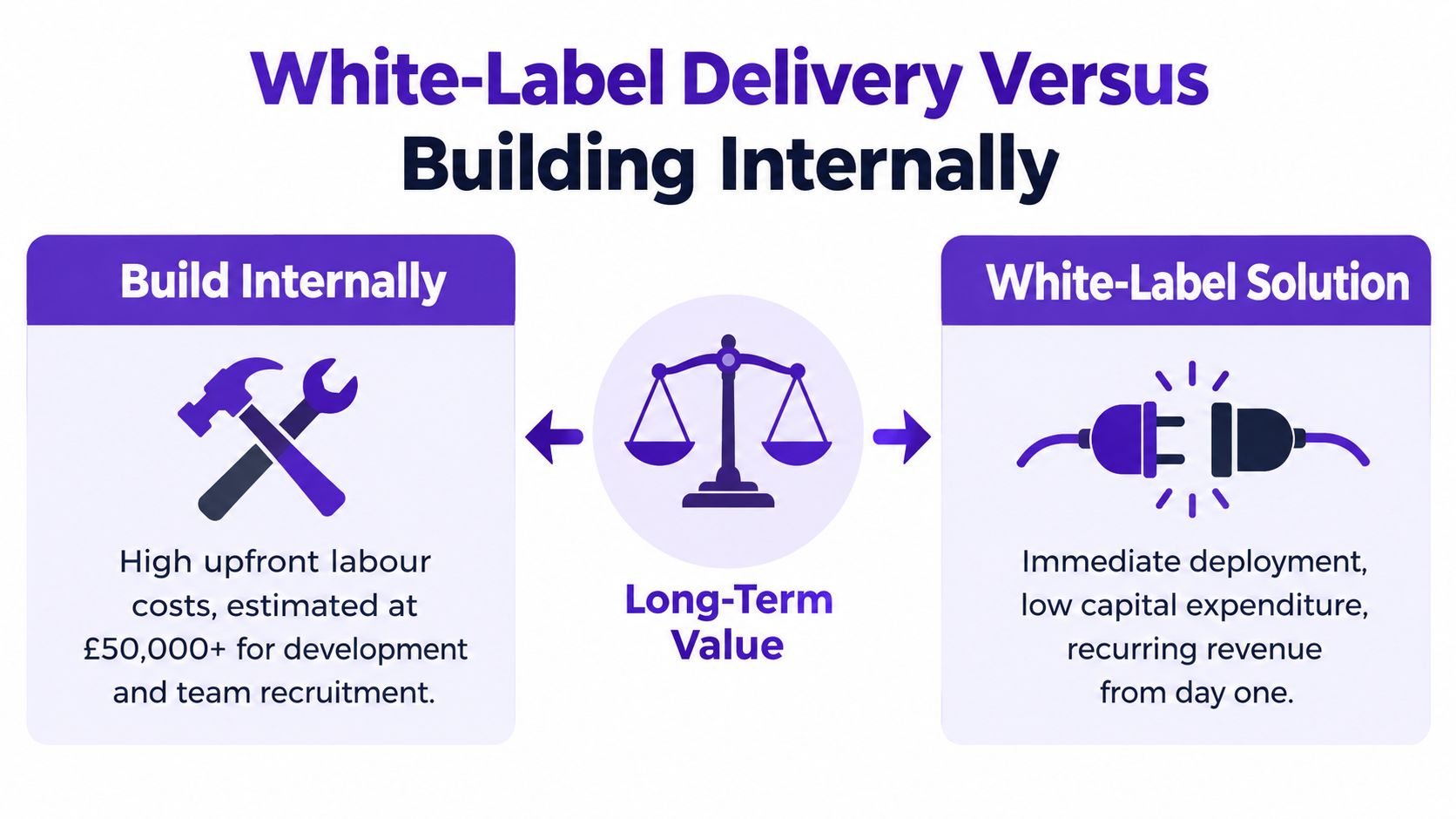
White-Label Delivery Versus Building Internally
Building an internal monitoring product gives a provider control over the roadmap, data presentation and commercial packaging. It also creates responsibility for data collection, detection quality, alert delivery, customer support, maintenance and the staff needed to run those functions.
A white-label platform takes a different route. The partner supplies the customer relationship, positioning, onboarding and account support, while the underlying service provides continuous scanning and the operational mechanics of identifying exposed credentials and domains.
The decision depends on the business model
| Decision criterion | Build internally | Use a white-label platform |
|---|---|---|
| Time to market | Dependent on product development and operational recruitment | Faster route to a packaged customer service |
| Upfront investment | Requires engineering, data work, testing and service design | Lower initial product-building burden |
| Ongoing responsibility | Provider owns monitoring, maintenance and support tooling | Provider focuses on customers, packaging and response |
| Differentiation | Maximum control over product behaviour | Differentiation comes through brand, service design and guidance |
| Specialist knowledge | Needed across product and security operations | Less specialist knowledge required for delivery |
| Customer ownership | Remains with the provider | Remains with the provider under the white-label model |
The honest trade-off is control versus speed. A provider with a substantial engineering team, a defined research capability and a long-term product roadmap may justify internal development. An MSP that wants to test demand, extend its portfolio or create a new subscription without delaying launch will usually value simplicity more.
The commercial context is also clear. The Government's Cyber Security Breaches Survey 2025 estimated that the average cost of the single most disruptive breach was £3,550 for UK businesses. That figure doesn't prove that monitoring prevents every loss, but it gives a customer a tangible context for discussing a monthly service. The figure is reported in this UK SME cyber security cost analysis.
Building internally may create a distinctive product. White-label delivery usually creates a sellable service sooner.
A partner should also examine the customer relationship carefully. White-label doesn't mean handing customers to another vendor. The service can be presented as the partner's own offering, with the partner managing the commercial terms, onboarding, support route and remediation discussion.
For most providers, the practical choice is to partner with a dark web monitoring provider when the objective is to launch a useful service without taking on a full security product operation.
Implementation Considerations and Evaluation Criteria
A good launch starts with service design, not a feature checklist. Decide who the service is for, which identifiers will be monitored, who receives alerts and what support is included when the platform finds exposure.
ONS data for the year ending March 2025 recorded approximately 692,000 incidents of computer misuse in England and Wales, with unauthorised access to personal information accounting for roughly 564,000 cases. The ONS analysis of computer misuse supports monitoring more than a single email address. A service should consider domains, email accounts, user accounts and mobile numbers where the customer has a legitimate reason to monitor them.
A sensible rollout sequence
Choose a customer segment: Start with organisations that already trust your support team and have a clear need for account or domain visibility. Existing managed-service customers are usually easier to onboard than cold prospects.
Define the alert workflow: Decide whether alerts go to your service desk, the customer's nominated contact or both. Write the first-response process in plain English before selling the service.
Connect commercial operations: Add the product to your quoting, billing and renewal process. A recurring service disappears commercially when engineers offer it informally but sales and finance can't package or track it.
Pilot with a small customer group: Use the pilot to test onboarding, alert quality, remediation conversations and support effort. Ask customers whether they understand the alert without a technical explanation.
Review the service before scaling: Track qualitative signals such as customer engagement, response speed, support workload, conversion from existing accounts and renewal conversations. These measures tell you whether the offer is useful, not just whether the platform generates findings.
What to assess before choosing
Look for accurate risk scoring, clear breach communication, useful redacted previews and the ability to monitor the identifiers your customers use. Confirm the available API and integration options, the quality of white-label controls and the provider's approach to data handling.
A UK-focused provider may also want to examine accreditation and assurance information, including Cyber Essentials status, before adding the service to its portfolio. For teams managing secure development and deployment alongside customer monitoring, guidance on secure Claude Code deployment may provide useful context for evaluating software delivery controls.
Don't overlook the human test. Ask a non-technical member of your team to read a sample alert and describe the required action. If they can't do that quickly, customers probably won't either.
Next Steps for Service Providers
A cyber security platform becomes commercially useful when it fits the way a service provider already works. White-label dark web monitoring can extend an MSP, telecom, hosting or consultancy portfolio with continuous scanning, clear alerts and recurring subscription value, without requiring a dedicated security team.
The sensible next step is to review how GoSafe could fit your customer segments, pricing model and support workflow. A demonstration should show the monitoring experience, breach context, risk scoring and white-label delivery, not just a list of features.
GoSafe Dark Web monitoring provides continuous scanning for compromised email addresses, exposed passwords and breached domains, with clear alerts that business users can understand and act on. Visit GoSafe Dark Web monitoring to assess how the service could support your customer relationships and recurring revenue model.