
43% of UK businesses reported a cyber security breach or attack, according to the government's Cyber Security Breaches Survey 2025/2026. For a technology reseller, that creates an opening for a useful recurring service, but it doesn't automatically create a profitable one.
The constraint is capacity. Before adding security monitoring to your portfolio, decide who will onboard customers, explain alerts and take responsibility for the next action. A service your team can deliver consistently is worth more than an attractive wholesale margin on something nobody owns.
Which Technology Reseller Model Fits Your Business
A technology reseller buys products or services from a supplier and sells them to business customers, adding value through installation, support or management. Your model determines how much of that work you own and how closely you stay involved after the sale.
A VAR selling installation projects needs a different recurring offer from an MSP already managing customer accounts. A referral partner might avoid delivery work altogether, but gives up control over the customer experience.
Technology reseller models compared
| Model | What it sells | How it earns | Customer relationship |
|---|---|---|---|
| Value-added reseller (VAR) | Hardware, software licences, implementation | Product margin plus project fees | Project-based, lower recurrence |
| Managed service provider (MSP) | Monitored IT support, backup, cloud, security | Monthly contracts plus project work | Recurring and close |
| Telecoms or VoIP reseller | Connectivity, hosted voice, line services | Monthly commission on services | Recurring, bundled with the line |
| Distributor | Wholesale stock and tools for other resellers | Volume discounts and rebates | Indirect, sells through partners |
| Referral or agency partner | Introductions to a supplier's product | Referral fee or revenue share | Low effort, low control |
These distinctions matter because recurring billing doesn't necessarily mean recurring service delivery. A telecoms reseller may already collect monthly payments without running a service desk equipped to investigate account exposure. An MSP may have that desk, but no spare capacity.
The wider business environment reinforces the staffing constraint: in March 2023, the UK digital sector contained approximately 200,600 businesses, and 91.9% employed fewer than 10 people, according to the government's UK software market analysis. Those figures describe digital businesses, not a reseller-only census, but they provide useful context for planning a small delivery team.
Specialist channel programmes are worth examining when comparing routes to market. The Splash Access reseller network is a relevant resource for exploring a supplier-led reseller route alongside building and supporting your own service.
Identify your operating model
List current revenue under one-off sales, project fees and monthly contracts. Match the largest share to the table, then check whether your staffing follows the same pattern.
If project work dominates, establish recurring billing, renewal ownership and ongoing support boundaries before adding a subscription. If monthly contracts dominate, assess the extra workload rather than assuming your existing desk can absorb it.
Practical rule: Choose the model your team can support after the sale, not the one with the most appealing headline margin.
How Resellers Earn Margin and Recurring Revenue
The government's Cyber Security Sectoral Analysis 2025 estimated that UK service providers, including MSPs and managed security service providers, generated approximately £7.4 billion in cyber-security-related revenue; it classified 71% of UK cyber-security firms primarily as service providers, against 26% primarily focused on product development. A reseller doesn't have to develop software to build a credible security business.
Scale isn't limited to security specialists. The UK's top 250 resellers and MSPs increased collective sales by 12.6% to £29.2 billion in their latest reported years, according to IT Channel Oxygen's 2025 Oxygen 250 report. That's market context, not a forecast for your monitoring offer.
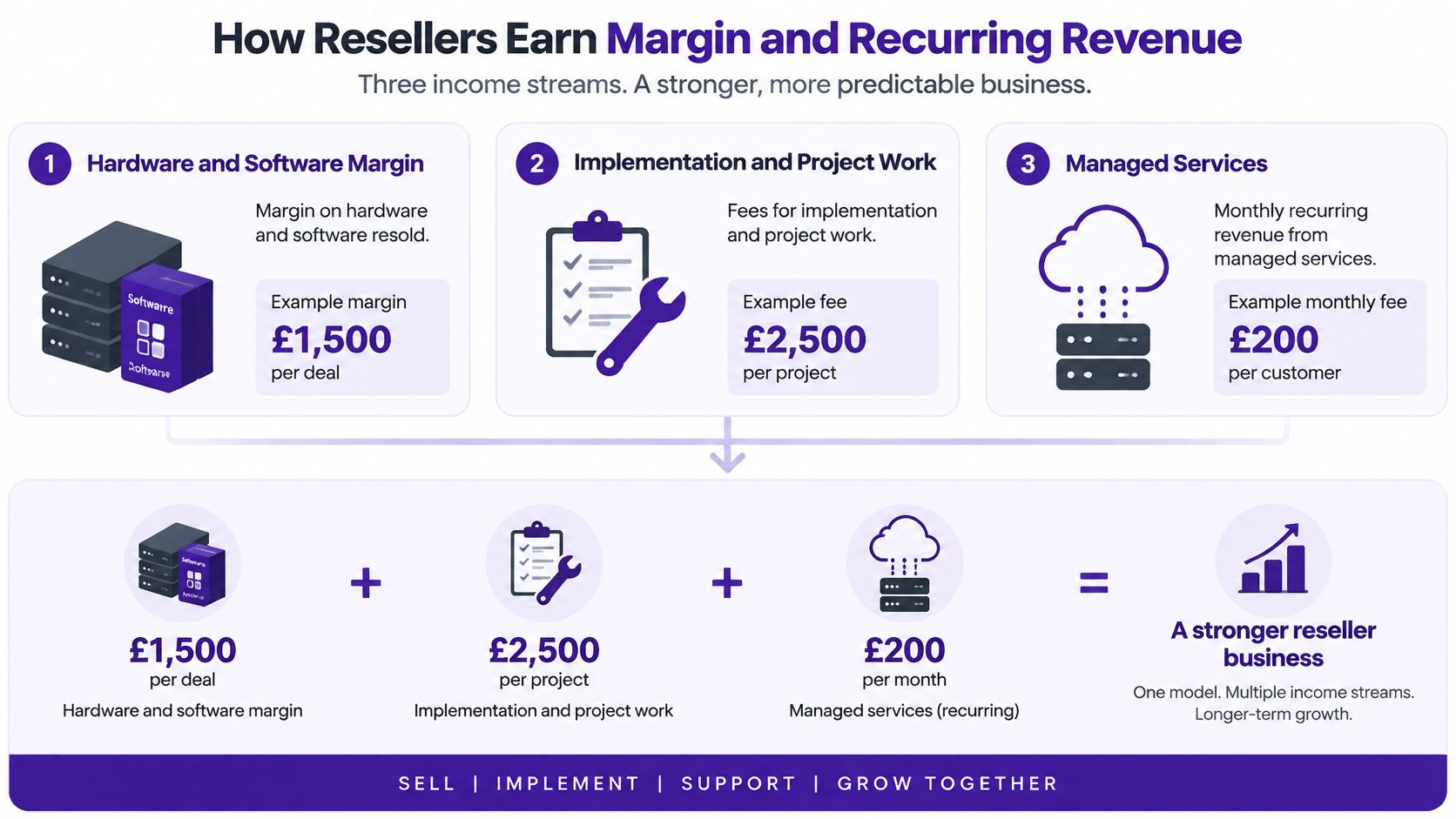
Separate the income streams
Product margin pays for sourcing and reselling hardware or software. Project fees pay for implementation, migration and configuration. Monthly recurring revenue pays for continuing access and an agreed service.
Subscribers add to a renewable revenue base, but renewal isn't automatic. Customers need evidence that the service remains useful, while you need delivery costs that don't consume the margin.
For monitoring, the supplier operates the software while the reseller handles acquisition, deployment, initial alert assessment and account management. That division can work well, provided the customer's subscription doesn't include unlimited investigation without anyone noticing.
Measure delivery as well as sales
Track these measures rather than licence volume alone:
- Attach rate: Divide monitoring customers by eligible customer accounts. A low result prompts a review of positioning, account targeting or the service bundle.
- Monitored identities or domains per account: Divide monitored scope by active accounts. Check that new starters and additional domains aren't missed.
- Alert-to-investigation time: Compare alert receipt with the first recorded review. Use ticket timestamps, not recollection.
- Renewal rate: Divide renewed subscriptions by subscriptions due for renewal. Record why customers leave.
- Gross recurring margin: Subtract wholesale fees and attributable delivery costs from recurring revenue, then compare the remainder with that revenue.
These are practical calculations, not industry benchmarks. Take the inputs from your billing system, licence records and service desk.
A profitable recurring revenue security service needs both commercial uptake and controlled labour. If sales rise while unresolved alerts accumulate, hiring, scope or pricing needs attention before further expansion.
Choosing a Vertical to Specialise In
A vertical specialism makes delivery more repeatable. You can reuse onboarding questions, recognise familiar account structures and explain exposure using the customer's own operational concerns.
Professional services is a transferable starting point for many existing IT providers. Other sectors may suit your relationships better, but choose on delivery fit rather than the apparent size of the opportunity.
Vertical specialisms for technology resellers
The drivers below are qualification topics, not claims that monitoring alone satisfies a legal or contractual requirement.
| Vertical | Why it buys monitoring | Compliance or contract driver | Easiest first offer |
|---|---|---|---|
| Professional services (consultancies) | Client files and remote working | Client contract requirements | Staff accounts for remote and hybrid workers |
| Healthcare and NHS suppliers | Patient and staff data, credential reuse | Data protection duties and procurement evidence | Staff email monitoring for all sites |
| Legal and accountancy firms | Client confidentiality and fraud risk | Professional body expectations and client due diligence | Monitored domains for partner and staff email |
| Schools and education trusts | Pupil data and shared logins | Data protection duties and safeguarding policies | Staff account monitoring with annual review |
| Construction firms | Payment fraud and supplier impersonation | Client contract security clauses | Monitoring for finance and project mailboxes |
| Hospitality groups | Booking data and multi-site staff access | Card payment obligations | Monitoring for head office and site managers |
| Manufacturing SMEs | Intellectual property and supplier logins | Customer supply-chain questionnaires | Domain monitoring for the core business |
Institutional procurement is a substantial channel opportunity: UK public-sector organisations spent £3.7 billion directly with VARs in FY2023/24, equivalent to 22% of the public-sector technology market, according to the government's digital and technologies sector economic statistics. For institutional buyers, prepare evidence of onboarding, escalation and reporting rather than relying on a feature list.
Apply a practical selection test
Choose a vertical by asking:
- Existing overlap: Do you already support businesses with similar systems and purchasing contacts?
- Data sensitivity: Can your team handle the exposure information appropriately?
- Repeatability: Can you reuse a service schedule and onboarding pack without rewriting everything?
Start with a single vertical for the first ninety days as a planning exercise. Build its account checklist, notification template and escalation route before widening the offer.
When you promote exposure checks to business customers, describe the operational problem plainly. A finance director needs to understand who acts on an exposed mailbox, not how many technical features sit behind the service.
How to Add Dark Web Monitoring to Your Portfolio
Attach monitoring to something the customer already buys. IT support, cloud services, hosting, connectivity, telecom systems and web services all provide an existing commercial relationship through which to explain the offer.
The government's managed service providers market report identified 12,867 active MSPs in March 2025, employing 343,762 people and generating an estimated £51 billion in revenue; more than half offered cloud services, while 22% performed cyber-security-related activities. The same report found that 56% of MSPs mentioning an accreditation cited Cyber Essentials, making that a useful account-review conversation, without presenting monitoring as certification.

The exposure problem is concrete: the government's fraud strategy states that the Genesis criminal marketplace hosted more than 80 million stolen credentials and digital fingerprints from over two million victims. Businesses can have compromised credentials circulating without knowing it.
Keep the offer narrow and understandable
GoSafe is a fully white-label Dark Web Monitoring tool, not a general security suite. It continuously scans for compromised email addresses, exposed passwords and breached domains, providing early, clear and understandable alerts when credentials appear on the dark web.
Partners can brand the portal, sell under their own company name and offer a monthly subscription within their own portfolio. There's no need to build security tools internally, no complex setup and no specialist security knowledge required to operate the monitoring tool.
Our dashboard lets providers track risk scores, view breach history, detect dark web threats and receive real-time alerts across their customers. GoSafe helps MSPs protect over 15,000 businesses worldwide.
Launch in controlled batches
- Choose the attach point. Start with an existing support or hosting package rather than creating an unrelated sales motion.
- Confirm monitoring scope. List approved domains and staff email identifiers, with a customer contact responsible for changes.
- Brand and price the service. Set a clear monthly subscription and distinguish included support from additional investigation.
- Batch onboarding. Leave enough desk capacity to review initial findings.
- Assign alert ownership. Route notifications to a named person and a backup, not an unattended shared inbox.
- Deliver the first exposure report. Explain the finding, its limitations and the agreed next action.
- Review at the monthly account meeting. Check scope changes and outstanding actions.
For staff learning how credential exposure can lead to misuse, Vigil Security on account takeover fraud provides relevant context for that customer conversation.
This makes dark web monitoring for MSPs an operational addition rather than a separate technical practice. See how GoSafe works for service providers and assess the branded workflow against your onboarding and service-desk capacity.
Turning Dark Web Alerts Into Customer Action
A monitoring feed without an owner becomes a notification customers ignore. UK businesses experienced an estimated 8.58 million cyber crimes in the period covered by the government's Cyber Security Breaches Survey 2025, which gives a practical reason to define response work before selling visibility.
The service should answer plain questions: what appeared, which account is affected, what needs checking and who acts next? An exposure notice is a starting point for assessment, not a conclusion that an attacker is currently inside the customer's systems.
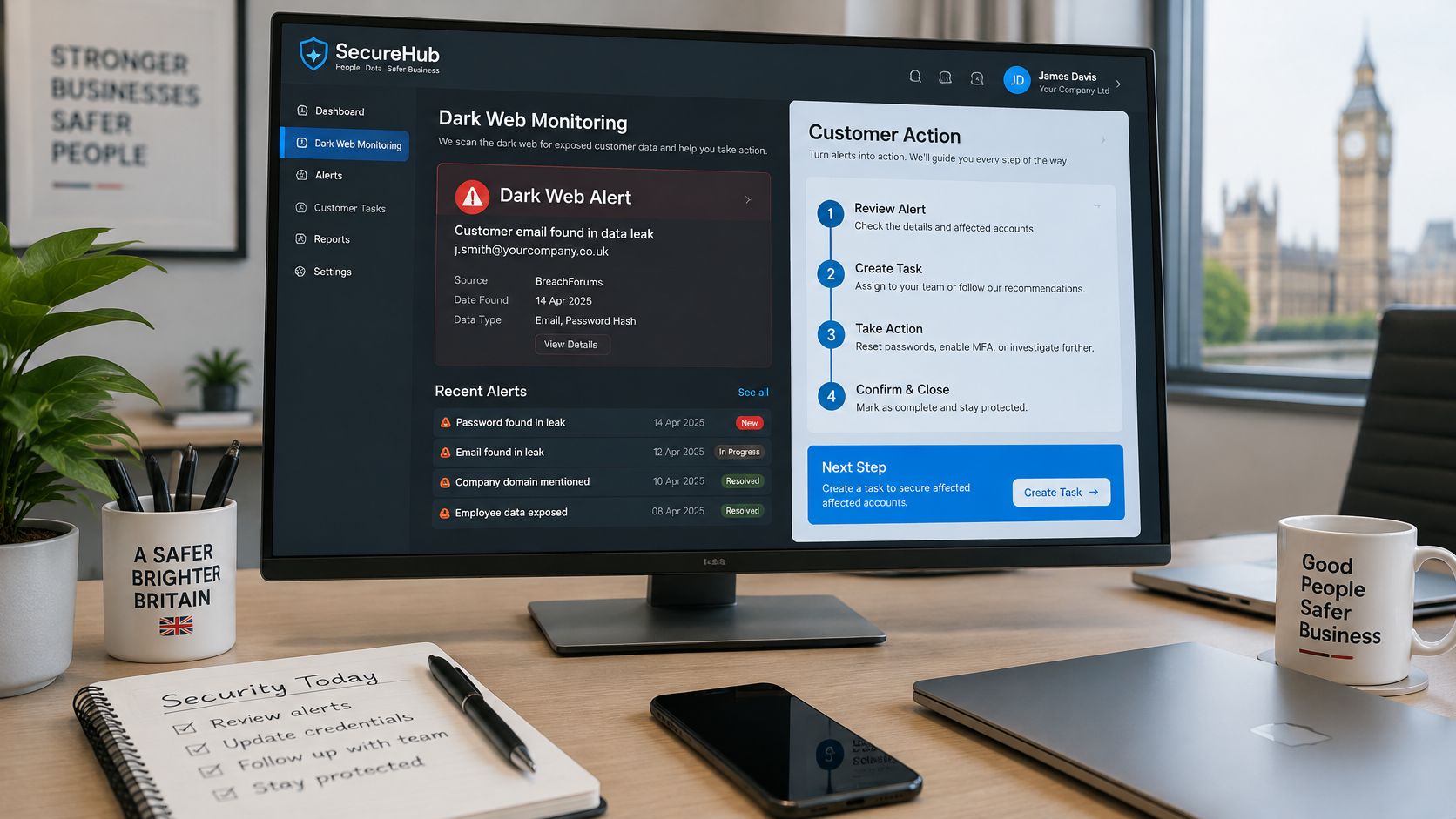
Alert types, first actions and owners
Use these as proposed internal response targets, not supplier guarantees or statutory deadlines. Confirm that staffing and customer access permissions make them achievable.
| Alert type | First action | Owner | Response target |
|---|---|---|---|
| Exposed password, single user | Reset password and enforce multi-factor authentication | Service desk | Same working day |
| Exposed staff email, no unusual login | Notify user and check recent sign-ins | Service desk | Within one working day |
| Breached company domain | Brief the customer contact and review domain accounts | Account manager with service desk | Same working day |
| Compromised password reused on an admin account | Reset admin credentials and review admin activity | Senior technician | Immediately |
| Customer personal data exposed | Escalate to the customer's data protection lead | Account manager and customer | Agree with customer before any notice |
After detecting leaked employee passwords, prioritise credential remediation and multi-factor authentication. Follow with a short phishing reminder that explains what staff should report and where to send it.
For an exposed email address without a password, check context before demanding disruptive action. Confirm that the person still works there, review available sign-in evidence and avoid treating an old exposure as proof of a new incident.
Close the ticket with evidence
Record the affected identifier, discovery context, customer notification, action taken and closure decision. Keep exposed personal data out of unnecessary email chains, restrict access and avoid copying raw passwords into tickets.
Clear notices let ordinary service-desk staff begin the process without a specialist security hire. Suspicious privileged activity or uncertain personal-data exposure still needs an escalation route.
Can a technician act on every row without improvising? If not, document the missing step or name the specialist who takes over before launch.
Customers should leave a review knowing what changed, not merely that another alert arrived.
What You Remain Responsible For
Buying software doesn't transfer your accountability. Running monitoring can require minimal platform management and no dedicated security team, but customer communication, incident decisions and support labour remain real work.
Set the scope as continuous checks for exposed credentials, with notification when relevant email addresses, passwords or domain-related information appear. Don't sell monitoring as prevention or imply that it can see every criminal source.
We monitor for exposed credentials and tell you when they appear, but we can't guarantee that nothing has been exposed.
An alert isn't proof of active misuse. Equally, an absence of alerts isn't proof of safety, and any reassurance must reflect those limits.
Keep operational and legal ownership explicit
- Customer communication: Your team explains findings and agrees next steps under your own brand.
- Remediation: Allocate password resets, access reviews and incident decisions to authorised people.
- Support labour: Price investigation and remediation separately from software where they fall outside the subscription.
- Processing responsibilities: Before searching, check customer contracts and take appropriate advice on lawful basis and end-user notices.
Resellers act as independent data controllers for their own customers, and GoBig Online LTD has no direct contractual relationship with reseller end users. Resellers must ensure that every end user for whom they perform searches has a lawful basis for that processing and has received appropriate notices.
GoBig Online LTD isn't liable for decisions, actions or inaction taken by resellers or end users based on GoSafe results or omissions. A white-label service preserves your customer relationship, but it doesn't remove the need to define who can authorise action.
Train the desk to recognise its limits. Staff don't need to become forensic investigators, but they do need to know when to stop routine handling and involve the customer's security or data protection lead.
Confirm Your Model Before You Book a Demo
A workable launch starts with decisions, not a bigger feature list. Use this checklist to establish whether reseller dark web monitoring fits the business you run.
Make the answers change the plan
- Which reseller model generates your revenue? A project-led VAR without monthly contracts needs a recurring service agreement and billing process before adding monitoring.
- Which vertical comes first? If every prospect needs different handling, narrow the initial segment until onboarding becomes repeatable.
- Where does monitoring attach? If there's no natural existing service, test the customer proposition before committing sales resources.
- Who communicates alerts? If the answer is whoever is available, appoint an owner and deputy.
- Are processing arrangements ready? If lawful basis or notices are unresolved, settle them before performing searches.
- What happens outside scope? If nobody can authorise specialist help, agree that route before accepting the customer.
Keep the first offer deliberately simple: a monthly price, a defined attach point and a focused vertical. That's easier to explain than a broad menu of white label security services, and easier for a small team to deliver consistently.
Model renewals and labour honestly
For a fixed-price customer cohort, customers multiplied by monthly price gives the recurring monthly revenue base. Applying the expected renewal rate estimates the portion retained at renewal, not guaranteed future income.
Then subtract wholesale fees and realistic delivery costs. Include onboarding, account reviews and customer communication, rather than treating staff time as free.
Review the dark web monitoring reseller program with your commercial and service-desk leads together. Use a demo to test the portal and alert workflow against the responsibilities you've assigned, so you can offer monitoring under your own brand without promising more than your team can deliver.
GoSafe Dark Web monitoring offers fully white-label credential monitoring that technology resellers can package as a monthly service under their own brand. Visit GoSafe Dark Web monitoring to explore how a focused monitoring offer can fit your existing customer relationships and recurring revenue model.