
A client calls after an employee nearly hands over their Microsoft 365 password. Another has read about a competitor's breach and wants a staff training programme in place before the next incident reaches the board. For MSPs, IT support companies, telecom providers and resellers, these conversations are no longer unusual. They're commercial signals.
The opportunity isn't to sell another annual compliance video. It's to build cybersecurity training programs around repeated practice, phishing simulations, clear reporting and useful dark web alerts. Packaged properly, training becomes one of the recurring revenue security services that strengthens an existing customer relationship instead of competing with it.
Why Your Clients Are Asking About Staff Training Now
The conversation often starts with a small incident. A finance employee receives an urgent payment request that appears to come from a director. A user clicks a link in an email that looks like a Microsoft 365 login page. The client's IT manager then asks the MSP, “What should our people have been trained to spot?”
That question matters because the client already trusts you with their systems. They may not want to find a separate awareness vendor, brief another supplier and manage another reporting process. They want practical advice from the partner who understands their users, devices, cloud services and business pressures.
The strongest MSP conversations focus on behaviour, not blame. Staff need to know how to pause, verify and report suspicious requests. They also need to understand that a compromised email address or exposed password can create risk even when nobody remembers clicking a malicious message.
Commercial observation: A phishing scare creates urgency, but a repeatable training service creates retention.
Demand is also becoming broader. Senior leaders want evidence that staff understand security responsibilities. Finance teams need practice with invoice fraud and payment diversion. Executives need guidance on impersonation and second-channel verification. Remote teams need simple procedures that work when they're away from the office and under time pressure.
The NCSC phishing guidance gives service providers a useful framework for these discussions. It sets out four defensive layers, make it harder for attackers to reach users, help users identify and report phishing, protect against undetected messages, and respond quickly when an incident occurs. It also recommends additional support for vulnerable staff and verification through a second communication channel.
A training offer can sit naturally beside IT support, cloud services, hosting, connectivity, VoIP, web services and backup. Service providers working across different sectors can also browse industry pages to see how operational context changes the risks and the language used with different customers. The sale becomes easier when training is presented as a practical extension of services the client already buys.
The Training Gap Most UK Businesses Still Face
The UK market remains uneven. The 2025 Cyber Security Breaches Survey found that only 19% of businesses and 21% of charities provided some form of staff cyber security training during the previous 12 months. Uptake was much higher among larger organisations, reaching 54% of medium businesses and 76% of large businesses according to the UK Government survey.
The later 2025/2026 survey showed a similar divide. Training was offered by 19% of businesses and 17% of charities, compared with 54% of medium businesses and 84% of large businesses in the published government results. The opportunity is therefore not hidden in the enterprise market. It sits with smaller firms, charities and distributed teams that often lack an internal security awareness owner.
Why packaged services fit smaller clients
A small organisation may understand that staff awareness matters but still lack the time, content and staff to run a programme. An MSP can remove that friction by providing enrolment, simulations, reminders, reporting and customer reviews as one managed service.
The national skills pipeline is growing, but that doesn't remove the need for practical programmes inside businesses. UK higher education enrolments on cyber security courses reached 20,890 students in 2021/22, a 14% year-on-year increase, while cyber security graduates increased by 34%, according to UK labour-market data. The same source records that only 24% of UK businesses had cyber-role staff undertake training in 2020, while 48% had a basic technical cyber security skills gap.
For a reseller, the conclusion is straightforward. Clients don't necessarily need a large internal team. They need a service that's easy to deploy, affordable to maintain and connected to the risks already visible in their environment.
Building a Curriculum That Addresses Real Threats
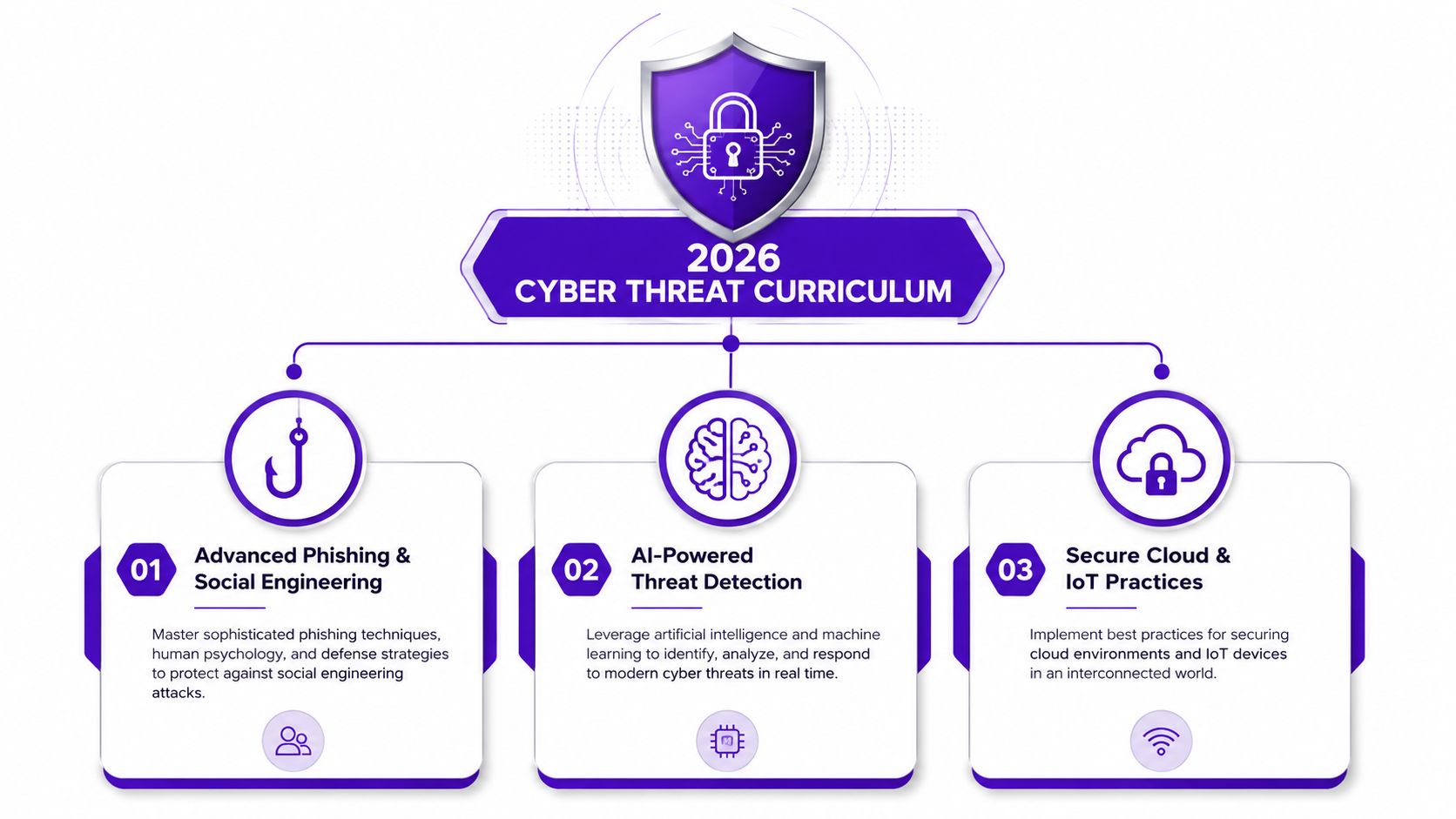
A useful curriculum starts with what employees do, not with a generic library of topics. The first layer should cover suspicious email, credential theft, password reuse, MFA prompts, malicious attachments and the correct reporting route. Keep the content short enough to complete during a normal working day, then reinforce it through realistic scenarios.
AI-assisted phishing deserves direct treatment. Attackers can create convincing messages, imitate business language and build urgency around invoices, account access or document sharing. Staff should practise checking the sender, questioning unusual requests, avoiding credential submission and verifying important instructions through a separate channel.
A practical module map
Use a common foundation, then add role-based learning:
- All staff: phishing recognition, password hygiene, MFA, safe link handling and immediate reporting.
- Finance teams: invoice changes, payment requests, supplier impersonation and independent verification.
- Executives and assistants: impersonation, urgent requests, confidential information and second-channel checks.
- IT and privileged users: administrator credentials, access approvals, suspicious MFA activity and escalation procedures.
- Remote and hybrid workers: personal device hygiene, home working habits, collaboration platforms and mobile requests.
The NCSC recommends confirming important email requests through another channel, such as a phone call, SMS, account login or post. That makes a good simulation exercise because it tests a decision, not merely whether someone remembers a definition.
Refresh the behaviour, not just the content
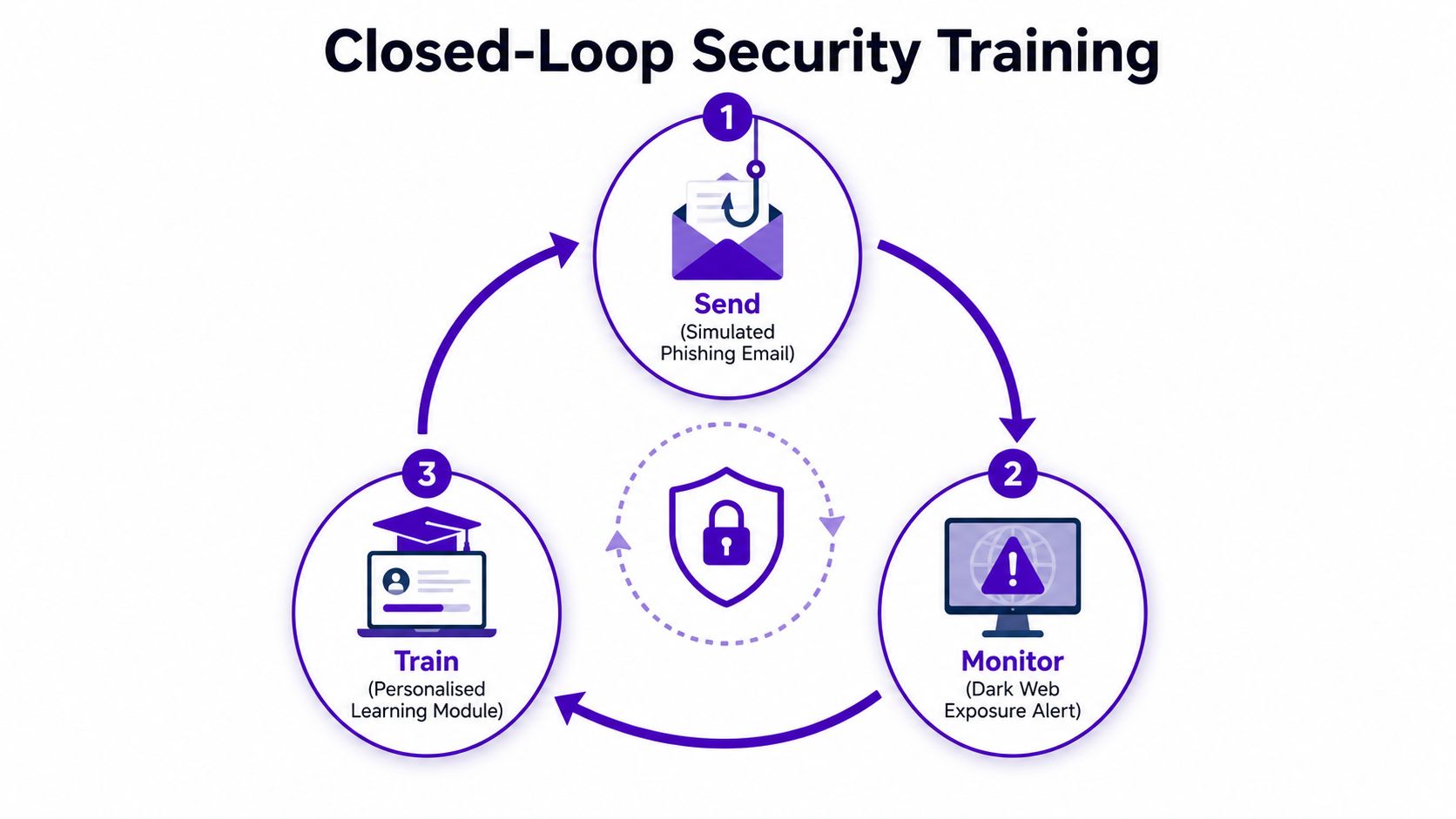
One annual session rarely changes habits for long. Build onboarding into the client's joiner process, use short refreshers during the year, and follow failed simulations with immediate coaching. Repeat clickers should receive customized remedial modules rather than being sent the same generic course as everyone else.
A closed loop connects the simulation result to the next action. A user who submits credentials receives a focused lesson on fake login pages. A finance team that ignores a payment verification step receives a scenario built around supplier fraud. A board that hasn't engaged with training receives a concise governance briefing.
For practical context on how monitoring and education can work together, GoSafe Dark Web monitoring training provides a relevant reference point for service providers designing this type of offer.
Combining Phishing Simulations with Dark Web Monitoring
Phishing simulations show how people respond to a controlled lure. Dark web monitoring shows whether an organisation's email addresses, passwords or domains have appeared in exposed data. Used together, they give the customer both behavioural evidence and external exposure intelligence.
Start with a baseline simulation. Measure clicks, credential submissions and reports without using the exercise to embarrass individuals. Explain that the result establishes where coaching should begin.
Next, schedule recurring simulations. A monthly or quarterly cadence gives the MSP a service event to manage and gives the client a regular view of behaviour. The exact frequency should reflect the customer's workforce, risk profile and ability to respond to results. A small business may need a simple recurring cycle. A larger client may need separate campaigns for finance, executives and administrators.
Turn alerts into teaching moments
When a monitoring service detects a compromised email address, exposed password or breached domain, the alert should trigger a defined workflow. Confirm the affected account, recommend password changes and MFA checks, then assign a short lesson on credential exposure and reporting.
This approach is more credible than presenting training as an abstract warning. The customer can see that an address connected to its business has appeared in leaked data, while the simulation programme shows whether staff can recognise the next attempt to use that information.
GoSafe Dark Web monitoring is one option for this model. It continuously scans for compromised email addresses, exposed passwords and breached domains, then provides clear alerts and breach breakdown information through email and a user-friendly dashboard. Its Go Phish Live feature supports realistic phishing tests, which a partner can connect to follow-up coaching under its own service process.
The same layered thinking applies outside the UK. Organisations operating in the United States, for example, may need to protect Atlanta operations from cybercrime while adapting training to local business practices and customer expectations. The principle remains consistent, technical controls and user behaviour need to support each other.
For partners building a packaged offer, the phishing simulation for resellers model is useful because it turns testing into a managed activity rather than a standalone licence.
Choosing Delivery Formats and Pricing Models
Delivery should match the client's capacity. Self-paced modules are efficient for distributed teams and routine refreshers. Live workshops work better when a customer needs discussion around a recent incident, policy change or sector-specific risk. A hybrid model usually gives the MSP the strongest balance, self-paced learning for scale, with live sessions reserved for higher-risk roles and leadership.
| Format | Best For | Pricing Model | Key Advantage |
|---|---|---|---|
| Self-paced modules | Smaller firms and distributed teams | Per-user monthly subscription | Easy to repeat and administer |
| Live virtual workshops | Finance, leadership and high-risk departments | Fixed session fee or package allowance | Allows questions and scenario discussion |
| Hybrid programme | Customers wanting managed security support | Monthly per-user package with workshop allocation | Combines scale with human guidance |
| Simulation-led service | Clients that need measurable behaviour change | Monthly subscription with scheduled campaigns | Produces recurring results for reviews |
Pricing should be simple enough for a client director to understand. A per-seat monthly model works when the customer has a stable workforce and wants predictable billing. A bundled package can combine training, phishing simulations, reporting and dark web monitoring into one recurring service, which makes the value easier to defend than several disconnected line items.
Tiering can reflect service depth rather than arbitrary feature lists. An entry package might include core modules, enrolment and periodic reporting. A higher package can add role-based simulations, targeted coaching, executive briefings and customer review meetings. Larger clients may prefer a negotiated package that accounts for multiple departments and reporting requirements.
Avoid pricing only for content access. The customer is paying for administration, reminders, interpretation, follow-up and evidence of progress. If the MSP absorbs every task without defining the service boundary, margins disappear.
Pricing principle: Charge for the managed outcome, not just the number of videos in a library.
Keep onboarding fees separate where the initial work is substantial. User import, policy alignment, baseline testing and report configuration take time, even when the underlying platform is simple. Recurring billing should then cover the operational cadence, customer support and regular review.
White-Label Packaging That Strengthens Your Brand
White-label delivery changes the customer's perception of the service. Instead of referring a client to an unrelated training provider, the MSP can sell dark web monitoring under its own brand and include it in a wider security portfolio.
A fully white-label platform should allow the partner to use its company name, visual identity and customer-facing reporting. The partner owns the customer relationship, controls the commercial conversation and decides whether the service sits alongside IT support, hosting, connectivity, telecom systems or web services.
GoSafe is designed as a Dark Web Monitoring tool, not a generic cybersecurity platform. It scans continuously for compromised email addresses, exposed passwords and breached domains, then presents early alerts in a format business users can understand. That simplicity matters in a reseller model. Customers want to know what was exposed, who needs to act and what should happen next.
The partner doesn't need to build security tools internally or hire a specialist security team to start the service. Setup should focus on branding, customer enrolment, domain and account monitoring, alert routing, simulation scheduling and a review template. Once those steps are documented, the process can be repeated across the customer base.
A practical bundle might include:
- Credential exposure monitoring: alerts for compromised email addresses and passwords.
- Domain monitoring: visibility of breaches linked to the customer's business domain.
- Phishing practice: realistic simulations followed by targeted learning.
- Service reporting: a clear summary of alerts, actions and training activity.
- Quarterly review: a commercial conversation about risk, remediation and next steps.
This creates natural upsell opportunities without forcing a hard security sale. A hosting customer may add monitoring after a domain exposure discussion. An IT support customer may add phishing simulations after a near miss. A VoIP provider may introduce training when discussing impersonation and verification procedures.
The white-label dark web monitoring option gives service providers a route to package this offer under their own identity, with recurring billing and minimal operational overhead.
Measuring Results and Onboarding Clients Smoothly
A repeatable deployment playbook keeps the service profitable. Start by identifying the customer's users, domains, high-risk roles, reporting route and existing security controls. Then enrol the agreed accounts, run a baseline simulation, confirm alert contacts and schedule the first coaching cycle.
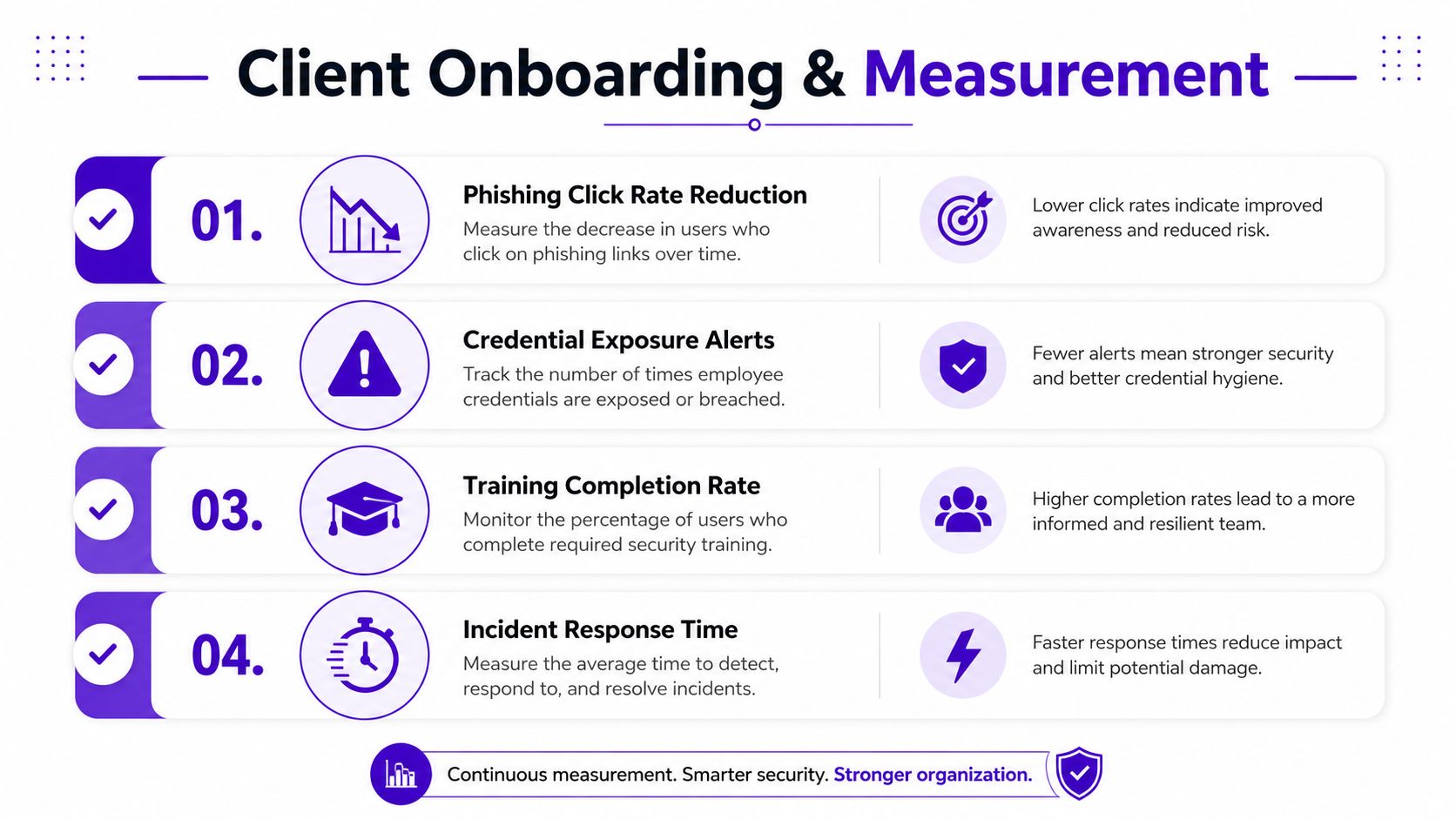
Track measures that support a customer conversation:
- Phishing click rate: whether simulated clicks decline across repeated exercises.
- Credential exposure alerts: how many monitored identities require investigation or remediation.
- Training completion: whether assigned learning reaches the intended users.
- Incident response time: how quickly staff report suspicious activity and how quickly the service team follows up.
The 2024 phishing benchmarking dataset covering 35,681 organisations and more than 12.5 million users recorded UK and Ireland phishing proneness falling from 32.3% at baseline to 18.4% after 90 days and 4.5% after one year with consistent training and testing in the published benchmark. The figures support a closed-loop model, but an MSP should present them as benchmark context, not as a promise for every client.
Board reporting should explain movement, exceptions and actions. Don't send a dashboard without interpretation. Tell the client which department needs coaching, which exposed credentials require remediation and what the next simulation will test.
The governance case also matters. The NCSC Cyber Assessment Framework states that people supporting essential network and information systems should be appropriately trained in cyber security, making training an assessable expectation for relevant organisations under CAF principle B6.
Explore the GoSafe reseller programme to see how you can add white-label dark web monitoring, phishing simulations and recurring training support to your existing services.
GoSafe Dark Web monitoring offers continuous scanning for compromised email addresses, exposed passwords and breached domains, with clear alerts that customers can act on. Visit GoSafe Dark Web monitoring to connect those alerts with phishing simulations and offer a practical, recurring cybersecurity training service under your own brand.