The sinking feeling when you realise you have been breached is something no business wants to experience. But in that moment of chaos, a clear, structured response plan is your best defence. The first few hours are absolutely critical for shutting down the attack and minimising the damage.
For telecom providers and MSPs, this is where you prove your value. Guiding a client through these initial steps transforms a crisis into a moment where you can build unshakable trust.
The key is to act fast, but not recklessly. Your playbook needs to be simple and direct, especially if you—or your client—are working without a dedicated security team on standby.
Your Immediate Response Plan After a Data Breach
Contain the Threat Immediately
First things first: you have to stop the bleeding. Containment is all about isolating the affected parts of your network to stop the attacker from moving laterally and causing more harm. This does not mean you have to pull the plug on your entire operation.
- Isolate Compromised Devices: Get any affected servers, workstations, or laptops off the network immediately. If you are not sure which specific devices are compromised, segmenting the part of the network where you are seeing suspicious activity is the next best thing.
- Secure Network Access: Temporarily block external access points that might have been the entry point. Think Remote Desktop Protocol (RDP) or any VPN connections that look suspect.
- Change Critical Passwords: This is non-negotiable. Immediately reset passwords for all administrator accounts and any user accounts you believe might be involved.
This simple flow breaks down the essential first moves.
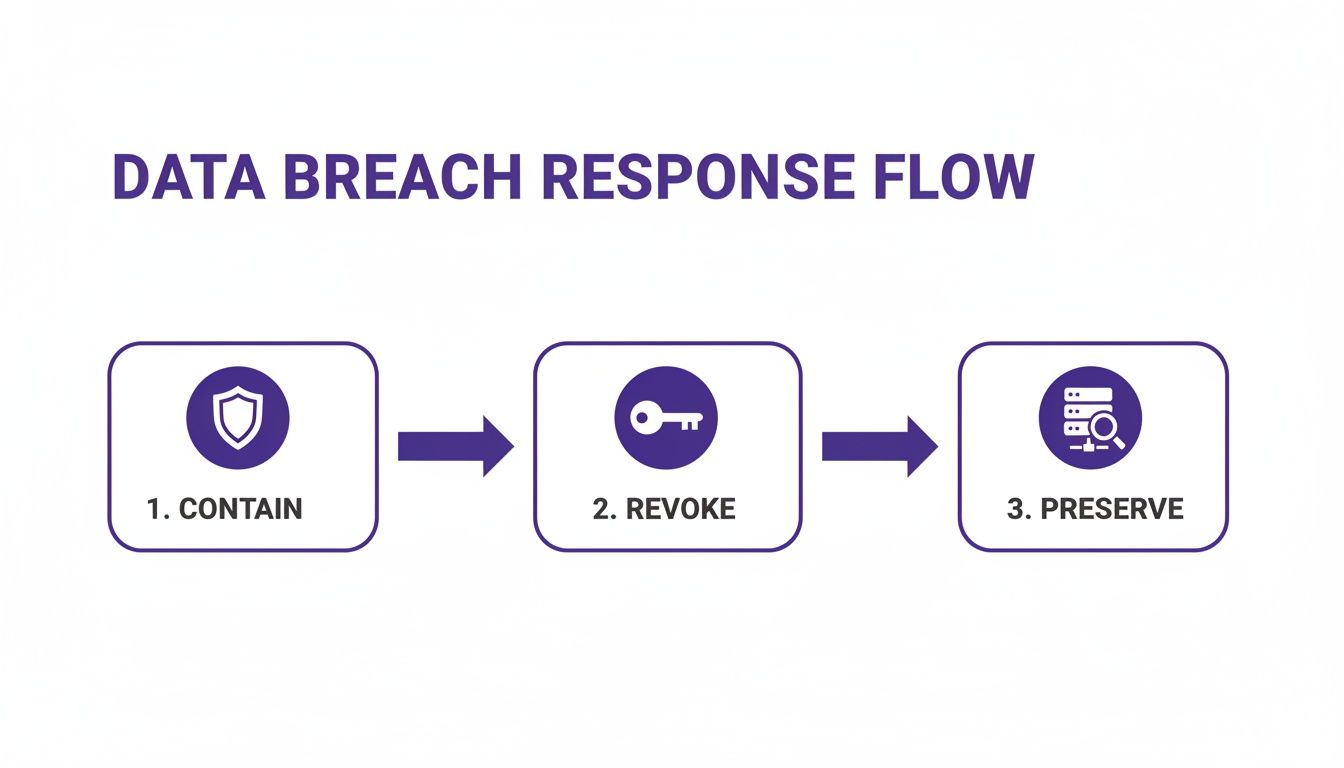
As the graphic shows, containment, revoking credentials, and preserving evidence are the three pillars of a solid initial response.
To help you act quickly, here's a checklist of the most critical first steps to take in the first 24 hours.
Data Breach First Response Checklist
| Priority Action | Responsibility (Example Role) | Objective |
|---|---|---|
| Isolate Affected Systems | IT Manager / MSP Technician | Prevent the breach from spreading across the network. |
| Revoke Compromised Credentials | Systems Administrator / IT Support | Lock out attackers by resetting passwords for admin and user accounts. |
| Preserve Forensic Evidence | Technical Lead / External Consultant | Take snapshots of affected systems before remediation to aid investigation. |
| Assemble the Response Team | Managing Director / Incident Lead | Assign clear roles for technical, communications, and coordination tasks. |
| Begin an Incident Log | Incident Lead | Document every action taken, with timestamps, for legal and regulatory purposes. |
This checklist is not exhaustive, but it covers the non-negotiable actions that will set the stage for a successful recovery.
Preserve Evidence for Analysis
While you are rushing to contain the breach, it is crucial you do not destroy the evidence. It is a common mistake—in the panic, people start wiping machines or deleting logs. Do not do it. You will need that information to figure out how the breach happened, what was taken, and who you need to notify.
Key Takeaway: Do not delete or alter any logs or files on compromised systems. The golden rule is to take forensic images (complete snapshots) of the affected machines before you start cleaning things up. This freezes the crime scene in time.
The threat is very real. Consider that 4.4 million user records were exposed in UK data breaches during Q4 2024 alone. While that figure was a drop from the previous quarter, it is a stark reminder of why immediate, decisive action is so important. For any UK business, the Information Commissioner's Office (ICO) makes it clear: your first job is containment. You can get a better sense of the current threat landscape by exploring the latest data breach trends from Statista.
Assemble Your Response Team
Even if you are a small business, you need to know who is doing what. This is not about creating a formal department; it is about assigning clear roles so nothing falls through the cracks.
- Incident Lead: You need one person steering the ship. This could be an IT manager, a company director, or your trusted MSP contact. They coordinate everything.
- Technical Lead: This is your hands-on person, responsible for isolating systems, digging into the data, and gathering the evidence.
- Communications Lead: Designate a single person to handle all messages—both internal and external. This ensures you are sending a consistent, controlled, and calm message when emotions are running high.
For MSPs and IT providers, this is also a chance to be proactive. Offering services like white label dark web monitoring can be a game-changer. It helps you spot compromised credentials long before they are used in an attack, positioning you as a forward-thinking security partner, not just a reactive one.
Navigating ICO Reporting and Customer Communication
Once you have stopped the immediate bleeding, the clock starts ticking on your legal and reputational duties. For any UK business, that means facing the strict demands of GDPR, enforced by the Information Commissioner’s Office (ICO). Getting this part right is not just about avoiding a fine; it is about rebuilding customer trust at the very moment it's most fragile.
This is where MSPs and telecom providers can really prove their worth. By guiding clients through the maze of ICO reporting and customer communications, you shift from being a service provider to an essential partner, helping them protect their brand when it matters most.
Understanding Your ICO Reporting Obligations
Here's the thing: not every security blip needs to be reported to the ICO. The crucial test is whether the breach is likely to result in a risk to the rights and freedoms of individuals. If personal data has been compromised in a way that could lead to identity theft, financial loss, or discrimination, then you are looking at a notifiable breach.
When it is notifiable, you have a strict 72-hour deadline to report it to the ICO from the moment you realise what has happened. That is a tight window, which is exactly why having a plan ready to go is non-negotiable. Missing this deadline can lead to hefty penalties, even if the breach itself was not catastrophic.
The problem is widespread. In the UK, where 43% of businesses reported a cyber incident last year, knowing how to handle regulatory notification is paramount. The ICO has issued over £20 million in penalties recently for compliance failures, including late reporting. And with identity theft now linked to 437,000 fraud victims from recent breaches, it is clear the regulator is not messing around. You can discover more UK cyber attack statistics and insights to get a better sense of the current threat landscape.
What to Include in Your ICO Report
Your first report to the ICO does not need to be perfect, but it absolutely must be on time. You can always provide more details as your investigation unfolds.
Your initial contact should cover:
- The Nature of the Breach: A clear description of what happened, including the types of data and the approximate number of people and records involved.
- Contact Details: The name and contact info for your Data Protection Officer (DPO) or whoever is leading the response.
- Likely Consequences: Your assessment of how this could realistically impact the people affected.
- Measures Taken: A quick summary of what you have already done—and plan to do—to fix the problem and limit the damage.
Commercial Insight: For IT providers, helping a client with their ICO report is a massive value-add. It shows you are more than just a tech fixer; you are a strategic advisor who understands the bigger picture of business risk.
To help you get it right, here’s a quick guide on what to do—and what to avoid—when you are talking to the regulator.
ICO Notification Do's and Don'ts
Reporting a breach can feel daunting, but following some simple principles makes the process much smoother. It is all about being timely, transparent, and organised.
| Do | Don't |
|---|---|
| Report within the 72-hour window, even if your investigation is incomplete. | Wait until you have all the answers. Procrastination is a costly mistake. |
| Be factual and transparent about what you know. | Downplay the severity or speculate without evidence. |
| Clearly outline the steps you are taking to contain and remediate the issue. | Submit a vague report that lacks specific details about the incident. |
| Keep a detailed log of your actions and communications for your records. | Forget to document your response process. This is crucial for demonstrating compliance. |
Essentially, the ICO wants to see that you are taking the situation seriously and have a credible plan. Honesty and proactivity go a long way.
Communicating Transparently with Customers
After dealing with the ICO, your next focus is the people whose data has been compromised, especially if the breach poses a high risk to them. The goal is to be clear, honest, and helpful without creating a panic.
Keep your communication straightforward. Tell customers what happened, what data was involved, and what you are doing about it. Crucially, give them clear, actionable steps to protect themselves, like changing their passwords or watching out for phishing emails.
For telecom providers and MSPs offering white label dark web monitoring, this is a powerful opportunity. You can help clients not just by crafting these communications but by offering a proactive solution to see if their credentials have been exposed. It is a way to turn a crisis into a chance to upgrade their security. To start these meaningful conversations, view the GoSafe reseller programme.
Understanding the Scope and Business Impact
Once the immediate threat is contained, the real work begins. You need to figure out exactly how bad the damage is. This is not just a technical task for the IT department; it is a critical business assessment that dictates everything you do next, from legal reporting to telling your customers what happened.
Getting the scope right moves you from chaotic firefighting to a strategic, measured recovery.
Your goal is to answer three questions, and you need clear answers: What data was taken? Which systems were hit? And how did they get in? If you are just guessing, you are leaving the door wide open for them to come back.
Determining the Full Scope of the Breach
To get those answers, you have to be methodical. Start with the evidence you gathered during containment—things like system logs, network traffic data, and forensic copies of affected machines. This is where you start to trace the attacker's footsteps.
You will want to focus on a few key areas:
- Data Exfiltration Points: Look for any strange outbound data transfers. Attackers have to move the stolen information out, and your traffic logs can often show you where it went.
- Affected Accounts: Figure out which user accounts were compromised. Was it a standard user, or did they get their hands on an administrator account? The difference is huge.
- Lateral Movement: Map how the attackers moved around once they were inside. Did they hop from one server to another? This tells you how deep the compromise really goes.
This is complex work, and for a business without a dedicated security team, it can feel like you are out of your depth. This is the moment for MSPs and IT providers to step up and show their value, guiding the client through a structured investigation. A solid understanding of what a data breach truly involves is fundamental here.
Key Takeaway: The single costliest mistake you can make right now is rushing this assessment. If you miss one compromised system or an overlooked backdoor, you have basically invited the attackers to return whenever they feel like it.
The Role of Dark Web Monitoring in Breach Assessment
This is where you need to be proactive, not just reactive. After a breach, everyone wants to know: have our passwords and emails been dumped online? Trying to find this out manually is a fool's errand. The dark web is enormous and hidden from normal view.
This is exactly what white label dark web monitoring is for. A service like GoSafe continuously scans dark web marketplaces and forums. It can tell you in near real-time if email addresses, passwords, or company domains from the breach have surfaced where they should not be.
For an IT reseller, this is a game-changer. You stop guessing and start showing your client hard evidence.
Imagine walking into a meeting and presenting a report that shows:
- Exactly which of their employees' credentials have been leaked.
- The source of the leak (for example, a specific breach dataset).
- What other data was stolen alongside the login details.
This kind of concrete proof cuts through the noise. If the finance director’s login is for sale on a criminal forum, you know exactly what to do first. It turns a vague, scary threat into a clear, actionable problem that you are perfectly positioned to solve. It is an easy sell that demonstrates immediate value and cements your role as their trusted security advisor.
Time to Fortify Your Defences
Once you have contained the immediate fallout, it is time to shift from crisis management to proactive defence. This is not just about cleaning up the mess; it is about turning a painful incident into a genuine opportunity to build a stronger, more resilient security posture. You have to ensure this never happens again.
For telecom and IT providers, this is exactly where you can prove your worth. By guiding clients through these next steps, you are not just fixing a problem—you are cementing your role as a trusted advisor, reducing their future risks, and building serious loyalty.
Mandate a Full Password Reset
Your first move is non-negotiable: force a mandatory, company-wide password reset for everyone. Stolen credentials are the lifeblood of cybercrime, so you must work on the assumption that every single password in your organisation is now in the wrong hands.
This reset has to be comprehensive. That means:
- All internal staff accounts (email, network logins, internal applications).
- Every single administrator and service account.
- Any customer-facing portals or third-party systems you control.
Doing this slams the door shut on attackers who might be sitting on stolen logins, waiting for the right moment to strike again.
Deploy Multi-Factor Authentication Everywhere
If you were not already using multi-factor authentication (MFA) across the board, now is the time. A data breach is the ultimate wake-up call, and MFA is one of the most powerful tools in your arsenal. It adds a crucial second layer of verification, like a code from a mobile application, stopping attackers cold even if they have a legitimate password.
A breach is often the only business case you will ever need for security investment. Rolling out MFA is one of the single most effective things you can do to prevent 99.9% of account compromise attacks. It is cheap, powerful, and instantly raises your security game.
As an IT provider, this is a straightforward, high-value service to offer. Do not frame it as a technical chore; explain it as the digital equivalent of locking the office doors at night. It is a simple way to add tangible value and generate recurring revenue.
Patch the Entry Point and Hunt for Others
The forensic investigation should have pinpointed exactly how the attackers got in. Now, you need to seal that entry point for good. Whether it was an out-of-date piece of software, a poorly secured remote desktop, or a misconfigured cloud server, patch it or reconfigure it immediately.
But do not stop there. A breach often exposes systemic weaknesses. Use this as an opportunity to run a full vulnerability scan across your entire network. It is far better to find and fix those other weak spots yourself before another attacker does it for you.
Turn Your People Into a Human Firewall
This is where UK firms really start to rebuild. With a shocking 74% of large businesses expected to be hit by cyber attacks in 2025, getting proactive is no longer optional. A huge number of breaches start with a simple human error, usually a phishing email. You can learn more in our guide on how to identify phishing emails.
Investing in staff training is not a 'nice-to-have'; it is a core part of your defence. Phishing simulations, for example, train employees to spot malicious emails in a safe environment, turning your biggest vulnerability into your first line of defence. For our telecom and IT partners, offering managed security awareness training is another excellent, high-value service that solves a real problem for clients. It directly tackles the root cause of so many incidents—after all, a staggering 80% of breaches involve weak or stolen passwords. For more context, you can read about the latest UK cybersecurity statistics.
When you combine technical fixes like password resets and MFA with people-focused training, you build a layered defence that is tough to break. This approach does not just help prevent a repeat performance; it shows customers and regulators you are serious about protecting their data. For IT resellers, this is the perfect time to bundle services. For example, you can position white label dark web monitoring as the foundational layer of an ongoing security strategy. You can see how GoSafe works for telecom and IT providers and find out how to add it to your service stack.
Why Continuous Monitoring Is Non-Negotiable After a Breach
Successfully navigating the immediate aftermath of a breach is a major milestone, but it is absolutely not the end of the story. A common—and incredibly costly—misconception is that once you have contained the incident and patched the hole, the danger has passed.
Unfortunately, that is rarely the case.
Think of a data breach not as a single event, but as the start of a long period of heightened risk. Those credentials stolen during the incident are a valuable commodity, and their journey through the criminal underworld has only just begun.
The Long Lifecycle of Stolen Data
Stolen data does not just vanish. It enters a thriving underground economy where it gets bought, sold, and traded for months, sometimes even years. Cybercriminals compile credentials from multiple breaches into massive lists, using them against countless online services in what are known as credential stuffing attacks.
The initial breach might have been through a single supplier, but that compromised employee email and password could easily be the same one they used for a corporate bank account, a cloud services portal, or the company CRM. The risk does not shrink over time; it multiplies as the data gets passed around.
Key Takeaway: A breach creates a long tail of risk that extends far beyond the initial incident. The stolen credentials become ticking time bombs, waiting to be used in a future, potentially more damaging, attack. This is precisely why continuous monitoring is so essential.
For telecom and IT providers, getting this point across to clients is critical. It shifts the entire conversation from a one-off fix to the need for an ongoing security partnership. It also builds a powerful business case for a service that gives them visibility into this hidden threat landscape.
Turning Visibility into a Commercial Advantage
This is where a service like GoSafe becomes a game-changer. It acts as your early warning system, constantly scanning the dark web for any sign of a client's compromised data. The moment a user's email or company domain appears in a new data dump, you get an immediate alert.
This alert is not just a technical notification; it is a powerful commercial opportunity. For MSPs and IT resellers, this is your chance to be proactive. Instead of waiting for the client to report another problem, you can reach out with a clear, specific warning.
- You can tell them an employee's credentials have just been found online.
- You can advise them to immediately reset the passwords for that user everywhere.
- You can use it as the perfect trigger to finally deploy multi-factor authentication.
This simple act transforms your service from reactive IT support into a proactive security advisory. It is a high-value interaction that proves you are actively protecting their business, strengthening the relationship and dramatically reducing churn. To really grasp how this works, it is worth exploring the fundamentals of what is dark web monitoring and the crucial visibility it provides.
A Simple, High-Margin Service Your Customers Understand
The beauty of white label dark web monitoring is its simplicity. You do not need to be a cybersecurity specialist to sell it, and your customers do not need a technical degree to see its value. The proposition is incredibly straightforward: "We will continuously watch the criminal underworld for your stolen data and alert you the moment we find it."
This service is easy to add to any existing managed IT, connectivity, or VoIP package. With no complex setup or specialist security knowledge needed, it becomes a low-overhead, high-margin source of predictable recurring revenue. It addresses a real business fear that clients can easily grasp, making it a natural and easy upsell.
By offering this, you empower your clients to see and act on threats before they cause real damage. It is a practical solution that builds trust, increases ARPU, and cements your position as an indispensable partner in their long-term security.
Your Data Breach Questions Answered
When a data breach hits, it is a chaotic time filled with high-stakes decisions and looming legal duties. We have cut through the noise to answer the most common questions UK businesses have, giving you clear, practical guidance to help you get back on your feet.
How Long Do We Have to Report a Breach?
The clock starts ticking the moment you suspect a breach. Under UK GDPR, you have a strict 72-hour window to report it to the Information Commissioner’s Office (ICO).
This is not 72 hours to have everything figured out. It is 72 hours to make the initial notification. A common—and costly—mistake is waiting until the investigation is complete. Get the initial report in, then update the ICO as you learn more. It shows you are taking things seriously and working to comply.
Do We Have to Tell Our Customers?
The short answer: yes, if the breach is likely to result in a high risk to their rights and freedoms. Think about what the stolen data could be used for. If it could lead to identity theft, financial fraud, or serious reputational harm, you must inform affected individuals without unnecessary delay.
Do not just tell them what happened. Your communication needs to be crystal clear. Explain which data was involved and, critically, give them specific, actionable steps to protect themselves. This includes things like changing passwords, watching out for phishing emails, and checking their bank statements.
What Is the Very First Thing We Should Do?
Before you do anything else, your number one priority is containment. You have to stop the bleeding.
This means isolating the affected systems from the rest of your network to prevent the attack from spreading. It means immediately revoking any compromised login details by forcing password resets. And it means preserving every bit of evidence for the investigation that will follow. Do not panic and wipe systems or delete logs—you will be erasing the very clues you need to understand how they got in.
Is Just Changing Passwords Enough?
A company-wide password reset is an essential first step, but it is rarely a silver bullet. The reality is that attackers do not just walk out the front door; they often leave a backdoor open to get back in later.
After a breach, if you have not already, you need to roll out multi-factor authentication (MFA) everywhere, immediately. It is one of the single most effective controls you can implement. Beyond that, a proper forensic investigation is needed to find the original vulnerability and patch it. If you do not fix the hole in the wall, you are just inviting them back for another visit.
Commercial Insight: For IT providers, answering these tough questions is a golden opportunity to prove your value. You shift from being a simple service supplier to a trusted security partner. This is the perfect moment to introduce proactive solutions like dark web monitoring for MSPs.
This kind of monitoring alerts you if the stolen credentials from this breach pop up for sale online months or even years later, giving your clients an ongoing layer of protection that builds real trust.
GoSafe helps telecom and IT providers offer their customers a crucial early warning system against data exposure. By adding a simple, high-value security service to your portfolio, you can start meaningful security conversations, increase recurring revenue, and strengthen client relationships.
Add white-label dark web monitoring to your service stack and see how easy it is to deliver proactive security under your own brand.