A clinic calls your service desk before breakfast. Its booking system is encrypted, staff can't access patient appointments, and the customer wants to know how an attack that seemed to happen overnight was possible. The visible disruption is new, but the attacker's motive, target selection and route into the environment were likely established much earlier.
That's why the question why do people hack matters to MSPs, IT support companies, telecom providers, hosting firms and resellers. Motive isn't a psychological footnote for an incident report. It helps you decide what to monitor, which alerts deserve immediate attention and how to package practical protection as a recurring service. UK evidence shows that attackers include profit-driven criminals, hacktivists, state-backed groups and individuals motivated by status or challenge, while human error helps enable an estimated 95% of successful cyber attacks, as described in UK parliamentary briefing material.
The Real Question Behind Why People Hack
The first mistake is treating every intrusion as the same event. A ransomware affiliate, a curious teenager testing a script and a politically motivated group may all appear in a customer's logs, but they're looking for different outcomes. One wants a payment, another wants recognition and the third may want disruption or publicity.
Practical rule: Identify the likely objective before deciding what “good monitoring” means.
A financially motivated criminal is interested in whatever can be converted into money. That might be a valid email login, an administrator account, sensitive data or access to a business that's likely to pay. A hacktivist may prefer defacement or service disruption because visibility matters more than quiet access. A state-linked operator may value information and persistence, even when there's no immediate financial demand.
For a service provider, the sequence is straightforward:
- Classify the likely motive. Ask whether the activity points to fraud, extortion, status, protest, disruption or espionage.
- Map the motive to assets. Credentials, domains, public-facing services, endpoints and sensitive data carry different risks.
- Define an alert that a customer can understand. “An employee password has appeared in exposed data” is more useful than an unexplained risk score.
- Attach a response. A password reset, endpoint isolation, domain investigation or crisis plan should follow the alert.
This approach gives partners a stronger commercial conversation. Instead of selling an undifferentiated security bundle, you can explain why dark web monitoring, identity controls, endpoint protection, brand monitoring or threat intelligence belongs in the customer's service plan. You can also prove security demand with data when discussing risk with a business owner or board.

The practical lesson is simple. Motive predicts behaviour, and behaviour tells you what to watch.
Financial Gain as the Dominant Driver
Money remains the most important answer to why people hack in the UK. The National Crime Agency describes organised cyber crime groups as profit-driven and says criminals exploit human or security weaknesses to steal passwords, data or money through methods such as fraud, malware and ransomware. The Cyber Security Breaches Survey 2024 estimates that UK businesses experienced about 7.78 million cyber crimes in the last 12 months.
That economic motive explains the popularity of credential theft. An attacker doesn't need to discover a novel vulnerability if a reused password, stolen session or compromised mailbox can provide a cheaper route to fraud. Infostealers collect credentials and other sensitive information, then criminals can reuse or trade that material across separate campaigns.
The business model has several participants:
- Initial access sellers obtain a foothold and pass it to another criminal.
- Affiliates use established ransomware infrastructure rather than building every component themselves.
- Fraud operators turn access to email, finance or customer systems into theft.
- Extortion groups threaten to publish or misuse data when encryption alone isn't enough.
The same access can support more than one revenue stream. A compromised mailbox might enable invoice fraud, password resets and internal phishing. A domain associated with a trusted organisation can make later messages more convincing. Attackers therefore tend to favour repeatable methods that lower effort per victim, including phishing, credential harvesting and social engineering.
The NCSC says ransomware attackers choose victims they believe are likely to pay or possess sensitive data. That's a commercial calculation, not random destruction. A clinic, legal practice or manufacturer may be selected because its operations, data or customer commitments create pressure to restore access.
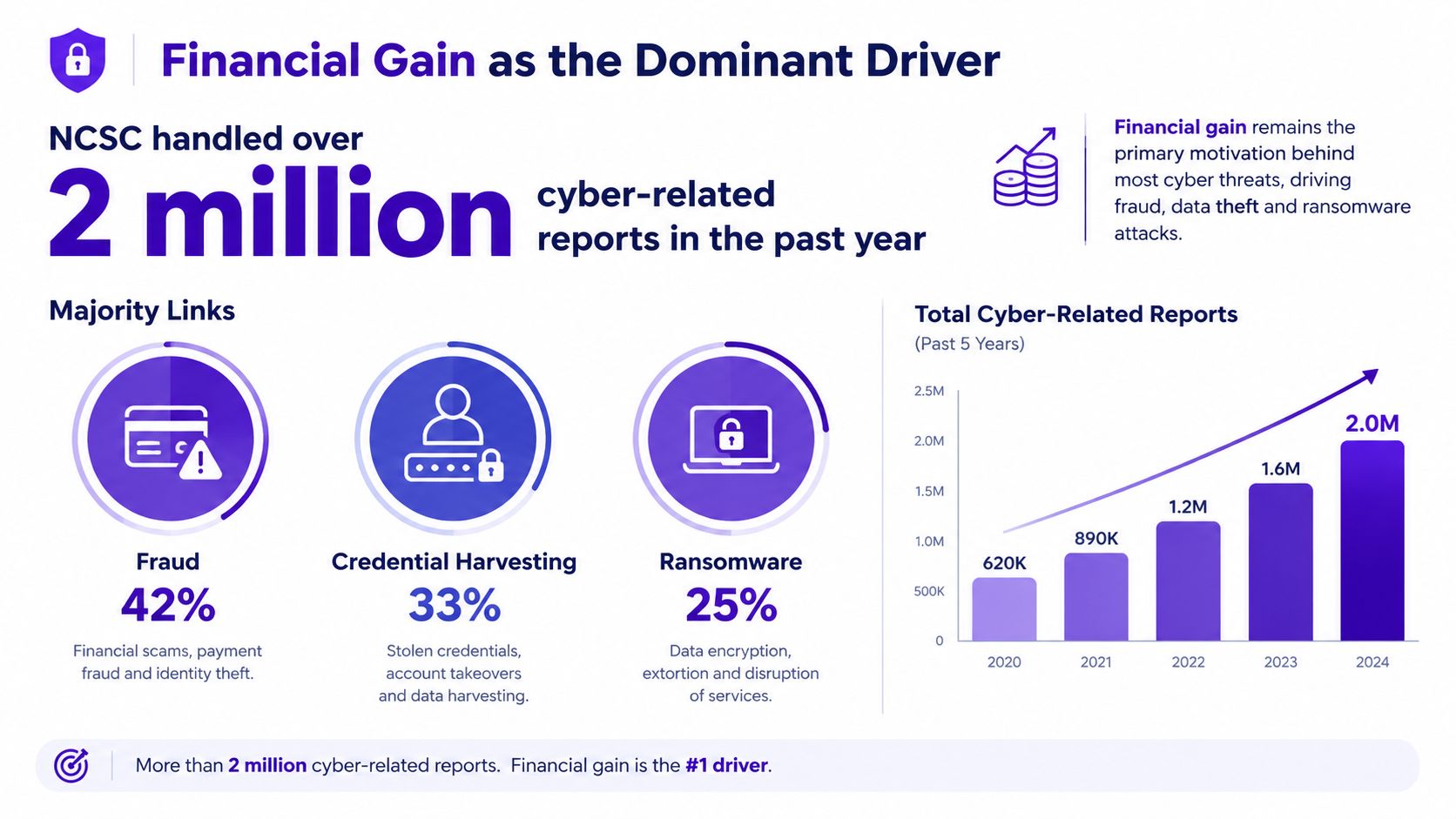
Service providers can turn those incentives into concrete outcomes. Credential exposure monitoring identifies compromised email addresses and passwords before criminals test them. Domain monitoring helps reveal whether a customer's email domain appears in breached data. Clear alerts then support password resets, session revocation, endpoint checks and customer communication.
Synthetic identity fraud sits alongside credential abuse because criminals combine real and fabricated information to manipulate verification processes. For a useful explanation of that related risk, point customers towards this AI Image Detector synthetic fraud guide.
Curiosity Status and the Pathway From Hobby to Crime
A teenager copies a script to test a game server, then notices that a misconfigured business service is just as easy to reach. The first reward may be recognition rather than money. Research from the National Crime Agency found that financial gain is often a secondary motivation for some young offenders, while belonging, skill development and peer approval can matter more. Earlier UK reporting described cybercrime suspects as relatively young and recorded offenders calling hacking fun without fully understanding the criminal consequences, as set out in the National Crime Agency publication on pathways into cyber crime.
That route usually develops through small steps. A minor defacement or copied tutorial can provide status. Online contacts may then introduce credential theft, access sales or more capable criminal groups. Repeated encouragement makes the next boundary easier to cross.
Curiosity alone does not make someone an offender. Ethical testing, bug bounty programmes and defensive research provide lawful ways to build the same skills. The dividing line is consent and purpose. An authorised test has a defined target and permission. Probing a customer's system because it appears weak does not.
For service providers, low-sophistication activity is still useful evidence. Default-password attempts, scans against exposed services and tutorial-level payloads may look insignificant separately. Combined across accounts, endpoints or customers, they can show reconnaissance and an actor searching for an easy foothold. Monitoring should connect these weak signals rather than treating each alert as an isolated event.
Sellable controls include:
- Exposure checks: Find public services and accounts that should not be reachable.
- Credential controls: Detect reused or exposed passwords and apply stronger authentication.
- Basic telemetry: Keep sufficient endpoint and identity data to link repeated attempts.
- Customer education: Explain how curiosity, convenience and password reuse create business risk.
For MSPs, this supports a managed-detection conversation. GoSafe dark web monitoring for service providers can help identify compromised credentials and exposed business data without requiring a partner to build its own monitoring tool. The alert becomes a practical service interaction: warn the customer, recommend password resets or access checks, and investigate related activity before a minor experiment becomes a broader incident.
Ideology Hacktivism and State-Linked Disruption
Financial criminals usually want to remain unnoticed until they can monetise access. Ideological actors may want the opposite. Publicity, disruption and embarrassment can be part of the objective, so a visible defacement or denial-of-service campaign may be considered a success even when no payment follows.
The NCSC warned in 2026 that Russian state-aligned hacktivist groups had persistently targeted UK organisations to disrupt networks. It described the activity as driven by ideology connected with perceived Western support for Ukraine rather than financial gain, as set out in its warning about hacktivist groups disrupting UK organisations.
That motive changes the defensive signals. Traffic spikes, altered web pages, coordinated claims on public channels and attacks timed around political events can matter more than a quiet credential sale. The Joint Committee on National Security also identifies state and state-sponsored groups, financially motivated criminals and hacktivists among the actors targeting the UK, with motives including espionage, financial gain, retribution and disinformation.
A state-linked operator normally has a different operating rhythm. It may seek long-term access, intelligence or strategic positioning. An activist group may prioritise speed and attention. The same vulnerability can therefore produce very different behaviour after access is obtained.
Ideological Actors at a Glance
| Attribute | Hacktivist Group | State-Linked APT |
|---|---|---|
| Main objective | Protest, publicity or disruption | Espionage, persistence or strategic advantage |
| Visibility | Often high, with defacement or service degradation | Usually low, with emphasis on stealth |
| Targeting | Organisations associated with a political or public issue | Government, critical services, technology or strategically valuable organisations |
| Useful monitoring | Brand protection, traffic anomalies, web integrity and threat intelligence | Identity telemetry, endpoint visibility, vulnerability intelligence and threat hunting |
| Response priority | Maintain service, protect reputation and communicate quickly | Contain access, preserve evidence and investigate persistence |
Providers should avoid selling “hacktivism monitoring” as a vague promise. Package specific outcomes instead, such as public-facing brand alerts, crisis communications support and threat-intelligence briefings. A GoSafe Dark Web monitoring hacktivism guide can help explain the difference between an exposed credential and a politically motivated disruption campaign.
The commercial opportunity is broader than breach prevention. A telecom or hosting provider can add availability and brand protection conversations to an existing account. A cyber consultant can include scenario planning and response retainers. The right offer reflects the actor's objective, not solely the presence of suspicious traffic.
Threat Actor Archetypes and What They Actually Want
A useful way to answer why do people hack is to identify the person or group behind the activity. Motive, resources and patience vary significantly between actor types, so a service that helps one customer may leave another exposed.
Threat Actor Archetype Comparison
| Archetype | Primary Motive | Typical Target | Preferred Tooling |
|---|---|---|---|
| Solo opportunist | Easy money, curiosity or notoriety | Exposed accounts, small businesses and public services | Credential stuffing, simple scripts and phishing |
| Organised cybercriminal crew | Financial gain through fraud or extortion | Businesses with valuable data or operational pressure | Ransomware, infostealers, phishing kits and access brokers |
| Insider | Revenge, money, grievance or personal advantage | Current or former employer | Legitimate accounts, copied data and authorised tools |
| Hacktivist collective | Ideology, protest or visibility | Public bodies, brands and politically associated organisations | DDoS, defacement, data leaks and public claims |
| State-sponsored operator | Espionage, retribution, disinformation or strategic access | Government, critical infrastructure and technology suppliers | Supply-chain compromise, stealthy implants and targeted exploitation |
The solo opportunist benefits from weak identity hygiene. The defensive response should make exposed credentials visible, reduce reuse and alert a provider when an account appears in breached data.
An organised criminal crew brings more coordination. Endpoint detection, immutable backups, privilege controls and ransomware readiness matter because the attacker may move beyond the first compromised account.
Insiders require a different conversation. A valid login may not look malicious at first, so access reviews, separation of duties and monitoring for unusual downloads or account behaviour become important. Providers should be careful not to frame every employee as a suspect. The objective is controlled access and evidence-based investigation.
Hacktivists need brand and availability coverage, while state-linked operators demand stronger threat hunting and vulnerability intelligence. The UK parliamentary briefing on the cyber threat describes this broad mixture of criminal, state-backed and hacktivist activity, which is why a single alerting model rarely fits every customer.
For resellers, the table also helps with packaging. Dark web monitoring for MSPs suits identity exposure and account takeover conversations. Endpoint and backup services address destructive criminal activity. Threat intelligence, vulnerability management and response retainers support customers concerned about persistent or politically motivated actors.
How Motive Shapes the Attack Chain You See
Attack chains become easier to prioritise when you connect each event to an objective. Financial actors want an efficient route to monetisation, so they often favour phishing, stolen credentials, infostealer logs and account takeover. A state-linked operator may accept a slower route if it provides durable access to valuable information.
The chain usually develops through recognisable stages:
- Reconnaissance: The attacker identifies people, domains, technologies or exposed services.
- Initial access: Phishing, stolen credentials, malware or exploitation provides the first foothold.
- Privilege escalation: The attacker seeks more authority or a more valuable account.
- Lateral movement: Access spreads across mailboxes, endpoints, cloud services or internal systems.
- Action on objectives: The actor commits fraud, steals data, encrypts systems, disrupts services or collects intelligence.
A financially driven campaign may leave identity signals first. A user's email address and password appear in exposed data, followed by a login from an unusual location or a suspicious mailbox rule. An infostealer can give the attacker more than a password, including session information that helps bypass a normal login flow.
A patient espionage operation may create fewer obvious alerts. It may use trusted software, compromise a supplier, or preserve access discreetly. The absence of noisy encryption or public claims doesn't make the activity benign.

Turning events into customer actions
At the reconnaissance stage, domain and exposure monitoring can reveal what an attacker may already know. During initial access, email telemetry, identity alerts and dark web notifications help identify compromised accounts. Lateral movement requires endpoint and cloud visibility. The final stage calls for tested response procedures, from payment-fraud containment to ransomware recovery or evidence preservation.
Motive becomes commercially useful here. A raw SIEM event may be difficult for a business owner to interpret. A clear alert stating that an employee credential has appeared in breached data, with a recommended reset and investigation path, is easier to understand and act upon.
Why Early Visibility Beats Reactive Defence
Reactive controls still matter, but they often alert after an attacker has attempted authentication, executed malware or moved inside the environment. Early visibility changes the timing of the response.
Consider a simple sequence. A stealer captures an employee's credentials. The data appears in a criminal marketplace or dump. Another operator acquires it and tests the login against email, VPN or a SaaS application. If the provider identifies the exposure before that testing occurs, the customer can reset the password, revoke sessions, check the endpoint and warn the user.
That opportunity is especially important because current UK reporting points to identity compromise rather than only dramatic software exploitation. IBM reported that the UK accounted for 25% of monitored incidents in Europe in 2025, that nearly one in three incidents in 2024 involved credential theft, and that phishing emails delivering infostealers increased by 180% compared with 2023, in its 2025 IBM X-Force threat reporting for the UK. UK government data also says phishing affected 93% of organisations that reported cyber crime in 2025/2026.
Reactive vs Proactive Visibility Outcomes
| Metric | Reactive Defence | Early Visibility |
|---|---|---|
| Detection point | After suspicious activity reaches a protected system | When exposed credentials or data are identified |
| Customer action | Investigate an active event | Reset credentials and contain risk before testing |
| Operational pressure | Incident response may be urgent and disruptive | Planned remediation can follow a defined playbook |
| Customer communication | Explain what has already happened | Explain what was found and what to do next |
| Commercial service | Reactive support or emergency response | Continuous monitoring subscription with regular reporting |
The value isn't that early monitoring replaces EDR, firewalls or identity controls. It complements them by giving those controls better timing. For a partner, that creates a straightforward service promise: continuous visibility of compromised email addresses, exposed passwords and breached domains, followed by clear alerts that business users can understand.
That promise supports recurring revenue without requiring the MSP to maintain a full security operations centre. It also creates regular customer conversations about risk, remediation and account hygiene instead of waiting for a crisis call.
Turning Attacker Psychology Into a Service Offering
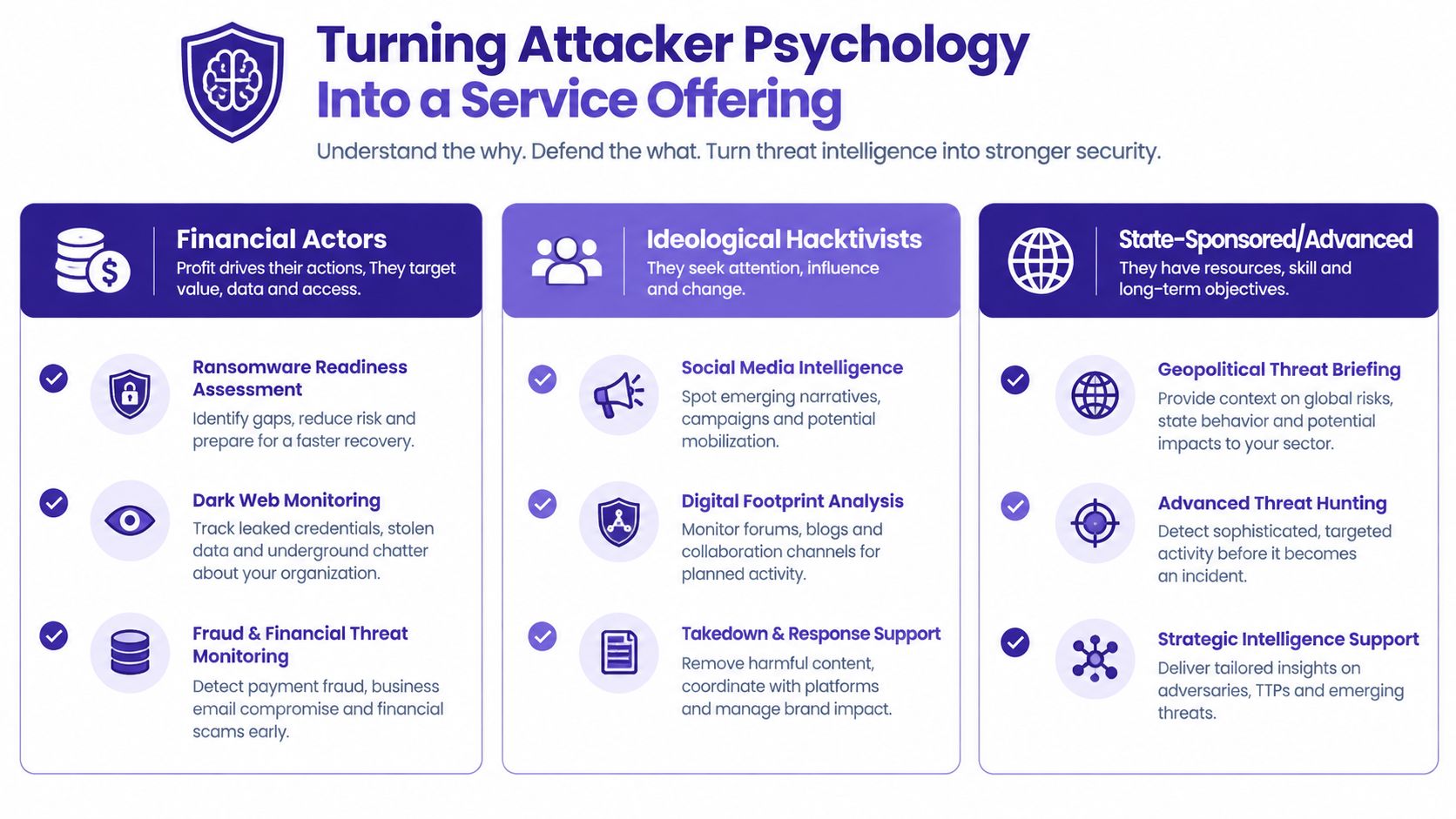
Attacker psychology becomes useful when it changes the service catalogue. Don't sell a customer an abstract answer to why people hack. Sell a defined monitoring and response outcome linked to the risks that matter to that organisation.
Financial actors support a clear starting point. Offer continuous dark web scanning for compromised email addresses, exposed passwords and breached domains. Add identity hardening, phishing awareness and a response playbook that tells the customer who resets what, when sessions are revoked and how affected users are contacted.
Hacktivist and disruption concerns call for another layer. Brand protection, public-facing website monitoring, availability checks and a crisis communications plan help a customer respond when visibility is part of the attacker's objective. A provider can package these services alongside hosting, connectivity, web services or telecom support.
State-linked concerns require more depth. Vulnerability intelligence, endpoint telemetry, supplier-risk reviews and threat hunting are appropriate for customers with sensitive information or a strategically important role. Curiosity-driven risk benefits from awareness training, access reviews and simple controls that remove low-barrier opportunities.
A practical service checklist
- Scope the customer: Record domains, business email addresses, privileged accounts and public-facing services.
- Set alert thresholds: Decide which exposed credentials require immediate contact and which can enter a scheduled report.
- Write the playbook: Define password resets, session revocation, endpoint checks, escalation and customer communication.
- Choose the cadence: Use immediate alerts for serious exposure, with a regular summary for account owners and decision-makers.
- Report in plain language: Explain what appeared, what it may enable and what the customer should do next.
- Review the pattern: Use recurring findings to recommend stronger authentication, password-manager adoption and staff training.
A white-label dark web monitoring service makes this easier to productise. GoSafe is a Dark Web Monitoring tool that continuously scans for compromised email addresses, exposed passwords and breached domains, then provides clear alerts and breach details through a simple dashboard. Partners can brand the platform as their own, sell it under their company name and offer it as a monthly subscription without building security tools internally or requiring specialist security knowledge.
That model suits reseller dark web monitoring and wider recurring revenue security services. An IT support company can add it to an existing contract. A telecom or VoIP provider can use it to start identity-risk conversations. A web agency or SaaS reseller can offer a practical security layer alongside services the customer already understands.
The strongest commercial position is also the most credible one. Explain the attacker's likely objective, monitor the evidence that supports that assessment and give the customer a clear next action.
View the GoSafe reseller programme to learn how service providers can offer white-label dark web monitoring under their own brand, package it as a monthly service and book a demo of the platform.
GoSafe Dark Web monitoring continuously scans for compromised email addresses, exposed passwords and breached domains, then delivers clear alerts that help businesses act before stolen credentials are misused. Visit GoSafe Dark Web monitoring to explore how this approach can turn attacker psychology into a practical, recurring service for your customers.