A lot of UK service providers are in the same spot right now. A client has heard about NIST CSF 2.0, asks whether it matters to them, and expects a clear answer that isn't full of framework jargon.
That moment is more valuable than it first appears. It's not just a compliance question. It's a buying signal.
For MSPs, IT support firms, telecom providers, VoIP resellers, hosting companies and cyber consultants, NIST CSF 2.0 creates a practical way to move security conversations away from break-fix support and towards ongoing managed services. The firms that handle this well won't just explain the framework. They'll package it into a simple commercial offer clients can understand, approve and keep paying for monthly.
Why NIST CSF 2.0 Is a Commercial Opportunity Not a Chore
A common scenario looks like this. A customer reads that NIST CSF 2.0 has changed, forwards an article to their account manager, and asks whether they need to do anything. If your answer is a technical lecture, the conversation stalls. If your answer is tied to risk, reporting and a manageable next step, the conversation turns commercial.
That's why this framework matters. It gives service providers a recognised language for discussing cyber risk with clients who don't want a security dissertation. They want to know three things:
- What's changed
- What it means for their business
- What they should do first
Clients already understand the cost of inaction
Security buyers in the UK don't need persuading that cyber risk exists. They already see it in phishing emails, account lockouts, suspicious logins and supplier concerns. In the UK, 93% of businesses that experienced a cyber crime were hit by phishing attacks, and the mean cost of a cyber crime to businesses is £1,970, according to UK cybercrime figures summarised by Heimdal.
That matters commercially because phishing often starts with exposed credentials, reused passwords or breached company domains. Those are issues that clients can understand quickly, and they fit naturally into a recurring monitoring service.
Practical rule: If a framework discussion doesn't lead to a visible risk conversation, it won't lead to recurring revenue either.
The better play is risk guidance, not framework theatre
Most clients aren't asking you to implement every part of NIST CSF 2.0 on day one. They're asking for confidence. They want to know whether they've missed something obvious, whether third-party exposure creates risk, and whether someone is watching for warning signs.
That creates a more useful sales motion than a pure compliance pitch:
| Client concern | Weak response | Strong commercial response |
|---|---|---|
| “Do we need NIST CSF 2.0?” | “It's a framework with several categories.” | “You don't need a massive project to start. We can assess your current position and monitor for exposed credentials and domain risks.” |
| “What should we do first?” | “Let's review the whole framework.” | “Let's identify immediate exposure, document current risk, and prioritise actions.” |
| “How do we justify spend?” | “It's best practice.” | “It gives you evidence of active risk management and a clear basis for decisions.” |
For many firms, this also sits alongside broader financial risk planning. If clients are already reviewing continuity, liability and incident costs, resources on essential cyber risk cover for businesses help frame cybersecurity as a board-level business issue rather than just an IT ticket queue.
Where service providers win
The opportunity isn't in selling a giant transformation programme. It's in selling an understandable managed service that supports governance, shows activity and creates regular account contact.
What works:
- Starting with visible evidence such as compromised credentials, breached domains or exposed passwords.
- Translating alerts into business language that a non-technical client can act on.
- Building monthly reporting into the offer so security becomes part of the service relationship.
What doesn't work:
- Leading with control libraries before the client sees immediate relevance.
- Treating NIST CSF 2.0 as a document exercise with no operational service attached.
- Overscoping the first engagement until the deal becomes slow, abstract and hard to approve.
Understanding the Core Concepts of NIST CSF 2.0
Most confusion around NIST CSF 2.0 comes from the way people explain it. They start with terminology, then lose the client. A simpler way is to treat it like a business planning model.
The framework has three fundamental elements: the Core, Tiers, and Profiles, and the Profiles help organisations define their Current Profile and Target Profile, which supports gap analysis and prioritised action plans, as outlined in the AWS overview of the NIST Cybersecurity Framework.
Think of it like a business continuity plan
If you've ever helped a client build a continuity plan, the logic is familiar.
- The Core is the checklist of outcomes you're trying to achieve.
- The Profile is the snapshot of where the client is now and where they want to be.
- The Tier reflects how mature and repeatable their approach is in practice.
That framing works well in client meetings because it avoids turning the conversation into an academic exercise.
The Core is the operating model
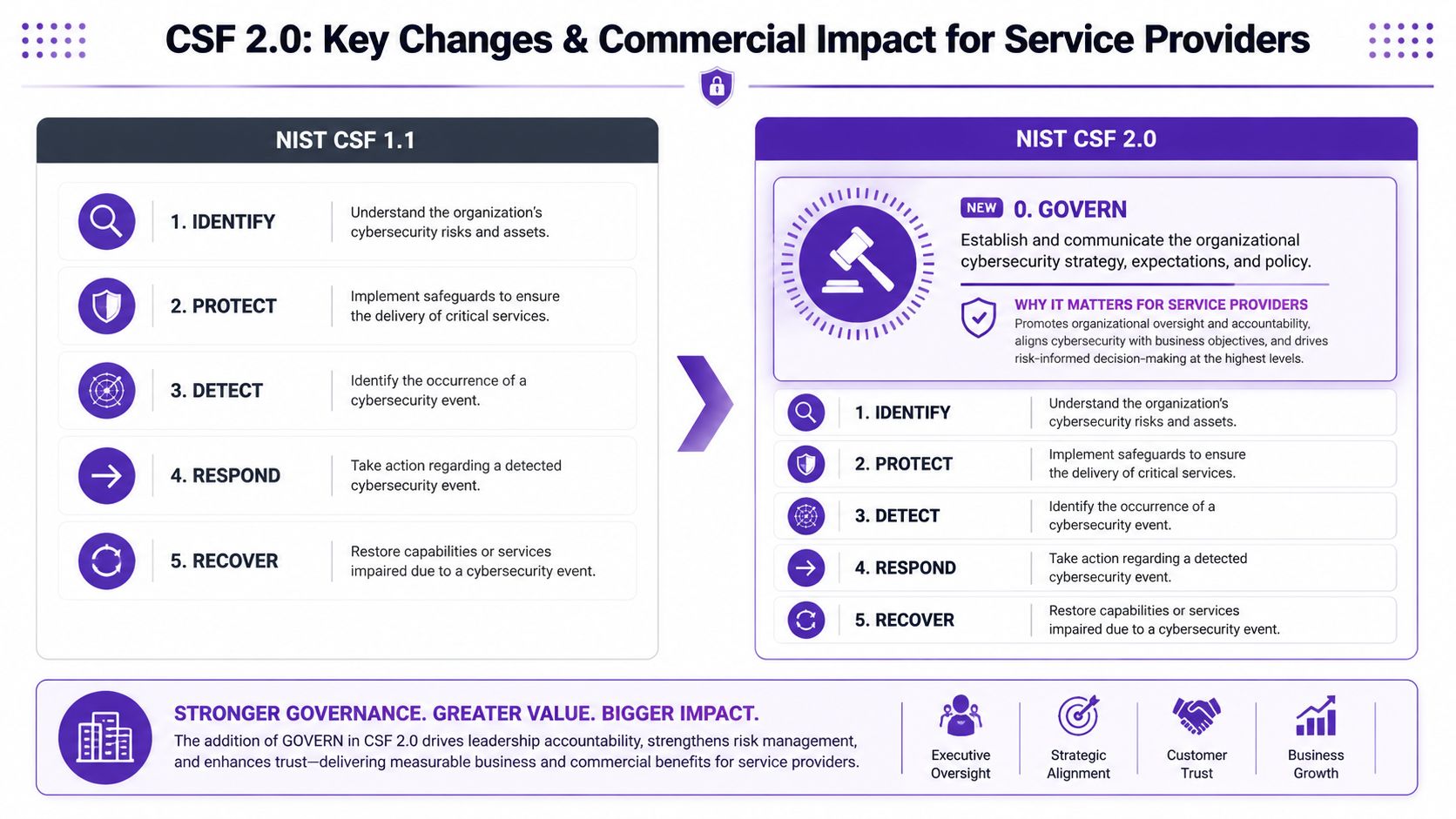
The Core gives structure to cyber risk management through six functions. Those functions are Govern, Identify, Protect, Detect, Respond and Recover.
For service providers, the important point isn't memorising subcategories. It's understanding the business meaning of each function:
| Function | Plain-English meaning for clients |
|---|---|
| Govern | Who owns cyber risk and how decisions get made |
| Identify | What the business needs to protect and where risk sits |
| Protect | What controls reduce the chance of harm |
| Detect | How the business notices warning signs and incidents |
| Respond | What happens when something goes wrong |
| Recover | How operations resume and lessons get captured |
If a client can grasp those six ideas, you can have a sensible commercial discussion.
Profiles make the sale easier
Profiles are often the most useful part in practice because they let you turn vague concern into a documented gap.
A Current Profile might show that a client has antivirus, MFA and email filtering, but no structured process for reviewing exposed credentials, breached domains or supplier-related exposure. A Target Profile then defines what “good enough” should look like for that client.
A framework becomes commercially useful when it helps a buyer say, “This is where we are, this is where we need to get to, and this is what we need from you.”
That's why firms exploring TekRecruiter's cybersecurity insights often find risk management content more helpful than compliance-only material. Buyers need a decision model, not just a list of controls.
This also creates a natural path for offering NIST-aligned services without forcing every client into a heavyweight programme.
Tiers help you explain maturity without overcomplicating it
Tiers are maturity markers. They show how well the organisation manages cyber risk, from ad hoc activity through to more adaptive practice.
For a non-technical client, the easiest explanation is this:
- Lower tier means the business does some security work, but it's inconsistent.
- Higher tier means the business works in a repeatable, documented way.
- The point isn't prestige. It's predictability.
That distinction matters for managed services. Clients don't buy ongoing support because a framework says they should. They buy it because repeatable monitoring and regular review reduce uncertainty.
The Major Changes in CSF 2.0 for Service Providers
NIST CSF 2.0 was officially released on February 26, 2024, and its structure moved from five functions to six, adding the new Govern function to emphasise executive accountability and risk management strategy, as outlined in Trend Micro's review of the 2024 update.
That's the change that matters most commercially.
Govern changes who you sell to
Under the earlier model, cybersecurity discussions often stayed with IT managers. With Govern designated as a top-level function, the conversation shifts towards leadership, accountability, investment and oversight.
For service providers, that's a major advantage. It gives you a credible reason to speak with directors, owners and operations leaders, not just technical contacts.
In practice, Govern means clients need answers to questions such as:
- Who owns cyber risk internally
- How risk decisions get recorded
- How external monitoring feeds into reporting
- What evidence supports management oversight
Those questions create room for managed reporting, regular review calls and board-friendly summaries. That's much more commercially useful than waiting for a firewall refresh cycle.
The framework now fits a wider market
Another meaningful change is scope. NIST CSF 2.0 is no longer framed in a way that feels limited to larger, heavily regulated environments. It's positioned for all sectors and organisation types.
That matters in the UK reseller market because it widens the addressable opportunity. MSPs and telecom providers don't need to reserve the framework for enterprise accounts. They can use it with smaller firms that still need a sensible structure for cyber risk.
The sales trade-off is straightforward:
| Approach | Upside | Downside |
|---|---|---|
| Pitch NIST CSF 2.0 as enterprise compliance | Feels serious | Excludes many smaller buyers |
| Pitch it as a flexible risk framework | Works across more accounts | Requires clearer explanation from the provider |
| Pitch a phased service around it | Easier to buy and deliver | Requires discipline in packaging and reporting |
Supply chain relevance is now harder to ignore
Service providers also need to pay attention to supply chain risk. The framework puts stronger emphasis on how organisations manage risk linked to partners, vendors and external service dependencies.
That matters for UK telecom, VoIP and cloud resellers because clients increasingly expect their providers to do more than keep systems running. They want visibility into external exposure, third-party dependencies and warning signs that might affect their own business.
Commercial reality: The firms that connect technical signals to governance reporting will be seen as strategic partners. The firms that only clear tickets will stay replaceable.
What works in client conversations
The strongest way to present these changes is not to walk line by line through the framework. It's to explain the commercial impact.
Good positioning sounds like this:
- “This gives us a recognised model for documenting your current security position.”
- “It helps show leadership where the gaps are and what should be prioritised.”
- “It supports an ongoing service, not just a one-off assessment.”
Weak positioning sounds like this:
- “There's a new version with updated categories.”
- “We can map all your controls eventually.”
- “It's mainly a framework exercise.”
Clients don't usually buy frameworks. They buy confidence, visibility and a service that helps them act.
A Practical Roadmap for CSF 2.0 Implementation
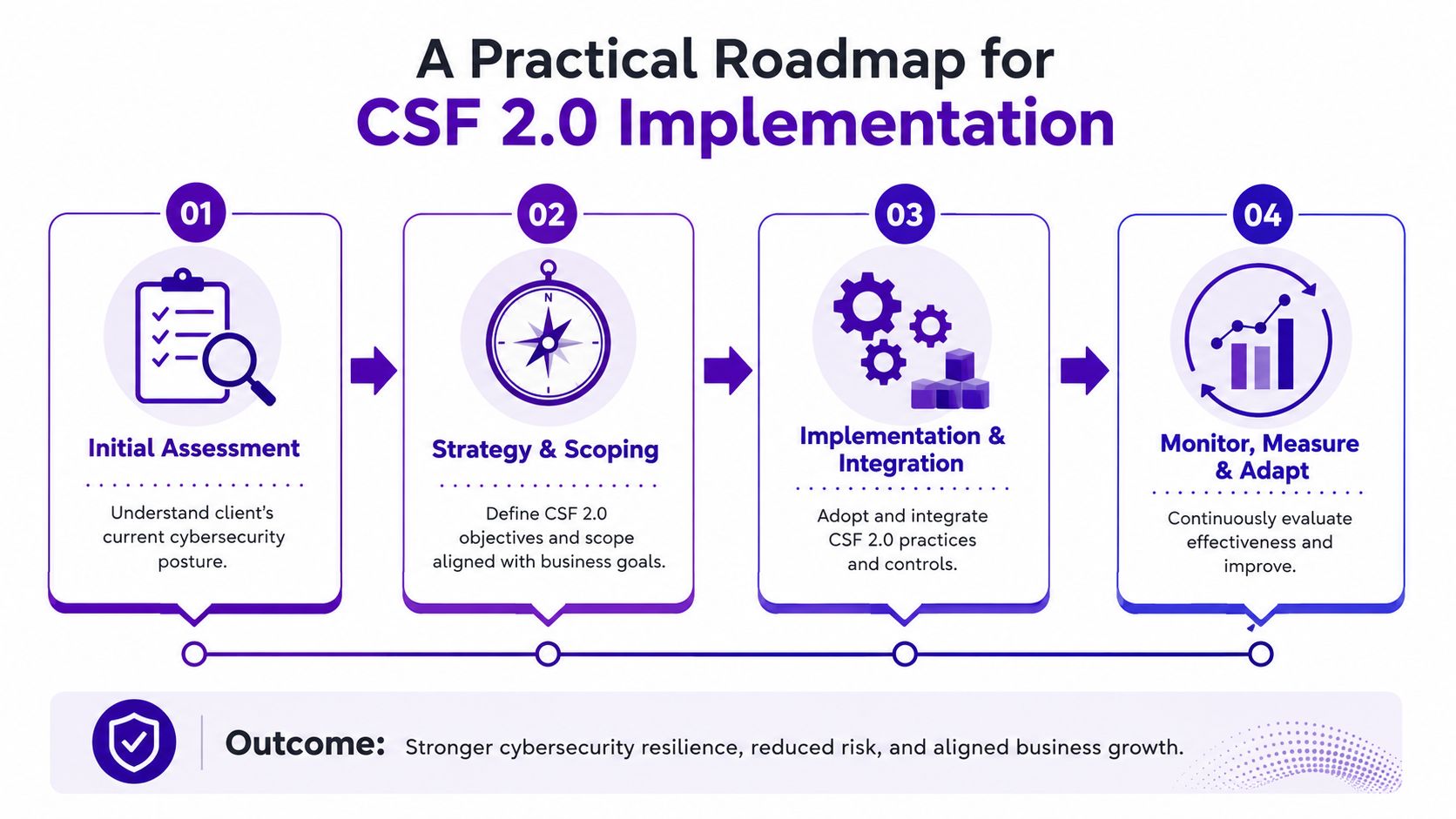
Clients rarely need a grand programme on day one. They need a route they can approve, understand and review. A four-stage roadmap works well because it gives the service provider clear deliverables and keeps the engagement commercially tidy.
The framework defines four Implementation Tiers, Partial, Risk Informed, Repeatable and Adaptive, with UK MSPs and resellers often targeting Tier 3 or Tier 4 where they want alignment with Cyber Essentials Plus style expectations for repeatable, policy-driven processes, according to NIST CSWP 29.
Stage one starts with scope, not tooling
The first deliverable is a scoped discussion about the client's environment, priorities and risk tolerance. Often, providers make a mistake here. They jump into products before they've defined what matters.
The better approach is to agree:
- Business scope. Which parts of the organisation matter most.
- Operational scope. Which systems, users, domains or suppliers should be considered.
- Risk scope. Which issues deserve immediate attention.
This gives you a sensible boundary for the rest of the engagement.
Stage two turns concern into a Current Profile
At this point, the provider documents the client's Current Profile and Target Profile. This doesn't need to be overengineered. It needs to be usable.
A practical Current Profile usually records what the client already has in place, where monitoring exists, how incidents are escalated, and where visibility is weak. The Target Profile should stay realistic. If you define an idealised end state, the plan loses momentum.
A good supporting read on documentation discipline is this practical guide to building a system security plan. It helps frame how providers can move from scattered controls to structured evidence.
Stage three is where the gap analysis earns its keep
Gap analysis is where providers prove their value. You compare the Current Profile against the Target Profile and identify what's missing, inconsistent or undocumented.
The strongest findings usually fall into these buckets:
- Visible gaps such as missing monitoring, weak reporting or inconsistent response actions.
- Process gaps where security activity happens, but nobody documents ownership or review.
- Governance gaps where leadership receives too little evidence to make decisions confidently.
Don't promise maturity all at once. Sell the next sensible improvement, document it properly, and make the service easy to renew.
Stage four is implementation plus ongoing monitoring
Recurring revenue comes into play. A one-off assessment can open the door, but monthly services keep the relationship alive.
A practical managed offer often includes:
| Service element | Why clients buy it | Why providers like it |
|---|---|---|
| Regular monitoring | It provides ongoing visibility | It supports monthly billing |
| Action-oriented reporting | It helps leaders understand risk | It creates review meetings and account contact |
| Priority-based remediation guidance | It avoids overwhelm | It supports upsell into adjacent services |
| Periodic profile review | It shows progress over time | It strengthens retention |
For many providers, the most reliable path is to use CSF 2.0 as the structure and keep the service itself simple. Buyers don't want a mountain of controls dropped in their lap. They want to know what needs attention, what's changed, and what you recommend next.
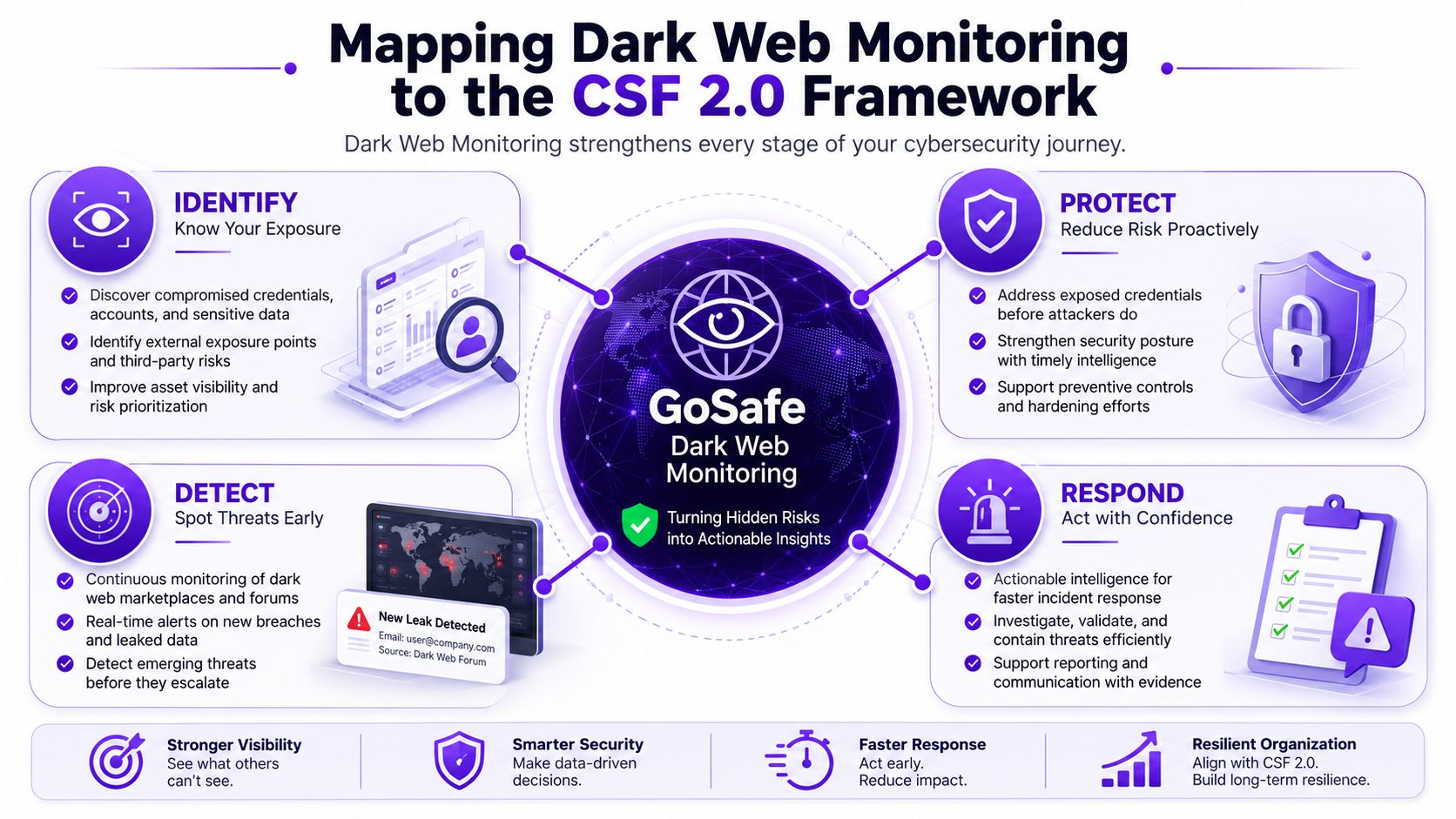
Mapping Dark Web Monitoring to the CSF 2.0 Framework
Many MSPs encounter a sticking point. They can explain the framework. They can sell monitoring. But they struggle to connect the output of a monitoring service to a formal NIST CSF 2.0 conversation.
That gap is real. A critical operational issue for MSPs is mapping dark web monitoring alerts to the Identify function's Asset Management and Risk Assessment subcategories, especially because 47% of UK small businesses lack a documented cybersecurity strategy, which makes it harder to prove that an alert should count as a valid risk assessment update, as discussed in SaltyCloud's implementation guidance.
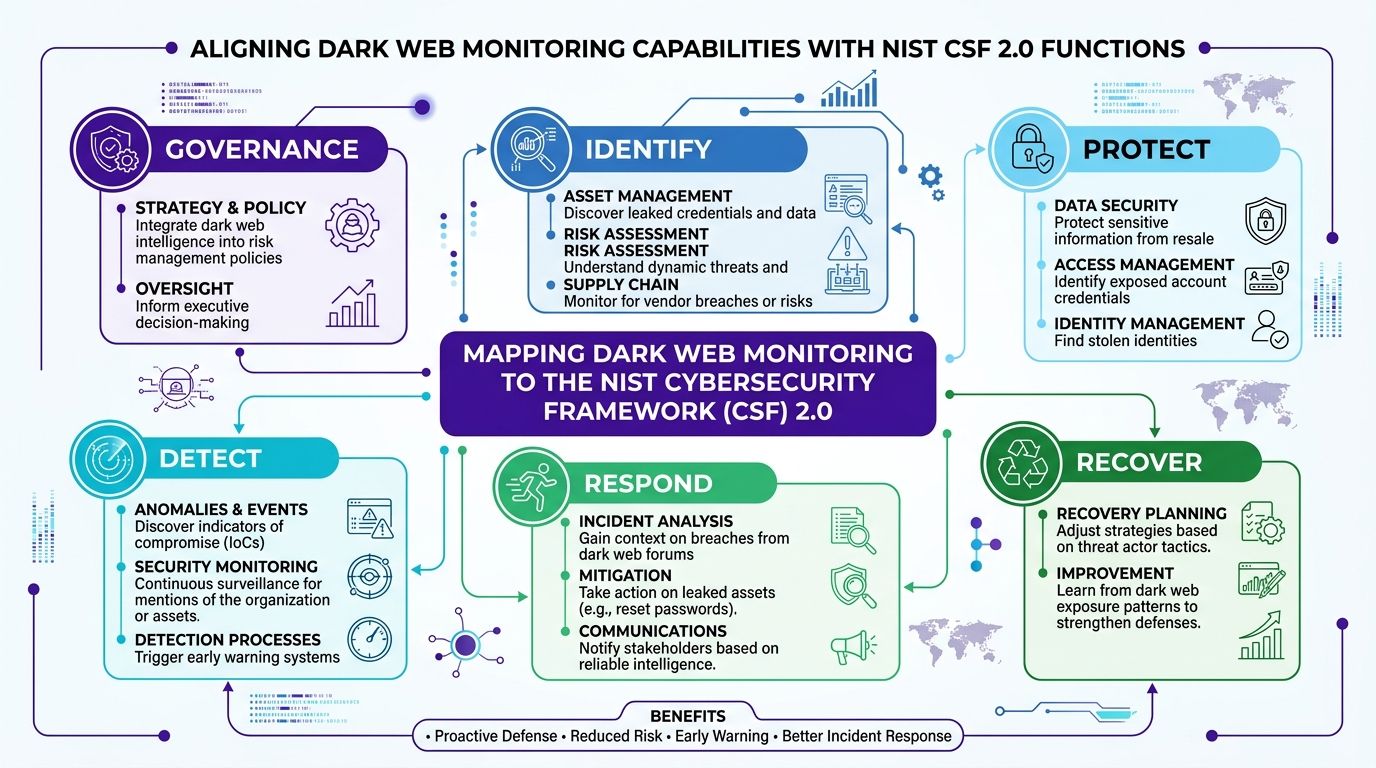
Start with what the alert actually means
A dark web alert isn't automatically a full security assessment. But it is valid risk evidence.
If a monitoring tool identifies a compromised email address, an exposed password, a breached domain or leaked company data, that gives the provider something concrete to document:
- An asset is affected
- A risk condition exists
- Action may be required
- The Current Profile should be reviewed
That's the significant shift. The alert is not the whole governance process. It's an input into the process.
The simplest mapping approach
Providers often overcomplicate this. A cleaner model is to map each alert type to a CSF 2.0 function and then decide what operational step follows.
| Monitoring output | CSF 2.0 relevance | Practical service action |
|---|---|---|
| Compromised email addresses | Identify and Detect | Record affected accounts, review user exposure, trigger follow-up checks |
| Exposed passwords | Protect and Respond | Enforce resets, review password hygiene, assess wider account risk |
| Breached domains | Identify and Govern | Update risk records, inform leadership, review exposure trends |
| Early breach alerts | Detect and Respond | Confirm scope, prioritise communication, define immediate actions |
That gives account managers and service teams a repeatable way to explain value.
Why this works well as a white-label service
For MSPs and resellers, white label dark web monitoring works because it solves two problems at once. It gives clients a simple service they can understand, and it gives the provider an evidence stream that supports broader security conversations.
Business customers usually don't want complex dashboards full of specialist terminology. They want clear alerts and an explanation of what to do next. That's why dark web monitoring for MSPs is often one of the easiest security services to add to an existing stack.
It also fits naturally with services the client already buys:
- IT support, where credential exposure can trigger account reviews
- Cloud services, where identity risk affects access and tenancy security
- Hosting, where domain-level visibility matters
- Connectivity and telecoms, where account integrity and third-party exposure create operational risk
- Web services, where customer-facing domains are part of the risk picture
If you can show a client that an alert updates their risk picture, you've moved from selling a tool to delivering a managed security service.
What not to do with alerts
Some providers make alerts too technical. Others make them too vague.
Avoid both extremes.
Poor handling usually looks like this:
- Forwarding raw alerts with no interpretation
- Treating every detection as a crisis
- Failing to connect the finding to a documented risk action
- Leaving the client unsure whether anything changed
Better handling is calmer and more structured. A provider should explain what was found, what it affects, whether it changes the Current Profile, and what action is recommended. That turns a monitoring event into a measurable service outcome.
For UK resellers looking at white label security services, this is one of the most practical entry points available. It doesn't require building internal tools, hiring a specialist security team or forcing customers through a complex deployment. It supports reseller dark web monitoring, it's easy to explain, and it creates a credible bridge between framework language and a monthly managed offer.
Build Your Recurring Revenue Service with NIST CSF 2.0
A client asks a familiar question during a QBR. They do not want a lesson on frameworks. They want to know what you can monitor for them every month, what you will report, and what action you will take when risk changes.
That is the commercial value of NIST CSF 2.0 for UK service providers. It gives you a credible structure for packaging cybersecurity into a managed service that clients can understand, budget for, and renew. For MSPs and resellers, the opportunity is not selling the framework itself. The opportunity is using the framework to justify a monthly security service with clear scope, clear reporting, and a clear commercial outcome.
Dark web monitoring fits that model well. It is easy to explain to non-technical buyers, relevant across a wide client base, and practical to deliver under a managed service wrapper. More importantly, it gives account managers and service teams something concrete to review each month instead of relying on broad security claims that are hard to prove.
The business case is straightforward:
- It creates monthly recurring security revenue instead of relying on one-off assessments or remediation work.
- It fits naturally with existing managed contracts across IT support, cloud, hosting, telecoms, and web services.
- It improves retention because you stay involved in the client's risk posture between incidents, not only after a problem appears.
- It keeps delivery overhead under control because you can package, review, and report on the service without building a full in-house SOC.
There is a trade-off. A low-cost monitoring offer is easy to add, but weak reporting and vague follow-up will turn it into a noisy add-on that clients question at renewal. A better approach is to productise it properly. Define what is monitored, what triggers a review, what the client receives each month, and which actions sit inside or outside the base fee.
That is where margin is protected. Providers who treat CSF 2.0 as an operating model can sell a service that feels measured and professional, not improvised. In practice, that means turning the framework into a named offer, attaching it to a review cadence, and delivering it through a white-label reseller program.
If you want to add a simple, commercially viable security service to your stack, book a demo of GoSafe Dark Web monitoring. It's built for service providers that want to offer white-label dark web monitoring under their own brand, create monthly recurring revenue, and give customers clear alerts about compromised credentials, exposed passwords and breached domains without adding unnecessary operational complexity.