43% of UK businesses identified a cyber breach or attack in the previous 12 months according to the UK government's Cyber Security Breaches Survey 2025/2026. That one figure changes how I frame the conversation about an AI risk assessment tool.
For most MSPs, resellers, telecom providers, and IT service firms, this isn't really a debate about whether customers need “more security”. They already do. The question is which security services are easy to explain, easy to deliver, and commercially sensible to sell every month.
That's where an AI risk assessment tool becomes useful. Not as a complicated platform that buries customers in technical noise, but as a practical way to turn scattered breach signals, exposed credentials, and suspicious activity into something a business client can understand and act on. In the UK, that conversation has also shifted. Public-sector guidance now treats AI risk assessment as an operational discipline with ongoing monitoring, not a one-off compliance form.
For partners building recurring revenue, that matters. A service that keeps scoring risk, spotting exposure early, and producing clear alerts is easier to package than a one-time security review that goes stale the moment it's delivered.
The Reality of Cyber Risk in UK Business
43% of UK businesses reported a cyber breach or attack in the last year. For firms that sell into UK organisations, that figure has commercial consequences as much as technical ones.
Risk now shows up in day-to-day service delivery. A customer can pass a yearly review and still have exposed credentials, weak password habits, or supplier-led exposure a month later. That gap matters even more in the UK public sector, where procurement and assurance expectations increasingly favour ongoing oversight over static declarations. A one-off checklist may help with a bid pack. It does not give a reseller or MSP a service model that holds up between reviews.
Why one-off reviews lose value quickly
I see the same pattern in mid-market and public-sector accounts. Someone completes an assessment, produces a traffic-light report, and files it away. Meanwhile, users reuse passwords, phishing emails get through, and third-party access changes in the background.
The problem is timing.
A point-in-time review can still support audits, insurance discussions, or procurement requirements. It just cannot keep pace with how cyber exposure changes. For partners selling managed services, that is the key operational shift. The service has to score risk continuously enough to trigger action before the customer is dealing with account compromise, fraud, or an avoidable compliance failure.
Practical rule: If security is only visible after an incident, the customer bought reporting, not risk management.
That distinction is commercially important. Recurring services are easier to retain when the customer can see fresh evidence each month. Exposure found, risk scored, action recommended. That model is much easier to package than a single assessment that starts ageing on the day it is delivered.
What buyers need from the service
Buyers usually do not ask for more dashboards. They ask for clarity and a next step.
They want to know:
- What is exposed: Have staff accounts, domains, or credentials appeared in breach data?
- What needs attention first: Which findings create immediate operational or compliance risk?
- What action is reasonable: Reset credentials, tighten access controls, brief users, or investigate a supplier dependency?
That is also why content such as 2026 cyber crime statistics for MSPs works well in sales conversations. It gives account teams a credible opening, then the service has to do the harder job of turning broad concern into a repeatable monthly deliverable.
A strong AI risk assessment tool helps with triage, evidence, and prioritisation. For UK partners selling into regulated and public-sector environments, that is the difference between an ad-hoc compliance exercise and a recurring governance service.
How an AI Risk Assessment Tool Works
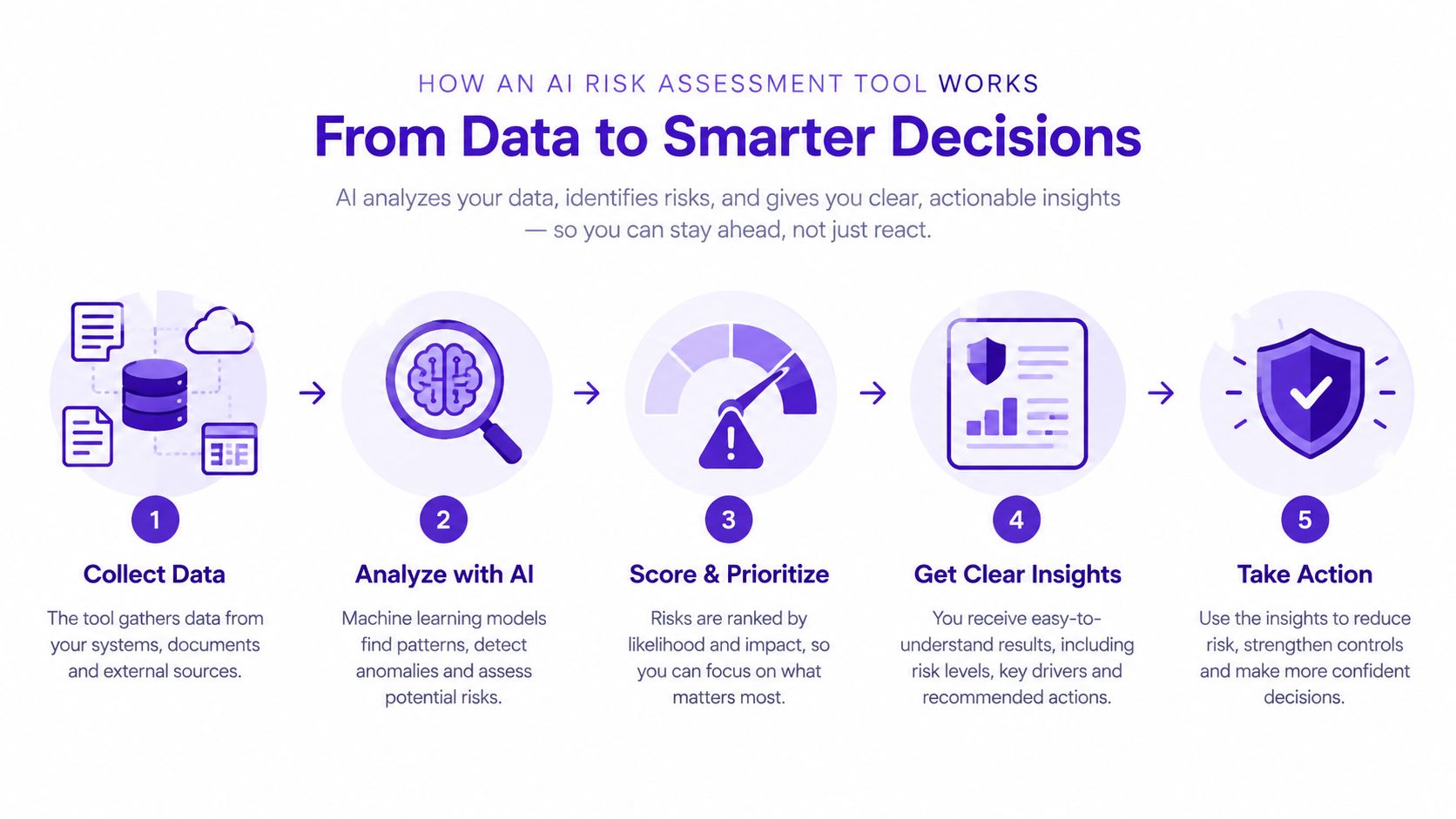
Without that assumption, the process may seem opaque at first. In practice, the useful versions are usually quite simple in commercial terms. They gather signals, weigh them, and present the result as a clear priority.
The inputs that matter
A practical AI risk assessment tool usually works from a mix of evidence sources. In a dark web monitoring context, that often includes breached credentials, exposed email addresses, leaked passwords, and breached domains. In broader risk workflows, it can also include authentication patterns, login anomalies, and user behaviour.
The UK National Cyber Security Centre recommends that organisations proactively identify vulnerable accounts by aggregating breach sets, checking whether their users' credentials appear in those breaches, forcing password changes where leaked credentials are found, and monitoring for anomalies such as unusual traffic patterns or changes in browser and IP behaviour in its credential stuffing advisory. That's the operational logic behind scoring. Finding exposure is only the first step. Prioritising what to do next is where the service becomes useful.
How the score is produced
The better systems don't just label something “high risk” because a record was found. They rank risk by combining context. Typical questions include:
How direct is the exposure
A breached password attached to a work email address is usually more actionable than a vague mention of a company name.Can the exposure be exploited easily
If leaked credentials could support account takeover or lateral movement, the score should reflect that.Is there supporting behaviour
If abnormal login attempts or repeated authentication failures appear alongside the exposure, the case becomes more urgent.What's the likely business impact
A credential tied to finance, admin access, or customer records usually deserves faster escalation.
That's why a scoring model needs to be transparent enough for partners to explain. If a reseller can't explain the score, the customer won't trust it.
Good scoring reduces noise. It doesn't just add another number to the screen.
For organisations working with vulnerable users, the same principle applies in adjacent areas too. This is why guidance on real-time scoring to protect seniors from phone scams is useful reading. It shows how live risk signals become practical decisions, not abstract analytics.
Why explainability matters commercially
Many tools fail. They produce technical output that makes sense to analysts but not to account managers, support teams, or business owners. For resellers, that creates friction in both sales and delivery.
A commercially workable service does something simpler:
| Stage | What the platform should do | Why it matters |
|---|---|---|
| Collect | Pull in exposure data from breach and credential sources | Creates evidence |
| Correlate | Match exposure to domains, users, or accounts | Adds business context |
| Score | Weigh severity and likelihood | Prioritises effort |
| Alert | Present clear warnings | Makes response easier |
| Track | Keep monitoring over time | Supports recurring service value |
If you want a clearer view of how that kind of model is packaged for partners, this guide to white-label dark web risk scoring is useful because it focuses on explainable scoring rather than opaque AI language.
From Static Checklists to Continuous Governance
The UK has moved past broad AI principles and into operational controls. On 8 September 2026, the government formally launched its AI Risk Management Toolkit to help public-sector teams and suppliers identify, assess, treat, monitor, and report risks from AI solutions. The accompanying workbook was published the same day and is aligned with the Orange Book risk-management framework used for UK government projects.
That's an important shift. It turns AI risk assessment into a repeatable governance process instead of an ad hoc review.
What static checklists miss
A static checklist can confirm whether somebody looked at security, bias, privacy, or legal issues at one point in time. It can't tell you whether the risk has changed since then. It also can't say much about new data exposure, changed supplier dependencies, or fresh misuse scenarios.
That gap is becoming harder to defend. The UK government's position is much more lifecycle-oriented now. In the same policy direction set after the Bletchley Declaration in November 2023, where 29 parties participated, including 28 countries plus the European Union, government guidance later directed projects to assess security, bias, legal, operational, and misuse risks as part of AI deployment in its AI regulation response.
A checklist can record that those topics were considered. It can't govern them continuously.
What continuous governance looks like
The more practical benchmark comes from the UK government's AI playbook. It positions risk assessment as a lifecycle control and instructs teams to use a consistent methodology such as the OWASP risk rating approach, evaluate impact and likelihood, and factor in system complexity, training-data quality, and exposure to human error or malicious intent when determining severity in the AI Playbook for the UK government.
For tool design, that changes the brief. A serious AI risk assessment tool should be able to:
- Separate risk drivers: Complexity, data provenance, and misuse potential shouldn't be collapsed into a vague label.
- Show defensible reasoning: Buyers need to see why the score moved.
- Support repeated review: Risk should be reassessed as systems, data, and threat conditions change.
- Surface control gaps: Missing evidence should be obvious before deployment, not after an incident.
A governance process only works if the score can be challenged, reviewed, and updated without rebuilding the whole assessment.
That's also why teams looking at policy-heavy AI environments often benefit from practical implementation guidance such as compliance with AgentStack. The useful part isn't the compliance language itself. It's the operational lesson that governance has to be maintained, not filed away.
Why this matters to resellers
For MSPs and service providers, the lesson is commercial as much as technical. If risk assessment is continuous, the service model should be continuous too. Monthly monitoring, repeatable reporting, and regular customer conversations fit the way buyers already consume managed services.
One-off reports are hard to renew. Ongoing visibility is much easier to retain.
Real-World Threats and Phishing Vulnerabilities
Phishing is still the most commercially useful threat story to lead with because customers understand it immediately. Sector summaries of the Cyber Security Breaches Survey 2025/2026 report that phishing was involved in around 85% of the cyber incidents UK businesses reported in the past year, affected 38% of all UK businesses, and was the most disruptive type in 69% of cases among organisations suffering any breach or attack, as summarised in this UK reporting on phishing simulation training.
That matters because phishing is often the front door to credential exposure.

How phishing turns into measurable risk
A common sequence is straightforward. A user enters credentials into a fake login page, those details are reused or traded, and the organisation only realises later when an account behaves strangely or a breach search returns a hit.
This is exactly why compromised credential monitoring belongs inside risk assessment rather than beside it. If an email address, password, or domain appears in breach data, that isn't just a historical record. It's evidence of likely future abuse unless the account is remediated properly.
The UK NCSC's earlier guidance supports that operational approach. It recommends finding vulnerable accounts by checking internal users against known breach sets, then forcing password resets and monitoring for unusual authentication behaviour. A tool that only reports “you were breached” is incomplete. A tool that helps rank which exposure is most likely to lead to misuse is much more useful.
What a practical scoring engine should flag
Dark web monitoring becomes concrete for buyers. The useful alerts are usually tied to questions they already care about:
- Whose account is affected: Staff account, shared mailbox, finance inbox, or admin user.
- What data was exposed: Email only, password exposure, or broader breach data.
- How urgent the response is: Immediate password reset, access review, or wider investigation.
- Whether the pattern is isolated: One user, one domain, or broader account exposure.
The customer doesn't need a lesson in threat intelligence. They need to know which account to lock down first.
UK-specific dark web intelligence reporting published in September 2026 states that more than 15 billion compromised credentials are now in circulation globally, while also noting that UK financial credentials remain a high-value target on dark web forums in this Dark Web Weekly Intel report. At that scale, manual triage isn't realistic. You need automation to filter, rank, and explain.
Why simple alerts win
Most business customers won't buy a service because it has a model. They'll buy it because it gives them early warning in plain English. That's especially true for smaller firms that already trust their MSP or telecom provider but don't have in-house security depth.
The most successful partner offers I've seen keep the workflow simple. Alert the customer when credentials appear on the dark web. Show the affected identity or domain. Explain the likely risk. Recommend the next action. Then keep monitoring.
That model is easy to understand, easy to renew, and easy to attach to other managed services.
The Commercial Case for MSPs and Resellers
The strongest security services for channel partners share three traits. They're understandable, repeatable, and low-friction to operate. An AI risk assessment tool can fit that model well when it's packaged as an ongoing monitoring service rather than a consultancy project.
That distinction matters. A consultancy-led risk review often depends on scarce expertise, long sales cycles, and bespoke delivery. A subscription service based on monitoring and prioritised alerts is much easier to attach to an existing account base.
Why recurring security sells better
If you already provide IT support, hosting, cloud management, telecoms, web services, or SaaS resale, you don't need to invent a new buying category. You're extending a relationship the customer already understands.
The offer is commercially attractive because it creates:
- Monthly recurring revenue: The service continues because exposure continues.
- Low operational overhead: You're not building a security operations team to deliver basic value.
- Easy upsell paths: Monitoring naturally connects to password policy work, awareness training, account reviews, and wider managed security conversations.
- Stronger retention: Customers are less likely to leave when you're actively helping them spot risk early.
What works in real sales conversations
The pitch usually fails when providers lead with AI, governance frameworks, or technical architecture. Most buyers don't start there. They start with practical concerns such as compromised staff logins, exposed business emails, or the question of whether their domain has appeared in a breach.
A better commercial message is simpler:
| Buyer concern | Service response |
|---|---|
| We don't know if we've been exposed | Continuous dark web scanning checks for compromised accounts and domains |
| We can't interpret security data | Risk scoring prioritises which findings matter first |
| We don't have in-house expertise | Clear alerts make response manageable |
| We need predictable costs | Subscription delivery fits existing managed service budgets |
Sales advice: If a customer can't explain the service back to you in one sentence, the packaging is too complicated.
This is why white label dark web monitoring works well for resellers. It's simple to position as part of a broader managed offer. It also lets the partner keep the customer relationship, own the branding, and avoid building security tools internally.
For firms that want to package that under their own service stack, the GoSafe Dark Web monitoring partner program is a straightforward example of how a recurring reseller model is structured.
Where many partners overcomplicate it
The mistake I see most often is trying to turn a practical service into a pseudo-enterprise security platform. That usually leads to too many dashboards, too much jargon, and too much delivery burden for frontline teams.
Customers don't need a complex security suite from every provider they work with. Many of them need a dark web monitoring service for businesses that tells them when credentials are exposed and what to do next. That's much easier to sell under your own brand, much easier to support, and much easier to renew.
Integrating GoSafe into Your Service Stack
An AI risk assessment tool only becomes commercially useful when it fits the way partners already sell. That means monthly billing, clear customer ownership, simple deployment, and alerts that non-specialists can explain without escalation every time.
GoSafe Dark Web monitoring fits cleanly. It is a Dark Web Monitoring tool built for white-label delivery, with continuous scanning for compromised email addresses, exposed passwords, and breached domains, plus clear alerts and AI-driven risk scoring. For service providers that want to sell dark web monitoring under your own brand, that combination matters more than a long list of advanced security features.
What fits well in partner delivery
The practical appeal is in the operating model:
- White-label branding: Partners can present the service under their own company name.
- Low setup burden: There's no need to build internal monitoring capability from scratch.
- Business-friendly output: Alerts are designed to be clear and understandable.
- Recurring value: Continuous scanning creates an obvious reason for monthly subscription billing.
That makes it suitable for MSPs, hosting firms, telecom providers, cyber consultants, and SaaS resellers that want recurring revenue security services without creating a specialist security practice first.
Where it aligns with the UK shift
The broader UK direction is toward repeatable, auditable, ongoing risk control. The UK's AI Cyber Security Code of Practice supports that approach through 11 principles covering areas such as threat awareness, secure-by-design development, asset tracking, supply-chain security, documentation, testing, end-user communications, and ongoing patching and mitigations. For a scoring model, that reinforces the importance of evidence, explainability, and continuous review rather than one-time status labels.
That's also why the underserved opportunity isn't just “compliance”. The Bank of England has warned that greater AI adoption could increase cyberattacks, third- and fourth-party dependency risk, correlated outcomes, and model or data-related risks, and notes that it has created an AI Taskforce and an AI Consortium in its approach to innovation in AI, DLT, quantum computing. Partners who can provide ongoing visibility into exposure are better placed than those still selling static reports.
For channel businesses, that creates a very practical opportunity. Offer reseller dark web monitoring as a simple monthly service. Keep the branding, keep the customer relationship, and keep the message focused on early warning and clear action.
If you want to add a practical AI-led risk visibility service without building security software yourself, GoSafe Dark Web monitoring gives partners a white-label way to monitor compromised credentials, exposed domains, and breach activity continuously. It's a sensible fit for providers that want to turn AI risk assessment into a clear monthly service customers can understand, buy, and keep renewing.