Approximately 612,000 UK businesses, or 43% of businesses, experienced a cyber security breach or attack in the previous 12 months, according to the UK Government's Cyber Security Breaches Survey 2025. That makes breached business data a practical concern for an ordinary customer portfolio, not just a problem for household-name companies.
For MSPs and resellers, the useful conversation isn't about frightening customers with spectacular breaches. It's about identifying exposed information, explaining what it could enable, and making sure someone acts when an alert arrives.
Breached Business Data Across UK Companies
UK breached business data indicators, 2024-25 survey period
Survey figures give providers a shared reference point for customer reviews. The indicators below come from the UK Government's Cyber Security Breaches Survey 2025. They measure breaches or attacks and their outcomes, which is a different question from how many businesses already have information circulating outside their control.
| Measure | Survey figure | How a provider should read it |
|---|---|---|
| Businesses with a breach or attack | 43 percent, about 612,000 | A widespread risk across a mixed UK customer base |
| Fraud from a cyber breach or attack | 3 percent of businesses, about 40,000 organisations and an estimated 72,000 events | Stolen credentials and records can support later fraud |
| Businesses reporting a negative outcome | 16 percent, up from 13 percent in 2024 | Reported harm is becoming more common |
| Ransomware | 3 percent of businesses | A minority pathway, not the only case for monitoring |
| Phishing | A major route into organisations | Credential capture deserves attention alongside malware |
A reseller can use these indicators to separate questions customers often combine into one. Has the business encountered an attack? Has information left its control? Has anyone used that information to cause harm? Those are different stages, and an affirmative answer to the first proves nothing about the others.
Read the figures without overstating them
The all-business measure establishes relevance across a mixed customer base. An IT support company doesn't need a portfolio of large enterprises to raise exposure sensibly. Equally, it shouldn't tell customers that every reported attack resulted in stolen data. Most rows in the table describe incidents, not confirmed losses.
The fraud measure answers a different objection: whether exposed information still matters once the original incident appears resolved. An exposed credential works like a copied office key. Replacing one lock helps that door, but duplicates may still circulate. An attacker could use employee details to impersonate a colleague, or use customer records to make a payment request sound credible, long after the affected device is restored.
Review-call rule: Explain what the survey measures before using it to justify a service. An attempted attack, confirmed data exposure and financial loss aren't interchangeable.
The negative-outcome row keeps the discussion focused on consequences rather than attack volume alone. The ransomware row prevents a different mistake: treating encrypted files as the only incident worth preparing for. A functioning business can still face misuse of information someone copied months earlier.
For providers, the practical question is broader than whether endpoint protection blocked an attachment. It's whether company information sits outside authorised control, whether someone could reuse it, and who owns the next action. That last point is where ongoing monitoring earns its place in a service agreement: exposure arrives on the attacker's schedule, not the customer's review cycle.
Breached business data is company information that has left authorised control and can be reused, including staff email addresses, passwords, domain-linked information and customer records.
What Counts as Breached Business Data
Think of a filing cabinet leaving the office. The documents matter, but so do the labels: they reveal names, responsibilities and relationships that someone could use to approach another part of the business. Digital exposure works similarly, except copies can remain available after the original weakness is fixed.
Say a small wholesaler discovers that a former employee's business login appears in a breach collection. That doesn't automatically mean its current finance system is compromised. It does create questions about password reuse, the employee's remaining access and the information associated with that address.

Translate the exposure into a business consequence
Staff and shared mailbox addresses help an attacker identify who works where. A finance inbox address isn't a secret by itself, but its appearance alongside internal details can make impersonation more convincing.
Passwords create a more direct access risk. A reused login could connect an unrelated supplier-site breach to Microsoft 365, a VPN or a finance application, particularly where multi-factor authentication is missing.
What counts as breached business data and what to do first
| Category | Typical example | Consequence if exposed | First step |
|---|---|---|---|
| Staff and shared mailbox addresses | Individual and shared inboxes | Impersonation and targeted phishing | Confirm the address and alert the user |
| Passwords and reused logins | Microsoft 365, VPN and finance logins | Account takeover where MFA is missing | Reset the password and check MFA |
| Company domains | Domain linked to leaked addresses | Exposure may extend across the organisation | Check authorised staff addresses on the domain |
| Customer and employee records | Names, phone numbers and account details | Fraud and targeted phishing | Assess the data and consider GDPR escalation |
A domain connects individual findings to a business. It doesn't prove that every employee is affected, or that the domain itself has been taken over. It gives the provider a sensible boundary for investigating related exposure.
Customer and employee records need a different response from a password alert. You can't revoke someone's name or telephone number. You can assess what was disclosed, restrict further access and prepare people for targeted contact.
An exposed record isn't proof of a live intrusion
A breach dump may be old, incomplete or repeatedly redistributed. To understand the distinction between deliberate access and accidental disclosure, compare data breaches and data leaks.
Business users need a short explanation naming the affected address, the exposure type and the next action. The category identifies a risk to investigate, not the system currently compromised.
Paths That Put Company Data Outside Control
Phishing was identified by 85% of organisations that experienced a cyber breach or attack in the 2024-25 period, while 65% described it as the most disruptive type, according to the UK Government's Cyber Security Breaches Survey 2025. For providers deciding where to focus, that puts account protection near the front of the queue.
The mechanism isn't always elaborate. A user follows a convincing message, reaches a familiar-looking login screen and enters credentials into a page controlled by someone else. The attacker then tests where those credentials work.
How phishing produces breached business data
| Pathway | What usually leaks | First control |
|---|---|---|
| Spoofed login page | Staff email address and password | Phishing-resistant or app-based MFA |
| Malicious attachment or link | Mailbox access and attached files | Disable legacy authentication as part of account hardening |
| Business-email compromise | Access to Microsoft 365, VPN, finance and customer platforms | Conditional access plus checks for exposed passwords |
These controls need to work together. Disabling legacy authentication doesn't stop a malicious attachment from running, so retain endpoint protection and attachment filtering. Similarly, app-based MFA adds protection, but phishing-resistant methods are preferable where available and appropriate.
Follow the account beyond the first login
Once an attacker reaches a mailbox, they may read supplier conversations, identify payment routines or create forwarding rules. A convincing follow-up message can then come from a genuinely compromised account rather than a lookalike address.
Review sign-in activity and mailbox rules when investigating suspected compromise. Apply conditional-access policies to challenge or block unexpected access, and test policy changes carefully so legitimate staff aren't locked out without a recovery route.
The accompanying monitoring control is to check whether corporate addresses and related passwords have appeared in breach intelligence. That gives the provider an opportunity to revoke an exposed credential before another attempt succeeds. It isn't a guarantee that the first misuse hasn't happened.
Protect the login, inspect the access it enables, and treat exposed credentials as something to remediate rather than simply report.
Keep external access within scope
Contractors introduce another boundary to manage. Do not share permanent staff credentials just because someone needs temporary connectivity; Purple's resource on contractor WiFi access with Purple offers useful context for separating contractor access from ordinary employee access.
Use named accounts, restrict permissions and remove access when the work ends. Controlled phishing simulations can also help staff practise spotting false login requests without turning every mistake into a disciplinary event.
Malware and ransomware still require their own controls. For a credential-focused monitoring service, however, the account pathway explains why exposed addresses and passwords warrant attention even when nobody reports encrypted files.
Why a One-Time Breach Check Falls Short
A clean post-incident search isn't a lasting clearance certificate. It tells you what the available intelligence revealed at the time of the search, not what another service will disclose later or what an employee might expose tomorrow.
The UK Government's Cyber Security Breaches Survey 2024 found that 50% of UK businesses, approximately 718,000 organisations, reported a breach or attack in the previous 12 months, including 70% of medium-sized businesses and 74% of large businesses. Earlier survey results recorded 46% in 2020 and 39% in both 2021 and 2022; among affected businesses in 2021, 27% reported incidents at least weekly and 83% identified phishing.
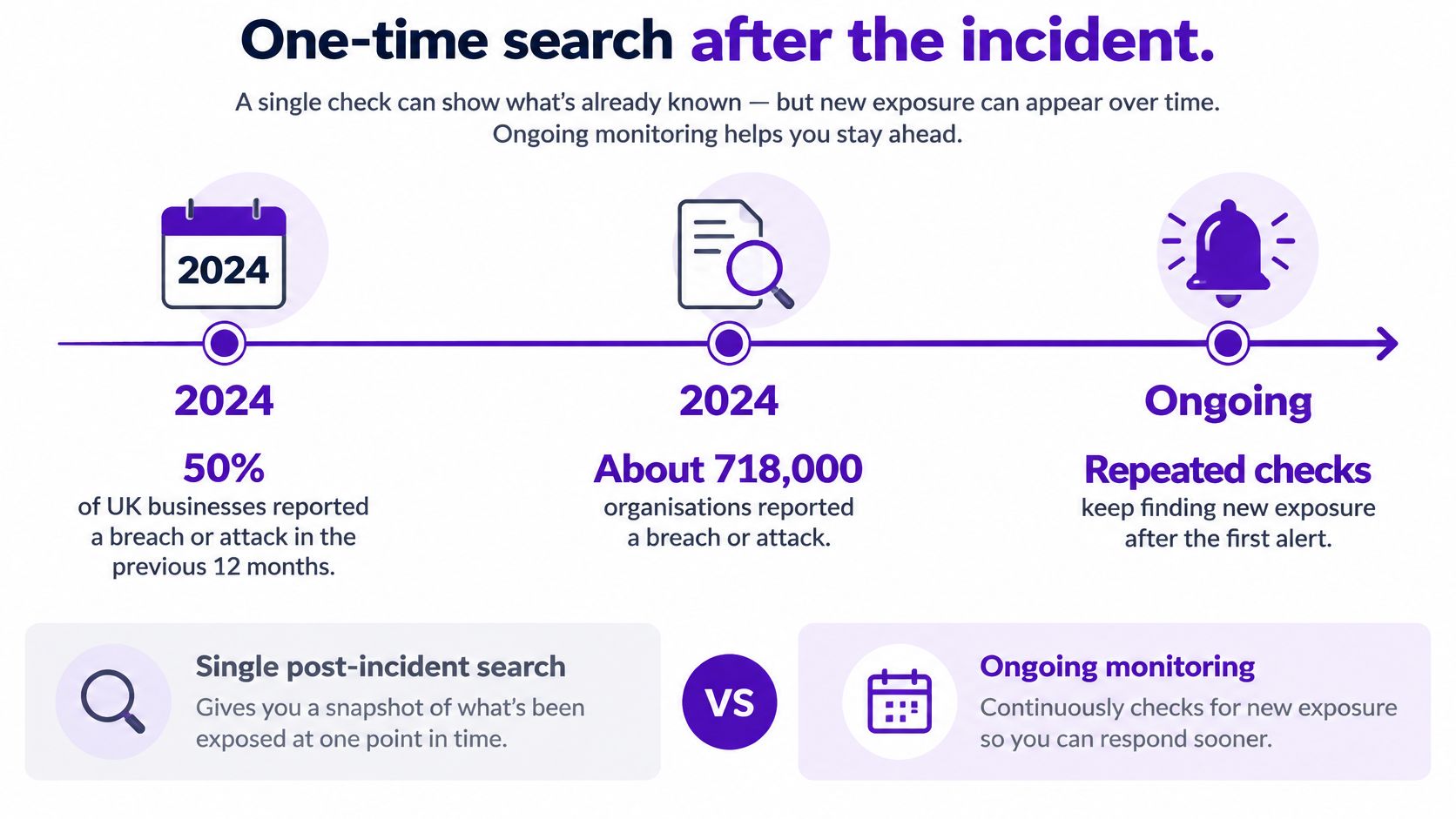
Those results demonstrate persistent attack exposure, not a smooth year-on-year rise. They also don't establish that every affected business had credentials published online. The operational lesson is narrower and more useful: a provider shouldn't design its exposure checks around the assumption that an incident happens once.
Make monitoring a repeatable service
A customer whose search returns nothing today could appear in a newly published collection later. An old password can also remain relevant if the user retained it elsewhere. The timing of publication and the timing of the original compromise aren't necessarily the same.
Continuous watching should create a manageable workflow:
- Maintain scope: Keep authorised company domains and staff addresses current as people join or leave.
- Route readable alerts: Send findings to someone who knows the customer and can explain the required action.
- Record remediation: Note password resets, access reviews and any remaining uncertainty.
- Review the record: Summarise findings and completed actions during customer service reviews.
The subscription should pay for that ongoing visibility and handling, not repeated alarm about an unchanged historical record. Distinguish a new finding from a duplicate, and don't imply that every alert represents a fresh attack.
Match the commercial model to the work
For an MSP, telecoms provider or IT support firm, a monthly dark web monitoring service for businesses fits this responsibility better than an emergency-only search. Customers of different sizes can receive the same basic control, with response support matched to their contract.
Be explicit about what's included. Monitoring, notifying, resetting accounts and investigating a suspected intrusion are related activities, but they aren't the same deliverable. Clear service boundaries make recurring revenue security services easier to price and sustain.
Containing Exposed Data and Responding to Alerts
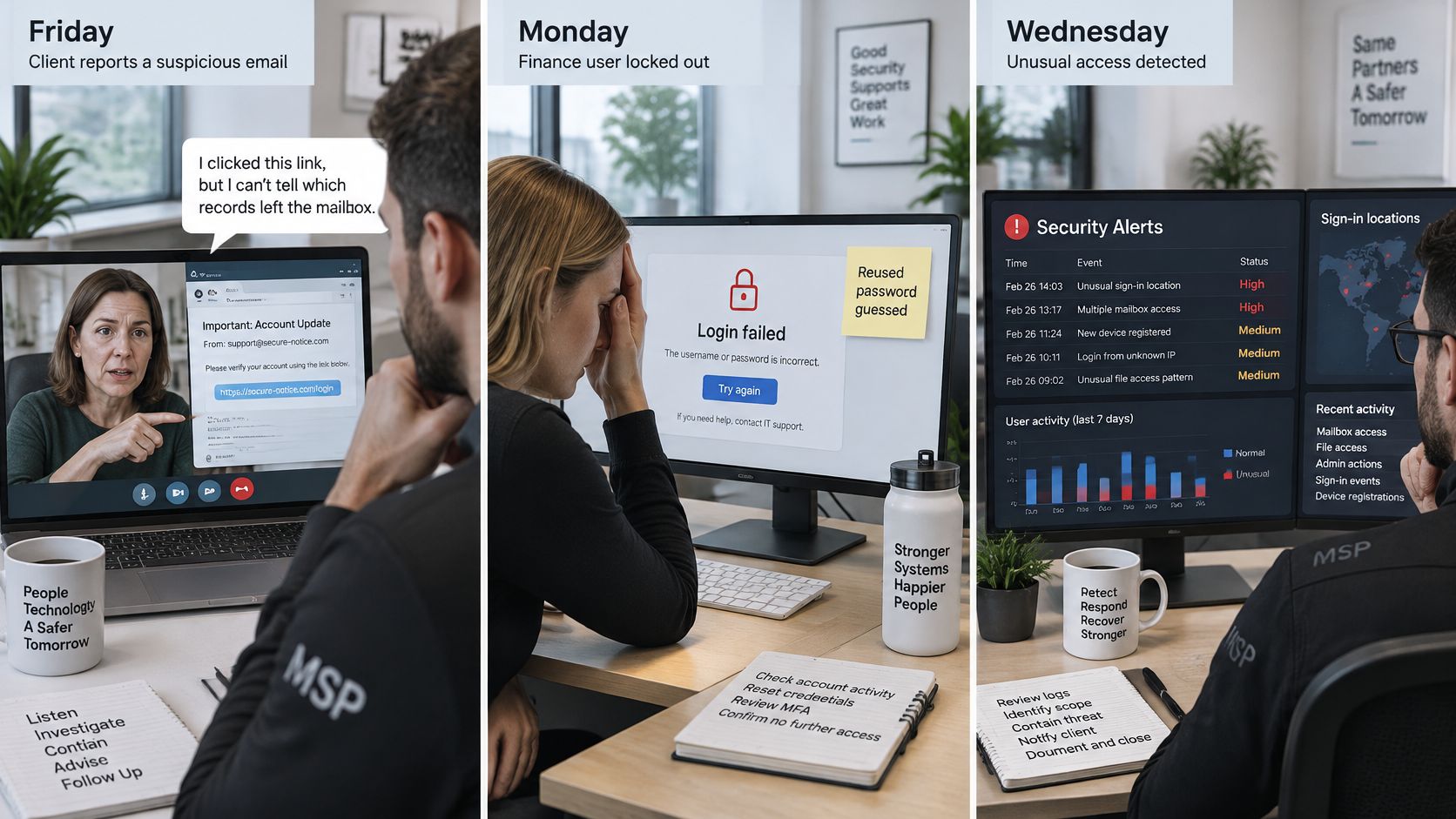
Consider a familiar working week. On Friday, a customer reports clicking a link but can't say which mailbox records were accessed; on Monday, a finance account is locked after overnight attempts using a reused password. By Wednesday, someone has emailed payroll information to the wrong supplier.
Analysis of Information Commissioner's Office records reported by IT Brief identified 26,364 UK data-security incidents with recorded reporting times from 2020 to 2025, including 5,496 human-error breaches in 2025, up 43% from 3,847 in 2020. Sending information to the wrong recipient was the largest identified human-error category, with 2,459 incidents in 2025 against 1,519 in 2020, a 62% rise.
Give every alert a named owner
Use a documented response routine rather than forwarding a notification and assuming the customer understands it.
- Confirm the identifier. Check that the address or domain belongs to the customer and whether the account remains active.
- Explain the exposure. State what information was visible, separating confirmed facts from assumptions.
- Secure the account. Reset affected passwords, check MFA and revoke active sessions where appropriate.
- Review and record. Inspect relevant access logs, permissions and mailbox rules, then record actions and ownership.
- Assess personal-data implications. Decide whether GDPR escalation is required, involving the customer's responsible person.
Outbound data-loss-prevention rules, recipient checks for sensitive messages and least-privilege access address risks that credential monitoring alone can't fix. Preserve useful audit evidence before making changes that could obscure what happened.
Providers building broader containment support can explore managed IT security through Wisely. For a documented customer workflow, use incident planning with GoSafe Dark Web monitoring to organise responsibilities and follow-up.
Keep processing responsibilities explicit
The government's 2025 visual summary reported that around 27% of businesses had board-level cyber-security responsibility and about 19% had provided staff cyber-security training during the preceding 12 months. Those gaps support plain-language communication, but don't establish that every customer lacks internal capability.
GoBig Online LTD is the Data Controller under UK GDPR for its processing. Resellers act as independent data controllers for their own customers, and GoBig Online LTD has no direct contractual relationship with reseller end users.
Before searching end-user identifiers, resellers must ensure there's a lawful basis for processing and that appropriate notices have been provided. Bundle the operational checks with managed IT, connectivity, hosted voice, hosting or web support, but don't treat a commercial bundle as permission to search.
Alerts start the work. Account changes, access reviews and documented GDPR decisions complete the response.
Selection Criteria and Deployment Checks for Resellers
A business password manager and dark web monitoring solve different problems. A password manager helps staff generate and store unique credentials; monitoring identifies existing credentials and business identifiers appearing in breach intelligence. Buying either doesn't remove the need for the other.
For a reseller, the selection decision should start with delivery rather than the longest feature list. Can your existing team onboard a customer, explain a finding and record the result without creating a separate security operation?
Questions to settle before signing
| Criterion | Vendor question | Why it matters |
|---|---|---|
| Alert clarity | Does an alert identify the affected address or domain, explain the exposure and recommend an action? | Customers need a decision, not an unexplained technical notification |
| White-label delivery | Can the service carry our brand and company name throughout the customer journey? | Your business should retain the customer relationship |
| Coverage | Can company domains and authorised individual addresses be monitored together? | Isolated findings need organisational context |
| Compatibility | How does delivery fit our Microsoft 365 administration, PSA, RMM and billing workflows? | Manual re-entry can undermine an otherwise simple service |
| Evidence | Can we retain findings, actions and customer review notes? | The service needs an auditable operational record |
Don't assume that a monitoring product has a native integration just because it supports MSP customers. Confirm each integration, export or manual hand-off individually, including who maintains it when something changes.
Ask for an onboarding demonstration using a realistic customer scenario. Include a shared mailbox, a departed employee and a customer contact who isn't technical. That reveals more about deployment than a presentation built around an ideal administrator.
Buying test: Your account manager should be able to explain the alert, while your technician should be able to identify the next action.
Define the hand-off before launch
Separate routine credential remediation from specialist incident investigation. A telecoms or VoIP provider may notify the customer and coordinate with its IT company, while an MSP may perform the reset directly under an existing agreement.
Use a short launch checklist:
- Authorisation: Record approved identifiers, processing responsibilities and customer notices.
- Ownership: Nominate the alert recipient and an alternative contact.
- Service boundaries: Document included actions and escalation routes.
- Commercial administration: Align onboarding, cancellation and billing records.
Deployment shouldn't require a custom security build or a dedicated security team. It still requires operational discipline. Dark web monitoring for MSPs works best when a finding enters an existing service process, rather than becoming another unattended inbox.
Add White-Label Monitoring to Your Services
Offer breached business data monitoring as a monthly subscription, with a clear description of what customers receive and what your team will do when something is found. The credible pitch is ordinary exposure: reused passwords, old mailboxes and supplier records that surface again, sold as steady visibility rather than a one-off scare.
GoSafe is a fully white-label Dark Web Monitoring tool. It scans the dark web 24/7 for leaked passwords and stolen company data, detecting compromised email addresses, exposed passwords and breached domains. It runs in the background and alerts users when compromised data is discovered, so a customer gets an early warning in clear language instead of a console they have to decode.
Put your brand on a defined service
With white label dark web monitoring, the platform carries your brand, sits in your portfolio and leaves the customer relationship with you. GoSafe includes branded customer portals, automated security alerts, centralised licence management and bulk customer onboarding, so you launch a monitoring service without developing software in-house.
Before launch, map the alert journey: who receives the first notification, who confirms the exposed record, who resets credentials and who explains the risk to the customer. An alert works like a smoke alarm; it shows where to look, while your agreed process decides who picks up the extinguisher.
This makes reseller dark web monitoring a practical addition for IT support companies, telecom and VoIP providers, cyber consultants, hosting providers, web agencies, SaaS resellers and technology resellers. Position it alongside IT support, cloud services, hosting, connectivity, telecom systems or web services.
Sell visibility rather than a guarantee
Many businesses may already have compromised credentials circulating without knowing it. Explain the offer plainly: monitor for exposure, notify clearly and agree the next step. Monitoring provides visibility and reassurance; it cannot cover every source or prevent every intrusion.
White label security services strengthen customer relationships when partners provide useful follow-up alongside notifications. The monthly subscription creates recurring revenue and gives customers a reason to keep security conversations active.
To sell dark web monitoring under your own brand, explore cybersecurity reseller opportunities and add a defined monitoring subscription to your existing services.
GoSafe Dark Web monitoring helps you turn exposed business credentials into clear customer alerts and a repeatable response process. Visit GoSafe Dark Web monitoring to understand the service, then use the reseller programme to launch monitoring under your own brand.