
An MSP that discovers compromised client credentials on the dark web has found a security risk, but also an evidence gap. Compliance monitoring is the continuous process of detecting, measuring, and evidencing that security controls are operating effectively against regulatory requirements.
That distinction matters when a client asks whether its controls work, not merely whether the policies exist. A password policy, access procedure or incident plan may look complete in a document, yet provide little protection if nobody checks whether staff follow it, whether alerts reach the right person, or whether remediation is recorded.
For service providers, compliance monitoring sits between governance and daily operations. It turns security activity into evidence that can be reviewed by customers, management, auditors and regulators. It also creates practical opportunities to offer white-label security services, including a dark web monitoring service for businesses that need clear warnings when email addresses, passwords or domains appear in exposed data.
Why Compliance Monitoring Matters in 2026
A client receives an email from a regulator asking for evidence of its security controls. The business has a policy document, an annual review file and a collection of meeting notes, but no reliable record showing whether access controls, encryption practices or incident processes operated consistently between reviews.
That situation is common in smaller organisations. A yearly audit can confirm what appeared to be true on the review date, but it can't show whether a former employee retained access last month, whether a compromised password was identified promptly, or whether an incident response plan would work under pressure.
The gap is visible in the UK government's latest cyber security baseline. The 2025/2026 Cyber Security Breaches Survey reports that only 47% of businesses require two-factor authentication, 14% store personal data without anonymisation or encryption, and 25% have a formal incident response plan. These figures are reported in the official UK Cyber Security Breaches Survey.
Paper compliance versus operating controls
A documented policy describes an intended state. Monitoring tests the operating state.
For example, an MSP might manage Microsoft 365 for a customer and confirm that a multi-factor authentication policy exists. Continuous checking asks a more useful question: are all relevant accounts covered, and what happens when a credential appears in a breach?
The same principle applies to personal data. A privacy statement may promise appropriate protection, but evidence needs to show what controls run, what they detected and how the business responded.
Practical rule: If a control matters enough to include in a policy, it matters enough to monitor and evidence.
UK regulators reflect this operating view. The FCA expects permanent compliance monitoring, while the ICO's logging requirements focus on records that support lawfulness checks, self-monitoring, investigations and disciplinary action. Compliance monitoring therefore isn't merely preparation for an audit. It's an active defence mechanism that helps a business identify a weakness before a customer, regulator or attacker finds it first.
For MSPs and resellers, this creates a commercial opportunity. Customers increasingly need understandable evidence, not a complicated security dashboard. A clear alert about an exposed business email address can start a practical conversation about password resets, stronger authentication and ongoing risk management. That makes monitoring useful both as a control and as one of the recurring revenue security services in a service portfolio.
What Compliance Monitoring Is
Compliance monitoring is the ongoing process of checking, testing and recording whether an organisation's controls meet regulatory, contractual and internal requirements. For an MSP, it turns a documented promise into evidence that the promised control operates in practice.
A workable programme answers four connected questions:
- What should happen? The business identifies its obligations, policies and control requirements.
- What is happening? Monitoring gathers signals from systems, users, transactions and operational processes.
- Is there a gap? The organisation compares observed activity with the expected standard.
- What happened next? Teams record ownership, remediation, approval and closure.
This evidence matters under UK GDPR Article 32, which requires appropriate technical and organisational measures. A policy may require access reviews or secure authentication, yet the policy alone does not demonstrate that those measures operate effectively. Monitoring supplies the trail of checks, exceptions, decisions and follow-up that supports an active regulatory defence.
An audit is a periodic examination of whether controls appeared effective during a defined period or at a particular point in time. Monitoring runs as activity occurs, while an audit can test whether the monitoring process remains reliable. The two work together: monitoring exposes weaknesses, and audit examines the quality of the evidence and response.
HMRC's beneficial ownership approval activity shows how supervised processes operate. In 2024–25, HMRC handled 84,568 applications, approved 58,835, rejected 80 and invalidated 319 through disciplinary measures, according to its 2024–25 annual report. The process combines assessment, decisions and possible enforcement.
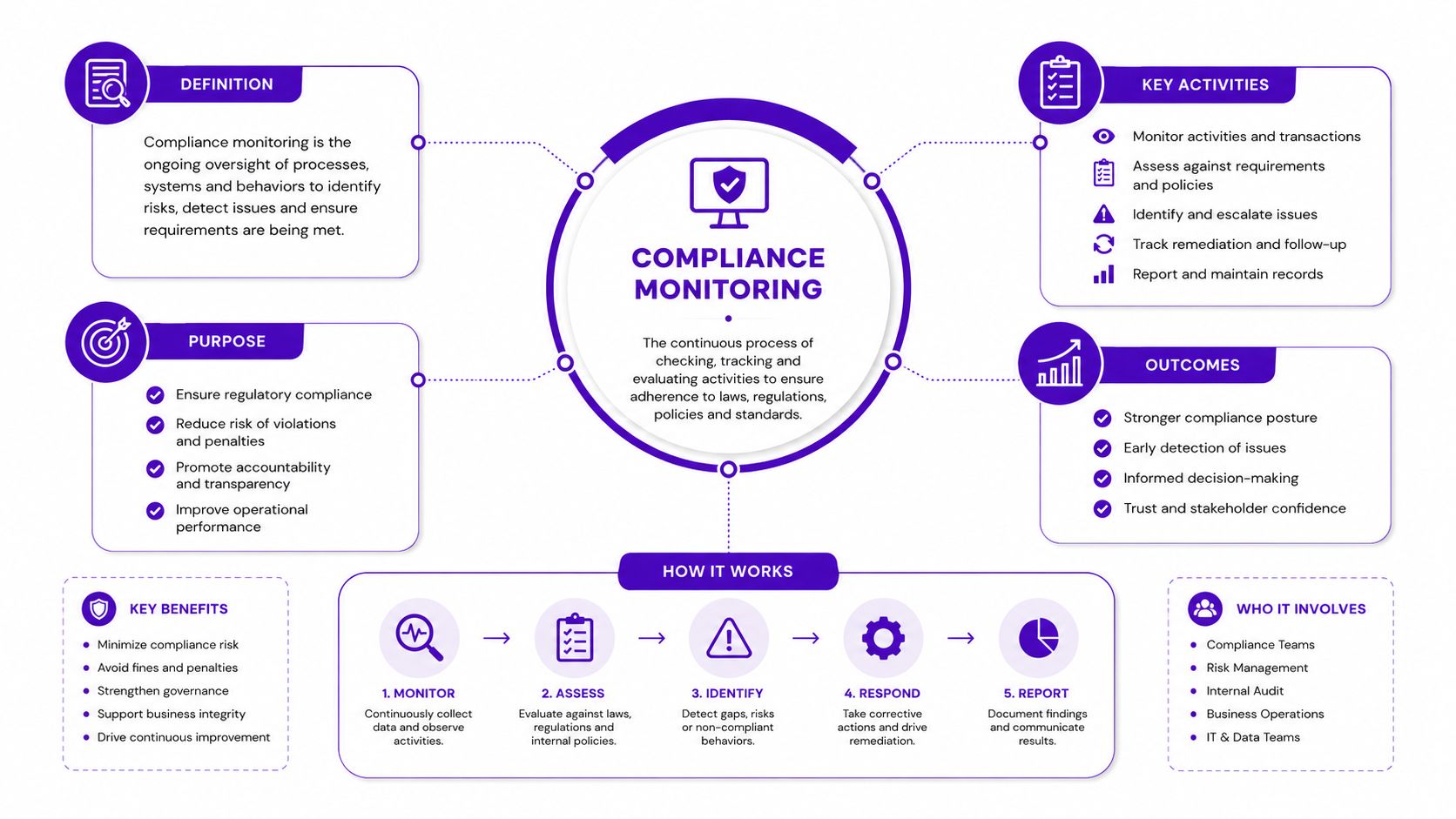
The six parts of a workable programme
A practical programme includes:
- Documented policies: Clear requirements and named control owners.
- Monitoring processes: Automated checks, manual testing and scheduled reviews.
- Logs and audit trails: Searchable records of events, decisions, alerts and changes.
- Incident response: A defined route from detection to containment, recovery and lessons learned.
- Training and awareness: Role-specific guidance on control responsibilities.
- Management reporting: Regular summaries of exposure, trends and unresolved actions.
Together, these elements help with reducing compliance risk for SMBs. MSPs and resellers can present the results through compliance reporting for resellers, giving customers usable evidence instead of raw technical events.
How Compliance Monitoring Works Day to Day
A functioning programme starts with collection. Automated tools check defined signals, while people review exceptions that require judgement. For an MSP, those signals might include a newly exposed customer email address, a change to an access permission, a failed control test or an incomplete remediation task.
The next step is triage. Someone must decide whether an alert is relevant, how serious it is and who owns the response. A compromised credential connected to a privileged account needs a different response from an old address with no active access, even though both may appear in the same monitoring feed.
From alert to evidence
A useful workflow records the full chain:
- Detection: The monitoring system identifies a deviation or risk signal.
- Validation: A reviewer confirms that the alert relates to the organisation and isn't a false positive.
- Assignment: The issue goes to a named owner with a clear action.
- Remediation: The owner completes the required response, such as resetting credentials or changing access.
- Verification: The team checks that the control now works as intended.
- Closure: The decision, evidence and approval remain available for later review.
This process turns a notification into defensible evidence. Without ownership and verification, a dashboard can show that an alert existed, but not whether the business managed the risk.
Leading and lagging indicators
Teams should measure both early signals and historical outcomes. The table below provides a useful structure without treating any single metric as sufficient on its own.
| Leading Indicators | Lagging Indicators |
|---|---|
| Monitoring coverage across the controls and assets in scope | Confirmed control failures |
| Time taken to triage new alerts | Time taken to remediate closed findings |
| Quality of alert routing and ownership | Repeat findings from earlier reviews |
| Completion of scheduled control tests | Incidents linked to an unaddressed gap |
| Age of unresolved actions | Audit exceptions and regulatory findings |
Leading indicators help managers intervene before a weakness becomes a formal failure. Lagging indicators show what has already happened and whether previous responses were effective.
For a reseller, this distinction also improves customer conversations. Instead of presenting an intimidating risk score, you can explain what was detected, why it matters, what action is required and how the outcome will be recorded.
Regulatory Contexts That Shape Compliance Monitoring
Compliance monitoring looks different across sectors, but the central requirement is consistent: the organisation must be able to demonstrate that relevant controls operate effectively.
| UK context | What monitoring needs to demonstrate | Practical implication for service providers |
|---|---|---|
| Financial services | Permanent monitoring and regular assessment of compliance measures | Evidence needs to reach governance and management reporting |
| Law-enforcement processing | Complete, understandable and retrievable logs | Event records must support investigation and accountability |
| Data protection | Effective technical and organisational safeguards | Monitoring must help show that security controls operate in practice |
| Medicines and distribution | Response to GMP or GDP failures and agreed corrective oversight | Providers may need structured evidence and remediation records |
| Payments regulation | Compliance with requirements and proportionate corrective action | Findings need prioritisation and timely resolution |
For financial services, the FCA Handbook requirements state that a firm's compliance function must monitor on a permanent basis, assess the adequacy and effectiveness of its measures, policies and procedures regularly, and report to the management body at least annually on the implementation and effectiveness of the overall control environment for designated investment business.
Logs must support investigation
The ICO requires law-enforcement processing logs to cover collection, alteration, consultation, disclosure, combination and erasure. Those records must be understandable and retrievable for audit or investigation use, as set out in the ICO guidance on logging.
That requirement changes the design of monitoring. A spreadsheet assembled after an incident may not establish who accessed data or when an action occurred. Searchable, protected event records provide stronger evidence and help internal investigators understand the sequence of events.
Businesses handling personal data should also connect monitoring to their legal duties under GDPR explained, particularly the expectation that security measures are appropriate and demonstrably maintained.
Sector-specific escalation
The MHRA's Compliance Monitor pilot, launched from April 2022, applies to companies that fail GMP or GDP requirements and are referred after inspection through the compliance escalation process. Suitable companies may receive oversight while implementing an agreed Compliance Protocol, according to the MHRA Compliance Monitor process.
The PSR takes a similarly practical approach. Its Compliance Monitoring Framework says it monitors industry compliance and acts quickly and proportionately where it identifies risk to, or impact on, service users. A broader business resilience strategic guide can help service providers connect compliance evidence with continuity planning.

Implementing a Compliance Monitoring Programme
A small business doesn't need to build a large compliance department before it starts monitoring. It needs a defined scope, clear ownership and a practical way to collect evidence.
Five phases for implementation
Phase one, scope. List the regulations, contracts and customer commitments that apply to the business. Identify important systems, data sets, accounts and suppliers, then decide which controls require continuous observation and which need periodic testing.
Phase two, map. Link each obligation to an actual control and an owner. If the requirement concerns credential security, identify the relevant identity systems, password process, authentication control and response procedure. This mapping prevents teams from monitoring activity that has no clear compliance purpose.
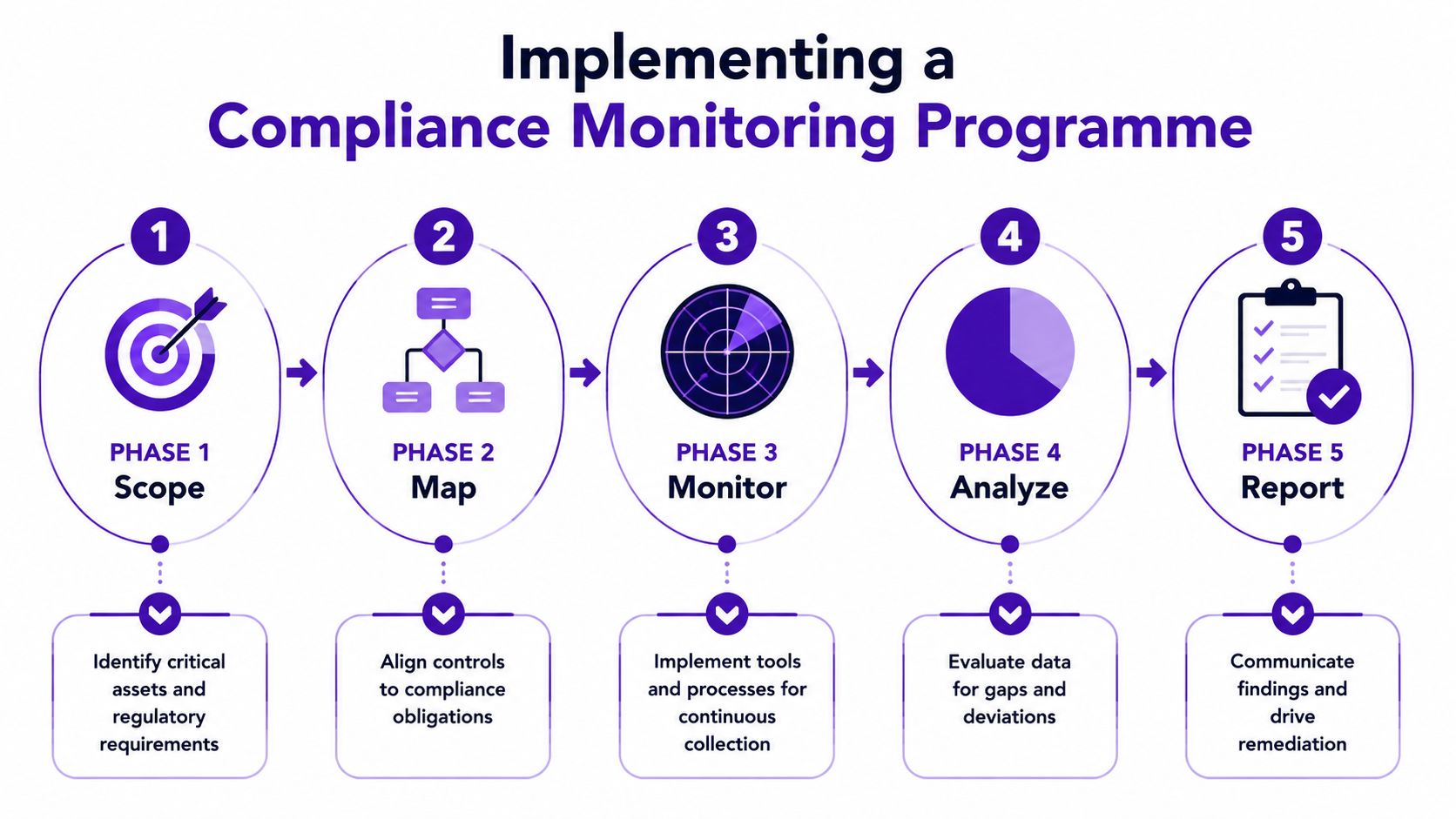
Phase three, monitor. Choose tools that collect useful signals without creating unnecessary work. One example is GoSafe Dark Web monitoring, a white-label tool that continuously scans for compromised email addresses, exposed passwords and breached domains, then sends clear alerts through email and a straightforward dashboard. It can sit alongside other controls rather than pretending to replace identity management, endpoint security or incident response.
Phase four, analyse. Define how the team validates alerts, assesses severity and records decisions. A signal has little value if nobody knows whether to contact the customer, reset an account, escalate internally or retain evidence for review.
Phase five, report. Give management and customers information they can act on. Reports should show open issues, actions, owners and status in plain language. Providers supporting regulated customers may also need managed security services for ISO 27001 aligned with the customer's wider control framework.
Make the workflow operational
Connect monitoring to ticketing, incident response and customer communication. Assign a service-level expectation for triage, define escalation routes and require verification before closure.
For MSPs, the commercial model should follow the operational model. A fully white-label platform can be branded as the partner's own service, sold under the partner's company name and included in a monthly package. That supports reseller dark web monitoring without requiring the partner to build a security tool internally or hire a specialist team.
Compliance Monitoring in Practice with Real Examples
Consider an MSP supporting professional services customers. During a routine dark web check, its monitoring service identifies that an employee email address linked to a customer domain appears in exposed data.
The MSP doesn't send a technical dump and leave the customer to interpret it. It validates the domain, contacts the customer's nominated administrator and recommends a controlled response. That may include resetting the affected password, checking reuse across other services, reviewing authentication settings and recording the completed actions.
The alert becomes useful because the MSP links detection to a workflow. The customer receives an early warning in language it understands, while the provider demonstrates proactive value and creates a sensible reason for ongoing monthly monitoring.
A practical reseller model
A telecom or VoIP provider could add the service during an account review. The conversation doesn't need to start with dark web terminology. It can begin with a simple question: would the customer know if a staff email address and password appeared in a breach?
If the answer is no, a branded monitoring service provides visibility without asking the customer to operate a complex security platform. The partner owns the relationship, controls the presentation and can offer monitoring alongside connectivity, hosted telephony or IT support.
The provider should still define boundaries. Dark web monitoring can identify exposed credentials and data, but it doesn't replace password management, authentication controls, patching or incident response. Its value lies in early detection and clear action.
A regulated healthcare example
A healthcare technology provider supporting systems connected to pharmaceutical operations may need evidence that access activity, configuration changes and data handling procedures are controlled. Continuous records help the provider show what changed, who was responsible and how exceptions were addressed.
That evidence becomes particularly relevant where a company enters an MHRA escalation pathway. The MHRA Compliance Monitor pilot applies to companies that fail GMP or GDP requirements and are referred after inspection. A structured Compliance Protocol and documented remediation process give the organisation a clearer way to demonstrate progress.
The lesson for service providers is straightforward. Monitoring doesn't create compliance by itself. It gives people the evidence needed to identify gaps, respond consistently and demonstrate that corrective work occurred.
Common Pitfalls and How to Move Forward
Many organisations assume that a large policy library means they have a strong compliance programme. It doesn't. Policies describe expectations, while monitoring shows whether people and systems meet them during normal operations.
The documentation trap
A company may have an access policy that requires prompt removal of leavers, but no automated check confirms that accounts were disabled. It may have an incident response plan, but no record shows whether alerts reached the correct owner or whether the team tested its escalation route.
Pair each material policy with an observable control. For credential exposure, monitor relevant addresses and domains. For access governance, record account changes and approvals. For incident response, retain alert, assignment, action and closure evidence.
A policy is an instruction. A monitored control is proof of execution.
The tool overload trap
Buying several disconnected security products can leave an MSP with overlapping alerts, inconsistent priorities and no clear customer story. Staff then spend time sorting notifications instead of resolving risks.
Start with one focused capability that addresses a known customer problem. Define who receives the alert, how it enters the ticketing process and what successful remediation looks like. Expand only when the first workflow is reliable.
The static programme trap
Compliance monitoring isn't a project that ends when the dashboard launches. Customer environments change, staff join and leave, services are added, and regulatory expectations evolve.
Put review activity into the operating calendar. Reassess scope, remove irrelevant checks, test escalation routes and review unresolved findings with management. The FCA's permanent-monitoring expectation reinforces why an annual paperwork exercise isn't enough for firms within its scope.
For MSPs, the practical route is to package monitoring as an ongoing service. White label dark web monitoring can be sold under your own brand, added to IT support, cloud, hosting, connectivity, telecoms or web services, and delivered as a monthly subscription. GoSafe is designed as a Dark Web Monitoring tool, not a generic cybersecurity platform, with continuous scanning for compromised email addresses, exposed passwords and breached domains, plus clear alerts that business users can understand.
GoSafe Dark Web monitoring helps service providers give customers early warning when credentials or domain data appear in dark web exposures, without building security tools internally. Visit GoSafe Dark Web monitoring to connect this practical monitoring capability to your compliance evidence, explore the reseller model and decide whether to offer it under your own brand.